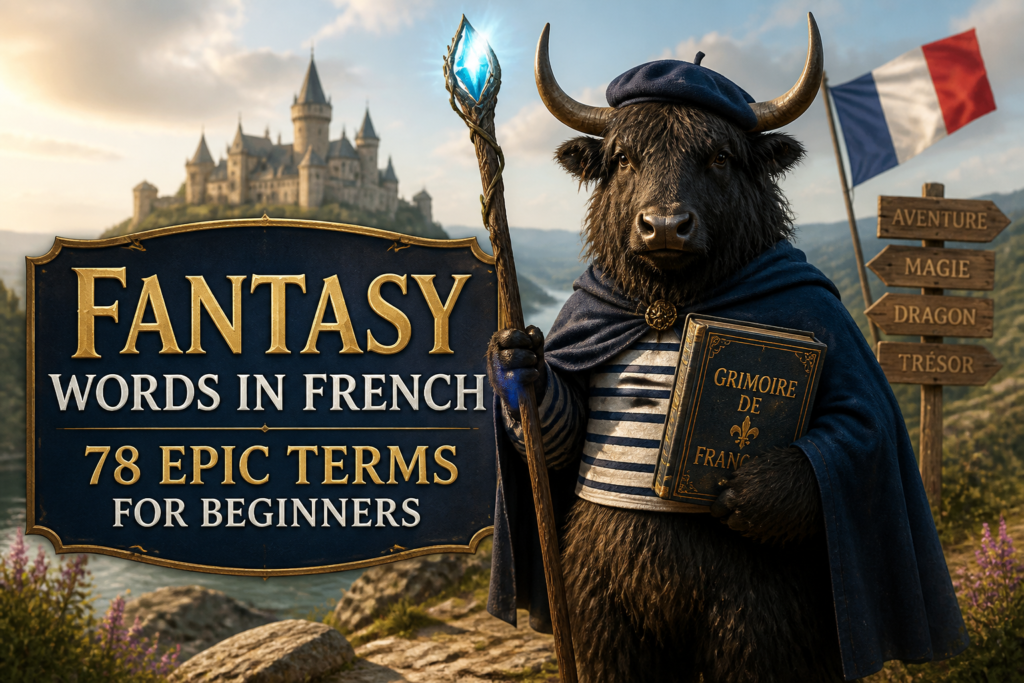
French is already a dramatic language. Add dragons, quests, enchanted forests, and suspiciously wise old wizards, and it somehow gets even better.
If you love fantasy novels, games, movies, or tabletop adventures, learning a little fantasy vocabulary in French is a fun way to build real language skills without sounding like a boring textbook swallowed a dictionary. You will learn useful beginner-friendly words, simple pronunciation help, clear meanings, and example sentences you can actually understand.
By the end, you’ll know how to talk about heroes, castles, magic, monsters, and epic journeys in natural modern French. And yes, a lot of these words are also handy outside fantasy. A quête can be a game quest, but life also loves handing people side quests they did not ask for.
If you want more beginner French after this, try the French placement test, check your word power with the French vocabulary test, or explore more fun terms in cool French words. You can also browse the full Learn French hub.
How To Read The Pronunciation
The pronunciation guides here are simple, English-friendly hints, not full phonetics. French has some silent letters, and the final consonant often disappears unless it is followed by a vowel in connected speech. Keep it practical. You are here to sound better, not to become a medieval pronunciation wizard.
Beginner rule: if a French word ends in a dramatic-looking consonant, there is a decent chance French refuses to pronounce it just to be difficult.
Fantasy World Basics
| French | Pronunciation | Meaning | Example Sentence | Translation | Learner Note |
|---|---|---|---|---|---|
| le royaume | luh rwah-yom | kingdom | Le royaume est en danger. | The kingdom is in danger. | Masculine noun. Very common in fantasy. |
| le château | luh sha-toh | castle | Le héros arrive au château. | The hero arrives at the castle. | Au = à + le. |
| la tour | lah toor | tower | La sorcière vit dans une tour. | The witch lives in a tower. | Feminine noun. |
| la forêt enchantée | lah fo-ray on-shon-tay | enchanted forest | Nous traversons la forêt enchantée. | We are crossing the enchanted forest. | Enchantée agrees with forêt, which is feminine. |
| le village | luh vee-lazh | village | Le village semble calme la nuit. | The village seems quiet at night. | Useful outside fantasy too. |
| la grotte | lah grot | cave | Le dragon dort dans la grotte. | The dragon sleeps in the cave. | Final e is not pronounced. |
| le donjon | luh don-zhon | dungeon, keep | Le prisonnier est dans le donjon. | The prisoner is in the dungeon. | Great classic fantasy word. |
| le trône | luh trohn | throne | La reine est assise sur le trône. | The queen is sitting on the throne. | Sur means “on.” |
| le portail | luh por-tie | portal, gateway | Le portail magique brille dans la nuit. | The magical portal glows in the night. | Not just a normal door. Nicely fantasy-coded. |
| le monde | luh mond | world | Ce monde est plein de mystères. | This world is full of mysteries. | Plein de = full of. |
Heroes, Villains, And Epic People
| French | Pronunciation | Meaning | Example Sentence | Translation | Learner Note |
|---|---|---|---|---|---|
| le héros | luh ay-ro | hero | Le héros protège le village. | The hero protects the village. | The h is silent. |
| l’héroïne | lay-ro-een | heroine | L’héroïne est plus courageuse que le roi. | The heroine is braver than the king. | Elision: la becomes l’. |
| le roi | luh rwah | king | Le roi écoute le conseil du mage. | The king listens to the mage’s advice. | Very common beginner word. |
| la reine | lah ren | queen | La reine gouverne avec sagesse. | The queen rules with wisdom. | Feminine form of royal title. |
| le prince | luh prenss | prince | Le prince cherche une épée magique. | The prince is looking for a magic sword. | Final e is silent. |
| la princesse | lah pran-sess | princess | La princesse refuse d’attendre. | The princess refuses to wait. | Much more useful when she actually does things. |
| le chevalier | luh shuh-va-lyay | knight | Le chevalier porte une armure lourde. | The knight wears heavy armor. | Classic fantasy staple. |
| le mage | luh mahzh | mage, wizard | Le mage connaît un ancien secret. | The mage knows an ancient secret. | Neutral fantasy term. |
| la sorcière | lah sor-see-air | witch | La sorcière prépare une potion. | The witch is preparing a potion. | Can be neutral or negative depending on context. |
| le monstre | luh mon-struh | monster | Le monstre apparaît dans le brouillard. | The monster appears in the fog. | Useful in fantasy and everyday exaggeration. |
Creatures And Beasts
| French | Pronunciation | Meaning | Example Sentence | Translation | Learner Note |
|---|---|---|---|---|---|
| le dragon | luh dra-gon | dragon | Le dragon garde le trésor. | The dragon guards the treasure. | Very easy cognate. |
| le loup | luh loo | wolf | Un loup observe les voyageurs. | A wolf watches the travelers. | Final p is silent. |
| le corbeau | luh kor-boh | raven, crow | Le corbeau vole au-dessus de la tour. | The raven flies above the tower. | Good gloomy atmosphere word. |
| la licorne | lah lee-korn | unicorn | La licorne traverse la clairière. | The unicorn crosses the clearing. | Yes, French gets unicorns too. |
| le géant | luh zhay-on | giant | Le géant habite dans la montagne. | The giant lives in the mountain. | Nasal sound in an. |
| le nain | luh nen | dwarf | Le nain fabrique une hache solide. | The dwarf makes a sturdy axe. | Fantasy meaning depends on context. |
| l’elfe | lel-fuh | elf | L’elfe tire une flèche précise. | The elf shoots a precise arrow. | Elision again: le becomes l’. |
| la fée | lah fay | fairy | La fée offre un cadeau magique. | The fairy offers a magical gift. | Often feminine in common use. |
| l’ogre | loh-gruh | ogre | L’ogre vit loin du village. | The ogre lives far from the village. | Another great storybook word. |
| le fantôme | luh fan-tohm | ghost | Le fantôme parle d’une voix douce. | The ghost speaks in a soft voice. | Useful in fantasy and spooky stories. |
Magic And Power Words
| French | Pronunciation | Meaning | Example Sentence | Translation | Learner Note |
|---|---|---|---|---|---|
| la magie | lah ma-zhee | magic | La magie change tout dans ce royaume. | Magic changes everything in this kingdom. | Feminine noun. |
| un sort | uhn sor | spell | Le mage lance un sort puissant. | The mage casts a powerful spell. | Lancer un sort = cast a spell. |
| l’enchantement | lon-shant-mon | enchantment | L’enchantement dure trois jours. | The enchantment lasts three days. | Masculine noun. |
| la potion | lah پو-see-yon | potion | Cette potion rend invisible. | This potion makes you invisible. | Pronounce the ending lightly: yon. |
| le pouvoir | luh poo-vwar | power | Elle découvre son vrai pouvoir. | She discovers her true power. | Also common in normal French. |
| magique | ma-zheek | magical, magic | C’est une épée magique. | It’s a magic sword. | Adjective. Same form for masculine and feminine in singular. |
| maudit / maudite | moh-dee / moh-deet | cursed | Le village est maudit. | The village is cursed. | Adjective changes with gender. |
| sacré / sacrée | sah-kray / sah-kray | sacred, holy | Ils protègent une relique sacrée. | They are protecting a sacred relic. | Common in fantasy settings. |
| invisible | an-vee-zeebl | invisible | Le voleur devient invisible. | The thief becomes invisible. | Great beginner cognate. |
| immortel / immortelle | ee-mor-tel / ee-mor-tell | immortal | Le dragon semble immortel. | The dragon seems immortal. | Watch the feminine ending. |
Weapons, Objects, And Treasure
| French | Pronunciation | Meaning | Example Sentence | Translation | Learner Note |
|---|---|---|---|---|---|
| l’épée | lay-pay | sword | L’épée brille au soleil. | The sword shines in the sun. | Feminine noun with elision. |
| le bouclier | luh boo-klee-yay | shield | Le chevalier lève son bouclier. | The knight raises his shield. | Useful action word with lever. |
| l’arc | lark | bow | L’elfe prend son arc. | The elf takes his bow. | Short and handy. |
| la flèche | lah flesh | arrow | La flèche touche la cible. | The arrow hits the target. | è gives an open sound. |
| la hache | lah ash | axe | Le guerrier porte une grande hache. | The warrior carries a large axe. | The h is silent. |
| l’armure | lar-mur | armor | Son armure est très ancienne. | His armor is very old. | Feminine noun. |
| la couronne | lah koo-ron | crown | La couronne appartient à la reine. | The crown belongs to the queen. | Common royal object word. |
| le trésor | luh tray-zor | treasure | Ils trouvent enfin le trésor. | They finally find the treasure. | Enfin = finally. |
| la carte | lah kart | map | La carte montre un chemin secret. | The map shows a secret path. | Not to be confused with “card” in some contexts. |
| la relique | lah ruh-leek | relic | La relique a un pouvoir ancien. | The relic has an ancient power. | Great story item word. |
Adventure Actions And Quest Verbs
| French | Pronunciation | Meaning | Example Sentence | Translation | Learner Note |
|---|---|---|---|---|---|
| la quête | lah ket | quest | La quête commence à l’aube. | The quest begins at dawn. | Very useful fantasy noun. |
| l’aventure | lah-von-tur | adventure | Cette aventure est dangereuse. | This adventure is dangerous. | Easy cognate. |
| voyager | vwah-yah-zhay | to travel | Ils voyagent vers le nord. | They travel toward the north. | Regular -er verb. |
| chercher | sher-shay | to look for | Nous cherchons la clé perdue. | We are looking for the lost key. | Very common everyday verb too. |
| trouver | troo-vay | to find | Tu trouves enfin la sortie. | You finally find the exit. | Another must-know verb. |
| combattre | kom-batr | to fight | Le héros combat le dragon. | The hero fights the dragon. | Often shortened in examples to present tense form combat. |
| sauver | so-vay | to save, rescue | Elle veut sauver son frère. | She wants to save her brother. | Very practical verb. |
| protéger | pro-tay-zhay | to protect | Ils protègent la ville. | They protect the city. | Accent helps pronunciation. |
| fuir | fweer | to flee | Les bandits fuient dans la forêt. | The bandits flee into the forest. | Short irregular verb. |
| vaincre | van-kr | to defeat, conquer | Nous allons vaincre le monstre. | We are going to defeat the monster. | Aller + infinitive is a nice beginner future pattern. |
Describing Epic Things
| French | Pronunciation | Meaning | Example Sentence | Translation | Learner Note |
|---|---|---|---|---|---|
| courageux / courageuse | koo-rah-zhuh / koo-rah-zhuhz | brave | La princesse est courageuse. | The princess is brave. | Adjective changes with gender. |
| sombre | sombr | dark, gloomy | Le château semble sombre. | The castle seems dark. | Useful for mood and atmosphere. |
| ancien / ancienne | on-syen / on-syen | ancient, old | Ils lisent un ancien livre. | They are reading an ancient book. | Context decides “old” or “ancient.” |
| mystérieux / mystérieuse | mees-tay-ree-uh / mees-tay-ree-uhz | mysterious | Une voix mystérieuse appelle son nom. | A mysterious voice calls his name. | Looks scary, but it’s manageable. |
| puissant / puissante | pwee-son / pwee-sont | powerful | C’est un sort puissant. | It is a powerful spell. | Common fantasy adjective. |
| dangereux / dangereuse | don-zhuh-ruh / don-zhuh-ruhz | dangerous | La route est dangereuse. | The road is dangerous. | Another useful everyday adjective. |
| perdu / perdue | pair-doo / pair-doo | lost | Le voyageur est perdu. | The traveler is lost. | Final spelling changes, pronunciation barely does. |
| secret / secrète | seh-kray / seh-kret | secret | Ils découvrent une porte secrète. | They discover a secret door. | Feminine form changes more clearly. |
Useful Fantasy Phrases You Can Actually Say
| French Phrase | Pronunciation | Meaning | Example Sentence | Translation | Learner Note |
|---|---|---|---|---|---|
| Il était une fois… | eel ay-tay oon fwah | Once upon a time… | Il était une fois un roi sans héritier. | Once upon a time there was a king without an heir. | Classic story opening. |
| Le destin du royaume | luh des-tan du rwah-yom | the fate of the kingdom | Le destin du royaume est entre tes mains. | The fate of the kingdom is in your hands. | Nicely dramatic. Use responsibly. |
| une épée légendaire | oon ay-pay lay-zhon-dair | a legendary sword | Il cherche une épée légendaire. | He is looking for a legendary sword. | Légendaire is a useful adjective. |
| un pouvoir caché | uhn poo-vwar ka-shay | a hidden power | Elle découvre un pouvoir caché. | She discovers a hidden power. | Very common fantasy plot device. |
| briser la malédiction | bree-zay lah mah-lay-deek-syon | to break the curse | Nous devons briser la malédiction. | We must break the curse. | Devoir = must, have to. |
| lancer un sort | lon-say uhn sor | to cast a spell | Le mage va lancer un sort. | The mage is going to cast a spell. | Very standard expression. |
| partir en quête | par-teer on ket | to go on a quest | Ils partent en quête d’un trésor. | They go on a quest for a treasure. | Great fixed phrase. |
| garder un secret | gar-day uhn seh-kreh | to keep a secret | La reine garde un terrible secret. | The queen keeps a terrible secret. | Useful way beyond fantasy. |
| suivre le chemin | swee-vr luh shuh-man | to follow the path | Suivez le chemin jusqu’à la tour. | Follow the path up to the tower. | Suivez is formal/plural “follow.” |
| au cœur de la forêt | oh kur duh lah fo-ray | in the heart of the forest | Le temple se trouve au cœur de la forêt. | The temple is located in the heart of the forest. | Very atmospheric phrase. |
Quick Grammar Notes For Fantasy French
1. Watch the articles. French nouns need articles a lot of the time: le dragon, la tour, l’épée, des monstres. If the word starts with a vowel sound, le or la often becomes l’: l’elfe, l’armure.
2. Adjectives often change. Compare un roi puissant and une reine puissante. French likes agreement. French also likes making learners do extra paperwork.
3. Use simple present or near future. Beginners can say Le héros combat le monstre or Le héros va combattre le monstre. Both are useful and natural.
4. Silent letters are everywhere. In words like loup, sort, and trésor, do not pronounce every final consonant like English wants to. French is not interested in your enthusiasm there.
Common Beginner Mistakes And Fixes
- Wrong: la dragon
Correct: le dragon
Because dragon is masculine. - Wrong: une château
Correct: un château
Château is masculine. - Wrong: la épée
Correct: l’épée
Use elision before a vowel sound. - Wrong: une sort
Correct: un sort
Sort is masculine when it means “spell.” - Wrong: la princesse est courageux
Correct: la princesse est courageuse
The adjective must match the feminine noun. - Wrong: ils va partir en quête
Correct: ils vont partir en quête
Match the verb with the subject.
Mini Practice
Try these fast little drills.
- Translate: The witch lives in a tower.
La sorcière vit dans une tour. - Translate: We are going to find the treasure.
Nous allons trouver le trésor. - Fill in the blank: Le héros protège ___ royaume.
le - Fill in the blank: La reine est ___. (powerful)
puissante - Say in French: to cast a spell
lancer un sort - Say in French: an enchanted forest
une forêt enchantée
Quick Reference Summary
- Places: le royaume, le château, la forêt enchantée, la grotte
- People: le héros, la reine, le chevalier, le mage
- Creatures: le dragon, l’elfe, la fée, le fantôme
- Magic: la magie, un sort, la potion, maudit
- Objects: l’épée, le bouclier, la couronne, le trésor
- Actions: chercher, trouver, combattre, sauver, vaincre
- Phrases: Il était une fois, partir en quête, briser la malédiction, au cœur de la forêt
That gives you 78 beginner-friendly fantasy and adventure terms in French, with enough real examples to start recognizing them in stories, games, and your own wonderfully overdramatic practice sentences. The Yak takeaway: learn the common words first, then build little scenes around them. One dragon, one quête, one épée magique at a time, and suddenly your French sounds a lot more legendary.