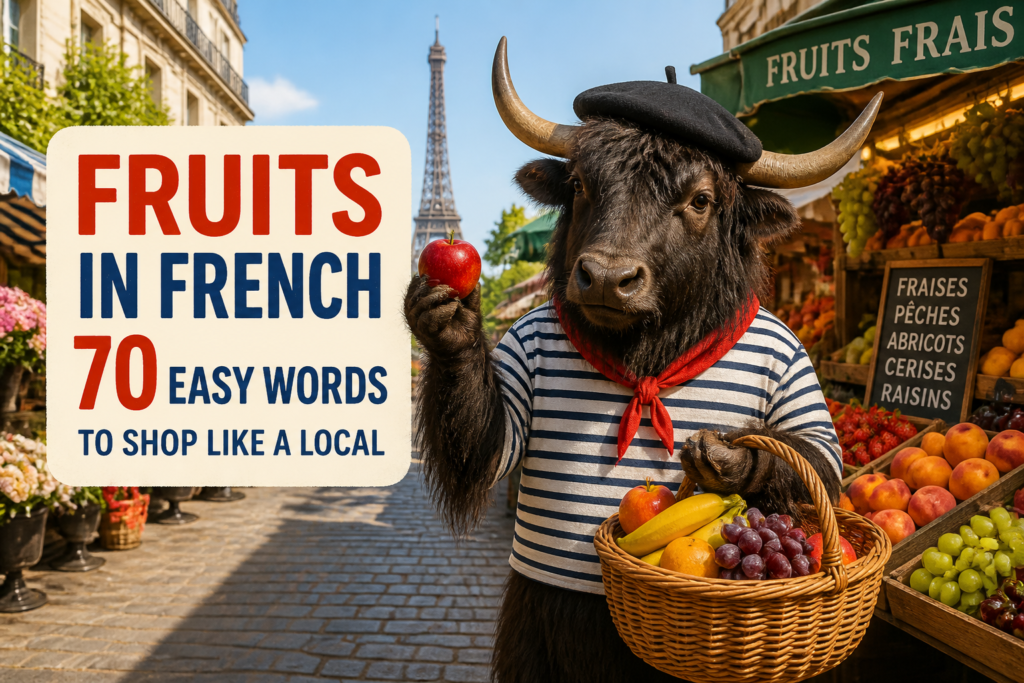
If you can say une pomme and point confidently at a market stall, congratulations: you are already halfway to sounding like someone who knows what they’re doing in France.
Fruit vocabulary is wonderfully practical because it shows up everywhere: supermarkets, outdoor markets, café menus, dessert counters, and those tiny neighborhood shops where the peaches look suspiciously more glamorous than your entire weekly meal plan.
In this guide, you’ll learn common fruits in French, useful shopping phrases, pronunciation help, and real-life examples so you can buy fruit without panicking, mumbling, or accidentally asking for two kilograms of plums when you only wanted a snack. For more French guides, see Learn French.
The Most Useful Fruit Words First
Let’s start with the fruits you’re most likely to see in everyday life. The pronunciation guides are simple on purpose. No phonetics ambush today.
| French | Pronunciation | Meaning | Example Sentence | Translation | Learner Note |
|---|---|---|---|---|---|
| une pomme | oon pom | apple | Je voudrais une pomme verte. | I’d like a green apple. | Pomme is feminine: une pomme. |
| une banane | oon ba-nan | banana | Les enfants mangent une banane au goûter. | The children eat a banana for a snack. | Very common everyday word. |
| une orange | oon oh-ronzh | orange | J’achète des oranges pour le jus. | I’m buying oranges for juice. | Same word as the color, but context makes it clear. |
| une poire | oon pwahr | pear | Cette poire est très mûre. | This pear is very ripe. | The sound is close to “pwahr.” |
| une pêche | oon pesh | peach | Je prends deux pêches, s’il vous plaît. | I’ll take two peaches, please. | Don’t confuse it with English “peachy.” Keep it short. |
| une prune | oon proon | plum | Les prunes sont sucrées cette année. | The plums are sweet this year. | Plural: des prunes. |
| du raisin | du reh-zan | grapes | Je voudrais du raisin blanc. | I’d like some green grapes. | Often treated as an uncountable food item in French. |
| une fraise | oon frez | strawberry | Cette tarte aux fraises est délicieuse. | This strawberry tart is delicious. | Feminine. Singular une fraise, plural des fraises. |
| une cerise | oon suh-reez | cherry | Il y a des cerises au marché. | There are cherries at the market. | The final s in singular is pronounced. |
| un citron | uhn see-tron | lemon | Je cherche un citron pour cuisiner. | I’m looking for a lemon for cooking. | Masculine: un citron. |
| un melon | uhn meh-lon | melon | On mange du melon en été. | We eat melon in summer. | Often used broadly for several melon types. |
| une pastèque | oon pas-tek | watermelon | La pastèque est bien fraîche. | The watermelon is nice and cool. | Very common in summer. |
More Common Fruits In French
Now let’s expand your market survival kit. These are common in shops, recipes, desserts, and polite conversations about what’s “de saison” because French food culture loves a season.
| French | Pronunciation | Meaning | Example Sentence | Translation | Learner Note |
|---|---|---|---|---|---|
| une framboise | oon from-bwaz | raspberry | J’adore les framboises avec du yaourt. | I love raspberries with yogurt. | Plural is very common: les framboises. |
| une mûre | oon myoor | blackberry | Les mûres tachent les doigts. | Blackberries stain your fingers. | The accent matters in writing: mûre. |
| une myrtille | oon meer-tee-yuh | blueberry | Je prends une tarte aux myrtilles. | I’ll have a blueberry tart. | In France French, this is the standard word. |
| un abricot | uhn na-bree-koh | apricot | Les abricots sont très parfumés. | The apricots are very fragrant. | The final t is usually silent. |
| un ananas | uhn na-na-nas | pineapple | On met de l’ananas dans la salade de fruits. | We put pineapple in the fruit salad. | Final s is pronounced here. |
| une mangue | oon mong | mango | Cette mangue est parfaite. | This mango is perfect. | Soft, short final sound. |
| un kiwi | uhn kee-wee | kiwi | Je coupe un kiwi en deux. | I cut a kiwi in half. | Same basic pronunciation as in English. |
| un pamplemousse | uhn pom-pluh-mooss | grapefruit | Elle boit du jus de pamplemousse. | She drinks grapefruit juice. | Long word, but common. |
| une figue | oon feeg | fig | La figue va très bien avec le fromage. | Fig goes very well with cheese. | Very French food-combo territory. |
| une datte | oon dat | date | Je mange deux dattes après le déjeuner. | I eat two dates after lunch. | Short, easy word. |
| un litchi | uhn lee-chee | lychee | Les litchis sont sucrés et parfumés. | Lychees are sweet and fragrant. | Sometimes written letchi regionally, but litchi is standard. |
| une clémentine | oon clay-mon-teen | clementine | Je prends des clémentines pour l’hiver. | I’m getting clementines for winter. | Very common in colder months. |
Tropical And Less Everyday Fruits
You may not need these every day, but they come up in markets, smoothies, dessert menus, and those moments when you want to sound weirdly competent in the produce aisle.
| French | Pronunciation | Meaning | Example Sentence | Translation | Learner Note |
|---|---|---|---|---|---|
| une papaye | oon pa-pie | papaya | La papaye est bien mûre. | The papaya is very ripe. | Common in imported fruit sections. |
| un fruit de la passion | uhn frwee duh la pa-syon | passion fruit | J’aime le yaourt au fruit de la passion. | I like passion fruit yogurt. | Multi-word noun; very useful in food contexts. |
| une goyave | oon gwah-yav | guava | Le jus de goyave est excellent. | Guava juice is excellent. | Less common, but useful. |
| une grenade | oon gruh-nad | pomegranate | Je mets de la grenade dans la salade. | I put pomegranate in the salad. | Also means grenade in another context. Food context saves the day. |
| une noix de coco | oon nwah duh koh-koh | coconut | On achète une noix de coco râpée. | We buy grated coconut. | Literally “a nut of coconut.” |
| un avocat | uhn na-vo-kah | avocado | Je voudrais un avocat bien mûr. | I’d like a nice ripe avocado. | Yes, it also means lawyer. French enjoys chaos too. |
| un kaki | uhn ka-kee | persimmon | Le kaki a une texture très douce. | The persimmon has a very soft texture. | Common enough in many supermarkets. |
| une passion | oon pa-syon | passion fruit (short food label form) | Je prends une mousse passion-mangue. | I’ll have a passion fruit and mango mousse. | Mostly seen in desserts and flavor labels. |
| une carambole | oon ka-rom-bol | star fruit | La carambole a une forme d’étoile. | Star fruit has a star shape. | Useful for menus more than daily shopping. |
| un coing | uhn kwan | quince | On fait de la gelée de coing. | We make quince jelly. | The spelling looks scary; the pronunciation is not obvious. |
| une groseille | oon gro-zay | redcurrant | Les groseilles sont assez acides. | Redcurrants are fairly tart. | More common in recipes and jams. |
| une airelle | oon eh-rel | cranberry / lingonberry | La sauce aux airelles accompagne bien certains plats. | Cranberry sauce goes well with certain dishes. | Meaning can vary by context and region. |
Fruit Categories And Useful Market Labels
These words are not fruit names, but they are exactly the kind of words you’ll see on signs and hear in shops.
| French | Pronunciation | Meaning | Example Sentence | Translation | Learner Note |
|---|---|---|---|---|---|
| un fruit | uhn frwee | fruit | Je mange un fruit après le repas. | I eat a piece of fruit after the meal. | Plural: des fruits. |
| les fruits | lay frwee | fruits | Les fruits sont moins chers en saison. | Fruit is cheaper in season. | The final s is silent. |
| les fruits rouges | lay frwee roozh | berries / red fruits | J’adore les desserts aux fruits rouges. | I love berry desserts. | In French, this often means mixed berries generally. |
| les agrumes | lay za-grum | citrus fruits | Les agrumes sont riches en vitamine C. | Citrus fruits are rich in vitamin C. | You may hear the liaison: lay-zagrumes. |
| les fruits exotiques | lay frwee egz-oh-teek | exotic fruits | Le magasin vend aussi des fruits exotiques. | The shop also sells exotic fruits. | Common supermarket label. |
| bio | bee-oh | organic | Je préfère les pommes bio. | I prefer organic apples. | Very common on signs and labels. |
| de saison | duh say-zon | in season | Ces fraises sont de saison. | These strawberries are in season. | Extremely useful phrase. |
| mûr / mûre | myoor | ripe | Cette mangue est mûre. | This mango is ripe. | Agree the adjective with the noun when written. |
| pas mûr | pah myoor | not ripe | L’avocat n’est pas encore mûr. | The avocado isn’t ripe yet. | Very practical in shops. |
| sucré / sucrée | soo-kray | sweet | Cette pêche est très sucrée. | This peach is very sweet. | Written form changes for feminine nouns. |
| acide | a-seed | acidic / tart | Le citron est très acide. | Lemon is very tart. | Useful for flavor descriptions. |
| juteux / juteuse | zhoo-tuh | juicy | Cette orange est bien juteuse. | This orange is really juicy. | The written masculine and feminine look different. |
Shopping Phrases To Use At The Market
Knowing fruit names is great. Being able to actually buy them is even better. These are the phrases that make you sound polite, normal, and pleasantly functional.
| French | Pronunciation | Meaning | Example Sentence | Translation | Learner Note |
|---|---|---|---|---|---|
| Je voudrais… | zhuh voo-dray | I would like… | Je voudrais un kilo de pommes. | I’d like a kilo of apples. | Polite and safe in almost any shop. |
| Je vais prendre… | zhuh vay prondr | I’ll take… | Je vais prendre trois bananes. | I’ll take three bananas. | Slightly more direct, still perfectly normal. |
| Combien coûtent… ? | kom-byan koot | How much do … cost? | Combien coûtent les cerises ? | How much are the cherries? | Useful for plural items. |
| C’est combien ? | say kom-byan | How much is it? | C’est combien, les fraises ? | How much are the strawberries? | Very common spoken French. |
| un kilo de… | uhn kee-lo duh | a kilo of… | Je prends un kilo de poires. | I’m taking a kilo of pears. | Standard market quantity. |
| un demi-kilo de… | uhn duh-mee kee-lo duh | half a kilo of… | Je voudrais un demi-kilo de raisins. | I’d like half a kilo of grapes. | Very useful if you don’t want too much. |
| Je peux goûter ? | zhuh puh goo-tay | Can I taste? | Je peux goûter une fraise ? | Can I taste a strawberry? | Use politely; depends on the stall and context. |
| Elles sont mûres ? | el son myoor | Are they ripe? | Elles sont mûres, ces pêches ? | Are these peaches ripe? | Use elles for feminine plural fruits like pêches. |
| Ils sont sucrés ? | eel son soo-kray | Are they sweet? | Ils sont sucrés, ces melons ? | Are these melons sweet? | Use ils for masculine plural nouns. |
| Vous avez… ? | voo za-vay | Do you have…? | Vous avez des myrtilles aujourd’hui ? | Do you have blueberries today? | You often hear liaison: voo-zavez. |
| Je cherche… | zhuh sher-sh | I’m looking for… | Je cherche des clémentines. | I’m looking for clementines. | Simple and practical. |
| Ça fait combien ? | sa fay kom-byan | How much does that come to? | Avec les oranges, ça fait combien ? | With the oranges, how much does that come to? | Very natural at checkout. |
Useful Quantities And Packaging Words
French fruit shopping often means dealing with weight, baskets, trays, and bunches. Here are the words that quietly save the day.
| French | Pronunciation | Meaning | Example Sentence | Translation | Learner Note |
|---|---|---|---|---|---|
| un kilo | uhn kee-lo | one kilo | Un kilo de pommes, s’il vous plaît. | A kilo of apples, please. | The standard market unit. |
| 500 grammes | sank son gramm | 500 grams | Je voudrais 500 grammes de fraises. | I’d like 500 grams of strawberries. | Also said as un demi-kilo. |
| une barquette | oon bar-ket | punnet / small tray | Je prends une barquette de framboises. | I’m taking a punnet of raspberries. | Common for berries. |
| une boîte | oon bwat | box | Il y a une boîte de dattes en promotion. | There’s a box of dates on sale. | General word for box. |
| une grappe | oon grap | bunch (of grapes) | Cette grappe de raisin est énorme. | This bunch of grapes is huge. | Specific and handy for grapes. |
| une pièce | oon pyess | one piece / item | Deux euros la pièce pour le melon. | Two euros each for the melon. | Often used on signs. |
| au kilo | oh kee-lo | per kilo | Les cerises sont à douze euros au kilo. | Cherries are twelve euros per kilo. | Very common pricing phrase. |
| le sachet | luh sa-shay | bag | Vous voulez un sachet ? | Do you want a bag? | Good one to recognize at checkout. |
French Example Mini Dialogue At A Fruit Stall
Here’s a quick realistic exchange. Nothing dramatic, no poetry, just useful French.
- Bonjour, je voudrais un kilo de pêches, s’il vous plaît.
Good morning, I’d like a kilo of peaches, please. - Bien sûr. Elles sont très sucrées aujourd’hui.
Of course. They’re very sweet today. - Parfait. Et vous avez des fraises ?
Perfect. And do you have strawberries? - Oui, une barquette ou deux ?
Yes, one punnet or two? - Une barquette, merci. Ça fait combien ?
One punnet, thanks. How much is that? - Ça fait huit euros cinquante.
That comes to eight euros fifty.
Yak Wisdom: In French shops, polite basics do a lot of heavy lifting. A calm bonjour, s’il vous plaît, and merci will cover many sins, including your accent having a small identity crisis.
70 Plus Fruit Words And Related Vocabulary Quick Reference
Here’s a compact reference list you can scan fast. It includes fruits plus a few high-value related words that help in actual shopping and eating situations.
- un fruit — fruit
- les fruits — fruits
- une pomme — apple
- une banane — banana
- une orange — orange
- une poire — pear
- une pêche — peach
- une prune — plum
- du raisin — grapes
- une fraise — strawberry
- une cerise — cherry
- un citron — lemon
- un citron vert — lime
- un melon — melon
- une pastèque — watermelon
- une framboise — raspberry
- une mûre — blackberry
- une myrtille — blueberry
- un abricot — apricot
- un ananas — pineapple
- une mangue — mango
- un kiwi — kiwi
- un pamplemousse — grapefruit
- une figue — fig
- une datte — date
- un litchi — lychee
- une clémentine — clementine
- une mandarine — mandarin
- une papaye — papaya
- un fruit de la passion — passion fruit
- une goyave — guava
- une grenade — pomegranate
- une noix de coco — coconut
- un avocat — avocado
- un kaki — persimmon
- une carambole — star fruit
- un coing — quince
- une groseille — redcurrant
- une airelle — cranberry
- les fruits rouges — berries / red fruits
- les agrumes — citrus fruits
- les fruits exotiques — exotic fruits
- bio — organic
- de saison — in season
- mûr — ripe
- pas mûr — not ripe
- sucré — sweet
- acide — tart / acidic
- juteux — juicy
- frais — fresh
- une salade de fruits — fruit salad
- du jus de fruit — fruit juice
- de la compote — fruit purée / compote
- de la confiture — jam
- une tarte aux fruits — fruit tart
- un smoothie — smoothie
- un kilo — kilo
- un demi-kilo — half kilo
- 500 grammes — 500 grams
- une barquette — punnet
- une boîte — box
- une grappe — bunch
- une pièce — piece / item
- au kilo — per kilo
- le sachet — bag
- Je voudrais… — I would like…
- Je vais prendre… — I’ll take…
- Combien coûtent… ? — How much do … cost?
- C’est combien ? — How much is it?
- Je peux goûter ? — Can I taste?
- Vous avez… ? — Do you have…?
- Je cherche… — I’m looking for…
- Ça fait combien ? — How much does that come to?
- Elles sont mûres ? — Are they ripe?
- Ils sont sucrés ? — Are they sweet?
A Few Useful Grammar Notes
French fruit words are a nice sneaky way to practice gender and articles. Yes, grammar has entered the market with us. Sorry.
- Use articles: une pomme, un citron, des fraises.
- Some fruit is often expressed as a quantity: du raisin, de l’ananas, du melon in food contexts.
- Adjectives may change in writing: un citron sucré, une pêche sucrée.
- After quantity words, use de: un kilo de pommes, une barquette de framboises.
- Elision matters: de l’ananas, j’achète, l’orange.
- Liaison pops up in speech: vous avez sounds like voo-zavez, and les agrumes often sounds like lay-zagrumes.
Common Mistakes English Speakers Make
- Saying just the noun without an article.
Better: Je voudrais une pomme, not just pomme. - Forgetting gender.
Une orange but un citron. French loves making you memorize this stuff. - Using English-style plural logic everywhere.
French often says du raisin rather than counting “grapes” one by one. - Skipping polite shop language.
Bonjour + je voudrais + merci goes a long way. - Confusing avocado and lawyer.
Un avocat can mean both. At a market stall, nobody thinks you are buying legal advice by the kilo.
Practice: Can You Say These In French?
Try these before peeking at the answers in your head.
- I’d like half a kilo of cherries.
- Are these peaches ripe?
- Do you have blueberries today?
- I’m taking one punnet of strawberries.
- How much are the melons?
- This mango is very sweet.
Possible answers:
- Je voudrais un demi-kilo de cerises.
- Elles sont mûres, ces pêches ?
- Vous avez des myrtilles aujourd’hui ?
- Je prends une barquette de fraises.
- C’est combien, les melons ? or Combien coûtent les melons ?
- Cette mangue est très sucrée.
Where To Go Next
Want to see how much French you already know? Try the French placement test or check your word power with the French vocabulary test.
If you’re building practical food and café vocabulary, you can also keep going with drinks in French. Fruit and coffee are not a complete meal, but they are a surprisingly solid start.
Yak Takeaway
If you remember just a handful of high-value words like une pomme, une fraise, un kilo de, de saison, and je voudrais, you can already handle a real French fruit shop without breaking into nervous supermarket charades. Add a few more each week, and pretty soon you’ll be discussing ripe peaches like a local, which is oddly satisfying.