
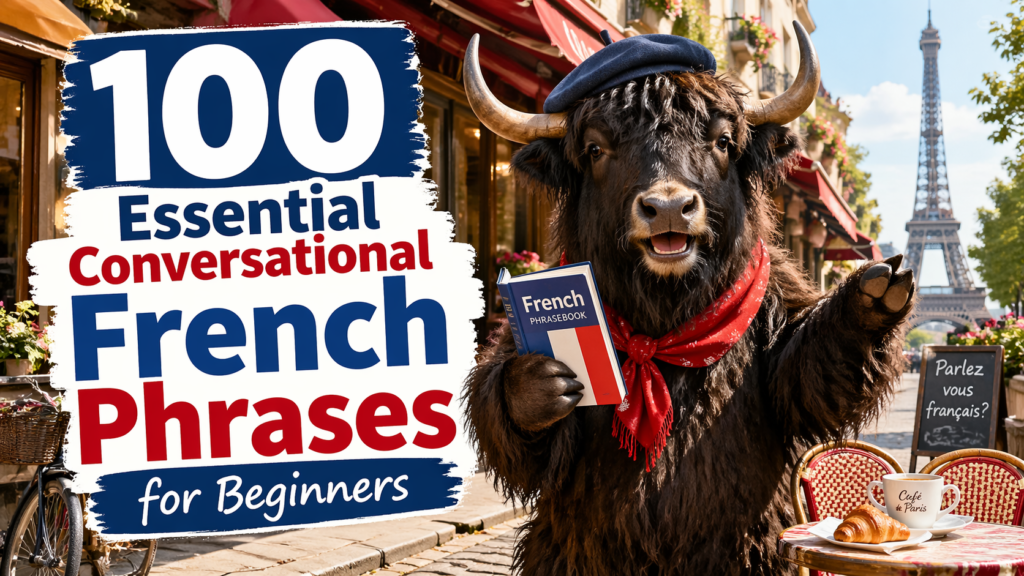
100 Essential Conversational French Phrases for Beginners
Want to speak French without sounding like you swallowed a dusty phrasebook? Start here. These 100 conversational French phrases cover greetings, cafés, shops, directions, small talk, opinions, apologies, emergencies, and those glorious moments when your brain turns into a baguette.
The goal is simple: learn phrases you can use today, not “the quill of my aunt” energy. Every phrase includes the English meaning and real French examples.
How To Use This List Without Melting
Pick one tiny situation: ordering coffee, saying hello, asking for help, or leaving politely. Learn 5 phrases for that situation first. Then add more. French confidence grows phrase by phrase, not by staring dramatically at a grammar chart. Very cinematic, not very useful.
- Use “vous” with strangers, staff, older people, and anyone in a formal situation.
- Use “tu” with friends, children, close classmates, or people who clearly invite casual speech.
- Say “bonjour” first when entering a shop, café, bakery, or conversation. It is tiny. It is powerful. It is basically social magic.
Quick Starter Cards
Bonjour
Meaning: Hello / good morning. Example: Bonjour, vous allez bien ? — Hello, are you well?
S’il Vous Plaît
Meaning: Please. Example: Un café, s’il vous plaît. — A coffee, please.
Excusez-Moi
Meaning: Excuse me. Example: Excusez-moi, c’est par où ? — Excuse me, which way is it?
Je Ne Comprends Pas
Meaning: I don’t understand. Example: Désolé, je ne comprends pas. — Sorry, I don’t understand.
Ça Va ?
Meaning: How’s it going? Example: Salut, ça va ? — Hi, how’s it going?
Combien Ça Coûte ?
Meaning: How much does it cost? Example: Combien ça coûte, ce pain ? — How much does this bread cost?
Je Voudrais…
Meaning: I would like… Example: Je voudrais une table pour deux. — I would like a table for two.
C’est Parti !
Meaning: Let’s go! / Here we go! Example: Tout le monde est prêt ? C’est parti ! — Everyone ready? Let’s go!
Greetings And Goodbyes
| French | English Meaning | Example 1 | Example 2 | Example 3 |
|---|---|---|---|---|
| Bonjour. | Hello / good morning. | Bonjour, madame. — Hello, ma’am. | Bonjour, ça va ? — Hello, how are you? | Bonjour, je peux vous aider ? — Hello, can I help you? |
| Bonsoir. | Good evening. | Bonsoir, monsieur. — Good evening, sir. | Bonsoir, vous avez réservé ? — Good evening, did you book? | Bonsoir, à demain. — Good evening, see you tomorrow. |
| Salut. | Hi / bye, casual. | Salut, ça va ? — Hi, how’s it going? | Salut, à plus ! — Bye, see you! | Salut, tu viens ? — Hi, are you coming? |
| Coucou. | Hey there, very casual. | Coucou, tu es là ? — Hey, are you there? | Coucou, ça va ? — Hey there, are you okay? | Coucou, j’arrive. — Hey, I’m coming. |
| Comment ça va ? | How are you? | Comment ça va aujourd’hui ? — How are you today? | Bonjour, comment ça va ? — Hello, how are you? | Comment ça va au travail ? — How’s work going? |
| Ça va ? | How’s it going? | Ça va, toi ? — How’s it going with you? | Salut, ça va ? — Hi, how’s it going? | Ça va ce matin ? — Are you okay this morning? |
| Très bien, merci. | Very well, thanks. | Ça va ? Très bien, merci. — How are you? Very well, thanks. | Je vais très bien, merci. — I’m very well, thanks. | Très bien, merci, et vous ? — Very well, thanks, and you? |
| Comme ci, comme ça. | So-so. | Ça va ? Comme ci, comme ça. — How are you? So-so. | Je suis comme ci, comme ça aujourd’hui. — I’m so-so today. | Le film était comme ci, comme ça. — The movie was so-so. |
| Au revoir. | Goodbye. | Au revoir, bonne journée. — Goodbye, have a good day. | Au revoir, à bientôt. — Goodbye, see you soon. | Au revoir, merci beaucoup. — Goodbye, thank you very much. |
| À bientôt. | See you soon. | À bientôt, j’espère. — See you soon, I hope. | Merci et à bientôt. — Thanks and see you soon. | À bientôt au café. — See you soon at the café. |
Polite Basics That Save Conversations
| French | English Meaning | Example 1 | Example 2 | Example 3 |
|---|---|---|---|---|
| S’il vous plaît. | Please, formal or polite. | Un verre d’eau, s’il vous plaît. — A glass of water, please. | Parlez lentement, s’il vous plaît. — Speak slowly, please. | La carte, s’il vous plaît. — The menu, please. |
| S’il te plaît. | Please, casual. | Aide-moi, s’il te plaît. — Help me, please. | Attends-moi, s’il te plaît. — Wait for me, please. | Répète, s’il te plaît. — Repeat, please. |
| Merci. | Thank you. | Merci pour votre aide. — Thank you for your help. | Merci, c’est gentil. — Thanks, that’s kind. | Merci, à demain. — Thanks, see you tomorrow. |
| Merci beaucoup. | Thank you very much. | Merci beaucoup pour le café. — Thank you very much for the coffee. | Merci beaucoup, madame. — Thank you very much, ma’am. | Merci beaucoup pour votre patience. — Thank you very much for your patience. |
| De rien. | You’re welcome / no problem. | Merci ! De rien. — Thanks! You’re welcome. | De rien, avec plaisir. — No problem, gladly. | Ce n’est rien. De rien. — It’s nothing. You’re welcome. |
| Je vous en prie. | You’re welcome, polite. | Merci, monsieur. Je vous en prie. — Thank you, sir. You’re welcome. | Je vous en prie, entrez. — Please, come in. | Je vous en prie, asseyez-vous. — Please, sit down. |
| Excusez-moi. | Excuse me, formal or polite. | Excusez-moi, où sont les toilettes ? — Excuse me, where are the toilets? | Excusez-moi, je suis perdu. — Excuse me, I’m lost. | Excusez-moi, c’est votre sac ? — Excuse me, is this your bag? |
| Pardon. | Sorry / pardon me. | Pardon, je passe. — Sorry, I’m passing through. | Pardon, je n’ai pas entendu. — Sorry, I didn’t hear. | Pardon, c’est ma faute. — Sorry, it’s my fault. |
| Désolé / Désolée. | Sorry. Use désolée if you identify as female. | Désolé, je suis en retard. — Sorry, I’m late. | Désolée, je ne comprends pas. — Sorry, I don’t understand. | Je suis désolé pour le bruit. — I’m sorry about the noise. |
| Ce n’est pas grave. | It’s not a big deal. | Ce n’est pas grave, ça arrive. — It’s not a big deal, it happens. | Tu es en retard ? Ce n’est pas grave. — You’re late? It’s not a big deal. | Ce n’est pas grave, on recommence. — It’s fine, we’ll start again. |
Introducing Yourself
| French | English Meaning | Example 1 | Example 2 | Example 3 |
|---|---|---|---|---|
| Je m’appelle… | My name is… | Je m’appelle Anna. — My name is Anna. | Bonjour, je m’appelle Marc. — Hello, my name is Marc. | Je m’appelle Léa, et vous ? — My name is Léa, and you? |
| Et vous ? | And you? formal or polite. | Je vais bien, et vous ? — I’m well, and you? | Je suis américain, et vous ? — I’m American, and you? | J’habite à Lyon, et vous ? — I live in Lyon, and you? |
| Et toi ? | And you? casual. | J’aime le café, et toi ? — I like coffee, and you? | Je suis fatigué, et toi ? — I’m tired, and you? | Je viens demain, et toi ? — I’m coming tomorrow, and you? |
| Enchanté / Enchantée. | Nice to meet you. Use enchantée if you identify as female. | Enchanté, monsieur. — Nice to meet you, sir. | Enchantée, Claire. — Nice to meet you, Claire. | Je suis enchanté de vous rencontrer. — I’m pleased to meet you. |
| Je suis… | I am… | Je suis étudiant. — I’m a student. | Je suis professeur. — I’m a teacher. | Je suis touriste. — I’m a tourist. |
| Je viens de… | I come from… | Je viens du Canada. — I come from Canada. | Je viens des États-Unis. — I come from the United States. | Je viens de Londres. — I come from London. |
| J’habite à… | I live in… | J’habite à Paris. — I live in Paris. | J’habite à Taipei. — I live in Taipei. | J’habite à côté de la gare. — I live near the train station. |
| Je parle un peu français. | I speak a little French. | Je parle un peu français, mais lentement. — I speak a little French, but slowly. | Je parle un peu français avec mes amis. — I speak a little French with my friends. | Bonjour, je parle un peu français. — Hello, I speak a little French. |
| Je suis débutant / débutante. | I’m a beginner. Use débutante if you identify as female. | Je suis débutant en français. — I’m a beginner in French. | Je suis débutante, parlez lentement. — I’m a beginner, speak slowly. | Je suis débutant, mais je continue. — I’m a beginner, but I keep going. |
| Ravi / Ravie de vous rencontrer. | Pleased to meet you. Use ravie if you identify as female. | Ravi de vous rencontrer. — Pleased to meet you. | Ravie de vous rencontrer, madame. — Pleased to meet you, ma’am. | Je suis ravi de vous rencontrer enfin. — I’m pleased to finally meet you. |
Understanding And Asking People To Repeat
| French | English Meaning | Example 1 | Example 2 | Example 3 |
|---|---|---|---|---|
| Je ne comprends pas. | I don’t understand. | Je ne comprends pas cette phrase. — I don’t understand this sentence. | Désolé, je ne comprends pas. — Sorry, I don’t understand. | Je ne comprends pas encore très bien. — I don’t understand very well yet. |
| Vous pouvez répéter ? | Can you repeat? formal or polite. | Vous pouvez répéter, s’il vous plaît ? — Can you repeat, please? | Pardon, vous pouvez répéter ? — Sorry, can you repeat? | Vous pouvez répéter la question ? — Can you repeat the question? |
| Tu peux répéter ? | Can you repeat? casual. | Tu peux répéter, s’il te plaît ? — Can you repeat, please? | Attends, tu peux répéter ? — Wait, can you repeat? | Tu peux répéter le mot ? — Can you repeat the word? |
| Parlez plus lentement, s’il vous plaît. | Speak more slowly, please. | Parlez plus lentement, s’il vous plaît. — Speak more slowly, please. | Je suis débutant, parlez plus lentement. — I’m a beginner, speak more slowly. | Pardon, plus lentement, s’il vous plaît. — Sorry, more slowly, please. |
| Qu’est-ce que ça veut dire ? | What does that mean? | Qu’est-ce que ça veut dire, “boulangerie” ? — What does “boulangerie” mean? | Qu’est-ce que ça veut dire en anglais ? — What does that mean in English? | Ce mot, qu’est-ce que ça veut dire ? — This word, what does it mean? |
| Comment dit-on… en français ? | How do you say… in French? | Comment dit-on “receipt” en français ? — How do you say “receipt” in French? | Comment dit-on ça en français ? — How do you say that in French? | Comment dit-on “I’m lost” en français ? — How do you say “I’m lost” in French? |
| Je cherche mes mots. | I’m looking for my words. | Attendez, je cherche mes mots. — Wait, I’m looking for my words. | Je cherche mes mots en français. — I’m looking for my words in French. | Désolé, je cherche mes mots. — Sorry, I’m looking for my words. |
| J’ai oublié le mot. | I forgot the word. | J’ai oublié le mot en français. — I forgot the word in French. | J’ai oublié le mot, évidemment. — I forgot the word, obviously. | Pardon, j’ai oublié le mot. — Sorry, I forgot the word. |
| Ça se prononce comment ? | How is that pronounced? | Ça se prononce comment ? — How is that pronounced? | Ce nom, ça se prononce comment ? — This name, how is it pronounced? | “Reims”, ça se prononce comment ? — How do you pronounce “Reims”? |
| Vous parlez anglais ? | Do you speak English? | Excusez-moi, vous parlez anglais ? — Excuse me, do you speak English? | Vous parlez anglais un peu ? — Do you speak a little English? | Bonjour, vous parlez anglais ? — Hello, do you speak English? |
Café And Restaurant French
| French | English Meaning | Example 1 | Example 2 | Example 3 |
|---|---|---|---|---|
| Je voudrais… | I would like… | Je voudrais un café. — I would like a coffee. | Je voudrais une table pour deux. — I would like a table for two. | Je voudrais payer, s’il vous plaît. — I would like to pay, please. |
| Je prends… | I’ll have… | Je prends le menu du jour. — I’ll have the set menu. | Je prends une salade. — I’ll have a salad. | Je prends ça, s’il vous plaît. — I’ll have that, please. |
| Vous avez une table ? | Do you have a table? | Vous avez une table pour deux ? — Do you have a table for two? | Bonsoir, vous avez une table ? — Good evening, do you have a table? | Vous avez une table en terrasse ? — Do you have a table outside? |
| La carte, s’il vous plaît. | The menu, please. | La carte, s’il vous plaît. — The menu, please. | On peut avoir la carte ? — Can we have the menu? | Je peux voir la carte ? — Can I see the menu? |
| L’addition, s’il vous plaît. | The bill, please. | L’addition, s’il vous plaît. — The bill, please. | On peut avoir l’addition ? — Can we have the bill? | Excusez-moi, l’addition, s’il vous plaît. — Excuse me, the bill, please. |
| C’est délicieux. | It’s delicious. | Ce fromage est délicieux. — This cheese is delicious. | C’est délicieux, merci. — It’s delicious, thank you. | Le dessert est délicieux. — The dessert is delicious. |
| Je suis allergique à… | I’m allergic to… | Je suis allergique aux noix. — I’m allergic to nuts. | Je suis allergique au lait. — I’m allergic to milk. | Je suis allergique aux fruits de mer. — I’m allergic to seafood. |
| Sans…, s’il vous plaît. | Without…, please. | Sans fromage, s’il vous plaît. — Without cheese, please. | Sans oignons, s’il vous plaît. — Without onions, please. | Sans sucre, s’il vous plaît. — Without sugar, please. |
| Avec…, s’il vous plaît. | With…, please. | Avec du lait, s’il vous plaît. — With milk, please. | Avec une carafe d’eau, s’il vous plaît. — With a jug of water, please. | Avec des frites, s’il vous plaît. — With fries, please. |
| À emporter. | To go / takeaway. | Un sandwich à emporter. — A sandwich to go. | C’est à emporter, s’il vous plaît. — It’s takeaway, please. | Deux cafés à emporter. — Two coffees to go. |
Shopping And Paying
| French | English Meaning | Example 1 | Example 2 | Example 3 |
|---|---|---|---|---|
| Combien ça coûte ? | How much does it cost? | Combien ça coûte ? — How much does it cost? | Combien ça coûte, ce sac ? — How much does this bag cost? | Excusez-moi, combien ça coûte ? — Excuse me, how much does it cost? |
| C’est combien ? | How much is it? | C’est combien, s’il vous plaît ? — How much is it, please? | Les croissants, c’est combien ? — How much are the croissants? | Cette robe, c’est combien ? — How much is this dress? |
| Je regarde seulement. | I’m just looking. | Merci, je regarde seulement. — Thanks, I’m just looking. | Bonjour, je regarde seulement. — Hello, I’m just looking. | Je regarde seulement pour l’instant. — I’m just looking for now. |
| Je peux essayer ? | Can I try it on? | Je peux essayer cette veste ? — Can I try this jacket on? | Je peux essayer la taille M ? — Can I try size medium? | Excusez-moi, je peux essayer ? — Excuse me, can I try it on? |
| Vous avez une autre taille ? | Do you have another size? | Vous avez une autre taille ? — Do you have another size? | Vous avez une taille plus petite ? — Do you have a smaller size? | Vous avez une taille plus grande ? — Do you have a bigger size? |
| Je vais le prendre. | I’ll take it, masculine object. | Ce pull me plaît. Je vais le prendre. — I like this sweater. I’ll take it. | Le livre ? Je vais le prendre. — The book? I’ll take it. | Oui, je vais le prendre. — Yes, I’ll take it. |
| Je vais la prendre. | I’ll take it, feminine object. | Cette chemise est belle. Je vais la prendre. — This shirt is nice. I’ll take it. | La baguette ? Je vais la prendre. — The baguette? I’ll take it. | Oui, je vais la prendre. — Yes, I’ll take it. |
| Je paie par carte. | I’m paying by card. | Je paie par carte, s’il vous plaît. — I’m paying by card, please. | Je peux payer par carte ? — Can I pay by card? | Je paie par carte ou en espèces ? — Do I pay by card or cash? |
| Je paie en espèces. | I’m paying in cash. | Je paie en espèces. — I’m paying in cash. | Vous acceptez les espèces ? — Do you accept cash? | Je préfère payer en espèces. — I prefer to pay in cash. |
| Vous avez un sac ? | Do you have a bag? | Vous avez un sac, s’il vous plaît ? — Do you have a bag, please? | Je peux avoir un sac ? — Can I have a bag? | Vous avez un petit sac ? — Do you have a small bag? |
Directions And Getting Around
| French | English Meaning | Example 1 | Example 2 | Example 3 |
|---|---|---|---|---|
| Où est… ? | Where is…? | Où est la gare ? — Where is the train station? | Où est le métro ? — Where is the metro? | Où est la sortie ? — Where is the exit? |
| C’est où ? | Where is it? | Le musée, c’est où ? — The museum, where is it? | La pharmacie, c’est où ? — The pharmacy, where is it? | Mon hôtel, c’est où ? — My hotel, where is it? |
| C’est loin ? | Is it far? | La gare, c’est loin ? — Is the station far? | C’est loin à pied ? — Is it far on foot? | C’est loin d’ici ? — Is it far from here? |
| C’est près d’ici ? | Is it near here? | Le café, c’est près d’ici ? — Is the café near here? | C’est près d’ici, la banque ? — Is the bank near here? | La station, c’est près d’ici ? — Is the stop near here? |
| Je suis perdu / perdue. | I’m lost. Use perdue if you identify as female. | Excusez-moi, je suis perdu. — Excuse me, I’m lost. | Je suis perdue dans le métro. — I’m lost in the metro. | Je suis perdu, vous pouvez m’aider ? — I’m lost, can you help me? |
| Je cherche… | I’m looking for… | Je cherche la rue Victor-Hugo. — I’m looking for Victor Hugo Street. | Je cherche un taxi. — I’m looking for a taxi. | Je cherche mon hôtel. — I’m looking for my hotel. |
| À gauche. | To the left. | Tournez à gauche. — Turn left. | C’est à gauche après le café. — It’s on the left after the café. | La pharmacie est à gauche. — The pharmacy is on the left. |
| À droite. | To the right. | Tournez à droite. — Turn right. | C’est à droite de la gare. — It’s to the right of the station. | Le musée est à droite. — The museum is on the right. |
| Tout droit. | Straight ahead. | Allez tout droit. — Go straight ahead. | C’est tout droit, puis à gauche. — It’s straight ahead, then left. | Continuez tout droit. — Continue straight ahead. |
| Je descends ici. | I’m getting off here. | Je descends ici, merci. — I’m getting off here, thanks. | Je descends à la prochaine station. — I’m getting off at the next stop. | Pardon, je descends ici. — Sorry, I’m getting off here. |
Travel And Hotel Phrases
| French | English Meaning | Example 1 | Example 2 | Example 3 |
|---|---|---|---|---|
| J’ai une réservation. | I have a reservation. | Bonjour, j’ai une réservation. — Hello, I have a reservation. | J’ai une réservation au nom de Martin. — I have a reservation under the name Martin. | J’ai une réservation pour deux nuits. — I have a reservation for two nights. |
| Je voudrais réserver… | I would like to book… | Je voudrais réserver une chambre. — I would like to book a room. | Je voudrais réserver une table. — I would like to book a table. | Je voudrais réserver pour demain. — I would like to book for tomorrow. |
| Une chambre pour deux personnes. | A room for two people. | Je voudrais une chambre pour deux personnes. — I’d like a room for two people. | Vous avez une chambre pour deux personnes ? — Do you have a room for two people? | C’est une chambre pour deux personnes. — It’s a room for two people. |
| À quelle heure est le petit-déjeuner ? | What time is breakfast? | À quelle heure est le petit-déjeuner ? — What time is breakfast? | Le petit-déjeuner est à quelle heure ? — Breakfast is at what time? | À quelle heure commence le petit-déjeuner ? — What time does breakfast start? |
| Je voudrais un taxi. | I would like a taxi. | Je voudrais un taxi pour l’aéroport. — I’d like a taxi to the airport. | Vous pouvez appeler un taxi ? — Can you call a taxi? | Je voudrais un taxi maintenant. — I’d like a taxi now. |
| Où est l’arrêt de bus ? | Where is the bus stop? | Où est l’arrêt de bus ? — Where is the bus stop? | L’arrêt de bus est loin ? — Is the bus stop far? | Je cherche l’arrêt de bus. — I’m looking for the bus stop. |
| Un billet pour… | A ticket to… | Un billet pour Lyon, s’il vous plaît. — A ticket to Lyon, please. | Je voudrais un billet pour Nice. — I’d like a ticket to Nice. | Un billet aller-retour pour Paris. — A return ticket to Paris. |
| À quelle heure part le train ? | What time does the train leave? | À quelle heure part le train ? — What time does the train leave? | Le train pour Lille part à quelle heure ? — What time does the train to Lille leave? | À quelle heure part le prochain train ? — What time does the next train leave? |
| Je cherche la voie… | I’m looking for platform… | Je cherche la voie 6. — I’m looking for platform 6. | La voie 3, c’est où ? — Where is platform 3? | Je cherche la voie pour Marseille. — I’m looking for the platform for Marseille. |
| J’ai raté mon train. | I missed my train. | J’ai raté mon train. — I missed my train. | Désolé, j’ai raté mon train. — Sorry, I missed my train. | J’ai raté mon train, il y en a un autre ? — I missed my train, is there another one? |
Small Talk And Everyday Chat
| French | English Meaning | Example 1 | Example 2 | Example 3 |
|---|---|---|---|---|
| Il fait beau. | The weather is nice. | Il fait beau aujourd’hui. — The weather is nice today. | Il fait beau, on sort ? — It’s nice out, shall we go out? | Enfin, il fait beau ! — Finally, the weather is nice! |
| Il fait froid. | It’s cold. | Il fait froid ce matin. — It’s cold this morning. | Il fait froid ici. — It’s cold here. | Il fait froid, prends ton manteau. — It’s cold, take your coat. |
| Il pleut. | It’s raining. | Il pleut beaucoup. — It’s raining a lot. | Il pleut encore. — It’s raining again. | Il pleut, quel choc. — It’s raining, what a shock. |
| Quoi de neuf ? | What’s new? | Salut, quoi de neuf ? — Hi, what’s new? | Alors, quoi de neuf ? — So, what’s new? | Quoi de neuf au travail ? — What’s new at work? |
| Pas grand-chose. | Not much. | Quoi de neuf ? Pas grand-chose. — What’s new? Not much. | Pas grand-chose, et toi ? — Not much, and you? | Aujourd’hui, pas grand-chose. — Today, not much. |
| Tu fais quoi ce week-end ? | What are you doing this weekend? | Tu fais quoi ce week-end ? — What are you doing this weekend? | Vous faites quoi ce week-end ? — What are you doing this weekend? | Je ne sais pas encore ce que je fais ce week-end. — I don’t know yet what I’m doing this weekend. |
| On se voit quand ? | When shall we meet? | On se voit quand ? — When shall we meet? | On se voit demain ? — Shall we meet tomorrow? | On se voit à quelle heure ? — What time shall we meet? |
| Ça te dit ? | Do you feel like it? casual. | Un café, ça te dit ? — Do you feel like a coffee? | Un film ce soir, ça te dit ? — Do you feel like a movie tonight? | Une promenade, ça te dit ? — Fancy a walk? |
| Bonne idée. | Good idea. | Un café ? Bonne idée. — A coffee? Good idea. | C’est une bonne idée. — That’s a good idea. | Bonne idée, on y va. — Good idea, let’s go. |
| Pourquoi pas ? | Why not? | Un dessert ? Pourquoi pas ? — Dessert? Why not? | On sort ce soir ? Pourquoi pas ? — Shall we go out tonight? Why not? | Pourquoi pas demain ? — Why not tomorrow? |
Opinions, Feelings, And Reactions
| French | English Meaning | Example 1 | Example 2 | Example 3 |
|---|---|---|---|---|
| J’aime bien. | I like it. | J’aime bien ce café. — I like this café. | J’aime bien cette chanson. — I like this song. | J’aime bien parler français. — I like speaking French. |
| J’adore. | I love it. | J’adore ce fromage. — I love this cheese. | J’adore Paris le matin. — I love Paris in the morning. | J’adore cette idée. — I love this idea. |
| Je n’aime pas trop. | I don’t really like it. | Je n’aime pas trop ce plat. — I don’t really like this dish. | Je n’aime pas trop attendre. — I don’t really like waiting. | Je n’aime pas trop ce film. — I don’t really like this movie. |
| C’est bien. | It’s good. | C’est bien, merci. — It’s good, thanks. | Le cours est bien. — The class is good. | C’est bien pour commencer. — It’s good for starting. |
| C’est super. | It’s great. | C’est super, bravo ! — That’s great, well done! | Le concert est super. — The concert is great. | C’est super gentil. — That’s super kind. |
| C’est dommage. | That’s a shame. | C’est dommage, il pleut. — That’s a shame, it’s raining. | C’est dommage, le musée est fermé. — That’s a shame, the museum is closed. | C’est vraiment dommage. — That’s really a shame. |
| Je suis fatigué / fatiguée. | I’m tired. Use fatiguée if you identify as female. | Je suis fatigué aujourd’hui. — I’m tired today. | Je suis fatiguée, je rentre. — I’m tired, I’m going home. | Je suis un peu fatigué. — I’m a little tired. |
| J’ai faim. | I’m hungry. | J’ai faim, on mange ? — I’m hungry, shall we eat? | J’ai très faim. — I’m very hungry. | J’ai faim après le cours. — I’m hungry after class. |
| J’ai soif. | I’m thirsty. | J’ai soif, je prends de l’eau. — I’m thirsty, I’ll have water. | Tu as soif ? — Are you thirsty? | J’ai soif après la marche. — I’m thirsty after the walk. |
| Ça m’énerve. | That annoys me. | Le bruit, ça m’énerve. — The noise annoys me. | Attendre longtemps, ça m’énerve. — Waiting a long time annoys me. | Ça m’énerve un peu. — That annoys me a little. |
Making Plans And Time Phrases
| French | English Meaning | Example 1 | Example 2 | Example 3 |
|---|---|---|---|---|
| À quelle heure ? | At what time? | À quelle heure on part ? — What time are we leaving? | À quelle heure est le film ? — What time is the movie? | À quelle heure vous fermez ? — What time do you close? |
| Je suis en retard. | I’m late. | Je suis en retard, désolé. — I’m late, sorry. | Je suis un peu en retard. — I’m a little late. | Le train est en retard. — The train is late. |
| Je suis à l’heure. | I’m on time. | Je suis à l’heure aujourd’hui. — I’m on time today. | Le bus est à l’heure. — The bus is on time. | Miracle, je suis à l’heure. — Miracle, I’m on time. |
| J’arrive. | I’m coming / I’m arriving. | J’arrive dans cinq minutes. — I’m arriving in five minutes. | Attends, j’arrive. — Wait, I’m coming. | J’arrive bientôt. — I’m arriving soon. |
| On y va ? | Shall we go? | On y va ? — Shall we go? | Il est tard, on y va ? — It’s late, shall we go? | On y va maintenant ? — Shall we go now? |
| C’est parti ! | Let’s go! / Here we go! | Tout le monde est prêt ? C’est parti ! — Everyone ready? Let’s go! | C’est parti pour le cours. — Here we go for class. | C’est parti, on commence. — Let’s go, we’re starting. |
| À tout à l’heure. | See you later today. | À tout à l’heure au café. — See you later at the café. | Merci, à tout à l’heure. — Thanks, see you later. | À tout à l’heure, vers six heures. — See you later, around six. |
| À demain. | See you tomorrow. | À demain, bonne soirée. — See you tomorrow, have a good evening. | Merci, à demain. — Thanks, see you tomorrow. | À demain matin. — See you tomorrow morning. |
| Pas maintenant. | Not now. | Pas maintenant, merci. — Not now, thanks. | Je ne peux pas maintenant. — I can’t now. | Pas maintenant, je travaille. — Not now, I’m working. |
| Plus tard. | Later. | On parle plus tard. — We’ll talk later. | Je mange plus tard. — I’ll eat later. | À plus tard ! — See you later! |
Help, Problems, And Emergencies
| French | English Meaning | Example 1 | Example 2 | Example 3 |
|---|---|---|---|---|
| Aidez-moi, s’il vous plaît. | Help me, please. | Aidez-moi, s’il vous plaît. — Help me, please. | Je suis perdu, aidez-moi. — I’m lost, help me. | Aidez-moi à trouver la gare. — Help me find the station. |
| J’ai besoin d’aide. | I need help. | J’ai besoin d’aide. — I need help. | Excusez-moi, j’ai besoin d’aide. — Excuse me, I need help. | J’ai besoin d’aide avec la machine. — I need help with the machine. |
| Il y a un problème. | There is a problem. | Il y a un problème avec ma chambre. — There is a problem with my room. | Il y a un problème avec le billet. — There is a problem with the ticket. | Je crois qu’il y a un problème. — I think there is a problem. |
| Ça ne marche pas. | It doesn’t work. | Le Wi-Fi ne marche pas. — The Wi-Fi doesn’t work. | Ma carte ne marche pas. — My card doesn’t work. | Ça ne marche pas, désolé. — It doesn’t work, sorry. |
| Je suis malade. | I’m sick. | Je suis malade aujourd’hui. — I’m sick today. | Je suis malade, je dois rentrer. — I’m sick, I need to go home. | Je suis malade depuis hier. — I’ve been sick since yesterday. |
| J’ai mal à… | My… hurts / I have pain in… | J’ai mal à la tête. — I have a headache. | J’ai mal au ventre. — My stomach hurts. | J’ai mal au pied. — My foot hurts. |
| Appelez un médecin. | Call a doctor. | Appelez un médecin, s’il vous plaît. — Call a doctor, please. | Il faut appeler un médecin. — We need to call a doctor. | Pouvez-vous appeler un médecin ? — Can you call a doctor? |
| Appelez la police. | Call the police. | Appelez la police, s’il vous plaît. — Call the police, please. | Il faut appeler la police. — We need to call the police. | Quelqu’un peut appeler la police ? — Can someone call the police? |
| Au secours ! | Help! emergency. | Au secours ! — Help! | Au secours, vite ! — Help, quickly! | Criez “Au secours !” seulement en vraie urgence. — Shout “Help!” only in a real emergency. |
| J’ai perdu… | I lost… | J’ai perdu mon téléphone. — I lost my phone. | J’ai perdu mon passeport. — I lost my passport. | J’ai perdu mes clés. — I lost my keys. |
Natural French Fillers And Conversation Glue
| French | English Meaning | Example 1 | Example 2 | Example 3 |
|---|---|---|---|---|
| Alors… | So… / well… | Alors, on commence ? — So, shall we start? | Alors, tu viens ? — So, are you coming? | Alors, comment ça va ? — So, how are you? |
| Bon… | Well… / okay… | Bon, on y va. — Well, let’s go. | Bon, je comprends. — Okay, I understand. | Bon, d’accord. — Well, okay. |
| Voilà. | There you go / that’s it. | Voilà votre café. — There’s your coffee. | Voilà, c’est fini. — That’s it, it’s finished. | Et voilà ! — There we go! |
| En fait… | Actually… | En fait, je suis débutant. — Actually, I’m a beginner. | En fait, je préfère le thé. — Actually, I prefer tea. | En fait, je ne peux pas venir. — Actually, I can’t come. |
| Je crois que… | I think that… | Je crois que c’est ici. — I think it’s here. | Je crois que le magasin est fermé. — I think the shop is closed. | Je crois que je comprends. — I think I understand. |
| Peut-être. | Maybe. | Peut-être demain. — Maybe tomorrow. | Oui, peut-être. — Yes, maybe. | Peut-être plus tard. — Maybe later. |
| D’accord. | Okay / agreed. | D’accord, merci. — Okay, thanks. | Je suis d’accord. — I agree. | D’accord, à demain. — Okay, see you tomorrow. |
| Pas de problème. | No problem. | Pas de problème, je comprends. — No problem, I understand. | Oui, pas de problème. — Yes, no problem. | Pas de problème, on recommence. — No problem, we’ll start again. |
| Bien sûr. | Of course. | Bien sûr, avec plaisir. — Of course, gladly. | Bien sûr, je peux aider. — Of course, I can help. | Oui, bien sûr. — Yes, of course. |
| Franchement. | Honestly. | Franchement, c’est très bon. — Honestly, it’s very good. | Franchement, je ne sais pas. — Honestly, I don’t know. | Franchement, c’est cher. — Honestly, it’s expensive. |
Useful Mini-Dialogues
At A Café
You: Bonjour, je voudrais un café, s’il vous plaît. — Hello, I would like a coffee, please.
Server: Sur place ou à emporter ? — For here or to go?
You: À emporter, merci. — To go, thanks.
You: Je paie par carte. — I’m paying by card.
Asking For Directions
You: Excusez-moi, je cherche la gare. — Excuse me, I’m looking for the train station.
Local: C’est tout droit, puis à gauche. — It’s straight ahead, then left.
You: Merci beaucoup. C’est loin ? — Thank you very much. Is it far?
Local: Non, cinq minutes à pied. — No, five minutes on foot.
When You Don’t Understand
You: Désolé, je suis débutant. — Sorry, I’m a beginner.
You: Vous pouvez répéter, s’il vous plaît ? — Can you repeat, please?
You: Parlez plus lentement, s’il vous plaît. — Speak more slowly, please.
You: Ah, je comprends. Merci ! — Ah, I understand. Thanks!
Common Beginner Mistakes And Quick Fixes
| Mistake | Better French | Why It Helps |
|---|---|---|
| Walking into a shop and immediately asking a question. | Bonjour, excusez-moi… | In France, “bonjour” comes first. Tiny word, huge difference. |
| Using “salut” with staff or strangers. | Bonjour / Bonsoir. | “Salut” is casual. With strangers, start polite. |
| Saying “bonne nuit” when leaving a restaurant in the evening. | Bonne soirée. | “Bonne nuit” is usually for going to bed. Yes, French has bedtime boundaries. |
| Using “tu” with everyone. | Use “vous” first. | “Vous” is safer until the relationship becomes casual. |
| Translating “I am hungry” as “je suis faim.” | J’ai faim. | French says “I have hunger.” Dramatic, but correct. |
Should I Learn Formal Or Casual French First?
Learn polite French first. It works in more situations: shops, cafés, hotels, stations, museums, and with strangers. Then add casual phrases like “salut,” “ça te dit ?,” and “tu fais quoi ?” for friends.
What Is The Most Important French Phrase For Beginners?
“Bonjour.” It opens almost every polite interaction. Pair it with “s’il vous plaît,” “merci,” and “excusez-moi,” and you already sound more natural than someone launching into English like a confused cannon.
How Many French Phrases Should I Memorize First?
Start with 10: bonjour, merci, s’il vous plaît, excusez-moi, je voudrais, combien ça coûte, où est, je ne comprends pas, vous pouvez répéter, and au revoir. That set covers a shocking amount of real life.
Final Yak
The best conversational French for beginners is not fancy. It is polite, flexible, and ready for real life. Learn the phrases that help you start, pause, ask, react, and recover when you forget everything except “croissant.” Honestly, that still might get you pretty far.
Choose 10 phrases from this list and use them out loud today. Whisper them to your coffee if necessary. The coffee will not judge you. Probably.