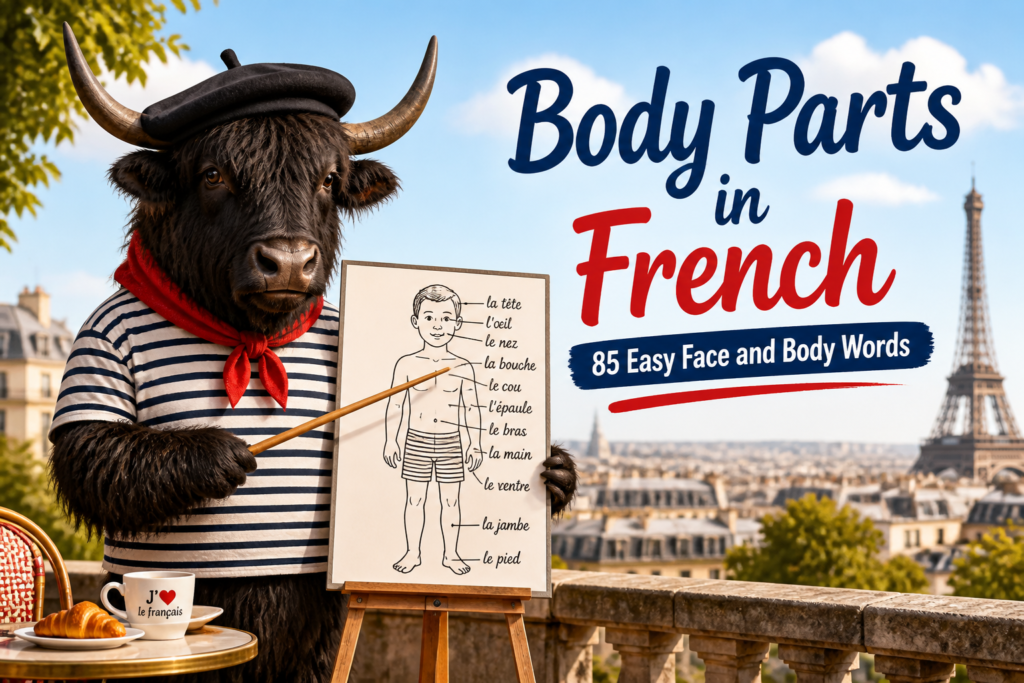
Body and face parts in French are some of the first words you actually use in real life. At the doctor, at the pharmacy, in the gym, in skincare talk, with kids, in class, or just while trying to explain that yes, your ankle is the problem, not your entire leg.
This guide gives you 85 useful French body words plus 15 practical phrases you can use right away. The goal is simple: less frantic pointing, more actual French.
French also loves body-related expressions, which is fun until you realize you know the word for “croissant” but not “elbow.” Let’s fix that.
If you want more core French study help after this, try the French placement test, the French vocabulary test, or keep going with body actions and gestures in French and body care and hygiene in French. You can also browse more lessons on the Learn French hub.
How To Say “Body Parts” In French
The general word for body is le corps (luh kor) = the body.
Example: Le corps humain est complexe.
Translation: The human body is complex.
Learner note: The final ps in corps is usually not pronounced in everyday speech. French spelling likes to keep a few silent letters around for decoration, apparently.
Head And Face Parts In French
| French | Pronunciation | Meaning | Example Sentence | Translation | Learner Note |
|---|---|---|---|---|---|
| la tête | lah tet | head | J’ai mal à la tête. | I have a headache. | Very common in health phrases. |
| le visage | luh vee-zazh | face | Elle a le visage rouge. | Her face is red. | Neutral word for face. |
| le front | luh fron | forehead | Il a touché son front. | He touched his forehead. | The final t is silent. |
| l’œil | luhy | eye | J’ai quelque chose dans l’œil. | I have something in my eye. | Plural is irregular: les yeux. |
| les yeux | lay zyuh | eyes | Elle a les yeux bleus. | She has blue eyes. | Liaison in les yeux. |
| la paupière | lah poh-pyehr | eyelid | Ma paupière est irritée. | My eyelid is irritated. | Useful for health and beauty topics. |
| le cil | luh seel | eyelash | J’ai un cil dans l’œil. | I have an eyelash in my eye. | Usually used in singular in that situation. |
| le sourcil | luh soor-seel | eyebrow | Il lève les sourcils. | He raises his eyebrows. | Common in descriptions. |
| le nez | luh nay | nose | J’ai le nez bouché. | My nose is blocked. | Very useful during cold season. |
| la narine | lah nah-reen | nostril | L’enfant a une narine bouchée. | The child has a blocked nostril. | More specific than nez. |
| la joue | lah zhoo | cheek | Elle a embrassé sa joue. | She kissed his cheek. | Soft j sound like in “measure.” |
| la bouche | lah boosh | mouth | Ouvre la bouche, s’il te plaît. | Open your mouth, please. | Common with doctors and dentists. |
| la lèvre | lah levr | lip | J’ai la lèvre sèche. | My lip is dry. | Singular or plural both common. |
| les lèvres | lay levr | lips | Elle a les lèvres rouges. | She has red lips. | Often used in beauty vocabulary. |
| la langue | lah long | tongue | Tire la langue. | Stick out your tongue. | Also means “language” in another context. |
| la dent | lah don | tooth | J’ai mal à une dent. | I have a toothache in one tooth. | Plural: les dents. |
| les dents | lay don | teeth | Il se brosse les dents. | He brushes his teeth. | French uses reflexive verbs a lot here. |
| la gencive | lah zhon-seev | gum | J’ai les gencives sensibles. | I have sensitive gums. | Mostly plural in everyday use. |
| le menton | luh mon-ton | chin | Il s’est cogné le menton. | He hit his chin. | Useful in injury talk. |
| la mâchoire | lah mah-shwar | jaw | J’ai mal à la mâchoire. | My jaw hurts. | Good to know for dental pain. |
| l’oreille | loh-ray | ear | J’ai mal à l’oreille. | My ear hurts. | Starts with a vowel, so use l’. |
| les oreilles | lay zoh-ray | ears | Le chien a de grandes oreilles. | The dog has big ears. | Liaison in les oreilles. |
| la barbe | lah barb | beard | Il a une barbe courte. | He has a short beard. | Used for facial hair on men. |
| la moustache | lah moo-stash | mustache | Mon oncle porte une moustache. | My uncle wears a mustache. | Easy cognate, thankfully. |
| la peau | lah poh | skin | J’ai la peau sensible. | I have sensitive skin. | Very common in skincare talk. |
| le grain de beauté | luh gran duh boh-tay | beauty mark, mole | Elle a un grain de beauté sur la joue. | She has a mole on her cheek. | Long phrase, but common. |
| la ride | lah reed | wrinkle | Il a quelques rides autour des yeux. | He has a few wrinkles around his eyes. | Useful in beauty and aging vocabulary. |
Hair And Neck Words In French
| French | Pronunciation | Meaning | Example Sentence | Translation | Learner Note |
|---|---|---|---|---|---|
| les cheveux | lay shuh-vuh | hair | Elle a les cheveux longs. | She has long hair. | French usually uses plural for hair. |
| une mèche | ewn mesh | strand of hair | Une mèche tombe sur son visage. | A strand of hair falls over her face. | Common in beauty talk. |
| le cuir chevelu | luh kweer shuh-vuh-loo | scalp | J’ai le cuir chevelu sec. | I have a dry scalp. | Very useful for shampoo labels too. |
| le cou | luh koo | neck | J’ai mal au cou. | My neck hurts. | Notice à + le = au: mal au cou. |
| la gorge | lah gorzh | throat | J’ai mal à la gorge. | I have a sore throat. | Very common illness phrase. |
| la nuque | lah nuk | nape, back of the neck | J’ai une douleur dans la nuque. | I have pain in the back of my neck. | More specific than cou. |
Upper Body Words In French
| French | Pronunciation | Meaning | Example Sentence | Translation | Learner Note |
|---|---|---|---|---|---|
| l’épaule | lay-pohl | shoulder | J’ai mal à l’épaule droite. | My right shoulder hurts. | Use droite or gauche if needed. |
| la poitrine | lah pwah-treen | chest | Il a mal à la poitrine. | He has chest pain. | Important medical word. |
| le sein | luh san | breast | Elle a une douleur au sein gauche. | She has pain in her left breast. | Medical and neutral. |
| le dos | luh doh | back | J’ai mal au dos. | My back hurts. | Extremely useful phrase. |
| la taille | lah ty | waist | Cette robe marque la taille. | This dress emphasizes the waist. | Can also mean size in other contexts. |
| le ventre | luh vontr | belly, stomach area | J’ai mal au ventre. | I have a stomachache. | Very common for general tummy pain. |
| l’estomac | lay-stoh-mahk | stomach | Mon estomac est fragile. | My stomach is sensitive. | More anatomical than ventre. |
| le nombril | luh nom-breel | belly button, navel | L’enfant montre son nombril. | The child shows his belly button. | A fun but genuinely useful word. |
| les côtes | lay koht | ribs | Je me suis fait mal aux côtes. | I hurt my ribs. | Often plural. |
| le cœur | luh kur | heart | Son cœur bat vite. | His heart is beating fast. | The œ sound is tricky; “kur” is close enough for beginners. |
| le poumon | luh poo-mon | lung | Le médecin écoute ses poumons. | The doctor listens to his lungs. | Usually plural in medical checks too. |
| les poumons | lay poo-mon | lungs | Il faut protéger ses poumons. | You need to protect your lungs. | Handy for health contexts. |
Arm And Hand Words In French
| French | Pronunciation | Meaning | Example Sentence | Translation | Learner Note |
|---|---|---|---|---|---|
| le bras | luh brah | arm | Il a mal au bras. | His arm hurts. | Final s is silent. |
| le coude | luh kood | elbow | Je me suis cogné le coude. | I bumped my elbow. | A classic real-life word. |
| le poignet | luh pwan-yay | wrist | Elle s’est foulé le poignet. | She sprained her wrist. | The gn sounds like “ny.” |
| la main | lah man | hand | Donne-moi la main. | Give me your hand. | Very common in daily speech. |
| le doigt | luh dwah | finger | Je me suis coupé le doigt. | I cut my finger. | Silent final t. |
| le pouce | luh pooss | thumb | J’ai mal au pouce. | My thumb hurts. | Useful when texting too much, maybe. |
| l’index | lan-deks | index finger | Il pointe avec l’index. | He points with his index finger. | Linked pronunciation after l’. |
| le majeur | luh mah-zhur | middle finger | Le majeur est le plus long doigt. | The middle finger is the longest finger. | Neutral anatomical term. |
| l’annulaire | lah-nyoo-lehr | ring finger | Elle porte une bague à l’annulaire. | She wears a ring on her ring finger. | Long word, but useful. |
| l’auriculaire | loh-ree-koo-lehr | little finger, pinky | L’enfant lève l’auriculaire. | The child raises his pinky. | More formal than everyday petit doigt. |
| le petit doigt | luh puh-tee dwah | pinky, little finger | Je me suis cassé le petit doigt. | I broke my pinky. | More common in everyday speech. |
| l’ongle | longl | nail | Je me suis cassé un ongle. | I broke a nail. | For fingernails and toenails. |
| la paume | lah pohm | palm | Il a écrit dans sa paume. | He wrote in his palm. | Good specific hand word. |
Lower Body Words In French
| French | Pronunciation | Meaning | Example Sentence | Translation | Learner Note |
|---|---|---|---|---|---|
| la hanche | lah onsh | hip | Elle a mal à la hanche. | Her hip hurts. | Common in medical and fitness talk. |
| la fesse | lah fess | buttock, cheek | Le bébé est tombé sur la fesse. | The baby fell on his bottom. | Neutral enough, but context matters. |
| les fesses | lay fess | bottom, butt | L’enfant s’est assis sur les fesses. | The child sat down on his bottom. | Common everyday plural form. |
| la jambe | lah zhomb | leg | Je me suis fait mal à la jambe. | I hurt my leg. | Useful and very common. |
| la cuisse | lah kweess | thigh | Il a une douleur à la cuisse. | He has pain in his thigh. | Common in sports injuries. |
| le genou | luh zhuh-noo | knee | Elle s’est blessée au genou. | She injured her knee. | Plural: les genoux. |
| le mollet | luh moh-lay | calf | J’ai une crampe au mollet. | I have a cramp in my calf. | Very useful in sports and travel. |
| le tibia | luh tee-bya | shin, tibia | Je me suis cogné le tibia. | I banged my shin. | Often used for shin in everyday speech too. |
| la cheville | lah shuh-vee-yuh | ankle | Je me suis foulé la cheville. | I sprained my ankle. | A survival word for clumsy people. |
| le pied | luh pyeh | foot | J’ai mal au pied. | My foot hurts. | Singular and plural are both common by context. |
| les pieds | lay pyeh | feet | J’ai les pieds froids. | My feet are cold. | Very common phrase. |
| le talon | luh tah-lon | heel | J’ai une ampoule au talon. | I have a blister on my heel. | Great word for walking problems. |
| la plante du pied | lah plant du pyeh | sole of the foot | J’ai mal sous la plante du pied. | The sole of my foot hurts. | Long but practical. |
| l’orteil | lor-tay | toe | Je me suis cassé un orteil. | I broke a toe. | Common injury vocabulary. |
| les orteils | lay zor-tay | toes | Il bouge les orteils. | He wiggles his toes. | Liaison in plural. |
| l’ongle de pied | longl duh pyeh | toenail | Je dois couper mes ongles de pied. | I need to cut my toenails. | Often plural: les ongles de pied. |
Internal And General Body Words In French
| French | Pronunciation | Meaning | Example Sentence | Translation | Learner Note |
|---|---|---|---|---|---|
| le muscle | luh mus-kl | muscle | J’ai mal aux muscles. | My muscles hurt. | Very common after exercise. |
| l’os | lohs | bone | Il s’est cassé un os. | He broke a bone. | Pronounced with the final s here. |
| le sang | luh son | blood | Il y a du sang sur sa main. | There is blood on his hand. | Important emergency vocabulary. |
| le cerveau | luh sair-voh | brain | Le cerveau contrôle le corps. | The brain controls the body. | Good general science word. |
| le nerf | luh nairf | nerve | Le dentiste a touché un nerf. | The dentist touched a nerve. | Also used figuratively. |
| la blessure | lah bleh-syur | injury, wound | Sa blessure n’est pas grave. | His injury is not serious. | Good all-purpose medical word. |
| la douleur | lah doo-lur | pain | La douleur est forte. | The pain is strong. | More formal than just j’ai mal. |
| la cicatrice | lah see-kah-trees | scar | Il a une cicatrice sur le bras. | He has a scar on his arm. | Useful for descriptions. |
| la sueur | lah swur | sweat | J’ai de la sueur sur le front. | I have sweat on my forehead. | Common in sports and heat talk. |
| la respiration | lah res-pee-rah-syon | breathing, respiration | Sa respiration est rapide. | His breathing is fast. | Useful in health contexts. |
| le souffle | luh soofl | breath | J’ai le souffle court. | I’m short of breath. | Very practical phrase. |
15 Useful French Phrases About Body Parts
| French Phrase | Pronunciation | Meaning | Example Sentence | Translation | Learner Note |
|---|---|---|---|---|---|
| J’ai mal à la tête. | zhay mahl ah lah tet | I have a headache. | Je ne peux pas sortir, j’ai mal à la tête. | I can’t go out, I have a headache. | Use avoir mal à for pain. |
| J’ai mal au dos. | zhay mahl oh doh | My back hurts. | Après le déménagement, j’ai mal au dos. | After the move, my back hurts. | à + le = au. |
| J’ai mal au ventre. | zhay mahl oh vontr | I have a stomachache. | Il a trop mangé, maintenant il a mal au ventre. | He ate too much, now he has a stomachache. | Very everyday phrase. |
| J’ai mal à la gorge. | zhay mahl ah lah gorzh | I have a sore throat. | Je parle moins parce que j’ai mal à la gorge. | I’m speaking less because I have a sore throat. | Common when sick. |
| J’ai mal aux pieds. | zhay mahl oh pyeh | My feet hurt. | Après cette randonnée, j’ai mal aux pieds. | After that hike, my feet hurt. | à + les = aux. |
| Je me suis foulé la cheville. | zhuh muh swee foo-lay lah shuh-vee-yuh | I sprained my ankle. | Je me suis foulé la cheville en courant. | I sprained my ankle while running. | Common injury phrase. |
| Je me suis cassé le bras. | zhuh muh swee kah-say luh brah | I broke my arm. | Quand j’étais petit, je me suis cassé le bras. | When I was little, I broke my arm. | French often uses reflexive forms for injuries. |
| Ouvre la bouche. | oovr lah boosh | Open your mouth. | Le dentiste a dit : “Ouvre la bouche.” | The dentist said, “Open your mouth.” | Informal singular command. |
| Ferme les yeux. | fairm lay zyuh | Close your eyes. | Ferme les yeux et respire. | Close your eyes and breathe. | Great for instructions. |
| Lève les bras. | lev lay brah | Raise your arms. | Le professeur dit : “Lève les bras.” | The teacher says, “Raise your arms.” | Useful in class, sport, or health contexts. |
| Baisse la tête. | bess lah tet | Lower your head. | Baisse la tête, le plafond est bas. | Lower your head, the ceiling is low. | Good practical phrase. |
| Tourne la tête à gauche. | toorn lah tet ah gosh | Turn your head to the left. | Tourne la tête à gauche, s’il te plaît. | Turn your head to the left, please. | Add à droite for “to the right.” |
| Montre-moi ta main. | montr mwah tah man | Show me your hand. | Montre-moi ta main, je veux voir la coupure. | Show me your hand, I want to see the cut. | Informal ta; formal would be votre. |
| Il a les yeux bleus. | eel ah lay zyuh bluh | He has blue eyes. | Mon frère a les yeux bleus. | My brother has blue eyes. | French uses avoir for physical features. |
| Elle a les cheveux bruns. | ell ah lay shuh-vuh brun | She has brown hair. | La nouvelle prof a les cheveux bruns. | The new teacher has brown hair. | Use plural adjective with cheveux. |
Quick Grammar Notes You Actually Need
1. French Usually Uses Definite Articles With Body Parts
Instead of saying “my hand hurts” with a possessive like English does, French often says:
- J’ai mal à la main. = My hand hurts.
- Je me lave les mains. = I wash my hands.
- Il s’est cassé le bras. = He broke his arm.
That le / la / les pattern is extremely normal in French when the body part belongs to the subject and the meaning is obvious.
2. Use “Avoir Mal À” For Pain
- J’ai mal à la tête. = I have a headache.
- Elle a mal au genou. = Her knee hurts.
- Nous avons mal aux épaules. = Our shoulders hurt.
Remember the contractions:
- à + le = au
- à + les = aux
So you get au dos, au bras, aux pieds, and so on.
3. Watch A Few Irregular Plurals
- l’œil → les yeux
- le cheveu → les cheveux
- le genou → les genoux
These are common enough that you should memorize them early and save yourself future annoyance.
Common Mistakes English Speakers Make
- Wrong: mon tête
Correct: ma tête
Why: tête is feminine. - Wrong: mes cheveu
Correct: mes cheveux
Why: The usual word for hair is plural. - Wrong: j’ai mal à le bras
Correct: j’ai mal au bras
Why: à + le contracts to au. - Wrong: j’ai mal mon dos
Correct: j’ai mal au dos
Why: Use avoir mal à, not a possessive like in English. - Wrong: les oeils
Correct: les yeux
Why: This plural is irregular and very common.
Mini Reference List: 85 Body And Face Words
- le corps — body
- la tête — head
- le visage — face
- le front — forehead
- l’œil — eye
- les yeux — eyes
- la paupière — eyelid
- le cil — eyelash
- le sourcil — eyebrow
- le nez — nose
- la narine — nostril
- la joue — cheek
- la bouche — mouth
- la lèvre — lip
- les lèvres — lips
- la langue — tongue
- la dent — tooth
- les dents — teeth
- la gencive — gum
- le menton — chin
- la mâchoire — jaw
- l’oreille — ear
- les oreilles — ears
- la barbe — beard
- la moustache — mustache
- la peau — skin
- le grain de beauté — mole
- la ride — wrinkle
- les cheveux — hair
- une mèche — strand of hair
- le cuir chevelu — scalp
- le cou — neck
- la gorge — throat
- la nuque — nape
- l’épaule — shoulder
- la poitrine — chest
- le sein — breast
- le dos — back
- la taille — waist
- le ventre — belly
- l’estomac — stomach
- le nombril — belly button
- les côtes — ribs
- le cœur — heart
- le poumon — lung
- les poumons — lungs
- le bras — arm
- le coude — elbow
- le poignet — wrist
- la main — hand
- le doigt — finger
- le pouce — thumb
- l’index — index finger
- le majeur — middle finger
- l’annulaire — ring finger
- l’auriculaire — little finger
- le petit doigt — pinky
- l’ongle — nail
- la paume — palm
- la hanche — hip
- la fesse — buttock
- les fesses — bottom
- la jambe — leg
- la cuisse — thigh
- le genou — knee
- le mollet — calf
- le tibia — shin
- la cheville — ankle
- le pied — foot
- les pieds — feet
- le talon — heel
- la plante du pied — sole of the foot
- l’orteil — toe
- les orteils — toes
- l’ongle de pied — toenail
- le muscle — muscle
- l’os — bone
- le sang — blood
- le cerveau — brain
- le nerf — nerve
- la blessure — injury
- la douleur — pain
- la cicatrice — scar
- la sueur — sweat
- la respiration — breathing
- le souffle — breath
Learn the body words you will actually say first: head, hand, arm, back, stomach, throat, eye, foot, knee. Nobody ever regrets knowing how to say “ankle” five seconds after twisting one.
Yak Takeaway
If you remember just one pattern from this lesson, make it this: j’ai mal à… plus the body part. That one structure alone will save you in pharmacies, clinics, sports classes, and dramatic travel moments.
Learn the most common body words first, then build outward. Start with la tête, le bras, la main, le dos, le ventre, la jambe, and le pied. After that, you can move on to fancier things like la mâchoire and l’annulaire and feel suspiciously competent.
And yes, now you can stop pointing. Mostly.