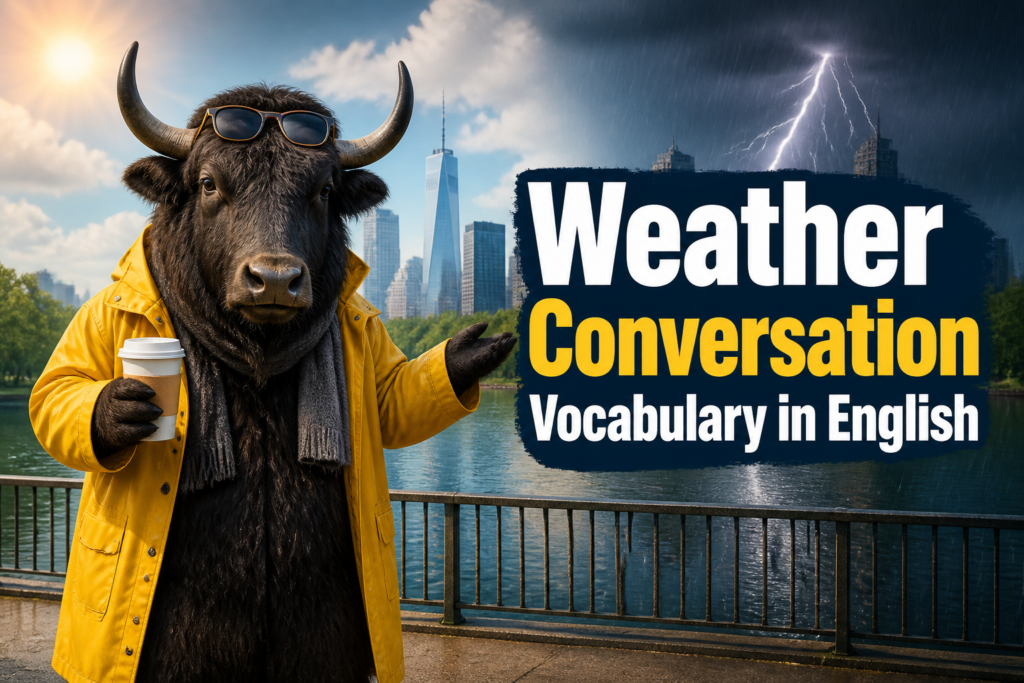
Weather is the classic small-talk topic for a reason: everyone has an opinion, and nobody needs a PhD to join in. You can talk about sunshine at the bus stop, rain in an email, or snow like you are personally offended by it.
For the broader learning path, visit our parent guide.
In this lesson, you will learn useful weather words and everyday phrases for real conversations. By the end, you should be able to describe the weather, answer simple questions about it, and sound natural instead of sounding like a weather app with feelings.
For a quick official overview of word meanings, you can also check Cambridge Dictionary. And if you want to compare your English level later, try the English Vocabulary Test or the English Placement Test CEFR.
One small thing first: in English, people often talk about the weather with short, easy phrases. That is normal. Nobody expects a dramatic speech about atmospheric conditions before breakfast.
Useful Weather Words
| English | Pronunciation | Meaning | Example Sentence | Learner Note |
|---|---|---|---|---|
| sunny | SUN-ee | with a lot of sun | It’s sunny today, so let’s walk to the park. | Common, positive, and very useful. |
| cloudy | KLOW-dee | covered with clouds | It’s cloudy, but it doesn’t look like rain. | Cloudy does not always mean cold. |
| rainy | RAY-nee | with rain | It’s rainy, so I brought an umbrella. | Very common in weather talk. |
| windy | WIN-dee | with a lot of wind | It’s windy, so hold onto your hat. | Pronounce the “d” clearly: WIN-dee. |
| snowy | SNOH-ee | with snow | It was snowy all morning. | Used for weather and conditions. |
| foggy | FOG-ee | with thick fog | The roads were foggy early in the morning. | Important for travel and driving. |
| stormy | STOR-mee | with a storm | It looks stormy, so stay inside. | Can suggest strong rain, wind, thunder, or lightning. |
| hot | hot | high temperature | It’s too hot to wear this jacket. | Very common in summer conversations. |
| warm | worm | pleasantly not cold | The weather is warm and comfortable. | Warmer than “cool,” but not as strong as “hot.” |
| cool | kool | slightly cold or comfortable | It’s cool tonight, so bring a light jacket. | Also means “great” in informal English, but not here. |
| cold | kohld | low temperature | It’s cold outside, so wear gloves. | One of the most common weather words. |
| humid | HYOO-mid | with a lot of moisture in the air | It’s hot and humid today. | Common in summer and tropical places. |
Everyday Weather Conversation Phrases
| English | Pronunciation | Meaning | Example Sentence | Learner Note |
|---|---|---|---|---|
| What’s the weather like? | wuhts thuh WETH-er lyk | asking about the weather now | What’s the weather like today? | Very common question. Easy and neutral. |
| It’s raining. | its RAY-ning | rain is falling now | It’s raining, so we should stay inside. | Use the present continuous for weather sometimes. |
| It looks like rain. | it LOOKS lyk rayn | it seems that rain may start soon | Take an umbrella. It looks like rain. | Good prediction phrase. |
| It’s pouring. | its POR-ing | it is raining very heavily | Don’t go out now—it’s pouring. | Casual and very common. |
| It’s drizzling. | its DRIZ-ling | light rain is falling | It’s only drizzling, so I didn’t take a big umbrella. | Drizzle = light rain. |
| There’s a breeze. | therz uh breez | a light wind is blowing | There’s a nice breeze by the beach. | Nice for calm weather comments. |
| It’s freezing. | its FREE-zing | it is extremely cold | It’s freezing outside this morning. | Informal, very common. |
| It’s mild. | its myld | pleasant, not too hot or cold | The weather is mild in spring. | Useful for talking about comfortable weather. |
| It’s clearing up. | its KLEER-ing up | clouds or bad weather are going away | The sky is clearing up now. | Common phrasal verb in weather talk. |
| It’s getting worse. | its GET-ing wurs | the weather is becoming more unpleasant | The storm is getting worse. | Useful when weather changes. |
| There’s a chance of rain. | therz uh chens uhv rayn | rain may happen | There’s a chance of rain this afternoon. | Common in forecasts and daily talk. |
| It’s supposed to rain. | its suh-POHZD tuh rayn | the forecast says rain will likely happen | It’s supposed to rain later. | Good for future weather predictions. |
Note: In American English, people often say “It’s supposed to rain.” In British English, that is also fine. The difference is usually small here, so do not let it become a weather-related identity crisis.
Common Weather Conversation Sentences
| English | Pronunciation | Meaning | Example Sentence | Learner Note |
|---|---|---|---|---|
| Nice day, isn’t it? | nys day, iz-nt it | a friendly comment about pleasant weather | Nice day, isn’t it? Perfect for a walk. | Very common small talk. |
| It’s a bit chilly. | its uh bit CHIL-ee | slightly cold | It’s a bit chilly, so I closed the window. | “Chilly” sounds natural and mild. |
| It’s really muggy. | its REE-lee MUG-ee | hot and humid, sticky feeling | It’s really muggy today, even at night. | Common in summer. Less basic, very useful. |
| We’re expecting rain. | weer ik-SPEK-ting rayn | we think rain will happen | We’re expecting rain this evening. | Good for plans and forecasts. |
| The sun came out. | thuh sun kame out | the clouds disappeared and the sun appeared | The sun came out after lunch. | Useful when weather improves. |
| It’s a beautiful day. | its uh BYOO-ti-ful day | the weather is very pleasant | It’s a beautiful day for a picnic. | Friendly and positive. |
| We had a lot of rain. | wee had uh lot uhv rayn | there was much rain | We had a lot of rain last week. | “A lot of” is common with rain, snow, and wind. |
| It was below zero. | it wuz bih-LOH ZEE-roh | the temperature was under 0°C or 0°F | Last night it was below zero. | Used in cold weather reports. |
| The forecast says… | thuh FOR-kast sez | the weather prediction says… | The forecast says it will be windy tomorrow. | Great phrase for weather reports. |
| What a change in the weather! | wuht uh chaynj in thuh WETH-er | the weather has changed a lot | What a change in the weather! Yesterday was sunny. | Nice for surprise or contrast. |
| Take an umbrella. | tayk an um-BREL-uh | bring an umbrella with you | Take an umbrella. It might rain later. | Simple advice phrase. |
| Dress in layers. | dres in LAY-erz | wear several thin pieces of clothing | It’s cold in the morning, so dress in layers. | Very useful for changing weather. |
Weather Words That Often Travel Together
These are common collocations, which means words that often go together. English loves collocations. It is one of those “because that is just how we do it” things.
- heavy rain — strong, intense rain
- light rain — gentle rain
- strong wind — powerful wind
- thick fog — fog that is hard to see through
- bright sun — strong, clear sunlight
- extreme heat — very hot weather
- freezing cold — extremely cold weather
- storm warning — official warning about a storm
- weather forecast — prediction of future weather
- change in the weather — weather becoming different
Learner note: In English, we usually say “heavy rain,” not “big rain.” And we say “strong wind,” not “hard wind.” English is picky in little ways. Very helpful. Very annoying. Very English.
Talking About Temperature
Temperature words are useful when you want to say more than just “hot” or “cold.”
| English | Pronunciation | Meaning | Example Sentence | Learner Note |
|---|---|---|---|---|
| warm | worm | pleasantly hot | The water feels warm. | Often positive. |
| hot | hot | high temperature | It’s hot in the afternoon. | Can describe weather, food, or objects. |
| boiling | BOY-ling | very hot, informal | It’s boiling in here. | Casual. Not literal boiling. |
| cold | kohld | low temperature | The water is cold this morning. | Very common and basic. |
| chilly | CHIL-ee | a little cold | It’s chilly at night. | Less strong than cold. |
| freezing | FREE-zing | extremely cold | It’s freezing outside. | Very common in speech. |
Grammar tip: With weather, English often uses it as the subject. For example: It’s hot. It’s raining. It’s windy. You do not usually say “The weather is raining.” That sounds odd unless you are trying to confuse everyone at the party.
American And British Weather Words
| American English | British English | Meaning | Example Sentence | Learner Note |
|---|---|---|---|---|
| sweater | jumper | warm knitted top | Bring a sweater because it may get cold. | British people usually say “jumper.” |
| fall | autumn | season after summer | The weather is nice in fall. | Both are correct. |
| flash flood | flash flood | very fast flood after heavy rain | There was a flash flood after the storm. | Common in news and warnings. |
| storm | storm | bad weather with wind, rain, thunder, or lightning | The storm lasted all night. | Used in both varieties. |
Note: “Weather” words are often shared across English varieties. The bigger differences are usually in everyday clothing words and season words, not in basic weather talk.
Mini Practice
Try these quick exercises. Simple is good. Confusing yourself is optional, not required.
- Change the sentence: It is cold. → Use freezing.
- Change the sentence: It is raining lightly. → Use drizzling.
- Choose the best word: sunny / stormy — “The day is bright and pleasant.”
- Choose the best phrase: It looks like rain / It’s boiling — “The sky is dark and clouds are coming.”
- Complete the sentence: Take an ________.
- Complete the sentence: The forecast says it will be ________ tomorrow.
Check Your Answers
- It is freezing.
- It is drizzling.
- sunny
- It looks like rain
- umbrella
- Any weather word that fits the forecast, such as rainy, windy, or cloudy
Common Mistakes And Fixes
| Wrong | Better | Why |
|---|---|---|
| The weather is rain. | It is raining. | Use the verb form raining for weather now. |
| It is a sunny. | It is sunny. | Do not use a before this adjective. |
| There is rain today. | It is raining today. | Both can work in some contexts, but the second is more natural for current weather. |
| It is very coldly. | It is very cold. | Cold is an adjective, not an adverb here. |
| The sky is cloud. | The sky is cloudy. | Use the adjective cloudy. |
| How is the weather like? | What’s the weather like? | This is the natural question form. |
Quick Reference Summary
- Weather basics: sunny, cloudy, rainy, windy, snowy, foggy
- Temperature words: hot, warm, cool, cold, chilly, freezing
- Common phrases: It’s raining, It looks like rain, It’s clearing up, It’s supposed to rain
- Small talk phrase: Nice day, isn’t it?
- Helpful advice: Take an umbrella, Dress in layers
If you want to keep practicing English words like these, the best move is to use them in real life: talk about the weather with a friend, describe today in a message, or notice how weather appears in forecasts and news. Boring topic? Maybe. Useful topic? Absolutely.
Yak takeaway: Weather conversation in English is usually short, simple, and practical. Learn a few key words, use them in full sentences, and you can talk about the sky without sounding like a broken thermometer.