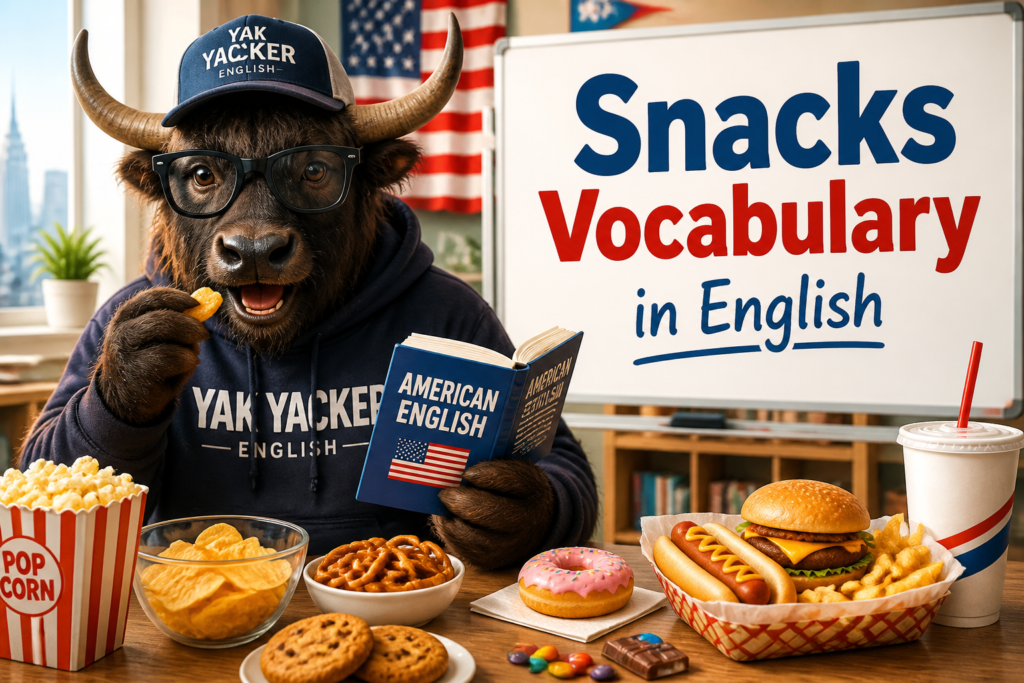
Snacks are the tiny food decisions that somehow become huge life events. One minute you want “just something small,” and the next minute you are emotionally committed to crackers, chips, or a cookie you “weren’t even planning to eat.” English has lots of useful snack words, and many of them show up in real conversations, menus, shopping lists, and casual texting.
In this guide, you’ll learn practical snacks vocabulary in English, plus common phrases, pronunciation help, and real example sentences. By the end, you’ll be able to talk about snacks more naturally at home, at school, at work, or while standing in front of an open fridge like a tired philosopher.
If you want more practice after this lesson, you can also try the English Vocabulary Test or check your level with the English Placement Test CEFR.
Useful Snacks Words and Phrases
Here are the most common snack words and phrases you’ll hear in everyday English. The first ones are the most useful, so start there.
| English | Pronunciation | Meaning | Example Sentence | Learner Note |
|---|---|---|---|---|
| snack | snak | small food eaten between meals | I need a snack before dinner. | Very common and neutral. |
| eat a snack | eat uh snak | have a small amount of food | She usually eats a snack after school. | Simple everyday phrase. |
| grab a snack | grab uh snak | quickly get a snack | I’m going to grab a snack from the kitchen. | Casual and very natural. |
| light snack | lyt snak | a small, not-heavy snack | We only need a light snack before the meeting. | Useful for travel, parties, and work. |
| quick snack | kwik snak | a snack eaten fast | Do you want a quick snack before class? | Often used when time is short. |
| healthy snack | hel-thee snak | a snack that is good for your body | Fruit is a healthy snack. | Common in health and school contexts. |
| sweet snack | sweet snak | a snack with sugar or dessert-like taste | Sometimes I want a sweet snack after lunch. | Opposite of salty snack. |
| salty snack | SOL-tee snak | a snack with salt or a salty taste | Chips are a popular salty snack. | Very common phrase. |
| crunchy snack | KRUN-chee snak | a snack that makes a crisp sound when eaten | Carrots are a crunchy snack. | Good for texture description. |
| tasty snack | TAY-stee snak | a snack that tastes good | This is a tasty snack recipe. | Very beginner-friendly. |
| mid-morning snack | mid-MOR-ning snak | snack eaten before lunch | I usually have a mid-morning snack at 10:30. | Useful in schedules and routines. |
| afternoon snack | af-ter-NOON snak | snack eaten in the afternoon | The kids get an afternoon snack after school. | Common with families and children. |
| late-night snack | layt-nyt snak | snack eaten late at night | I should not have a late-night snack. | Often used in funny or honest conversations. |
| between meals | bi-TWEEN meelz | in the time between breakfast, lunch, and dinner | Snacks are eaten between meals. | Important phrase for defining “snack.” |
Common Snack Types
English speakers often talk about snacks by type. Some words are general, while others are specific foods you’ll see in stores and menus.
| English | Pronunciation | Meaning | Example Sentence | Learner Note |
|---|---|---|---|---|
| chips | chipz | thin fried potato slices; in British English, “crisps” | I bought a bag of chips. | American English = chips. British English = crisps. |
| crisps | krisps | British English for chips | She likes cheese and onion crisps. | Mainly British English. |
| cookies | KOO-keez | sweet baked snack; in British English, often “biscuits” | Do you want a cookie with your tea? | American English word. |
| biscuits | BIS-kits | British English for cookies; also a soft bread roll in some US regions | He bought some biscuits for the office. | Meaning changes by region, so be careful. |
| crackers | KRAK-erz | thin, dry snack often eaten with cheese or dips | I like crackers and cheese. | Very common in lunchboxes and party trays. |
| pretzels | PRET-zuhlz | twisted baked snack, often salty | There are pretzels in the snack bowl. | Good party and airport word. |
| popcorn | POP-korn | popped corn eaten as a snack | We had popcorn at the movie. | Very common with movies and events. |
| granola bar | gruh-NOH-luh bar | bar made with oats, nuts, and sometimes honey | I keep a granola bar in my bag. | Popular on the go. |
| protein bar | PRO-teen bar | a bar with extra protein, often for fitness | He ate a protein bar after the gym. | Common in sports and fitness contexts. |
| trail mix | TRAYL miks | mix of nuts, dried fruit, and sometimes chocolate | Trail mix is easy to carry when traveling. | Very common in hiking and travel English. |
| nuts | nuts | small hard seeds eaten as food, like almonds or peanuts | She ate a handful of nuts. | Can be a snack by itself or part of a mix. |
| seeds | seedz | small edible seeds, such as pumpkin or sunflower seeds | Sunflower seeds are a popular snack in some places. | Useful in health-food conversations. |
| fruit | froot | natural sweet food from plants | Apple slices make a simple snack. | Countable as types; uncountable as a category. |
| yogurt | YOH-gurt | soft dairy food, often eaten as a snack | I had yogurt with berries. | American spelling is usually yogurt; British also uses yoghurt. |
More Snack Words You’ll See Often
These words are useful when you want to describe snacks more clearly or talk about snack habits. Because yes, “I ate something” is not exactly thrilling language.
| English | Pronunciation | Meaning | Example Sentence | Learner Note |
|---|---|---|---|---|
| portion | POR-shuhn | an amount of food | The snack portions are small. | Useful in restaurants and packaging. |
| serving | SUR-ving | one standard amount of food | One serving of chips is 150 calories. | Common on labels and nutrition facts. |
| packaged snack | PA-kijd snak | snack sold in a package or bag | Packaged snacks are easy to carry. | Useful in shopping contexts. |
| homemade snack | HOHM-mayd snak | snack made at home | We made homemade popcorn. | Natural and positive phrase. |
| on the go | on thuh goh | while moving or traveling | I need a snack for on-the-go eating. | Very common modern phrase. |
| mess-free | mes-free | not likely to make a mess | Crackers are a mess-free snack. | Great for kids, cars, and offices. |
| bite-size | BYT-syz | small enough to eat in one bite | They served bite-size snacks at the party. | Often hyphenated before a noun. |
| food craving | food KRAY-ving | a strong desire for a certain food | I had a craving for something salty. | Very common in casual English. |
| munchies | MUN-cheez | informal word for a craving for snacks | I’ve got the munchies. | Casual slang; not for formal settings. |
| nibble | NIB-uhl | a small bite or small amount of food | She took a nibble of the cookie. | Can be a noun or verb; gentle, small amount. |
| munch | munch | to chew snacks noisily or eat in a relaxed way | He was munching on carrots during the meeting. | Informal and very common. |
| have a bite | hav uh byt | eat a little food | Let’s have a bite before we leave. | Friendly, casual phrase. |
| share a snack | shair uh snak | eat the same snack with someone else | We shared a snack during the trip. | Good for social situations. |
| snack break | snak brayk | a short break to eat a snack | We took a snack break after the meeting. | Common at school and work. |
Useful Snack Phrases In Real Life
These are the kinds of phrases people actually say. Memorizing these can help you sound much more natural than just knowing single words.
- Do you want a snack? — a friendly offer
- I’m hungry for a snack. — you want to eat something small
- I need something salty. — you want chips, crackers, or similar food
- I want something sweet. — you want cookies, fruit, or candy
- Let’s grab a quick snack. — casual phrase for eating something fast
- I’m just snacking. — you are eating a little, not a full meal
- This is my go-to snack. — your usual favorite snack
- I’m trying to eat healthier snacks. — common health and lifestyle phrase
- We need snacks for the road. — snacks for a car trip or travel
- There are snacks in the break room. — common work phrase
- Can I have a bite? — polite casual way to ask for a small taste
- I’m full, but I could still eat a cookie. — a very English sentence, honestly
American And British Snack Words
Some snack words change depending on the variety of English. This is one of those small but annoying details that learners bump into all the time.
| American English | British English | Meaning | Example |
|---|---|---|---|
| chips | crisps | thin fried potato snack | She bought chips / crisps at the store. |
| cookies | biscuits | sweet baked snack | I ate two cookies / biscuits. |
| yogurt | yoghurt | soft dairy snack | The yogurt / yoghurt is in the fridge. |
| fries | chips | fried potato sticks, not snack chips | We ordered fries with lunch. |
Learner note: In British English, the word chips means what Americans call fries. So if someone offers you chips in the UK, they probably mean the crunchy snack, not the potato sticks. English likes to keep people slightly confused for fun.
Snack Words By Taste And Texture
These words help you describe snacks more naturally. They are especially useful when talking about food preferences, shopping, or recipes.
| English | Pronunciation | Meaning | Example Sentence | Learner Note |
|---|---|---|---|---|
| sweet | sweeth | tasting like sugar or dessert | These grapes are very sweet. | Also used for candy, cookies, and fruit. |
| salty | SOL-tee | tasting of salt | The popcorn is salty. | Common with chips and pretzels. |
| spicy | SPY-see | having hot flavor | We bought spicy nuts. | Can mean hot and strong in taste. |
| savory | SAY-vuh-ree | not sweet; often salty or meaty | I prefer savory snacks to sweet ones. | Useful contrast with sweet. |
| crispy | KRIS-pee | hard and crunchy in a pleasant way | The crackers are crispy. | Common food adjective. |
| crunchy | KRUN-chee | makes a crunchy sound when eaten | Fresh carrots are crunchy. | Very natural in snack descriptions. |
| soft | soft | not hard | This snack is soft and chewy. | Useful for bars, bread, and fruit. |
| chewy | CHOO-ee | must be chewed a lot | These granola bars are chewy. | Good for texture vocabulary. |
| fresh | fresh | recently made or naturally good | Fresh fruit is my favorite snack. | Common and versatile. |
| stale | stayl | not fresh anymore, especially bread or crackers | The crackers are stale. | Useful for food that is old or dry. |
Grammar Tip: Countable And Uncountable Snack Words
Some snack nouns are countable, and some are uncountable. This matters because English grammar is a little picky here.
| Pattern | Meaning | Example | Learner Note |
|---|---|---|---|
| a snack / two snacks | countable noun | I ate one snack. / We bought two snacks. | Use numbers with countable nouns. |
| some popcorn | uncountable noun | She had some popcorn. | Do not say “a popcorn” in normal English. |
| some yogurt | uncountable in general use | I want some yogurt. | In stores, one container can be “a yogurt” informally. |
| some chips | plural countable noun | He bought some chips. | Use plural with this snack word. |
| some fruit | uncountable in general use | Fruit is a healthy snack. | “Fruits” can mean types of fruit, but not always. |
Pronunciation Notes
Some snack words are easy, but a few cause trouble because English spelling enjoys chaos.
- cookie = KOO-kee. The stress is on the first syllable.
- pretzel = PRET-zuhl. The second part is softer, not “pret-zell.”
- granola = gruh-NOH-luh. The middle syllable gets the stress.
- yogurt = YOH-gurt. American English usually says this with two syllables.
- crisp / crisps = clear s sound at the end, not “crisp-uh.”
- chewy = CHOO-ee. Try to keep both syllables clear.
Practice Time
Let’s make the words stick. No dramatic food quiz buzzers required.
- Fill in the blank: I want a ______ snack before dinner. (light / loudly)
- Choose the correct word: In British English, cookies are often called ______. (biscuits / salads)
- Fill in the blank: Chips are a common ______ snack. (salty / sleepy)
- Rewrite the sentence with a natural phrase: “I want to get a snack quickly.” → ______
- Choose the best word: A bar made with oats and honey is a ______ bar. (granola / tomato)
- Fill in the blank: We had popcorn at the ______. (movie / toothbrush)
- Say it aloud: grab a snack, quick snack, healthy snack, late-night snack
Possible answers: light, biscuits, salty, “I’m going to grab a snack,” granola, movie.
Common Mistakes And Fixes
| Wrong | Better | Why |
|---|---|---|
| I ate a chips. | I ate some chips. | Chips is usually plural in American English. |
| I want a popcorn. | I want some popcorn. | Popcorn is usually uncountable. |
| I have hunger for snack. | I’m hungry for a snack. | This sounds much more natural. |
| I want eat a snack. | I want to eat a snack. | Need to before the verb. |
| She likes chips in British English for crisps. | She likes crisps in British English. | Use the correct regional word. |
| He grab a snack. | He grabs a snack. | Third person singular needs -s. |
Quick Reference Summary
- snack = small food between meals
- grab a snack = get a snack quickly
- healthy snack = better-for-you snack
- salty snack = chips, pretzels, crackers
- sweet snack = cookies, fruit, candy
- on the go = while traveling or moving
- munchies = informal craving for snacks
- chips = American English; crisps = British English
- cookies = American English; biscuits = British English
Yak takeaway: if you can ask for a snack, describe it, and tell someone whether it is sweet, salty, crunchy, or healthy, you already know enough English to survive a fridge raid with confidence.
For a broader learning path, visit Learn English and keep building your everyday vocabulary one snack at a time.