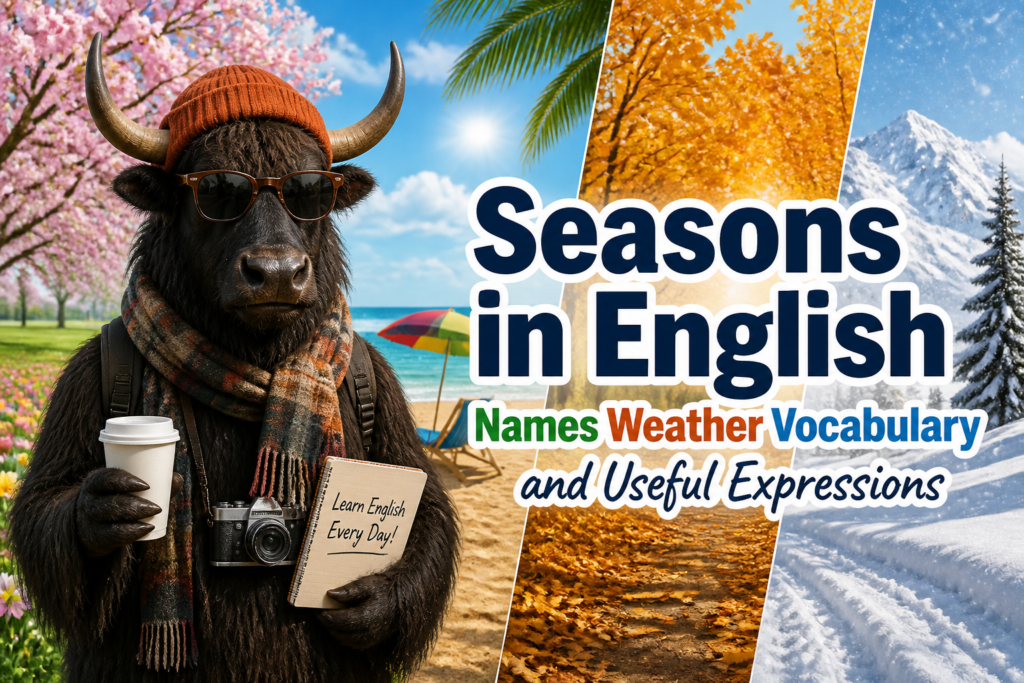
Seasons are one of those topics that look simple until you try to talk about them naturally in English. Then suddenly you need words for weather, clothing, activities, and all those little expressions people use without thinking. Classic English: simple on paper, annoyingly lively in real life.
In this guide, you’ll learn the four seasons in English, common weather vocabulary, useful phrases, and natural expressions people use when talking about the year, the climate, and everyday plans.
By the end, you’ll be able to talk about seasons more clearly, understand common weather conversations, and use practical English that sounds natural in real life.
The Four Seasons In English
| English | Pronunciation | Meaning | Example Sentence | Learner Note |
|---|---|---|---|---|
| spring | spring | The season after winter and before summer | Flowers bloom in spring. | Often linked with new growth, mild weather, and fresh starts. |
| summer | SUM-er | The warmest season of the year | We usually travel in summer. | Commonly associated with hot weather, vacations, and long days. |
| autumn | AW-tum | The season after summer and before winter | The leaves change color in autumn. | Very common in British English. |
| fall | fawl | Another word for autumn | In the U.S., people often say fall. | Most common in American English. |
| winter | WIN-ter | The coldest season of the year | It gets dark early in winter. | Think cold, snow, and heavy coats. |
Small but useful note: In British English, people usually say autumn. In American English, fall is more common. Both are correct. English enjoys giving you two options for the same thing, just to keep life interesting.
Seasons are usually written in lowercase in normal sentences:
- I like spring best.
- We go skiing in winter.
- It rains a lot in autumn.
But if a season starts a sentence, it is capitalized like any other first word.
Useful Weather Vocabulary
Weather words are the real engine of season talk. You can describe what the season feels like, what you wear, and what you do outside.
| English | Pronunciation | Meaning | Example Sentence | Learner Note |
|---|---|---|---|---|
| hot | hot | Very warm; high temperature | It’s too hot to walk far today. | Common in summer weather. |
| warm | worm | Comfortably hot, but not too hot | The weather is warm and sunny. | Often a positive word. |
| cool | kool | Fairly cold, but not freezing | The evenings are cool in autumn. | Can also mean “good” in informal English, but here it means temperature. |
| cold | kohld | Low temperature | It’s cold in winter. | Very common with weather and drinks. |
| freezing | FREE-zing | Extremely cold | This morning was freezing. | Informal and very common in spoken English. |
| sunny | SUN-ee | With a lot of sun | We had a sunny day at the beach. | Great for talking about nice weather. |
| cloudy | CLOW-dee | Covered with clouds | It looks cloudy today. | Use for gray skies, even if it does not rain. |
| rainy | RAY-nee | With rain | It’s a rainy afternoon. | Useful in forecasts and daily conversation. |
| snowy | SNOW-ee | With snow | The mountain town is snowy in winter. | Common in places with cold winters. |
| windy | WIN-dee | With a lot of wind | It’s very windy near the ocean. | Don’t confuse with “wind” the noun. |
| humid | HYOO-mid | Hot and damp, with a lot of water in the air | Summer here is hot and humid. | Very common in weather reports. |
| mild | myld | Not too hot and not too cold | The weather is mild in spring. | Good choice for comfortable weather. |
A helpful pattern is this:
- It’s + weather adjective
- It’s hot.
- It’s windy.
- It’s mild.
You can also use There is/There are for some weather conditions:
- There is a lot of snow in winter.
- There are strong winds today.
Useful Phrases For Talking About Seasons
These are the kinds of phrases people actually use when talking about the weather, plans, holidays, and seasonal habits. Not dramatic. Just useful. The good kind of useful.
| English | Pronunciation | Meaning | Example Sentence | Learner Note |
|---|---|---|---|---|
| What’s the weather like? | wuts thuh WETH-er lyk | Ask about the weather | What’s the weather like in December? | Very common question. |
| It’s getting warmer. | its GET-ing WORM-er | The temperature is rising | It’s March, so it’s getting warmer. | Use in spring or toward summer. |
| It’s getting colder. | its GET-ing KOHL-der | The temperature is falling | In October, it’s getting colder. | Very useful in autumn and winter. |
| The weather is nice. | thuh WETH-er iz nys | The weather is pleasant | The weather is nice today, so let’s go out. | Neutral and friendly. |
| The sun is out. | thuh SUN iz out | The sun is shining | The sun is out after the rain. | Common in everyday conversation. |
| It’s pouring. | its POOR-ing | It is raining heavily | We stayed inside because it’s pouring. | Informal, vivid, and very common. |
| It’s drizzling. | its DRIZ-ling | It is raining lightly | It’s just drizzling, so I brought a small umbrella. | Light rain, not heavy rain. |
| There’s a heatwave. | therz uh HEET-wayv | A period of very hot weather | There’s a heatwave this week. | Common in news and conversation. |
| There’s a cold snap. | therz uh kohl SNAP | A short period of very cold weather | There’s a cold snap in the north. | Useful in weather reports. |
| Leaves are falling. | leevz ar FAW-ling | The leaves are dropping from trees | Leaves are falling all over the park. | Very seasonal; often used in autumn. |
| The days are longer. | thuh dayz ar LONG-ger | There is more daylight | In summer, the days are longer. | Great for talking about daylight changes. |
| The days are shorter. | thuh dayz ar SHORT-er | There is less daylight | In winter, the days are shorter. | Very common in seasonal discussion. |
| I’m looking forward to summer. | aim LOOK-ing FOR-werd to SUM-er | I am excited about summer coming | I’m looking forward to summer and a break from school. | Natural and friendly expression. |
| We’re in the middle of winter. | weer in thuh MID-uhl ov WIN-ter | It is the central part of winter | We’re in the middle of winter, so it’s very cold. | Useful for describing the season stage. |
Pronunciation tip: In fast speech, What’s the weather like? often sounds like one smooth question, not four separate words. English likes blending words together when nobody is looking.
Seasonal Activities And Clothing
When people talk about seasons, they often talk about what they do and what they wear. That makes these words very practical.
| English | Pronunciation | Meaning | Example Sentence | Learner Note |
|---|---|---|---|---|
| jacket | JAK-it | A light coat | Bring a jacket; it gets cold at night. | Useful for spring and autumn. |
| coat | koht | A warm piece of outer clothing | She wore a thick coat in winter. | Heavier than a jacket. |
| umbrella | um-BREL-uh | A tool for rain or sun | I always carry an umbrella in rainy season. | Very common in wet weather. |
| scarf | skarf | A long piece of cloth for the neck | He put on a scarf because it was windy. | Good for cold weather. |
| boots | boots | Strong shoes, often for rain or snow | I wear boots when it snows. | Often used with winter weather. |
| sunscreen | SUN-skreen | Lotion that protects skin from the sun | Use sunscreen in summer. | Important in hot, sunny weather. |
| vacation | vay-KAY-shun | A holiday trip or time away from work/school | We go on vacation during summer. | American English. British English often says holiday. |
| holiday | HOL-i-day | A special day or a vacation time | They travel on holiday in August. | British English often uses this for vacation. |
| festival | FES-tuh-vul | A special event or celebration | The town has a music festival in summer. | Common in many seasonal events. |
| holiday season | HOL-i-day SEE-zun | The time of year with many holidays and celebrations | Stores are busy during the holiday season. | Often means late November to December in the U.S. |
Notice the pattern wear + clothing:
- I wear a coat in winter.
- She wears sunglasses in summer.
- They wear boots when it rains.
And another useful pattern:
- go + activity
- go skiing
- go swimming
- go hiking
- go apple picking
These often connect to seasons:
- We go skiing in winter.
- People go swimming in summer.
- Families go hiking in spring or autumn.
Common Expressions With Seasons
English speakers love seasonal expressions. Some are literal, and some are a little more figurative. Because plain words were apparently not exciting enough.
| Expression | Pronunciation | Meaning | Example Sentence | Learner Note |
|---|---|---|---|---|
| seasonal weather | SEE-zuh-nul WETH-er | Weather that matches the season | We’re having very seasonal weather this year. | Common in news and conversation. |
| spring cleaning | spring KLEE-ning | Deep cleaning in spring | My family does spring cleaning every April. | Traditional expression in many places. |
| summer break | SUM-er brayk | Vacation time in summer | Students are excited for summer break. | Very common in school English. |
| summer sale | SUM-er sayl | A discount period in summer | The store has a summer sale on shoes. | Useful for shopping vocabulary. |
| in full swing | in fool swing | Fully active and busy | By June, summer is in full swing. | Idiomatic; not only for seasons. |
| out of season | out uhv SEE-zun | Not the right time of year | These fruits are out of season now. | Very useful for food and travel. |
| in season | in SEE-zun | Available at the right time of year | Strawberries are in season in early summer. | Common with food, clothes, and activities. |
| the rainy season | thuh RAY-nee SEE-zun | The time of year when it rains a lot | The rainy season lasts for months. | Very common in tropical climates. |
| the dry season | thuh dry SEE-zun | The time of year with little rain | Travel is easier during the dry season. | Often used in warm climates. |
| all year round | awl yeer rownd | During the entire year | It is warm here all year round. | Very useful and common. |
Good learner note: seasonal is an adjective. It means “connected to a season.”
- seasonal fruits
- seasonal clothes
- seasonal work
- seasonal weather
Talking About The Weather By Season
Here are simple ways to describe each season in natural English.
| Season | Common Weather Words | Example Sentence | Learner Note |
|---|---|---|---|
| spring | mild, rainy, fresh, windy | Spring is mild, and the flowers start to bloom. | Often linked with rain and new growth. |
| summer | hot, sunny, humid, dry | Summer is hot and sunny in my city. | Can also be humid in some places. |
| autumn / fall | cool, windy, rainy, crisp | Autumn is cool and a little windy. | Crisp means fresh and cool, often pleasantly so. |
| winter | cold, snowy, freezing, cloudy | Winter is cold, cloudy, and sometimes snowy. | Often the harshest season in colder countries. |
Crisp deserves a quick note. It can describe cool, fresh weather, especially in autumn. Example: It’s a crisp autumn morning. That sounds natural and a little prettier than just saying “It’s cold.” English does like its seasonal poetry now and then.
Yak wisdom: “Cold” is not enough if you want to sound natural. English speakers often choose words like mild, crisp, humid, or freezing to paint a clearer picture.
Grammar Pattern: Use Of “In” With Seasons
We usually use in before a season name.
| Pattern | Meaning | Example | Learner Note |
|---|---|---|---|
| in + season | During that season | I travel in summer. | This is the normal pattern. |
| in the + season | During that season, often in a general way | The flowers bloom in the spring. | Both in spring and in the spring can be correct. |
| during + season | At some point in that season | It rained a lot during winter. | Often a little more formal. |
Examples:
- We go hiking in spring.
- We go hiking in the spring.
- The beach is crowded in summer.
Use at for exact times, not seasons:
- at 7:00
- at night
- at the weekend
So don’t say at summer. That sounds wrong. English is picky here, because apparently it needs one more rule to keep life interesting.
Common Mistakes And Fixes
| Incorrect | Correct | Why |
|---|---|---|
| I like the summer. | I like summer. | Use no article in general statements unless you mean a specific summer. |
| It is rain. | It is raining. | Rain is a noun. Raining is the verb form used for weather. |
| We go skiing on winter. | We go skiing in winter. | Use in with seasons. |
| It is very freeze. | It is freezing. | Freezing is the correct adjective for very cold weather. |
| Autumn and fall are two different seasons. | Autumn and fall mean the same season. | They are regional words, not different seasons. |
| She wear a coat in winter. | She wears a coat in winter. | Third-person singular needs -s. |
Quick pronunciation reminder: windy ends with a clear -ee sound: WIN-dee. Winter is WIN-ter. Don’t mix them up unless you want the season to sound like a breeze.
Mini Practice
Try these quick exercises. No pressure. Just enough practice to stop the vocabulary from escaping.
1) Fill in the blank with the correct season word.
- We wear thick coats in __________.
- Flowers bloom in __________.
- The weather is hot and sunny in __________.
- Leaves often fall in __________.
Answers: winter, spring, summer, autumn/fall
2) Choose the best word.
- The sky is gray and __________ today. (cloudy / snow)
- It’s very __________, so take a scarf. (cold / rain)
- The rain is light. It is __________. (drizzling / freezing)
- The sun is shining. It’s __________. (sunny / windy)
Answers: cloudy, cold, drizzling, sunny
3) Rewrite the sentence naturally.
- We travel during summer. → We travel __________.
- It is very cold. → It is __________.
- The temperature is rising. → It’s __________.
Possible answers: in summer / getting warmer / freezing or very cold
Quick Reference Summary
Here’s the short version you can remember fast:
- Spring = mild, rainy, fresh
- Summer = hot, sunny, humid
- Autumn or fall = cool, windy, crisp
- Winter = cold, snowy, freezing
- Use in with seasons: in winter, in summer
- Use It’s + weather adjective: It’s cloudy, It’s windy
- British English: autumn
- American English: fall
If you want to keep learning, you can also try a English Vocabulary Test or check your level with the English Placement Test CEFR. For a broader learning path, visit the main Learn English page.
Seasons are simple in theory, but the words around them do a lot of work. Learn the season names, weather adjectives, and a few natural expressions, and suddenly your English sounds a lot more alive. Yak takeaway: don’t just say the season—describe the feeling of it.