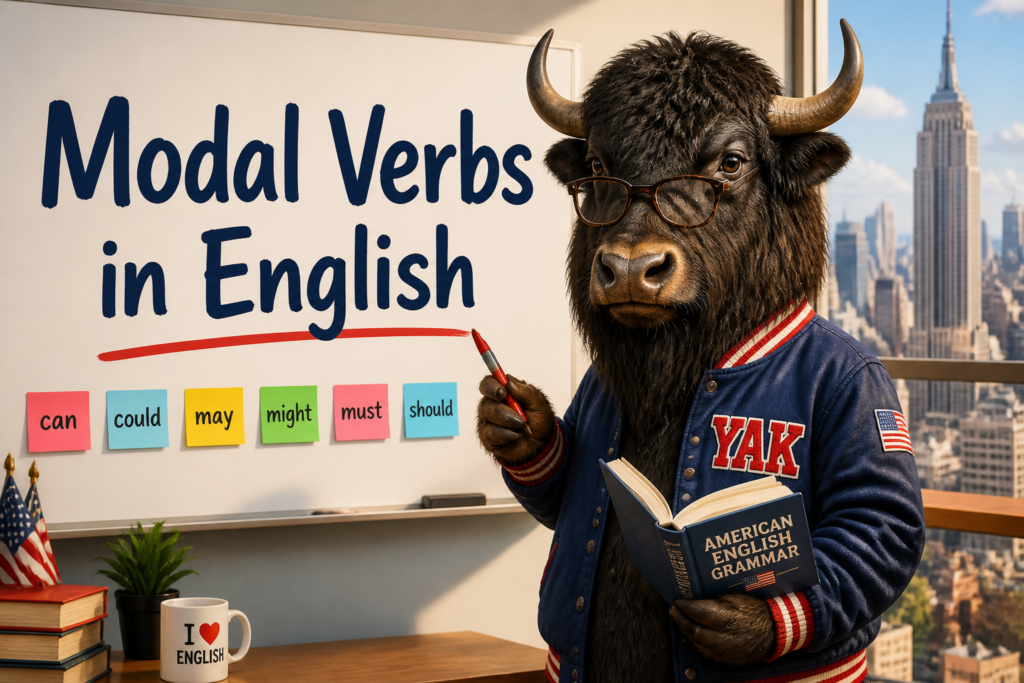
Modal Verbs in English are the little helper verbs that make your sentences sound useful, polite, natural, and occasionally very bossy. They help you say things like permission, advice, ability, possibility, obligation, and polite requests without sounding like a robot in a necktie.
If you have ever said “I can swim,” “You should rest,” or “We might go,” congratulations: you already know modal verbs. English uses them all the time, especially in everyday conversation, emails, travel, work, and customer service. Tiny verbs, big job. Rude, honestly.
By the end of this guide, you will understand the most common modal verbs, what they mean, how to use them, and the mistakes learners make most often.
What Modal Verbs Do
Modal verbs are special helper verbs that come before the main verb. They change the meaning of the sentence.
| Pattern | Meaning | Example | Learner Note |
|---|---|---|---|
| Modal + base verb | Shows ability, advice, permission, possibility, obligation, or necessity | I can drive. / You should study. / She must go. | The main verb stays in the base form: go, not to go. |
Important rule: modal verbs do not usually change form. We say she can, not she cans. We also say they should, not they shoulds. English likes to be annoying in a very consistent way.
The Most Common Modal Verbs
Here are the core modal verbs you will see and hear most often.
| Modal | Pronunciation | Main Meaning | Example Sentence | Learner Note |
|---|---|---|---|---|
| can | kan | ability, permission | I can speak English. | Very common in everyday speech. |
| could | kood | past ability, polite request, possibility | Could you help me? | Politer than can in requests. |
| may | may | permission, possibility | May I come in? | More formal than can. |
| might | might | possibility | It might rain later. | Often means a weaker possibility than may. |
| must | muhst | strong obligation, certainty | You must wear a seat belt. | Strong and serious. |
| shall | shal | formal suggestion, future in some styles | Shall we start? | More common in British English and formal speech. |
| should | shood | advice, expectation | You should drink water. | Very useful for advice. |
| will | wil | future, promise, decision | I will call you tomorrow. | Very common for the future. |
| would | wood | polite request, imaginary situations, repeated past action | Would you like some tea? | Very useful in polite English. |
Can: Ability And Permission
Can is one of the first modal verbs learners meet because it is practical and easy to use.
- Meaning 1: ability — You are able to do something.
- Meaning 2: permission — You are allowed to do something.
| Pattern | Meaning | Example | Learner Note |
|---|---|---|---|
| can + base verb | ability | He can play the guitar. | Use for skills and real ability. |
| can + base verb | permission | Can I open the window? | Casual and common. |
In many situations, Can I…? is natural and friendly. For more formal requests, Could I…? often sounds better.
Could: Polite Requests And Past Ability
Could is the polite cousin of can. It also talks about past ability.
| Pattern | Meaning | Example | Learner Note |
|---|---|---|---|
| could + base verb | polite request | Could you send me the file? | Sounds softer than Can you…? |
| could + base verb | past ability | I could swim when I was five. | Use for something possible in the past. |
| could + base verb | possibility | We could take the bus. | Means “it is one possible choice.” |
Small but important note: could is often more polite than can, especially in requests. English speakers love politeness wrapped in grammar.
May And Might: Possibility And Permission
May and might often talk about possibility. May can also ask for permission, especially in formal English.
- May = possibility or formal permission
- Might = smaller or less certain possibility
| Pattern | Meaning | Example | Learner Note |
|---|---|---|---|
| may + base verb | possibility | It may snow tonight. | Often a little formal. |
| may + base verb | permission | May I leave early? | More formal than Can I leave early? |
| might + base verb | possibility | She might be late. | Usually less certain than may. |
In everyday American English, people often use can instead of may for permission. In formal situations, may is still common.
For a clear dictionary-style overview of modal verbs, see Cambridge Dictionary’s grammar guide on modal verbs.
Must, Have To, And Need To
These three are related, but they are not exactly the same. This is where learners sometimes sigh loudly into a notebook.
| Pattern | Meaning | Example | Learner Note |
|---|---|---|---|
| must + base verb | strong obligation or strong conclusion | You must finish this today. | Sounds strong, sometimes official or serious. |
| have to + base verb | external obligation | I have to work late. | Very common in everyday English. |
| need to + base verb | necessary action | You need to take a break. | Often sounds a little softer than must. |
- must is often used for rules, strong advice, or certainty.
- have to is common for schedules, duties, and outside pressure.
- need to is useful when something is important or necessary.
Example: You must wear a helmet sounds more strict than You have to wear a helmet. Both are correct, but the tone is different.
Should: Advice And Expectation
Should is one of the most useful modal verbs for giving advice without sounding too direct.
| Pattern | Meaning | Example | Learner Note |
|---|---|---|---|
| should + base verb | advice | You should visit a doctor. | Friendly and common. |
| should + base verb | expectation | The train should arrive soon. | Means “this is probably true.” |
| should + base verb | recommendation | We should try that restaurant. | Good for suggestions. |
A very common pattern is You should + verb. It is practical, polite, and useful in real life. Not magic. Just extremely handy.
Will And Would: Future, Politeness, And Imaginary Situations
Will and would are close relatives, but they do different jobs.
| Pattern | Meaning | Example | Learner Note |
|---|---|---|---|
| will + base verb | future, promise, decision | I will text you later. | Very common in everyday English. |
| would + base verb | polite request | Would you like some water? | Very polite and natural. |
| would + base verb | imaginary situation | I would travel more if I had time. | Often used in conditionals. |
| would + base verb | repeated past action | When I was young, I would visit my grandparents every summer. | Shows a past habit in storytelling. |
Would you like…? is one of the most useful polite phrases in English. It works for offers, invitations, and orders that are not really orders because you are being civilized.
Modal Verbs In Real Life
Modal verbs appear everywhere in real communication. Here are some everyday examples.
| Situation | Useful Modal | Example | Learner Note |
|---|---|---|---|
| Asking for permission | can / may / could | Can I use your phone? | Could I…? sounds more polite. |
| Giving advice | should | You should rest. | Common with health advice and opinions. |
| Talking about rules | must / have to | You have to show ID. | Very common in public places and work. |
| Making a plan | will / would | I will call you tomorrow. | Will is straightforward future. |
| Guessing | might / may / could | He might be at home. | Use for uncertainty. |
Common Learner Mistakes
Modal verbs are not hard, but a few mistakes show up again and again.
| Wrong | Correct | Why |
|---|---|---|
| I can to swim. | I can swim. | Modal verbs are followed by the base verb, not to + verb. |
| She musts go now. | She must go now. | Modals do not take -s in the third person singular. |
| You should to study. | You should study. | No to after modal verbs. |
| Could you helps me? | Could you help me? | The main verb stays in base form. |
| May you open the door? | Could you open the door? | May for permission is formal; Could sounds more natural in many requests. |
Also remember: modal verbs usually do not need another auxiliary verb for negatives and questions. We say Can you help? and I can’t help, not Do you can help? because English enjoys creating problems and then calling them rules.
Short Practice
Try these quick exercises. Say the answer out loud if you want real practice.
- Fill in the blank: I ____ speak French a little. Answer: can
- Fill in the blank: You ____ see a dentist. Answer: should
- Fill in the blank: ____ I sit here? Answer: May or Can
- Fill in the blank: It ____ rain later. Answer: might
- Rewrite politely: Give me the menu. → Could I have the menu, please?
- Choose the better option: You musts finish now. or You must finish now. Answer: You must finish now.
Pronunciation tip: in fast speech, modal verbs are often weak and short. For example, can may sound more like “kn” in casual speech, and would often sounds like “wood” with a soft, quick ending.
Quick Reference Summary
| Modal | Most Common Use | Simple Example |
|---|---|---|
| can | ability, permission | I can help. |
| could | polite request, past ability, possibility | Could you repeat that? |
| may | permission, possibility | May I ask a question? |
| might | possibility | She might be late. |
| must | strong obligation, certainty | You must stop here. |
| should | advice, recommendation | You should try again. |
| will | future, promise | I will email you. |
| would | polite request, imaginary situation | Would you help me? |
If you want to check your English level and review more grammar or vocabulary, try the Learn English section, then take the English Vocabulary Test or the English Placement Test CEFR.
Yak Takeaway: modal verbs are small, but they do heavy lifting. Learn the base pattern, use the right tone, and suddenly your English sounds much more natural. Tiny verbs, big upgrade.