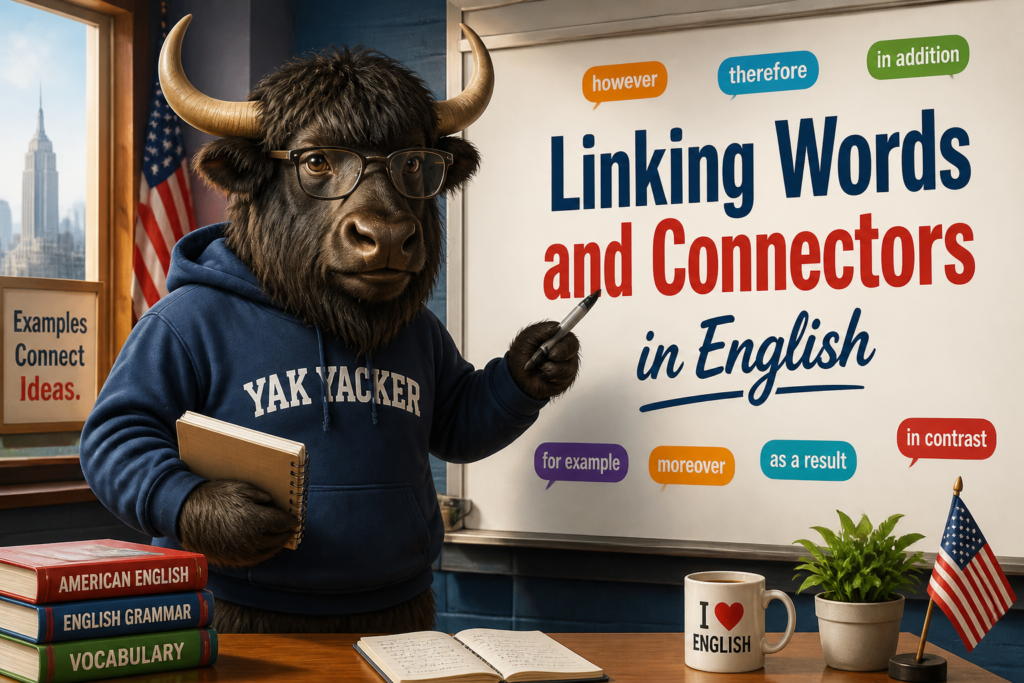
Linking words are the tiny glue that stops English from sounding like a bag of random sentences dumped on the floor. Useful, charming, and annoying if you ignore them. They help you connect ideas, show cause and effect, compare, contrast, add information, and make your speech and writing flow more naturally.
If you want English to sound clearer, smoother, and more confident, connectors are a big win. By the end of this guide, you’ll understand the most common linking words, when to use them, and how to avoid the classic learner mistakes that make sentences feel a little “robot with a grammar manual.”
Here’s a boring but useful fact: strong connectors are a big part of the writing and speaking skills tested in many exams. If you want to check your level later, you can try the English Placement Test CEFR or the English Vocabulary Test.
What Are Linking Words?
Linking words and connectors are words or short phrases that show the relationship between ideas. They connect sentences, clauses, and paragraphs.
For example:
- I was tired, so I went home early.
- She likes coffee, but he prefers tea.
- We stayed inside because it was raining.
Without connectors, English can sound choppy. With them, your English sounds more natural and easier to follow.
Core Types Of Linking Words
Most connectors do one of a few jobs. Learn the job first, and the word becomes easier to remember. English does enjoy making simple things look slightly more complicated than necessary.
| Type | Function | Examples |
|---|---|---|
| Addition | Add more information | and, also, too, moreover, in addition |
| Contrast | Show difference | but, however, although, though, whereas |
| Cause and Result | Show reason or result | because, so, therefore, as a result |
| Sequence | Show order | first, then, next, after that, finally |
| Example | Introduce an example | for example, for instance, such as |
| Condition | Show a condition | if, unless, provided that |
| Summary | Conclude an idea | in short, overall, in conclusion |
Useful Linking Words And Connectors
Below are the most useful connectors for everyday English. These are the ones you’ll actually see in conversations, emails, essays, and articles—not dusty old grammar museum pieces.
| English | Pronunciation | Meaning | Example Sentence | Learner Note |
|---|---|---|---|---|
| and | and | adds information | I bought bread and milk. | Very common and neutral. |
| also | AWL-soh | adds more information | She speaks Spanish and also French. | Often used in writing and speaking. |
| too | too | in addition | I like coffee, and I like tea too. | Usually goes at the end of a sentence. |
| as well | uz WEL | also | I’d like a salad as well. | A little more formal than too. |
| but | but | shows contrast | I wanted to go, but I was busy. | Very common in speech. |
| however | how-EH-ver | shows contrast | The hotel was expensive. However, it was very clean. | More formal than but. |
| because | bih-KAWZ | gives a reason | I stayed home because I was sick. | One of the most important connectors for learners. |
| so | soh | shows result | It was late, so we took a taxi. | Very common in speech. |
| therefore | THER-for | shows result | The store was closed; therefore, we left. | Formal and more common in writing. |
| although | awl-THOH | shows contrast | Although it was cold, we went out. | Can start a sentence or join clauses. |
| though | thoh | shows contrast | It was cold, though we still went out. | Also used at the end of a sentence in speech: “It was hard, though.” |
| because of | bih-KAWZ uhv | reason before a noun phrase | The game was canceled because of the rain. | Use with a noun, not a full clause. |
| for example | for ig-ZAM-pul | introduces an example | Many fruits are healthy. For example, apples and oranges. | Very useful in speaking and writing. |
| for instance | for IN-stens | introduces one example | Some jobs, for instance teaching, require patience. | Similar to for example, a bit more formal. |
| such as | suhch az | gives examples | I enjoy outdoor activities such as hiking and cycling. | Use before examples in a list. |
Addition Connectors
Use addition connectors when you want to add another idea. These are simple, but they do a lot of work.
- and — joins two similar ideas
- also — adds information, often in the middle of a sentence
- too — means “in addition,” usually at the end
- as well — similar to “too,” a little more formal
- moreover — formal, used in writing
- in addition — formal, often used in essays or reports
Rule → Use and for simple, natural addition. Use moreover or in addition when you want a more formal tone.
Examples:
- I bought apples and bananas.
- She is smart and also very kind.
- We’re studying English, and our teacher is helping us too.
- In addition, the hotel offers free breakfast.
Contrast Connectors
Contrast connectors show difference, surprise, or an opposite idea. These are great for speaking and writing because real life is full of “yes, but…” moments.
| Pattern | Meaning | Example | Learner Note |
|---|---|---|---|
| but | simple contrast | I wanted to call you, but I lost my phone. | Most common contrast word. |
| however | formal contrast | The food was cheap. However, it was excellent. | Often starts a new sentence or clause. |
| although | contrast inside one sentence | Although she was tired, she kept working. | Good for more advanced, natural sentences. |
| though | contrast, more casual | It was expensive, though it was worth it. | Very common in speech. |
| whereas | contrast between two facts | My brother likes music, whereas I prefer silence. | More formal, often in writing. |
Quick tip: Don’t use but and however in exactly the same way. But is simpler and more common in speech. However sounds more formal.
English loves contrast. If one idea is sunny and the other is rainy, a connector is usually waiting nearby.
Cause And Result Connectors
These connectors show why something happened or what happened because of it. They are essential for clear explanations.
- because — gives a reason
- because of — gives a reason before a noun phrase
- so — gives a result
- therefore — formal result
- as a result — result, often in writing
- due to — formal reason, often before nouns
Rule → Use because before a full clause with a subject and verb. Use because of before a noun or noun phrase.
| Pattern | Meaning | Example | Learner Note |
|---|---|---|---|
| because + clause | reason | I stayed home because I was sick. | “I was sick” is a full clause. |
| because of + noun | reason | I stayed home because of the rain. | “the rain” is a noun phrase. |
| so + clause | result | It was raining, so we stayed inside. | Very natural in conversation. |
| therefore | formal result | The train was delayed; therefore, we were late. | More common in writing than speaking. |
| as a result | result | He missed practice, and as a result, he lost his place on the team. | Good for essays and reports. |
Common mistake: Don’t say because of I was tired. That’s not correct. Say because I was tired or because of my tiredness.
Sequence Connectors
Sequence connectors help you organize steps, instructions, stories, and explanations. They are especially useful in speaking and writing when you don’t want your ideas to bounce around like an unpaid attention span.
| English | Pronunciation | Meaning | Example Sentence | Learner Note |
|---|---|---|---|---|
| first | furst | number one in order | First, wash your hands. | Often used with commas in writing. |
| then | then | next | Then add the sugar. | Very common in instructions. |
| next | nekst | after that | Next, open the file. | Simple and clear. |
| after that | AF-ter that | later | After that, we went home. | Good for stories and routines. |
| finally | FINE-uh-lee | last | Finally, we arrived at the hotel. | Shows the final step or conclusion. |
| at first | at furst | initially | At first, I was nervous. | Often contrasts with later change. |
Example And Explanation Connectors
These connectors help you make your meaning more specific. They are especially useful when you want to clarify a general idea.
- for example — introduces one or more examples
- for instance — similar to “for example,” a little more formal
- such as — introduces examples inside a phrase
- like — informal, often used in speech
- in other words — restates the idea differently
Rule → Use such as before examples inside a sentence. Use for example or for instance to start a new example or sentence.
| Pattern | Meaning | Example | Learner Note |
|---|---|---|---|
| for example | example | Some animals, for example dolphins, are very intelligent. | Very common in essays and speaking. |
| for instance | example | Many cities, for instance Tokyo, have great public transport. | A bit more formal. |
| such as | examples in a list | I like vegetables such as carrots and spinach. | Do not use a full sentence after it. |
| like | similar to / example | He enjoys sports like soccer and tennis. | More casual than such as. |
| in other words | restates clearly | She’s multilingual. In other words, she speaks several languages. | Useful for explanation and paraphrase. |
Condition Connectors
Condition connectors talk about what must happen before something else can happen. In real life, this is basically the grammar version of “if this, then that.”
| English | Meaning | Example Sentence | Learner Note |
|---|---|---|---|
| if | only when this happens | If it rains, we’ll stay home. | Very common and essential. |
| unless | if not | I won’t go unless you come too. | Negative meaning. Be careful. |
| provided that | on the condition that | You can borrow it provided that you return it tomorrow. | More formal. |
| as long as | if only this condition is true | You can stay as long as you are quiet. | Very common in speech. |
Common mistake: Learners sometimes use unless when they mean if. Remember: unless = if not.
Time And Order Connectors In Writing
When you write an email, story, or essay, time connectors make your ideas easier to follow. They tell the reader when things happen.
- before — earlier than something else
- after — later than something else
- while — during the same time
- when — at the time something happens
- until — up to a point in time
- during — throughout a period
Example: I answered emails while I was waiting, then I called my manager after lunch.
Formal Vs Casual Connectors
Some connectors work in almost any situation. Others sound more formal or more casual. Choosing the right one helps your English sound natural instead of oddly stiff or too informal.
| Casual / Neutral | More Formal | Example |
|---|---|---|
| but | however | I wanted to help, however I was late. |
| so | therefore | The roads were icy, therefore school was closed. |
| also | moreover | The plan is cheap. Moreover, it is easy to use. |
| for example | for instance | Some countries, for instance Canada, have cold winters. |
| kids | children | He works with children, not kids, in formal writing. |
Learner note: In conversation, simple connectors are often best. In essays or business writing, more formal connectors can sound polished. But don’t force them everywhere. Overusing moreover is how English becomes a necktie.
American And British English Notes
Most basic linking words are the same in American and British English. But there are a few small style differences.
- moreover, therefore, and however are common in both, especially in writing.
- as well is common in both, but in American English people often use too more casually.
- while can mean “during the same time” in both varieties.
- British speakers may use some connectors more often in formal writing, but the core list is shared.
Common Learner Mistakes And Fixes
Here are the mistakes learners make most often. Good news: they are easy to fix once you notice the pattern.
| Wrong | Correct | Why |
|---|---|---|
| Because of I was tired, I slept. | Because I was tired, I slept. | Because of is followed by a noun phrase, not a full clause. |
| I like tea, however I like coffee too. | I like tea. However, I like coffee too. | However usually starts a new sentence or clause. |
| She is smart and she works hard too also. | She is smart and works hard too. | Too many addition words sound repetitive. |
| If you don’t hurry unless we’ll be late. | If you don’t hurry, we’ll be late. | Unless means “if not,” so it changes the meaning. |
| For example apples are healthy. | For example, apples are healthy. | Use a comma after introductory connectors in writing. |
Practice: Choose The Best Connector
Try these. Then check the answers mentally, or with a friend, or with your very serious English-learning brain.
- I was late, ___ I missed the bus.
- She speaks French ___ German.
- ___ it was cold, we went for a walk.
- The meeting was canceled ___ the snow.
- He likes sports such as soccer and ___ basketball.
- I studied hard. ___, I passed the test.
Suggested answers: so, and, although, because of, basketball, therefore
Practice: Rewrite For Better Flow
Make these sentences smoother with linking words.
- It was raining. We stayed inside.
- He was tired. He finished the work.
- She bought fruit. She bought bread.
- I enjoy reading. I enjoy writing.
Possible answers:
- It was raining, so we stayed inside.
- Although he was tired, he finished the work.
- She bought fruit and bread.
- I enjoy reading and writing.
Quick Reference Summary
| Job | Connectors |
|---|---|
| Add information | and, also, too, as well, moreover, in addition |
| Show contrast | but, however, although, though, whereas |
| Show reason/result | because, because of, so, therefore, as a result |
| Show order | first, then, next, after that, finally |
| Give examples | for example, for instance, such as, like |
| Show condition | if, unless, as long as, provided that |
| Restate clearly | in other words |
When in doubt, choose the simplest connector that matches your meaning. Clear English is usually better than fancy English pretending to be important.
Learn More And Test Your English
If you want to keep building connected, natural English, explore more lessons at Yak Yacker English learning. Then test your vocabulary and level with the English Vocabulary Test or the English Placement Test CEFR.
Yak takeaway: connectors are not decoration. They are the road signs of English. Use them well, and your ideas stop bumping into each other.