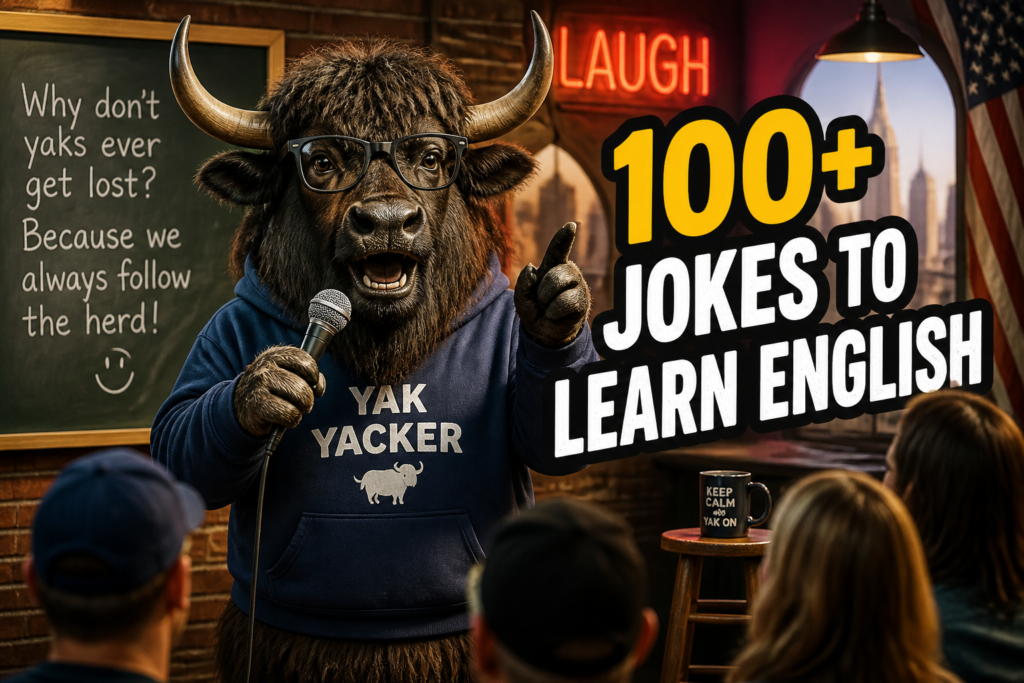
Fun, easy examples to practice vocabulary, grammar, and humor
English jokes can be wonderfully strange. Sometimes the joke is in the sound of a word. Sometimes it is in the grammar. And sometimes it is just a tiny bit silly, which, frankly, is half the charm.
This article uses jokes to teach real English: common words, natural phrases, pronunciation, and a few grammar patterns learners often meet in daily life. You do not need to become a stand-up comedian. You only need enough English to laugh and maybe understand why everyone else is laughing.
For extra practice, you can also check your level with the English Placement Test CEFR and review more lessons on Learn English.
Why Jokes Help You Learn English
Jokes are useful because they make you notice how English really works. You hear word stress, double meanings, short grammar patterns, and common everyday vocabulary all in one tiny package. That is a lot of learning for one laugh.
Many English jokes use puns, which are jokes based on words that sound similar or have more than one meaning. The Cambridge Dictionary explains pun as a joke using a word that has two meanings or sounds like another word. Very clever. Very annoying. Very English.
The best part? Even simple jokes can teach useful phrases you can actually use in conversation, texting, and class. A joke may be short, but the language inside it is often doing serious work.
Quick Joke Vocabulary
| English | Pronunciation | Meaning | Example Sentence | Learner Note |
|---|---|---|---|---|
| joke | johk | something funny someone says or does | That joke made everyone laugh. | Very common and neutral. |
| funny | FUH-nee | causing laughter | My brother is really funny. | Can also mean “strange” in some contexts. |
| laugh | laf | to make a sound because something is funny | I laughed so hard I cried. | Common in everyday English. |
| pun | pun | a joke with a word play | That was a terrible pun. | People often say “terrible” as a compliment in joke culture. |
| wordplay | WURD-play | funny use of words | This joke uses wordplay. | Useful for humor and writing. |
| punchline | PUNCH-line | the funny final part of a joke | The punchline came at the end. | The “surprise” line. |
| set up | SET up | the beginning part of a joke | The set-up was simple. | Opposite of the punchline. |
| wisecrack | WYZE-krak | a short, clever joke | He made a wisecrack during class. | More casual; sometimes a little cheeky. |
| sarcasm | SAR-kaz-uhm | saying the opposite of what you mean, often to be funny or rude | Her sarcasm was easy to hear. | Can sound funny or mean. Watch the tone. |
| humor | HYOO-mer | the quality of being funny | I like his dry humor. | American spelling; British: humour. |
100+ Easy Jokes With English Practice
Below are short jokes grouped by language feature. After each joke, there is a tiny English lesson hiding in plain sight. Sneaky, but educational.
1. Jokes With Simple Wordplay
| Joke | What You Learn |
|---|---|
| Why did the math book look sad? Because it had too many problems. | problems can mean math exercises or life troubles. |
| Why don’t eggs tell jokes? They might crack up. | crack up means “laugh a lot.” |
| Why did the bicycle fall over? It was two-tired. | tired sounds like two-tired, a pun on numbers. |
| What do you call cheese that isn’t yours? Nacho cheese. | Nacho sounds like “not your.” |
| Why was the belt arrested? It held up a pair of pants. | hold up can mean support, and also rob. |
| What do you call a fake noodle? An impasta. | impostor becomes a food pun. |
| Why did the tomato blush? Because it saw the salad dressing. | dressing can mean clothes or sauce. |
| Why did the golfer bring two pairs of pants? In case he got a hole in one. | hole in one is a golf term and a clothing joke. |
| Why can’t your nose be 12 inches long? Because then it would be a foot. | foot is both a body part and a unit of length. |
| What’s brown and sticky? A stick. | Simple surprise joke. Great for adjective practice. |
| What do you call a sleeping bull? A bulldozer. | dozer sounds like “dozing,” or sleeping lightly. |
| Why did the scarecrow win an award? He was outstanding in his field. | outstanding means excellent, but also literally standing outside. |
2. Jokes About Grammar
| Joke | What You Learn |
|---|---|
| Why did the teacher wear sunglasses? Because her students were so bright. | bright can mean intelligent or very sunny. |
| I used to be a banker, but I lost interest. | lost interest means both “stopped caring” and “lost money interest.” |
| I’m reading a book about anti-gravity. It’s impossible to put down. | put down means place something down or stop reading a book. |
| Did you hear about the restaurant on the moon? Great food, no atmosphere. | atmosphere can mean air or mood. |
| I’m on a seafood diet. I see food and I eat it. | seafood becomes a playful phrase pattern. |
| My boss told me to have a good day, so I went home. | Funny misunderstanding with a polite phrase. |
| Why did the student bring a ladder to school? Because she wanted to go to high school. | high school sounds like “higher school.” |
| I asked my dog what two minus two was. He said nothing. | nothing is a common answer in joke setups. |
| My calendar is full. It has too many dates. | dates can mean calendar days or romantic meetings. |
| Why did the comma break up with the period? It felt too final. | Punctuation words can be used in jokes too. |
| I would tell you a joke about construction, but I’m still working on it. | working on it means continuing to improve something. |
| The past, present, and future walked into a bar. It was tense. | tense is a grammar word and a feeling word. |
3. Jokes With Common Idioms
| Joke | What You Learn |
|---|---|
| Why did the cookie go to the doctor? Because it felt crummy. | crummy means bad or low quality, and sounds like “crumbs.” |
| That was a joke about time travel, but I’m not sure if it works yet. | not sure is a common natural phrase. |
| My friend said I was drawing too many dogs. I told him that was a barking matter. | barking up the wrong tree is a common idiom, used creatively here. |
| I tried to catch fog yesterday. Mist. | mist sounds like “missed.” |
| Why did the man put his money in the blender? He wanted liquid assets. | liquid assets is a finance term with a funny twist. |
| My computer and I had a disagreement. It had a byte. | byte sounds like “bite.” |
| Why did the man stare at the orange juice? Because it said concentrate. | concentrate can mean focus or a juice product. |
| My train of thought has left the station. | Common idiom meaning you lost your idea. |
| I’m not lazy. I’m just on energy-saving mode. | Casual humor with modern technology language. |
| It’s raining cats and dogs. | Classic idiom meaning heavy rain. Not actual animals, thankfully. |
| She let the cat out of the bag. | Idiom meaning she revealed a secret. |
| He hit the nail on the head. | Idiom meaning he was exactly right. |
4. Jokes About Jobs, School, And Daily Life
| Joke | What You Learn |
|---|---|
| Why did the employee bring a pencil to work? In case he needed to draw a conclusion. | draw a conclusion means decide something. |
| Why was the meeting so long? Because everyone wanted to touch base. | touch base is a business phrase meaning connect briefly. |
| The chef was great, but his jokes were a little raw. | raw can mean uncooked or unpolished. |
| Why did the student eat his homework? The teacher said it was a piece of cake. | a piece of cake means very easy. |
| The librarian had a lot of shelf control. | shelf control is a playful twist on self-control. |
| Why did the cashier smile? Because the customer was being changeable. | change can mean money or becoming different. |
| My alarm clock and I are not on speaking terms. | on speaking terms is an idiom for having a relationship. |
| I asked the doctor for a second opinion. He said, “You’re ugly.” | Dark humor; shows direct, surprising dialogue. |
| Why did the waiter bring a ladder? The soup was on the house. | on the house means free in a restaurant. |
| My teacher asked me to use “calendar” in a sentence. I said, “Today is a date.” | date again shows multiple meanings. |
| The student said, “I have a photographic memory.” The teacher said, “Then please develop it.” | develop has a photo meaning and a general meaning. |
| I told my boss I needed a raise. He said, “You need to raise your grades first.” | raise can mean more money or lift something up. |
5. Jokes With Animals
| Joke | What You Learn |
|---|---|
| What do you call a fish with no eyes? Fsh. | Sound-based joke; useful for spelling and pronunciation awareness. |
| Why did the cat sit on the computer? It wanted to keep an eye on the mouse. | keep an eye on means watch carefully. |
| What do you call a bear with no teeth? A gummy bear. | gummy sounds like “gum” and is also candy language. |
| Why do cows have hooves instead of feet? Because they lactose. | lactose sounds like “lack toes.” |
| What do you call a pig that does karate? A pork chop. | pork chop is a food phrase turned into a joke. |
| Why are fish so smart? Because they live in schools. | school means a group of fish, not a building. |
| What did the duck say when it bought lipstick? Put it on my bill. | bill can mean a duck’s beak or a payment request. |
| Why did the owl say hello? Because it was a night owl. | night owl is a phrase for someone active late at night. |
| What do you call a lazy kangaroo? A pouch potato. | Parodies the phrase couch potato. |
| Why did the horse go behind the tree? To change his jockeys. | jockeys sounds like “jockey shorts” in some versions. Silly, not elegant. |
| What do you call a sleeping lion? A nap king. | Simple compound-word humor. |
| Why did the dog sit in the shade? Because it did not want to become a hot dog. | Shows compound word meanings in a playful way. |
6. Jokes About Food And Restaurants
| Joke | What You Learn |
|---|---|
| Why did the bread go to therapy? It had too many emotional rolls. | rolls can mean bread or repeated actions in life. |
| I asked for a salad, but they gave me a lecture. It was a Caesar dressing-down. | dressing-down means a scolding. |
| Why did the banana go to the doctor? It wasn’t peeling well. | peeling sounds like “feeling.” |
| I told the waiter I wanted a glass of water. He brought me a mirror. | A simple misunderstanding joke. |
| What did the lettuce say to the celery? Lettuce be friends. | lettuce sounds like “let us.” |
| Why did the cookie cry? Its mom was a wafer too long. | wafer sounds like “away for.” |
| What do you call a sleeping pizza? A pie in bed. | pie and bed create a visual pun. |
| Why did the grape stop in the middle of the road? It ran out of juice. | run out of is a very useful phrase. |
| What did the lemon say to the lime? You’re a-peeling. | a-peeling sounds like “appealing.” |
| Why did the steak refuse to fight? It was too well done. | well done means cooked more, or a compliment. |
| Why was the soup nervous? It was under a lot of pressure. | pressure works literally and emotionally. |
| What do you call a fake noodle in a restaurant? An impasta. | Yes, it is back. Good jokes deserve extra appearances. |
7. Short Jokes That Teach Grammar Patterns
| Joke | Grammar Focus |
|---|---|
| I’m reading a book on anti-gravity. It’s impossible to put down. | It’s + adjective + to + verb |
| She had a photographic memory, but she never developed it. | Past tense and a word with two meanings |
| If practice makes perfect, and nobody is perfect, then why practice? | If clause + logic joke |
| I used to be a baker, but I couldn’t make enough dough. | used to for past habits |
| They told me to be myself, so I went home. | Imperative plus literal misunderstanding |
| I have a fear of speed bumps, but I’m slowly getting over it. | get over means recover from fear or illness |
| The chicken crossed the road because it wanted to get to the other side. | Classic simple sentence structure |
| My friend said, “I’m not a complete idiot.” I said, “Don’t sell yourself short.” | sell yourself short means underestimate yourself |
| I told my friend 10 jokes to get him to laugh. Sadly, no pun in ten did. | pun + in ten did sounds like “intended” |
| The more I study English, the more I notice weird jokes. | The more…, the more… comparison pattern |
| She said she would call me back. I’m still waiting on that joke and the call. | Present continuous idea: still waiting |
| He is the kind of person who always makes a scene. | who clause for describing people |
Useful English Phrases From Jokes
These phrases are common in real English. The jokes make them easier to remember, which is nice because memory sometimes likes to be dramatic.
| English Phrase | Pronunciation | Meaning | Example Sentence | Learner Note |
|---|---|---|---|---|
| crack up | krak up | laugh a lot | The class cracked up when he told the joke. | Casual and very common. |
| put down | put down | place something on a surface; stop holding a book or phone | I could not put the book down. | Very useful in daily English. |
| run out of | run out of | have none left | We ran out of milk. | Common with food, money, time, and patience. |
| used to | YOOS too | did something in the past, but not now | I used to tell terrible jokes. | Important grammar phrase. |
| get over | get OH-ver | recover from something difficult | She is getting over a cold. | Also means recover emotionally. |
| on the house | on thuh howss | free from a business, usually a restaurant or bar | The dessert was on the house. | Friendly customer-service phrase. |
| touch base | tuch bays | contact someone briefly | Let’s touch base next week. | Very common in work English. |
| keep an eye on | keep an eye on | watch carefully | Can you keep an eye on my bag? | Useful and natural. |
| a piece of cake | uh pees uhv kayk | very easy | The test was a piece of cake. | Friendly informal phrase. |
| not sure | not shoor | uncertain | I’m not sure what he meant. | Use when you do not know. |
| sell yourself short | sel yur-SELF short | underestimate your abilities | Don’t sell yourself short—you’re doing fine. | Encouraging phrase. |
| make a scene | mayk uh seen | behave loudly in public | Please don’t make a scene in the store. | Slightly negative. |
Pronunciation Tips Hidden In The Jokes
Some jokes only work because English words sound alike. That means your ears get practice, not just your brain.
- two / too / to — same sound, different meanings.
- crack up — stress the first word: CRACK up.
- used to — the “d” sound is often soft; many learners say it too strongly.
- punchline — one smooth word: PUNCH-line.
- humor — American English usually says HYOO-mer; British English often spells it humour.
- puns often disappear in fast speech, so listen carefully for stressed words.
If you want a pronunciation reality check, the Cambridge Dictionary entry for humor is a boring but reliable place to hear and compare word pronunciation.
Common Mistakes Learners Make With Joke English
| Common Mistake | Better Version | Why |
|---|---|---|
| I am not sure it is funny. | I’m not sure it’s funny. | Contractions sound natural in spoken English. |
| He make a joke. | He makes a joke. | Third-person singular needs -s. |
| I laughed much. | I laughed a lot. | a lot is the natural phrase. |
| The joke was very interest. | The joke was very interesting. | Use the adjective form. |
| He told me a sarcasm. | He used sarcasm. | sarcasm is an uncountable noun. |
| I did a pun. | I made a pun. | We usually say make a pun. |
Practice Section
Try these quick drills. No pressure. English jokes are supposed to be a little weird anyway.
Choose The Best Word
- The teacher was so bright that everyone cracked up / ran out of.
- I could not put down / touch base the funny book.
- We ran out of / used to milk.
- She is not sure / punchline what the joke means.
- The waiter said the drink was on the house / a piece of cake.
Fill In The Blank
- Why did the tomato blush? Because it saw the salad ________.
- I ________ be terrible at jokes, but now I’m slightly less terrible.
- Can you ________ an eye on my bag?
- That test was ________ of cake.
- He told a joke, and the whole class ________ up.
Rewrite The Sentence
- Change “I am not sure” into a more natural spoken phrase.
- Turn “He made a joke” into present simple.
- Replace “very easy” with a common idiom.
- Use “used to” in a sentence about your old habits.
- Make a sentence with “run out of” using food or time.
Mini Translation Practice
- Translate: “He is funny, but his jokes are terrible.”
- Translate: “We are running out of time.”
- Translate: “The joke had a clever punchline.”
- Translate: “Don’t make a scene.”
- Translate: “The dessert is on the house.”
Quick Reference Summary
- Jokes help you learn vocabulary, grammar, pronunciation, and natural phrases.
- Puns are jokes based on word meaning or sound.
- Punchline is the funny ending.
- Used to talks about past habits.
- Run out of means have none left.
- On the house means free.
- Keep an eye on means watch carefully.
- A piece of cake means very easy.
- Sell yourself short means underestimate yourself.
- Crack up means laugh a lot.
Yak takeaway: if a joke makes you groan a little, congratulations — your English ears are probably working harder than you think.
If you want more practice after these jokes, take the English Vocabulary Test and see which funny words you actually remember when the laughter stops.