English For Work And Daily Life
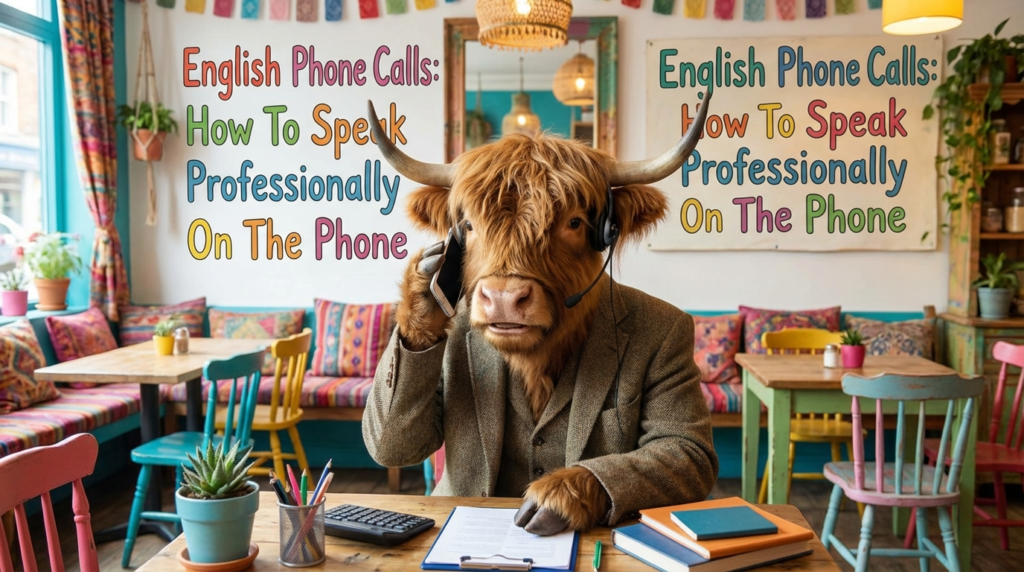
How To Speak Professionally On The Phone
Phone calls feel harder than emails because the phone is rude like that: it gives you no edit button. You have to sound clear, polite, and confident in real time.
This guide teaches the English you actually need for professional phone calls: how to answer, introduce yourself, ask for someone, clarify details, handle hold and transfer situations, leave messages, and end the call without sounding awkward. You will also get 60 useful phrases with meanings and real examples.
Yak Box: The Simple Formula
A professional phone call usually follows this pattern:
- Greet: Say hello and identify yourself.
- Connect: Check who you are speaking to or ask for the right person.
- State your reason: Say why you are calling early.
- Clarify: Repeat, confirm, and ask questions when needed.
- Close clearly: Summarize the next step and end politely.
That is it. Not magic. Just structure. Professional speakers sound calm because they know where the conversation is going.
Six Rules That Make You Sound Professional Fast
Speak A Little Slower
Professional does not mean robotic. It means easy to understand.
State The Reason Early
Do not make people guess why you called. Busy people hate guessing.
Use Short Sentences
Phone audio is messy. Short, clear sentences travel better than long ones.
Confirm Important Details
Repeat dates, names, times, and numbers. It saves everyone trouble later.
Sound Polite, Not Weak
“Could you” and “would you mind” sound respectful. They do not make you smaller.
End With A Next Step
Professional calls do not fade into silence. They finish with a clear action.
Before You Call
Do these things before the call starts:
- Write the goal of the call in one sentence.
- Prepare names, dates, prices, account numbers, or order numbers.
- Choose a quiet place.
- Keep a pen or notes app ready.
- Decide your opening line before you dial.
- Know your closing line too, because endings are where confidence goes to die.
60 Useful Phrases For Professional Phone Calls
Each phrase below gives you three things: the English phrase, the meaning in simple English, and a real example sentence.
1) Answering The Phone And Introducing Yourself
| English | English Meaning | Real Example |
|---|---|---|
| Good morning, Brightline Services, Maya speaking. | A formal way to answer and identify yourself. | Good morning, Brightline Services, Maya speaking. How may I help you? |
| Thank you for calling. How may I help you? | A polite welcome at the start of the call. | Thank you for calling. How may I help you today? |
| This is Daniel from the sales team. | A phone-style way to introduce yourself. | Hello, this is Daniel from the sales team. |
| May I ask who’s calling, please? | A polite way to ask the caller’s name. | May I ask who’s calling, please? I’ll let her know. |
| How can I assist you today? | A professional way to ask what the caller needs. | How can I assist you today with your order? |
| One moment, please. | A short polite line when you need a little time. | One moment, please. I’m opening your file now. |
| I’m calling from Northgate Logistics. | A clear way to say where you work. | I’m calling from Northgate Logistics regarding your shipment. |
| Am I speaking with Ms. Carter? | A way to check you have the right person. | Am I speaking with Ms. Carter from the finance department? |
| Is this a good time to talk? | A respectful way to check availability. | Is this a good time to talk, or would later be better? |
| Thanks for taking my call. | A polite way to begin after someone answers. | Thanks for taking my call. I just need two minutes. |
2) Asking For Someone And Stating Your Reason
| English | English Meaning | Real Example |
|---|---|---|
| May I speak to Mr. Lee, please? | A formal way to ask for a person. | May I speak to Mr. Lee, please? I’m calling about tomorrow’s meeting. |
| Is Anna available at the moment? | A polite way to ask if someone can talk now. | Is Anna available at the moment, or is she in a meeting? |
| I’m calling regarding your invoice. | A professional way to say the topic. | I’m calling regarding your invoice from March 3. |
| The reason for my call is to confirm the schedule. | A direct line that explains your purpose. | The reason for my call is to confirm the schedule for Friday. |
| I’d like to follow up on our last conversation. | A way to continue a previous discussion. | I’d like to follow up on our last conversation about the contract. |
| I’m calling to confirm the delivery date. | A line for checking a detail. | I’m calling to confirm the delivery date for order 4187. |
| I’m calling to ask about your availability next week. | A line for asking about time or schedule. | I’m calling to ask about your availability next week for a short call. |
| Could you connect me with the accounts department? | A polite request to reach the correct team. | Could you connect me with the accounts department, please? |
| I was hoping to speak with Paula about the proposal. | A softer way to ask for someone. | I was hoping to speak with Paula about the proposal we sent yesterday. |
| I wanted to check on the status of my request. | A professional way to ask for an update. | I wanted to check on the status of my request from last Thursday. |
3) Keeping The Conversation Clear And Organized
| English | English Meaning | Real Example |
|---|---|---|
| Let me briefly explain the situation. | A line to introduce a short explanation. | Let me briefly explain the situation before we decide on the next step. |
| Here’s what we need from you. | A clear way to say what action is needed. | Here’s what we need from you: the signed form and your ID number. |
| The next step is to send the revised draft. | A line to guide the process forward. | The next step is to send the revised draft by 4 p.m. |
| Just to keep things clear, there are two issues. | A way to organize the conversation. | Just to keep things clear, there are two issues: the budget and the deadline. |
| From our side, everything is ready. | A way to explain your team’s position. | From our side, everything is ready to move ahead. |
| As discussed, we will review the report today. | A line that links to previous discussion. | As discussed, we will review the report today and respond tomorrow. |
| To move this forward, we need your approval. | A line that focuses on progress. | To move this forward, we need your approval by noon. |
| I’ll keep this brief. | A polite way to show respect for time. | I’ll keep this brief. I only have one question about the order. |
| Let me give you a quick update. | A line for sharing new information. | Let me give you a quick update on the repair work. |
| Thanks for your patience. | A polite line after someone waits or deals with a delay. | Thanks for your patience while I checked the information. |
4) Clarifying, Repeating, And Confirming
| English | English Meaning | Real Example |
|---|---|---|
| I’m sorry, could you repeat that? | A polite way to ask to hear something again. | I’m sorry, could you repeat that? The line cut out for a second. |
| I didn’t quite catch that. | A natural way to say you did not hear or understand. | I didn’t quite catch that. Did you say 15 or 50? |
| Could you speak a little more slowly, please? | A polite way to control speed. | Could you speak a little more slowly, please? I’m writing this down. |
| Would you mind spelling that for me? | A way to check names, codes, or addresses. | Would you mind spelling that for me? I want to make sure I have it right. |
| Let me make sure I understood correctly. | A line before you repeat the information back. | Let me make sure I understood correctly: the meeting starts at 9:30. |
| So, if I understand correctly, the fee changed. | A way to test your understanding. | So, if I understand correctly, the fee changed after the first month. |
| Just to confirm, you need the file by Friday. | A direct way to confirm a key detail. | Just to confirm, you need the file by Friday at 5 p.m. |
| Could you clarify what you mean by “priority”? | A polite way to ask for a more exact meaning. | Could you clarify what you mean by “priority” in this case? |
| Did you say Tuesday or Thursday? | A focused way to check one confusing detail. | Did you say Tuesday or Thursday for the site visit? |
| Let me repeat that back to you. | A line used before you repeat important information. | Let me repeat that back to you: Room 204, second floor, 11 a.m. |
5) Hold, Transfer, Messages, And Problem Situations
| English | English Meaning | Real Example |
|---|---|---|
| Would you mind holding for a moment? | A polite way to ask someone to wait. | Would you mind holding for a moment while I check that for you? |
| May I place you on a brief hold? | A formal way to ask permission to pause the call. | May I place you on a brief hold while I speak with my manager? |
| Thank you for holding. | A polite line when you return after a wait. | Thank you for holding. I have the information now. |
| I’m going to transfer you to technical support. | A clear line before moving the caller to another person or team. | I’m going to transfer you to technical support. They can help with that. |
| Before I transfer you, let me explain the issue. | A line that gives context before transfer. | Before I transfer you, let me explain the issue so you don’t have to repeat everything. |
| I’m afraid Ms. Patel is unavailable right now. | A polite way to say someone cannot answer now. | I’m afraid Ms. Patel is unavailable right now. She is in a meeting. |
| Can I take a message? | A simple way to offer to write information down. | Can I take a message, or would you prefer to call back later? |
| Could I have your number, please? | A line to collect contact details. | Could I have your number, please? I’ll ask him to return your call. |
| Would you like me to connect you to voicemail? | A polite offer when the person is unavailable. | Would you like me to connect you to voicemail, or shall I take a message? |
| The line is a little unclear on my end. | A professional way to mention a bad connection. | The line is a little unclear on my end. Could you say that once more? |
6) Ending The Call And Following Up
| English | English Meaning | Real Example |
|---|---|---|
| Thank you for your time today. | A polite way to begin closing the call. | Thank you for your time today. This was very helpful. |
| I appreciate your help. | A warm but professional thank-you. | I appreciate your help with this booking issue. |
| I’ll send a follow-up email after this call. | A line that promises written confirmation. | I’ll send a follow-up email after this call with the updated schedule. |
| I’ll get back to you by tomorrow afternoon. | A clear promise for next contact. | I’ll get back to you by tomorrow afternoon once I have approval. |
| Please let me know if anything changes. | A line that invites updates. | Please let me know if anything changes with the delivery time. |
| Is there anything else I can help you with? | A professional final check before ending. | Is there anything else I can help you with today? |
| It was a pleasure speaking with you. | A formal and friendly closing line. | It was a pleasure speaking with you, Mr. Harris. |
| Thanks again, and have a great day. | A common closing line with warmth. | Thanks again, and have a great day. |
| I understand your concern. | A calm line for tense or unhappy calls. | I understand your concern, and I’m checking the fastest solution now. |
| Let’s see how we can resolve this. | A professional line that moves from emotion to action. | Let’s see how we can resolve this before the end of the day. |
Professional Upgrades: Say This, Not That
| Too Casual | Professional Upgrade | Why It Works |
|---|---|---|
| Yeah | Certainly. | It sounds more polished and respectful. |
| Hang on. | One moment, please. | It sounds calmer and more courteous. |
| What? | I’m sorry, could you repeat that? | It keeps the call polite. |
| I dunno. | Let me check that for you. | It sounds helpful instead of careless. |
| No problem. | You’re welcome. | It is safer in formal situations. |
| You need to send it today. | Could you please send it today? | It sounds cooperative, not bossy. |
| That’s not my job. | Let me connect you with the right person. | It solves the problem instead of blocking the caller. |
| Calm down. | I understand your concern. | It reduces tension instead of increasing it. |
| Wait. | Would you mind holding for a moment? | It shows respect for the other person’s time. |
| Bye. | Thank you for your time. Have a great day. | It gives the call a proper ending. |
Mini Scripts You Can Actually Use
Script 1: Answering A Work Call
A: Good afternoon, Rowan Media, Elena speaking.
B: Hello, this is Marcus Hill from Axis Print. Is Nina available at the moment?
A: I’m afraid Nina is unavailable right now. Can I take a message?
B: Yes, please. I’m calling regarding the revised quote. Could you ask her to call me back this afternoon?
A: Certainly. Could I have your number, please?
B: It’s 555-0184.
A: Thank you. I’ll make sure she gets the message.
Script 2: Calling To Follow Up
A: Hello, this is Leo Park from Horizon Labs. Is this a good time to talk?
B: Yes, that’s fine.
A: Great, thanks for taking my call. I’m calling to follow up on the sample request we discussed last week.
B: Right, I remember.
A: Just to confirm, you need the final version by Thursday, correct?
B: Yes, by Thursday morning.
A: Perfect. I’ll send a follow-up email after this call.
Script 3: Handling A Bad Connection Politely
A: I’m sorry, the line is a little unclear on my end.
B: No problem.
A: Could you repeat the delivery address a little more slowly, please?
B: Sure. It’s 24 River Street, Building C.
A: Thank you. Let me repeat that back to you: 24 River Street, Building C.
B: That’s correct.
A: Excellent. Thanks for your patience.
Common Mistakes And Fast Fixes
- Starting too casually: “Yeah, hello?” → Try: “Good morning, this is Ana speaking.”
- Not saying your reason: Do not wander around the topic. Say why you are calling in the first 20 seconds.
- Speaking too fast: Slow down, especially with names, dates, and numbers.
- Using filler words: Too many “um,” “uh,” and “like” make you sound unprepared.
- Interrupting: Let the other person finish. Then confirm what you heard.
- Putting people on hold without asking: Always ask first.
- Ending without a next step: Say what will happen next and when.
- Sounding cold when there is a problem: Use empathy first, then action. “I understand your concern. Let’s see how we can resolve this.”
Practice Section
Use these short drills to turn the phrases into real speaking habits.
Drill 1: Make It Professional
- Hang on. → ________
- What? → ________
- I dunno. → ________
- Bye. → ________
Drill 2: Fill In The Blank
- Good afternoon, Westfield Clinic, Emma ________.
- I’m calling ________ your appointment next Tuesday.
- Just to ________, the meeting starts at 2 p.m.
- Would you mind ________ for a moment?
- I’ll send a follow-up ________ after this call.
Drill 3: Read This Out Loud
“Hello, this is Omar from Delta Systems. Is this a good time to talk? I’m calling regarding the updated contract. Just to confirm, you need the final copy by Friday. I’ll send a follow-up email after this call. Thank you for your time.”
Read it once slowly, once at natural speed, and once with a smile. Yes, really. Your voice changes.
Check Your Answers
Drill 1: One moment, please. / I’m sorry, could you repeat that? / Let me check that for you. / Thank you for your time. Have a great day.
Drill 2: speaking / regarding / confirm / holding / email
Quick Reference Summary
| Call Stage | Useful Pattern | Model Line |
|---|---|---|
| Answering | Greeting + name/company | Good morning, Arlo Tech, Nina speaking. |
| Checking | Confirm the person | Am I speaking with Mr. Stone? |
| Purpose | State the reason early | I’m calling regarding your delivery. |
| Clarifying | Ask + confirm | Could you repeat that? Just to confirm, you said Friday. |
| Hold/Transfer | Ask permission first | May I place you on a brief hold? |
| Closing | Next step + thank-you | I’ll send a follow-up email after this call. Thank you for your time. |
Final Yak
To speak professionally on the phone, you do not need fancy English. You need clear structure, polite phrases, and good follow-up. Start with a strong greeting, say your reason early, check important details, and end with the next step. That is what sounds professional.
Pick 10 phrases from this guide and practice them until they feel automatic. Once those lines come out smoothly, the phone stops feeling scary and starts feeling manageable. Not fun, maybe. But manageable is a beautiful first win.