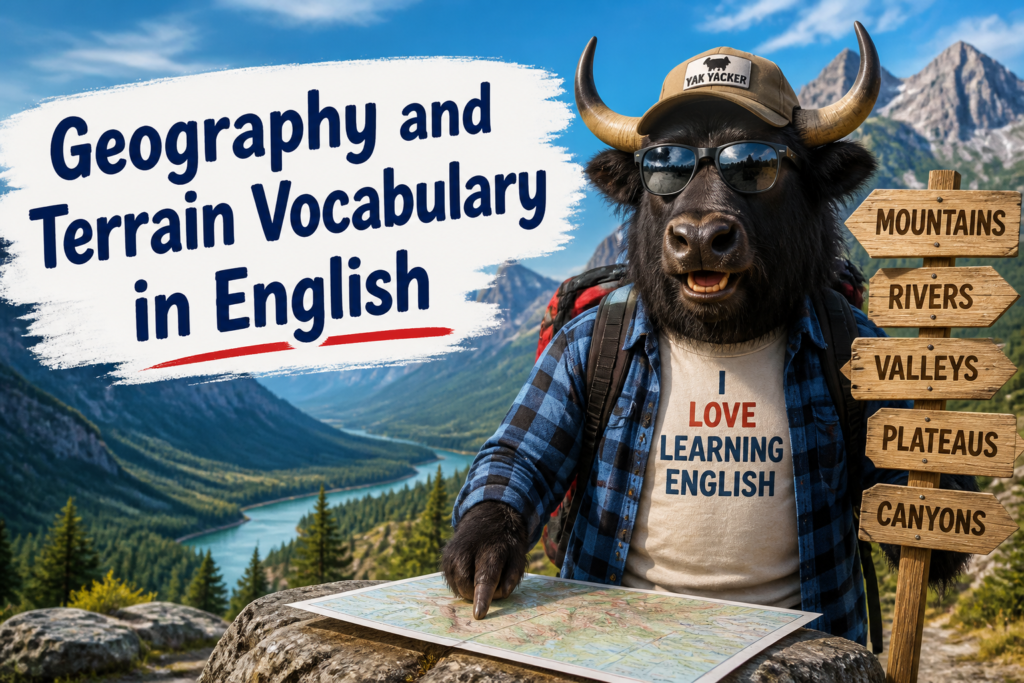
Geography and terrain vocabulary is the English you use to talk about mountains, rivers, forests, coasts, deserts, hills, valleys, and all the other lovely bits of the planet that refuse to stay flat. If you can name the land around you, you can describe a place more clearly in travel, school, work, and everyday conversation.
For the broader learning path, visit our parent guide.
This guide teaches the most useful English words and phrases for natural land features and terrain. You will learn what they mean, how to say them, and how to use them in real sentences without sounding like a robot reading a map.
Also, one small warning: English has a funny habit of using almost the same words for geography, landscape, and terrain, then pretending that is perfectly normal. Rude, honestly. But manageable.
Yak Tip: If you can describe the land, you can describe the story of a place.
Core Geography And Terrain Words
Start with these common words. They appear in travel guides, textbooks, news reports, and everyday conversation about nature.
| English | Pronunciation | Meaning | Example Sentence | Learner Note |
|---|---|---|---|---|
| mountain | MOWN-tən | A very high area of land with steep sides | The village is near a mountain. | Used for high land; one mountain or many mountains. |
| hill | hil | A raised area of land, lower than a mountain | We walked up the hill to the park. | A hill is usually smaller and easier to climb than a mountain. |
| valley | VAL-ee | Low land between hills or mountains | The river runs through the valley. | Often green and fertile. |
| plain | playn | A large area of flat land | Farmers grow crops on the plain. | Flat land, often used for farming. |
| plateau | pla-TOH | High, flat land | The road crossed a high plateau. | Useful in geography writing. |
| coast | kohst | Land next to the sea | Many people live on the coast. | Common in travel and weather descriptions. |
| beach | beech | Land by the sea with sand or small stones | We spent the afternoon at the beach. | A beach is a specific coastal place. |
| cliff | klif | A very steep wall of rock or earth | The trail goes near the cliff. | Be careful: cliffs can be dangerous. |
| desert | DEH-zert | A very dry area with little rain | Some deserts are extremely hot. | Not all deserts are hot; some are cold. |
| forest | FOR-ist | A large area full of trees | We saw deer in the forest. | More natural and large than a small wood. |
| wood | wud | A small forest or area with trees | They took a short walk through the woods. | In American English, woods is very common. |
| jungle | JUNG-gəl | A thick tropical forest | The guide warned us about the jungle path. | Often hot, wet, and full of dense plants. |
If you want a quick dictionary check for pronunciation and examples, Cambridge Dictionary is a boring but very useful place to look. Boring sources are often the best ones. Nature is wild enough already.
Landform Vocabulary You Will See Everywhere
These words describe the shape of the land. They are especially useful in geography classes, travel writing, and reading maps.
| English | Pronunciation | Meaning | Example Sentence | Learner Note |
|---|---|---|---|---|
| lake | layk | A large area of water surrounded by land | We camped near the lake. | Natural water, not man-made. |
| river | RIV-er | A large natural stream of water flowing to the sea or a lake | The river is very wide here. | Use for moving water on land. |
| stream | streem | A small river | A stream runs behind the house. | Smaller than a river. |
| waterfall | WAW-ter-fawl | Water falling over a cliff or steep area | The waterfall was beautiful after the rain. | Common in travel descriptions. |
| island | EYE-land | Land surrounded by water | They visited a small island. | Not the same as a peninsula. |
| peninsula | puh-NIN-syuh-luh | Land almost surrounded by water | The country has a long peninsula. | Great for map descriptions. |
| bay | bay | A part of the sea partly surrounded by land | The boats were anchored in the bay. | Smaller and calmer than the open sea. |
| cave | kayv | A natural hole in the ground or rock | We explored a cave near the coast. | Often dark and underground. |
| canyon | KAN-yən | A deep valley with steep sides | The canyon was carved by a river. | Very common in North American geography. |
| gorge | gawrj | A narrow valley between hills or mountains | The trail followed a steep gorge. | Close to canyon, but often narrower. |
| delta | DEL-tuh | Land where a river splits into smaller parts near the sea | The river delta is rich in soil. | Important in geography and farming. |
| floodplain | FLUD-playn | Flat land near a river that can flood | Homes on the floodplain are at risk during heavy rain. | Common in environmental topics. |
Terrain Words For Shape, Slope, And Surface
Terrain means the type and shape of the land in an area. In everyday English, people often use it when talking about hiking, driving, farming, construction, or travel.
| English | Pronunciation | Meaning | Example Sentence | Learner Note |
|---|---|---|---|---|
| flat | flat | Level land with no hills | The land here is flat and easy to walk on. | Useful for roads, farms, and cities. |
| sloped | slohpt | Leaning at an angle | The garden is on sloped ground. | Describe a gentle rise or fall. |
| steep | steep | Rising or falling sharply | The path is too steep for beginners. | Common with hills, roads, and cliffs. |
| rugged | RUG-id | Rough, uneven, and hard to travel across | The hikers crossed rugged terrain. | Used in travel, outdoor, and geography writing. |
| rocky | ROK-ee | Covered with rocks | We climbed over rocky ground. | Often describes coastlines and hills. |
| sandy | SAN-dee | Covered with sand | The island has sandy beaches. | Useful for beaches and deserts. |
| muddy | MUD-ee | Covered with mud | The trail was muddy after the storm. | Common after rain. |
| fertile | FUR-tyl | Good for growing plants | The valley has fertile soil. | Often used in farming and geography. |
| barren | BAR-ən | Empty, dry, or not able to grow plants well | The land looked barren and dry. | Opposite of fertile in many contexts. |
| lush | lush | Full of healthy green plants | The area is lush and tropical. | Often positive and descriptive. |
| remote | ri-MOHT | Far away from towns and cities | They live in a remote mountain village. | Useful for isolated areas. |
| wilderness | WILD-er-ness | A natural area with little or no human development | The region is a protected wilderness. | Common in nature and conservation talk. |
Useful Phrases For Talking About Geography
These phrases help you speak more naturally when describing places. They are handy in conversations, presentations, and school writing.
| English | Pronunciation | Meaning | Example Sentence | Learner Note |
|---|---|---|---|---|
| be surrounded by | suh-ROWN-did by | Have something all around it | The village is surrounded by mountains. | Very common for islands, forests, and cities. |
| lie to the north/south/east/west of | ly too the … | Be located in a direction from something else | The city lies to the west of the river. | Formal or academic style. |
| be located on | loh-KAY-tid on | Be placed on a particular area | The town is located on the coast. | Useful in travel and business descriptions. |
| stretch across | strech uh-KROSS | Extend over a large area | The forest stretches across the border. | Good for big natural areas. |
| rise above | ryz uh-BUV | Be higher than the surrounding land | The cliffs rise above the sea. | Strong visual description. |
| run through | run throo | Go through an area | A road runs through the valley. | Useful for rivers, roads, and paths. |
| border on | BAWR-der on | Touch or be next to another area | The desert borders on the mountains. | Common in formal geography. |
| be covered in | KUV-erd in | Have a surface full of something | The hills are covered in grass. | Very flexible phrase. |
| be dotted with | DOT-id with | Have many small things spread around | The plain is dotted with small farms. | Nice for descriptive writing. |
| drop off | drap of | Fall steeply | The land drops off near the cliff. | Often used for slopes and edges. |
| flow into | floh in-too | Move into another body of water | The river flows into the sea. | Very common with water vocabulary. |
| pass through | pass throo | Travel across an area | We passed through a long valley. | Works for roads, rivers, people, and weather. |
Common Collocations And Natural Combinations
Collocations are words that often go together. Learning them helps your English sound less stiff and more natural. Because “very strong mountain” is grammatical, sure, but nobody needs that emotional journey.
| Collocation | Meaning | Example Sentence | Learner Note |
|---|---|---|---|
| mountain range | A group of mountains | The Andes is a famous mountain range. | Very common geography phrase. |
| coastal area | Area near the sea | Tourism is strong in the coastal area. | Used in travel and economics. |
| river bank | Land next to a river | We sat on the river bank. | Not the same bank as a money bank. |
| highland area | Land at a high elevation | The highland area is cooler than the coast. | Useful in climate descriptions. |
| low-lying land | Land at a low height | Low-lying land can flood easily. | Common in weather reports. |
| dry climate | Weather with little rain | Deserts usually have a dry climate. | Climate and terrain often appear together. |
| dense forest | Forest with many trees close together | The trail went through a dense forest. | Good descriptive phrase. |
| rolling hills | Soft, gently moving hills | The countryside has rolling hills. | Often used in travel writing. |
| rocky shore | Coast with many rocks | The rocky shore was hard to walk on. | Useful for coast and beach descriptions. |
| fertile soil | Soil that grows plants well | Farmers prefer fertile soil. | Very common in agriculture. |
American English Vs British English
Most geography words are the same in American and British English, but a few differences show up in everyday usage.
| American English | British English | Note |
|---|---|---|
| the mountains | the hills may be used more casually in some places | Both are correct, but local habits differ. |
| woods | woods / woodland | Woodland is a little more common in British English and formal writing. |
| canyon | gorge or ravine may be more common in some British contexts | Meaning overlaps, but usage varies by region. |
| coast | coast | Same word, very common in both varieties. |
For a general test of vocabulary level and English readiness, you can try the English Vocabulary Test or the English Placement Test CEFR.
Common Mistakes And Easy Fixes
These are mistakes learners make often when talking about geography. Fix them early and your English will sound much more natural.
| Wrong | Better | Why |
|---|---|---|
| The village is in the mountain. | The village is in the mountains. | Usually use the plural for a mountain area. |
| The river goes to the sea. | The river flows into the sea. | Flows into is more natural for rivers. |
| It is a very high hill. | It is a very high mountain. | A hill is usually lower than a mountain. |
| The land is very desert. | The land is very dry / The area is a desert. | Desert is a noun, not an adjective in this sentence. |
| The coast is under the sea. | The coast is by the sea. | By is the correct preposition here. |
| The forest covers with trees. | The forest is covered with trees. | Use passive form: is covered with. |
Pronunciation Tips
Some geography words look simple but surprise learners when spoken aloud. English enjoys doing that, because apparently clarity is too mainstream.
- mountain sounds like MOWN-tən, not “mount-ain” with two clear parts.
- river has stress on the first syllable: RIV-er.
- valley sounds like VAL-ee.
- coast has a long oh sound.
- desert and dessert are different words. desert = dry land. dessert = sweet food after a meal.
- plateau is usually pronounced pla-TOH.
- canyon has stress on the first syllable: KAN-yən.
- forest is FOR-ist, not “for-REST.”
Practice Time
Try these quick exercises. Tiny practice now saves bigger confusion later. That is not just a language-learning slogan; it is a survival strategy.
1) Fill In The Blank
- The village is __________ by mountains. (surrounded)
- The river __________ into the sea. (flows)
- The path is too __________ for beginners. (steep)
- They live near a small __________ in the forest. (stream)
- The farm has __________ soil. (fertile)
2) Choose The Best Word
- Land surrounded by water: island / hill / valley
- Very dry area with little rain: forest / desert / bay
- High, flat land: hill / plateau / beach
- Steep wall of rock: cliff / stream / plain
- Large area of trees: river / forest / coast
3) Sentence Swap
- Change “The land is flat” to a more natural geography sentence: The plain is flat.
- Change “The village is near the water” to a more exact sentence: The village is on the coast.
- Change “The river goes through the valley” to a more natural version: The river runs through the valley.
Quick Reference Summary
| Category | Key Words | Typical Use |
|---|---|---|
| High land | mountain, hill, plateau | Describe height and shape |
| Low land | valley, plain, floodplain | Describe flatter or lower areas |
| Water features | river, stream, lake, waterfall, bay | Talk about natural water places |
| Coastal features | coast, beach, cliff, island, peninsula | Talk about sea and shore geography |
| Land quality | fertile, barren, rocky, sandy, muddy | Describe surface and soil |
| Terrain description | steep, rugged, remote, lush, flat | Describe how land feels or looks |
Geography vocabulary helps you talk about the world with more detail and more confidence. Once you know these words, maps stop looking like mysterious art projects and start looking like something you can actually describe. Yak takeaway: learn the land words first, and English will give you a much better map.