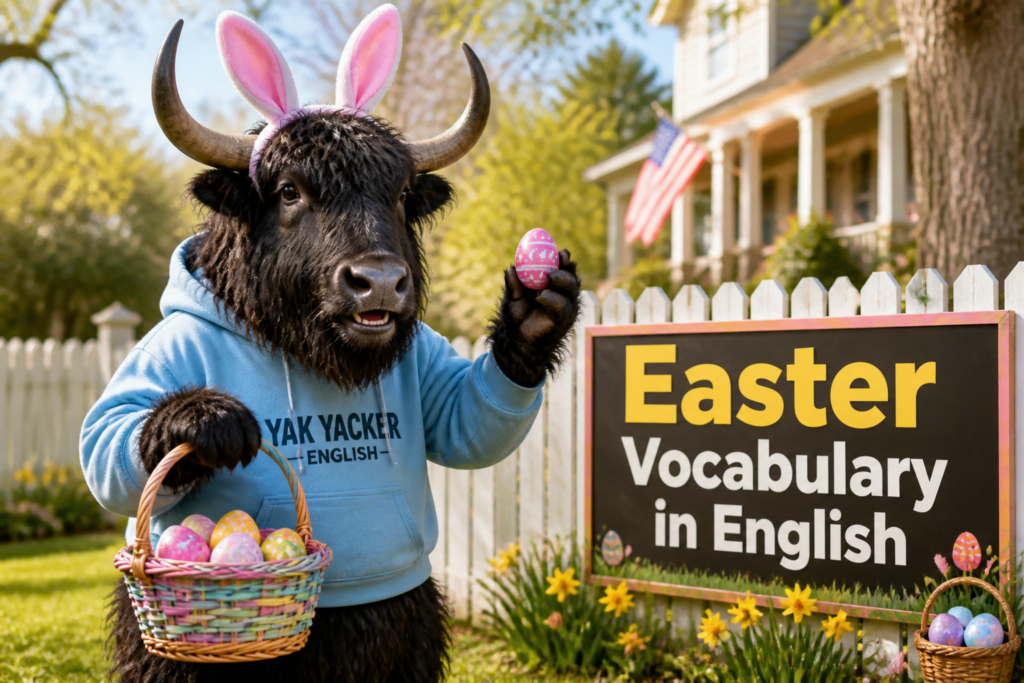
It’s Egg Hunting Time! Easter is one of those holidays that brings together family meals, chocolate, spring flowers, and a lot of very enthusiastic children with baskets. And yes, sometimes adults get just as competitive about the egg hunt. Strange but true.
If you want to talk about Easter in natural English, you need more than just egg and bunny. You also need words for traditions, decorations, church, food, and all the little phrases people use around the holiday.
This guide gives you practical Easter vocabulary in English, with simple meanings, pronunciation help, and real example sentences. You’ll also see some common American and British usage differences where they matter, because English likes to act simple and then quietly make things weird.
For more practice with English words and levels, you can also try the English Vocabulary Test or the English Placement Test CEFR.
Useful Easter Words And Phrases
Here are the most useful Easter words and phrases for everyday conversation, messages, school activities, and holiday fun.
| English | Pronunciation | Meaning | Example Sentence | Learner Note |
|---|---|---|---|---|
| Easter | EE-ster | A Christian holiday celebrating the resurrection of Jesus; in many places, also a spring holiday with family traditions | We usually visit my grandparents at Easter. | Capitalized because it is a holiday name. |
| Easter Sunday | EE-ster SUN-day | The Sunday when Easter is celebrated | Easter Sunday is important in many churches. | Common in both American and British English. |
| Good Friday | good FRY-day | The Friday before Easter Sunday, a Christian holiday | Schools may be closed on Good Friday. | Often a public holiday in the UK and some other places. |
| resurrection | rez-uh-REK-shun | The act of coming back to life; especially in Christianity, Jesus rising from the dead | Church services often mention the resurrection. | More formal or religious word. |
| church service | CHURCH SER-vis | A religious gathering in a church | Our family goes to a church service on Easter morning. | Natural phrase for religious context. |
| spring | spring | The season after winter | Easter often comes during spring. | Many Easter words connect to spring weather and flowers. |
| basket | BAS-kit | A container with a handle, often used for carrying eggs or gifts | The children brought baskets for the egg hunt. | Very common in Easter egg-hunting vocabulary. |
| egg hunt | EG hunt | A game where people search for hidden eggs | We had an egg hunt in the backyard. | Very common in American English. |
| Easter egg hunt | EE-ster EG hunt | An egg hunt done as part of Easter celebrations | The Easter egg hunt starts at 10 a.m. | Longer, more specific version of “egg hunt.” |
| hidden egg | HID-ən eg | An egg that has been placed in a secret spot | She found the hidden egg behind the flowerpot. | Useful with hunt-related descriptions. |
| chocolate egg | CHOK-lət eg | An egg-shaped sweet made of chocolate | He got a chocolate egg from his aunt. | Common in the UK and many other countries. |
| decorated egg | DEK-uh-ray-tid eg | An egg that has been painted or decorated | We made decorated eggs at school. | Useful for crafts and classroom activities. |
| dyed egg | dyed eg | An egg colored with dye | We dyed the eggs red and blue. | Simple past of dye sounds like “dye.” |
| Easter bunny | EE-ster BUN-ee | A rabbit character linked to Easter, especially in children’s traditions | The Easter bunny left candy in the basket. | Common in the U.S.; also understood elsewhere. |
| rabbit | RAB-it | A small animal with long ears | Children often draw rabbits on Easter cards. | More general than “bunny.” |
| bunny | BUN-ee | A cute word for a rabbit | My niece loves bunny decorations. | Cute, friendly, informal. |
| egg dye | EG dye | Color used to decorate eggs | Be careful with the egg dye; it stains. | Often used in craft instructions. |
| candy | KAN-dee | Sweets or sugary treats | The children got too much candy at Easter. | American English. British English often says sweets. |
| sweets | sweets | Sugary treats | The shop is full of Easter sweets. | British English. In the U.S., people usually say candy. |
| spring flowers | spring FLOU-ers | Flowers that bloom in spring | Spring flowers make Easter decorations look fresh and bright. | Often used in decoration and greeting cards. |
| churchgoer | CHURCH-goh-er | A person who goes to church regularly | Many churchgoers attend a special Easter service. | More formal word. |
More Easter Vocabulary For Real Life
These words and phrases are useful when you are talking about Easter plans, food, family time, or holiday traditions.
| English | Pronunciation | Meaning | Example Sentence | Learner Note |
|---|---|---|---|---|
| holiday | HOL-uh-day | A special day when people rest, celebrate, or do something important | Easter is a holiday in many countries. | In American English, “holiday” can mean any special day. In British English, it can also mean a vacation. |
| public holiday | PUB-lik HOL-uh-day | A day off recognized by the government | Good Friday is a public holiday in some countries. | Common in British English and many global contexts. |
| vacation | vay-KAY-shun | A time away from work or school for rest or travel | Some families take a short vacation at Easter. | American English. British English often says holiday. |
| weekend getaway | WEE-kend GET-uh-way | A short trip away for the weekend | They planned a weekend getaway over Easter. | Useful for travel conversations. |
| family gathering | FAM-uh-lee GATH-er-ing | A time when family members meet together | Easter is often a family gathering. | Neutral and very natural. |
| brunch | brunch | A meal that is a mix of breakfast and lunch | We had Easter brunch at noon. | Very common for holiday meals in American English. |
| feast | feest | A large, special meal | Grandma made a feast for Easter Sunday. | Often used for big holiday meals. |
| ham | ham | Meat from a pig, often served at Easter | We usually eat ham for Easter dinner. | Very common in American Easter meals. |
| hot cross buns | hot KROSS bunz | Sweet buns with a cross on top, traditional in the UK and some other places | Hot cross buns are popular around Easter in Britain. | Strong British and Commonwealth tradition. |
| cross | kross | A symbol used in Christianity | The cross is an important symbol during Easter. | Simple word with religious meaning. |
| blessing | BLESS-ing | A religious prayer asking for good things or protection | The priest gave a blessing during the service. | Formal and religious. |
| prayer | prayer | Words said to God | They said a prayer before dinner. | Common in religious contexts. |
| church bell | CHURCH bel | A bell in a church tower | The church bells rang on Easter morning. | Useful in cultural descriptions. |
| springtime | SPRING-tym | The season or period of spring | Easter often feels like a true springtime holiday. | Poetic but still common. |
| pastel colors | pas-TEL KUL-erz | Soft, light colors such as pale pink, yellow, and blue | Pastel colors are common in Easter decorations. | Very useful for describing Easter style. |
| decorations | dek-uh-RAY-shunz | Things used to make a place look festive or beautiful | The decorations were all yellow and green. | Plural noun in this meaning. |
| card | kard | A greeting card | She sent me an Easter card. | Common for holiday greetings. |
| greeting | GREE-ting | Words used to say hello or send good wishes | “Happy Easter” is a common greeting. | Useful in messages and cards. |
| celebrate | SEL-uh-brayt | To do something special for a holiday or event | Many families celebrate Easter with dinner and games. | Very common holiday verb. |
| tradition | truh-DISH-un | A custom or activity passed from one generation to the next | Egg hunting is a tradition in our family. | Useful for talking about culture and family habits. |
Common Easter Phrases
These are the phrases you’ll actually hear in real life, not just in a dictionary wearing a tie.
| English Phrase | Pronunciation | Meaning | Example Sentence | Learner Note |
|---|---|---|---|---|
| Happy Easter! | HAP-ee EE-ster | A friendly greeting used during Easter | Happy Easter! I hope you have a nice day. | The most common Easter greeting in English. |
| Easter break | EE-ster brayk | A school or work break around Easter | We have a short Easter break this year. | Common in schools and universities. |
| Easter weekend | EE-ster WEE-kend | The weekend when Easter happens | We’re traveling over the Easter weekend. | Very natural for planning and travel. |
| egg hunt | EG hunt | A search game for hidden eggs | The egg hunt starts in the garden. | Very common in family and school settings. |
| hide the eggs | HYD thee egz | To place eggs in secret spots | We hide the eggs before the children wake up. | Usually in the context of an egg hunt. |
| find the eggs | fynd thee egz | To discover the hidden eggs | The kids were excited to find the eggs. | Simple and useful action phrase. |
| decorate eggs | DEK-uh-rayt egz | To paint or decorate eggs | We decorate eggs with stickers and markers. | Often used with children’s activities. |
| chocolate bunny | CHOK-lət BUN-ee | A bunny made of chocolate | She ate the chocolate bunny before lunch. | Very common Easter treat in the U.S. |
| Easter basket | EE-ster BAS-kit | A basket filled with gifts, candy, or eggs | The children woke up to Easter baskets. | Very common in American English. |
| give someone an egg | giv SUM-wun an eg | To give an Easter egg as a gift | They gave each child an egg after the hunt. | Simple, useful verb pattern. |
| wear pastel colors | wer pas-TEL KUL-erz | To wear soft, light colors | Many people wear pastel colors for Easter brunch. | Useful for describing holiday clothes. |
| go to church | goh too CHURCH | To attend church | Some families go to church on Easter morning. | Simple and very common phrase. |
| have family dinner | hav FAM-uh-lee DIN-er | To eat dinner with family | We have family dinner after the egg hunt. | Good for holiday routines. |
| share a meal | share uh meel | To eat together | They share a meal every Easter. | Polite, friendly phrase. |
| send Easter wishes | send EE-ster WISH-iz | To send good holiday messages | She sent Easter wishes to her cousins. | Good for cards, texts, and emails. |
Short Meaning Notes For Common Confusions
Some Easter words look easy, but learners still mix them up. Here are the main trouble spots.
- Egg hunt = the activity. Easter egg hunt = the same activity, but clearly linked to Easter.
- Bunny = cute, informal word for rabbit. Rabbit = general word for the animal.
- Candy = American English. Sweets = British English.
- Holiday can mean a special day in American English. In British English, it can also mean a vacation.
- Decorate eggs is more natural than “make eggs beautiful,” unless the goal is to sound accidentally dramatic.
- Happy Easter is the normal greeting. You usually do not say “Merry Easter” in standard English.
American Vs British Easter Vocabulary
| American English | British English | Notes |
|---|---|---|
| candy | sweets | Both mean sugary treats. |
| Easter basket | Easter basket | Understood in both, but more common in the U.S. |
| egg hunt | egg hunt | Used in both varieties. |
| vacation | holiday | In British English, “holiday” can mean time away from work or school. |
| fries | chips | Not an Easter word, but still a classic English trap if food comes up at Easter dinner. |
| fall | autumn | Again, not Easter-specific, but useful when talking about seasons and spring holidays. |
For a standard word reference, Cambridge Dictionary’s entry for “Easter” is a solid place to check meaning and usage.
Useful Easter Sentences To Copy And Use
Here are natural example sentences you can use in conversation, messages, or writing.
- Happy Easter! Have a wonderful day with your family.
- We’re having a big Easter brunch on Sunday.
- The children are excited about the egg hunt.
- My mom dyed the eggs yesterday.
- The Easter bunny left chocolate eggs in the garden.
- Some families go to church on Easter morning.
- We usually visit our grandparents over the Easter weekend.
- These pastel decorations make the room feel like spring.
- She sent me an Easter card with a sweet message.
- In the UK, hot cross buns are a classic Easter food.
Spelling, Pronunciation, And Usage Tips
- Easter starts with a long EE sound: EE-ster.
- Egg is short and clear. Do not add extra sounds: not “eh-guh.”
- Bunny has two syllables: BUN-ee.
- Resurrection has stress on the third syllable: rez-uh-REK-shun.
- Decorate and decoration are related words, but the stress changes: DEK-uh-rayt / dek-uh-RAY-shun.
- Dyed egg is not the same as “died egg.” One is color. One is, well, a grammar disaster.
- Happy Easter is friendly and natural in messages, cards, and conversation.
Quick Practice
Try these short exercises to check your Easter vocabulary.
- Fill in the blank: We hide the ____ before the egg hunt. Answer: eggs
- Choose the American English word: candy or sweets? Answer: candy
- Choose the British English word: candy or sweets? Answer: sweets
- Correct the sentence: “Happy Easter to you and your fam.” Possible answer: Happy Easter to you and your family.
- Say it aloud: Easter bunny, hot cross buns, pastel colors, church service.
- Make a sentence with egg hunt.
- Make a sentence with Easter weekend.
Yak Takeaway: Easter vocabulary is a mix of holiday words, family phrases, food, and spring symbols. Learn the common ones first, and you’ll sound much more natural when the egg hunt starts.
If you want more English practice after this, keep building your holiday vocabulary on the main Learn English page. Your future English self will thank you, awkwardly but sincerely.