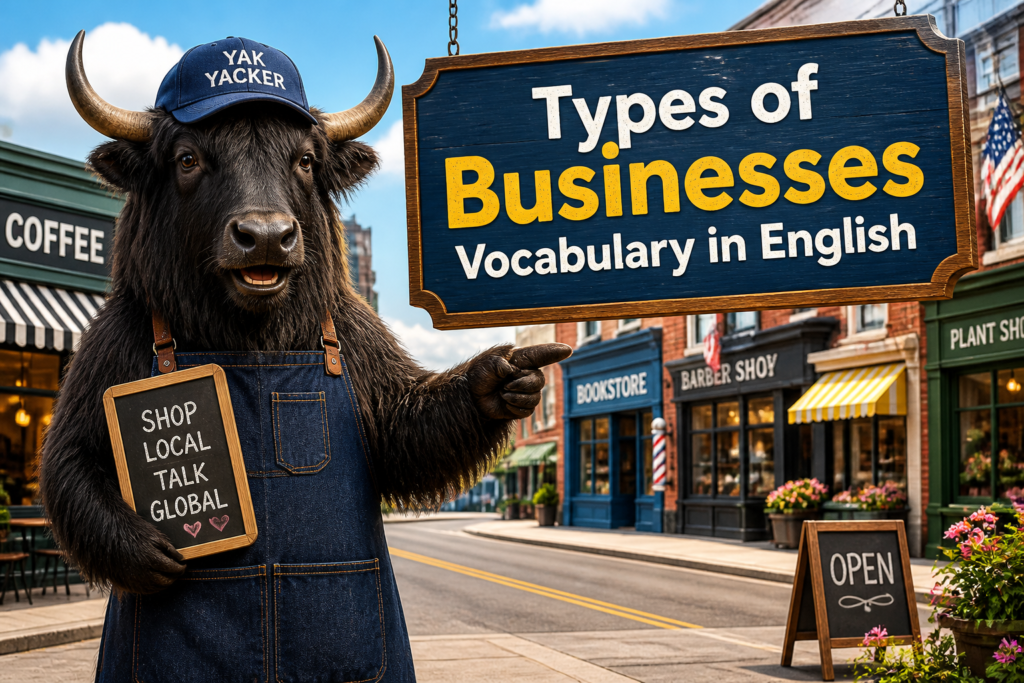
Knowing business vocabulary is useful long before you ever sit in a fancy office and say things like “Let’s circle back.” In real life, you need this language for shopping, taxes, job hunting, travel, and small talk with humans who ask, “So what kind of business is that?”
For the broader learning path, visit our parent guide.
This guide teaches common types of businesses in natural English, plus pronunciation help, meanings, example sentences, and a few notes that save learners from awkward mistakes. Because “company” and “corporation” are not always the same thing, and English loves making simple ideas slightly annoying.
Yak wisdom: if you can name the business, you can usually understand the conversation. If you can also pronounce it, even better.
Common Types Of Businesses
Here are some of the most common words people use to talk about business types in English. Start with these first. They cover a lot of everyday situations.
| English | Pronunciation | Meaning | Example Sentence | Learner Note |
|---|---|---|---|---|
| company | KUM-puh-nee | A business organization | She works for a small tech company. | Very common and neutral. |
| business | BIZ-nis | An organization that sells goods or services | He started his own business last year. | Can mean the whole company or the activity of selling. |
| corporation | kor-puh-RAY-shun | A large company legally treated as one unit | The corporation has offices in five countries. | More formal than company. |
| enterprise | EN-ter-prahyz | A business, often a larger or more formal one | The city supports small enterprise. | Common in formal writing, less common in casual speech. |
| firm | furm | A business, especially a professional one | She joined a law firm in New York. | Very common with law, accounting, architecture, and consulting. |
| startup | START-up | A new business, often in tech | He works at a startup with ten employees. | Popular in modern business English. |
| small business | SMAWL BIZ-nis | A business with few employees or limited size | Many towns depend on small businesses. | Very useful and very common. |
| chain | chayn | Many stores or restaurants under one brand | That coffee chain is on every corner. | Great for stores, cafes, and restaurants. |
For a quick dictionary check, you can compare meanings in Cambridge Dictionary. That is the sort of boring source that actually helps.
Business Types You See In Everyday Life
| English | Pronunciation | Meaning | Example Sentence | Learner Note |
|---|---|---|---|---|
| store | stor | A place that sells things | We bought milk at the store. | Very common in American English. |
| shop | shop | A place that sells things | There is a shoe shop near my house. | More common in British English; in American English, shop can sound a little less general than store. |
| restaurant | RES-tron-t | A place where people buy and eat meals | They opened a Japanese restaurant downtown. | Neutral and very common. |
| café | ka-FAY | A small place for coffee, drinks, and light food | Let’s meet at the café after class. | Usually casual and friendly. |
| bakery | BAY-kuh-ree | A place that sells bread and cakes | She buys fresh bread from the bakery. | Useful for daily life. |
| pharmacy | FAR-muh-see | A place that sells medicine | I need to stop at the pharmacy. | American English often says pharmacy; British English also says chemist. |
| gas station | GAS STAY-shun | A place to buy fuel for cars | We filled the car at the gas station. | American English. British English usually says petrol station. |
| laundromat | LAWN-druh-mat | A self-service place to wash clothes | I do laundry at the laundromat on Sundays. | Very American English. |
Helpful Words For Business Structure
These words describe how a business is organized. They are useful when you read company information, job ads, or business news.
| English | Pronunciation | Meaning | Example Sentence | Learner Note |
|---|---|---|---|---|
| owner | OH-ner | The person who owns the business | The owner opened a second location. | Very common and practical. |
| founder | FOWN-der | The person who started the business | The founder launched the company in 2018. | Common in startup and company stories. |
| partner | PAHR-ter | A person who shares ownership in a business | She is a partner in a consulting firm. | Can also mean a husband, wife, or romantic partner, so context matters. |
| employee | em-PLOY-ee | A person who works for a business | The company has 50 employees. | Plural: employees. |
| employer | em-PLOY-er | The person or company that hires workers | Her employer offers health insurance. | Do not mix this up with employee. |
| branch | branch | A local office or store of a larger business | Our bank branch is near the station. | Useful for banks, stores, and fast-food chains. |
| head office | HED AW-fis | The main office of a company | All decisions come from head office. | British English often says head office; American English often says headquarters. |
| franchise | FRAN-chyz | A business using another company’s brand and system | That burger place is a franchise. | Common in food, retail, and hotels. |
If you want to test your vocabulary, try the English Vocabulary Test later. Or now, if you enjoy being mildly humbled.
Types Of Businesses By Size Or Ownership
These words describe business size, ownership, or legal style. You will often see them in news articles, company profiles, and job applications.
- sole proprietorship — a business owned by one person
- partnership — a business owned by two or more people
- limited company — a company with legal protection for owners; common in British English
- limited liability company or LLC — a common business structure in the United States
- public company — a company whose shares are sold to the public
- private company — a company not sold on the stock market
- multinational company — a company that works in many countries
- family business — a business owned or run by family members
Small note: the word company is broad and easy. But words like LLC, corporation, and limited company are more legal and country-specific. So yes, English made business law sound like a puzzle on purpose.
Industry And Business Sector Vocabulary
Sometimes you need the type of business by industry, not by legal structure. For example, a business can be a startup, but it can also be in healthcare, fashion, or food service.
| English | Pronunciation | Meaning | Example Sentence | Learner Note |
|---|---|---|---|---|
| retail business | REE-tayl BIZ-nis | A business that sells directly to customers | They opened a retail business in the mall. | Very common in shopping contexts. |
| wholesale business | HOHL-sayl BIZ-nis | A business that sells in large amounts to other businesses | The company runs a wholesale business. | Often compared with retail. |
| service business | SER-vis BIZ-nis | A business that provides services, not products | Cleaning companies are service businesses. | Useful for many small business conversations. |
| manufacturing company | MAN-yuh-FAK-chur-ing KUM-puh-nee | A company that makes products in factories | The manufacturing company employs 300 workers. | Common in industry and economics. |
| tech company | tek KUM-puh-nee | A company working with technology | She was hired by a tech company. | Very common modern phrase. |
| consulting firm | kun-SUL-ting furm | A business that gives expert advice | He works for a consulting firm. | Common in business English. |
| real estate agency | REE-ul ih-STAYT AY-jun-see | A business that helps people buy, sell, or rent property | We used a real estate agency to find an apartment. | Agency is a useful business word. |
| travel agency | TRAV-uhl AY-jun-see | A business that helps people book trips | The travel agency booked our flight. | Still useful, even in the internet age. |
Common Phrases For Talking About Businesses
These phrases are the kind of thing people actually say in everyday English. They are handy in conversations, emails, and simple business writing.
| English Phrase | Pronunciation | Meaning | Example Sentence | Learner Note |
|---|---|---|---|---|
| run a business | run uh BIZ-nis | manage a business | She runs a business from home. | Very common. “Run” here means manage. |
| start a business | start uh BIZ-nis | begin a business | He wants to start a business next year. | Good for entrepreneurship topics. |
| own a business | ohn uh BIZ-nis | be the owner of a business | Do you own a business? | Simple and very useful. |
| work for a company | wurk for uh KUM-puh-nee | be employed by a company | I work for a software company. | Common in introductions. |
| open a branch | OH-pun uh branch | start a new location | The restaurant opened a branch in Chicago. | Useful for chains and franchises. |
| go out of business | goh out uhv BIZ-nis | close permanently | The shop went out of business last year. | Very common phrase. Sad, but practical. |
| do business with | doo BIZ-nis with | buy from or sell to another company | We do business with several local suppliers. | Common in formal and everyday English. |
| set up a company | set up uh KUM-puh-nee | create and organize a company | They set up a company in 2021. | Very useful in British and international English. |
| expand the business | ik-SPAND the BIZ-nis | make the business bigger | The owner wants to expand the business online. | Common in growth conversations. |
| launch a product | lawnch uh PROD-ukt | introduce something new to the market | The company launched a new product yesterday. | Business and marketing favorite. |
Words For Business Places And Locations
- office — a place where people do office work
- headquarters — the main office of a company
- storefront — the front part of a shop or business facing the street
- warehouse — a large building for storing goods
- factory — a building where products are made
- outlet — a store of a brand, often a cheaper shop or location
- location — a place where a business is situated
- premises — the buildings and land used by a business; more formal
Learner note: location is very broad. Branch means a specific part of a larger company. Headquarters means the main center. If you say “We visited the location,” people may ask which one, because English enjoys unnecessary detective work.
Useful Differences: American English Vs British English
| American English | British English | Meaning | Example |
|---|---|---|---|
| store | shop | place to buy things | We went to the store/shop. |
| gas station | petrol station | place to buy fuel | The gas/petrol station is near the highway. |
| apartment | flat | not a business term, but often used in property businesses | The real estate agent showed us an apartment/flat. |
| headquarters | head office | main office | The company’s headquarters/head office is in London. |
| LLC | limited company | legal business structure | The company is registered as an LLC/limited company. |
For more official English-level guidance, the CEFR page from Cambridge English is a reliable place to understand language levels. Not glamorous, but useful.
Mini Practice
Try these quick exercises. Small practice beats heroic suffering later.
- Choose the best word: My uncle owns a small ________ in town. business / factory / headquarters
- Choose the best word: She works for a law ________. firm / chain / warehouse
- Choose the best word: They opened a new ________ of the restaurant in Miami. branch / product / employee
- Choose the best phrase: He wants to ________ a business online. start / restaurant / employee
- Choose the best phrase: The shop went ________ business last month. out of / in / with
- Change the sentence: “I own a small café.” Use “run.”
- Change the sentence: “The company has many employees.” Use “staff.”
Answers: 1) business 2) firm 3) branch 4) start 5) out of 6) I run a small café. 7) The company has many staff members.
Common Mistakes And Fixes
- employee and employer: an employee works for the company; an employer hires workers.
- shop vs store: in American English, store is more common for general retail; in British English, shop is very common.
- company vs business: company often means the organization; business can mean the organization or the activity of selling services or products.
- branch vs office: a branch is a local part of a larger company; an office is a work place and may not sell anything.
- factory vs store: a factory makes products; a store sells products.
- start a business vs open a business: both can work, but start a business is more common for creating a new company.
Quick Reference Summary
| Type | Examples | Simple Use |
|---|---|---|
| General business words | company, business, firm, startup | Talk about an organization |
| Retail and service | store, shop, restaurant, café, pharmacy | Talk about places people visit |
| Business structure | owner, founder, partner, employee, employer | Talk about roles in a business |
| Business size or legal type | LLC, corporation, partnership, sole proprietorship | Talk about ownership and legal structure |
| Industry words | retail, wholesale, manufacturing, consulting, tech | Talk about the kind of work a business does |
If you want more practice with business vocabulary, try the English Placement Test CEFR after this. It is a neat way to see where your vocabulary level sits, without the drama.
Yak takeaway: business vocabulary is mostly about three things: what the business does, who owns it, and where it operates. Learn those, and English business talk becomes a lot less mysterious—and only slightly less boring.