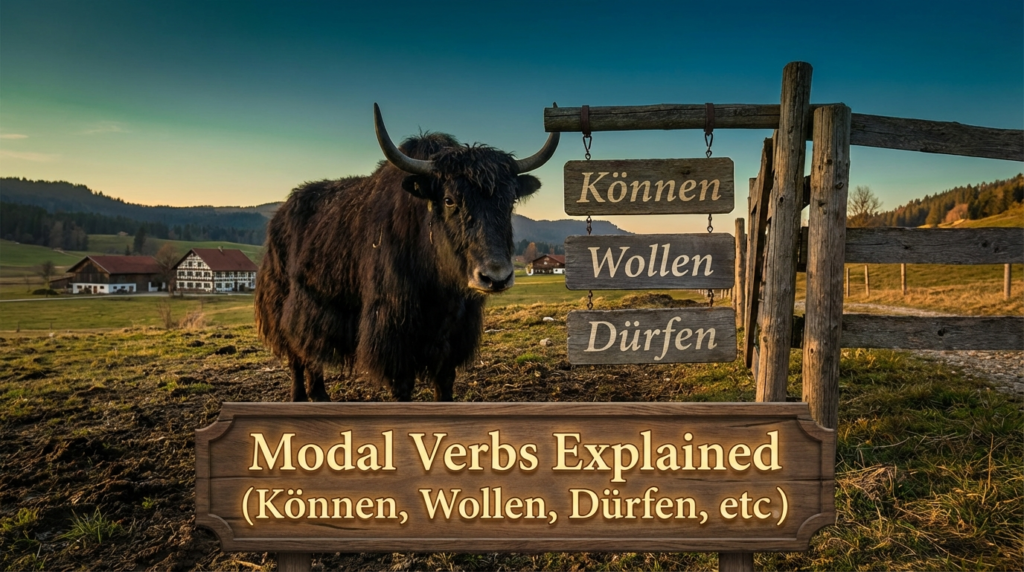
German Modal Verbs Explained: The Beginner-Friendly Guide To Können, Wollen, Dürfen, Müssen, Sollen, And Möchten
These tiny verbs do a lot of heavy lifting. They help you say what you can do, want to do, must do, should do, and are allowed to do without sounding like a confused phrasebook with legs.
Once you understand the pattern, German modal verbs stop looking scary and start feeling weirdly useful. Very useful, actually. Annoyingly useful.
In this guide, you’ll learn what the main German modal verbs mean, how they change the sentence structure, when they sound natural, and where beginners usually trip over their own grammar. We’ll keep it simple, practical, and full of real examples.
Yak Box: The One Rule To Remember First
With a modal verb, the modal verb is conjugated and the main verb goes to the end in the infinitive.
Ich kann Deutsch lernen.
I can learn German.
No extra drama. No zu. Just modal verb up front, main verb at the end.
What Modal Verbs Do In German
Modal verbs change the meaning of another verb. They add ideas like ability, permission, obligation, intention, or polite wishes. Instead of only saying ich lerne (“I learn” or “I am learning”), you can say:
- Ich kann lernen. — I can study.
- Ich will lernen. — I want to study.
- Ich muss lernen. — I have to study.
- Ich darf lernen. — I am allowed to study.
Same main verb, very different life situation.
The Main German Modal Verbs At A Glance
können
English meaning: can, to be able to
Ich kann heute nicht kommen.
I can’t come today.
wollen
English meaning: want to
Wir wollen Deutsch lernen.
We want to learn German.
dürfen
English meaning: may, to be allowed to
Darf ich hier sitzen?
May I sit here?
müssen
English meaning: must, have to
Ich muss morgen arbeiten.
I have to work tomorrow.
sollen
English meaning: should, be supposed to
Du sollst mehr Wasser trinken.
You should drink more water.
mögen / möchten
English meaning: like / would like
Ich mag Kaffee.
I like coffee.
Ich möchte einen Kaffee.
I would like a coffee.
How Modal Verbs Change Sentence Structure
- The modal verb is conjugated. It changes with the subject: ich kann, du kannst, wir können.
- The main verb stays in the infinitive. That means the basic dictionary form: lernen, gehen, sprechen.
- The main verb goes to the end. German loves this move. Get used to it early.
- You usually do not use zu after a modal verb. Say Ich will schlafen, not Ich will zu schlafen.
| Pattern | Meaning | Example |
|---|---|---|
| Subject + modal + … + infinitive | Normal statement | Ich kann heute bleiben. — I can stay today. |
| Modal + subject + … + infinitive? | Yes/no question | Willst du mitkommen? — Do you want to come along? |
| Subject + modal + nicht + … + infinitive | Negation | Wir dürfen hier nicht rauchen. — We are not allowed to smoke here. |
| Subject + modal + … + infinitive + subordinate clause ending | Verb-final in clauses | Ich weiß, dass ich früh gehen muss. — I know that I have to leave early. |
That last one matters: in a subordinate clause, the modal verb often moves to the end too. German likes stacking verbs at the back like it’s building a tiny grammatical parking lot.
Present Tense Cheat Sheet
| Verb | ich | du | er/sie/es | wir | ihr | sie/Sie |
|---|---|---|---|---|---|---|
| können | kann | kannst | kann | können | könnt | können |
| wollen | will | willst | will | wollen | wollt | wollen |
| dürfen | darf | darfst | darf | dürfen | dürft | dürfen |
| müssen | muss | musst | muss | müssen | müsst | müssen |
| sollen | soll | sollst | soll | sollen | sollt | sollen |
| mögen | mag | magst | mag | mögen | mögt | mögen |
| möchten | möchte | möchtest | möchte | möchten | möchtet | möchten |
The singular forms often change their stem, so they do not behave like boring regular verbs. Sadly, that means you actually need to learn them. Happily, you will use them all the time, so they stick fast.
What Each Modal Verb Really Means
Können: Ability Or Possibility
English meaning: can, to be able to
Use können when someone has the ability to do something or when something is possible.
- Ich kann gut kochen. — I can cook well.
- Kannst du mir helfen? — Can you help me?
- Wir können morgen kommen. — We can come tomorrow.
Wollen: Strong Intention
English meaning: want to
Use wollen for a real intention or desire. It can sound direct, which is fine with friends, but not always ideal in polite requests.
- Ich will nach Berlin fahren. — I want to go to Berlin.
- Was willst du essen? — What do you want to eat?
- Sie wollen heute Deutsch üben. — They want to practice German today.
In a café, Ich will einen Kaffee sounds a bit bossy. Use Ich möchte einen Kaffee instead, unless you are auditioning for the role of rude customer number three.
Dürfen: Permission
English meaning: may, to be allowed to
Use dürfen when something is allowed.
- Darf ich reinkommen? — May I come in?
- Du darfst hier parken. — You may park here.
- Kinder dürfen heute länger aufbleiben. — Children are allowed to stay up later today.
Negative dürfen is important: Du darfst das nicht machen. means “You are not allowed to do that.” It is about prohibition, not lack of ability.
Müssen: Necessity
English meaning: must, have to
Use müssen when something is necessary.
- Ich muss jetzt gehen. — I have to go now.
- Wir müssen mehr lernen. — We have to study more.
- Musst du morgen arbeiten? — Do you have to work tomorrow?
Here is the classic beginner trap: nicht müssen means “do not have to,” not “must not.”
Ich muss heute nicht arbeiten. — I do not have to work today.
Ich darf heute nicht arbeiten. — I am not allowed to work today.
Sollen: Advice, Expectation, Or Reported Instruction
English meaning: should, be supposed to
Sollen usually brings in an outside voice: advice, expectation, rules, or something someone said.
- Du sollst mehr schlafen. — You should sleep more.
- Ich soll meine Mutter anrufen. — I am supposed to call my mother.
- Der Film soll gut sein. — The film is said to be good.
If it is your wish, use wollen. If it is someone else’s instruction or expectation, sollen is usually the better choice.
Mögen And Möchten: Liking Vs Polite Desire
English meaning: like / would like
Mögen means “to like.” Möchten is used for polite wishes and requests. It behaves a lot like a modal verb in beginner German, even though grammar nerds will happily point out that it is technically a special form. They are not wrong, but you still need it.
- Ich mag Hunde. — I like dogs.
- Magst du Musik? — Do you like music?
- Ich möchte ein Wasser. — I would like a water.
- Möchten Sie noch etwas? — Would you like anything else?
Rule To Meaning Patterns You Will Use Constantly
| Pattern | English Meaning | Real-Life Sentence |
|---|---|---|
| Ich kann … | I can … | Ich kann heute Abend telefonieren. — I can call tonight. |
| Ich will … | I want to … | Ich will mehr Deutsch sprechen. — I want to speak more German. |
| Darf ich … ? | May I … ? | Darf ich das Fenster öffnen? — May I open the window? |
| Ich muss … | I have to … | Ich muss früh aufstehen. — I have to get up early. |
| Ich soll … | I am supposed to … | Ich soll dem Lehrer schreiben. — I am supposed to write to the teacher. |
| Ich möchte … | I would like … | Ich möchte ein Ticket kaufen. — I would like to buy a ticket. |
Common Mistakes And Fast Fixes
- Wrong: Ich kann zu schwimmen.
Right: Ich kann schwimmen.
After a modal verb, do not use zu. - Wrong idea: Ich muss nicht gehen = “I must not go.”
Correct meaning: “I do not have to go.”
Use ich darf nicht gehen for “I am not allowed to go.” - Wrong tone: Ich will einen Kaffee.
Better in polite situations: Ich möchte einen Kaffee. - Wrong word order: Ich kann lernen Deutsch.
Right: Ich kann Deutsch lernen.
The infinitive goes to the end. - Wrong meaning choice: Ich soll nach Hause gehen when you mean your own wish.
Better: Ich will nach Hause gehen.
Sollen usually implies outside expectation.
Practice Section
Try these before peeking at the answers. Yes, your brain will complain a little. Let it.
- Choose the best modal verb: “I am allowed to park here.”
- Choose the best modal verb: “We have to leave now.”
- Turn this into German: “Can you help me?”
- Turn this into German: “I would like to order.”
- What is the meaning difference between Ich muss nicht kommen and Ich darf nicht kommen?
- Fix the sentence: Du willst zu lernen.
Answer Key
- I am allowed to park here. → Ich darf hier parken.
- We have to leave now. → Wir müssen jetzt gehen.
- Can you help me? → Kannst du mir helfen?
- I would like to order. → Ich möchte bestellen.
- Ich muss nicht kommen = I do not have to come.
Ich darf nicht kommen = I am not allowed to come. - Fix: Du willst lernen.
Quick Reference Summary
| Modal Verb | Main Use | English Meaning | Example |
|---|---|---|---|
| können | ability, possibility | can | Ich kann kommen. — I can come. |
| wollen | wish, intention | want to | Ich will kommen. — I want to come. |
| dürfen | permission | may, be allowed to | Ich darf kommen. — I may come. |
| müssen | necessity | must, have to | Ich muss kommen. — I have to come. |
| sollen | advice, expectation | should, be supposed to | Ich soll kommen. — I am supposed to come. |
| möchten | polite wish | would like to | Ich möchte kommen. — I would like to come. |
Final Yak
If you remember just three things, make them these: the modal verb gets conjugated, the main verb goes to the end, and nicht müssen is not the same as nicht dürfen. Nail those, and you are already ahead of a lot of beginners.
Start with können, wollen, müssen, and möchten. They show up everywhere in real German, from classrooms to cafés to those mildly passive-aggressive family messages you will eventually understand.