


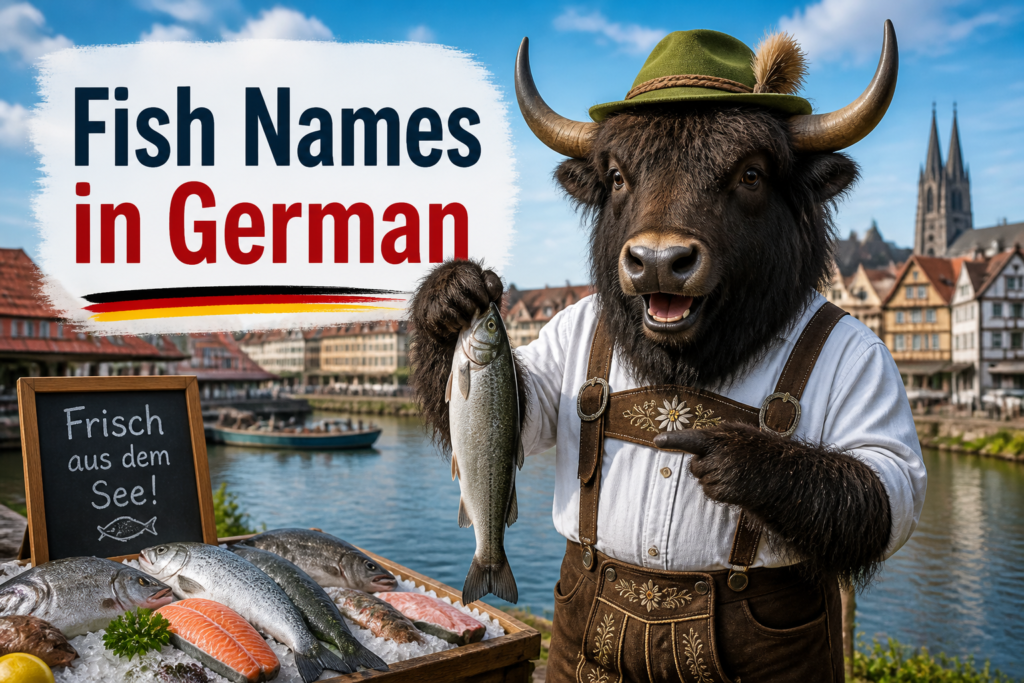
Fish Names (Fischarten) In German sounds simple until German politely throws in a few surprises: gender, plural forms, and fish names that are also everyday words. Because of course language wants to keep things interesting.
If you like talking about food, travel, markets, aquariums, fishing, or just understanding a menu without accidental mystery, this lesson will help. By the end, you’ll know common fish names in natural German, plus useful phrases for buying, ordering, and talking about fish like a real human being.
For a broader animal vocabulary boost, you can also compare this guide with animal names in German and bird names in German. Same language family, slightly less slippery.
And yes, this topic is very useful in restaurants, at the fish counter, at the lake, and when you’re reading a recipe that suddenly expects you to know the difference between Forelle and Lachs.
Quick Core Fish Words
First, here are the fish names you’re most likely to see in Germany-based everyday German. These are the useful ones, not the rare dictionary fish hiding in the weeds.
| German | Pronunciation | Meaning | Example Sentence | Translation | Learner Note |
|---|---|---|---|---|---|
| der Fisch | fish | fish | Der Fisch ist frisch. | The fish is fresh. | Generic word for “fish.” Also masculine: der. |
| der Lachs | lahks | salmon | Ich esse Lachs zum Abendessen. | I eat salmon for dinner. | Very common in restaurants and supermarkets. |
| die Forelle | foh-REL-eh | trout | Die Forelle schmeckt sehr gut. | The trout tastes very good. | Feminine: die. Common in menus. |
| der Hering | HAY-ring | herring | Hering ist oft eingelegt. | Herring is often pickled. | Important in Northern German food. |
| der Thunfisch | TOON-fish | tuna | Thunfisch passt gut in einen Salat. | Tuna goes well in a salad. | Compound noun: Thun + Fisch. |
| der Kabeljau | KAH-bel-yow | cod | Kabeljau ist ein typischer Nordseefisch. | Cod is a typical North Sea fish. | Very common in fish and chips style dishes too. |
| der Seelachs | ZAY-lahks | pollock / Alaska pollock | Seelachs wird oft paniert verkauft. | Pollock is often sold breaded. | Despite the name, it is not salmon. |
| die Sardine | zar-DEE-neh | sardine | Sardinen sind klein, aber aromatisch. | Sardines are small, but flavorful. | Often used in the plural. |
| die Makrele | mah-KREH-leh | mackerel | Makrele ist ein fetterer Fisch. | Mackerel is a fattier fish. | Good to know in smoked fish dishes. |
| die Dorade | do-RAH-deh | sea bream | Die Dorade wird im Ganzen gegrillt. | The sea bream is grilled whole. | Very common in Mediterranean-style restaurants. |
| der Hecht | hecht | pike | Hecht lebt oft in Seen und Flüssen. | Pike often lives in lakes and rivers. | Useful for freshwater fishing vocabulary. |
| der Zander | TSAHN-der | pike-perch / zander | Zander ist in Deutschland sehr beliebt. | Zander is very popular in Germany. | One of the classic restaurant fish. |
| die Scholle | SHOL-leh | plaice | Scholle mit Kartoffeln ist ein Klassiker. | Plaice with potatoes is a classic. | Common in coastal areas. |
Learner note: In German, fish names are often used without the article in shopping, menu, or recipe language. Still, learning the article helps you sound less like you just escaped a dictionary.
More Common Fish Names
Here’s a bigger set of fish vocabulary you’ll actually meet in real life. The pronunciation is written simply, so you don’t need to wrestle with IPA unless you want to.
| German | Pronunciation | Meaning | Example Sentence | Translation | Learner Note |
|---|---|---|---|---|---|
| die Sardelle | zar-DEL-leh | anchovy | Sardellen sind klein und salzig. | Anchovies are small and salty. | Plural is common in food contexts. |
| die Seezunge | ZAY-tsoo-nguh | sole | Seezunge ist ein feiner Fisch. | Sole is an elegant fish. | Often in upscale menus. |
| die Rotbarbe | ROHT-bar-beh | red mullet | Rotbarbe wird oft mediterran zubereitet. | Red mullet is often prepared in a Mediterranean style. | Less common, but useful in restaurant settings. |
| der Barsch | barsch | perch | Barsch lebt in Süßwasser. | Perch lives in freshwater. | Short, useful, and very German-looking somehow. |
| die Wels | vels | catfish | Welse können sehr groß werden. | Catfish can get very large. | Plural: Welse. |
| der Aal | aahl | eel | Aal ist in Norddeutschland beliebt. | Eel is popular in northern Germany. | Common in smoked versions. |
| die Flunder | FLUN-der | flounder | Flunder ist ein Plattfisch. | Flounder is a flatfish. | Nice for learning fish categories too. |
| der Karpfen | KARP-fen | carp | Karpfen ist ein traditioneller Weihnachtsfisch. | Carp is a traditional Christmas fish. | Very cultural, especially in some regions. |
| die Krabbe | KRAH-beh | crab / shrimp-like crustacean depending on context | Krabben auf Brot sind beliebt. | Crab/shrimp on bread is popular. | Food term can vary by species and region. |
| die Garnele | gar-NAY-leh | shrimp / prawn | Garnelen schmecken gut mit Knoblauch. | Shrimp taste good with garlic. | Very common in menus and supermarkets. |
| der Hummer | HUM-mer | lobster | Hummer ist teuer. | Lobster is expensive. | Yes, the price is usually the main storyline. |
| der Tintenfisch | TIN-ten-fish | squid / octopus family name in general usage | Tintenfisch wird oft frittiert serviert. | Squid is often served fried. | Can also cover octopus in casual usage; context matters. |
| der Oktopus | OK-toh-pus | octopus | Oktopus ist auf manchen Speisekarten zu finden. | Octopus is found on some menus. | Clearer than Tintenfisch when you mean octopus specifically. |
Fish-counter wisdom: If a German menu says gebraten, it means fried or pan-fried. If it says gegrillt, it’s grilled. If it says geräuchert, it’s smoked. If it says paniert, it has a breadcrumb coating and is probably very popular with everyone who loves crunch.
Useful Phrases For Buying And Ordering Fish
These phrases are the ones you’ll use at a market, fish stall, restaurant, or supermarket. Real life tends to be less romantic than textbook dialogue, so let’s keep it practical.
| German | Pronunciation | Meaning | Example Sentence | Translation | Learner Note |
|---|---|---|---|---|---|
| Ich hätte gern … | ikh HET-te gern | I’d like … | Ich hätte gern ein Stück Lachs. | I’d like a piece of salmon. | Very useful and polite in shops and restaurants. |
| Haben Sie frischen Fisch? | HAH-ben zee FRI-shen fish? | Do you have fresh fish? | Haben Sie frischen Fisch? | Do you have fresh fish? | Formal Sie version. Good default with strangers. |
| Was empfehlen Sie? | vahs emp-FEH-len zee? | What do you recommend? | Was empfehlen Sie? Ich kenne mich nicht aus. | What do you recommend? I’m not familiar with it. | Polite and very handy in restaurants. |
| Ich nehme den Zander. | ikh NAY-meh den TSAHN-der | I’ll take the zander. | Ich nehme den Zander. | I’ll take the zander. | Using nehmen is natural when ordering. |
| Ist der Fisch filetiert? | ist der fish fee-leh-TEERT? | Is the fish filleted? | Ist der Fisch filetiert? | Is the fish filleted? | Useful if you want fewer bones and less drama. |
| Ist der Fisch entgrätet? | ist der fish ent-GREH-tet? | Is the fish deboned? | Ist der Fisch entgrätet? | Is the fish deboned? | Gräten are fish bones. Very practical word. |
| Ich esse keinen Fisch. | ikh ES-seh KY-nen fish | I don’t eat fish. | Ich esse keinen Fisch. | I don’t eat fish. | Kein is used with nouns. Simple, important, useful. |
| Ist das mit Knochen? | ist das mit KNOH-khen? | Does it have bones? | Ist das mit Knochen? | Does it have bones? | Good question if you’re eating fish with kids or with caution. |
| Wie frisch ist der Fisch? | vee frish ist der fish? | How fresh is the fish? | Wie frisch ist der Fisch? | How fresh is the fish? | Good for markets and fish shops. |
| Kann ich das probieren? | kann ikh dahs proh-BEE-ren? | Can I try that? | Kann ich das probieren? | Can I try that? | More common for food samples than for whole fish, but still useful. |
| Bitte ohne Gräten. | BIT-teh OH-neh GREH-ten | Please without bones. | Bitte ohne Gräten. | Please without bones. | Short, natural, and wonderfully direct. |
| Ist das regional? | ist das reh-gee-OH-nahl? | Is this regional? | Ist das regional? | Is this regional? | Handy if you want local fish specialities. |
Fish At The Restaurant
Restaurant German often compresses a lot into short menu words. You’ll see prep words like gebraten, gegrillt, gedünstet, and geräuchert. The fish name is only half the story.
Here’s a simple menu decoder in table form, because reading a fish menu should not feel like reverse-engineering a submarine.
| German | Pronunciation | Meaning | Example Sentence | Translation | Learner Note |
|---|---|---|---|---|---|
| gebraten | geh-BRAH-ten | fried / pan-fried | Der Fisch ist gebraten. | The fish is fried. | Very common on menus. |
| gegrillt | geh-GRILT | grilled | Ich nehme den gegrillten Lachs. | I’ll take the grilled salmon. | Adjective ending changes after den. |
| gedünstet | geh-DUENS-tet | steamed / gently cooked | Gedünsteter Fisch ist leicht und mild. | Steamed fish is light and mild. | Often used for healthier dishes. |
| geräuchert | geh-RÖY-khert | smoked | Geräucherter Aal ist kräftig im Geschmack. | Smoked eel has a strong taste. | Watch the äu sound: it’s more like “oy.” |
| paniert | pah-NEERT | breaded | Panierten Fisch gibt es oft mit Kartoffelsalat. | Breaded fish is often served with potato salad. | Often a friendly, familiar comfort-food choice. |
| filetiert | fee-leh-TEERT | filleted | Der Fisch ist filetiert. | The fish is filleted. | Great if you want fewer bones. |
| mit Kartoffeln | mit kar-TOF-feln | with potatoes | Forelle mit Kartoffeln ist klassisch. | Trout with potatoes is classic. | Very German, very normal, very reliable. |
| mit Zitronenscheibe | mit tsee-TROH-nen-shy-beh | with lemon slice | Der Fisch kommt mit Zitronenscheibe. | The fish comes with a slice of lemon. | Restaurant classic, because fish and lemon are old friends. |
Small but useful grammar note: after a definite article like der or den, the adjective usually changes. So you get der gegrillte Lachs but den gegrillten Lachs. German likes making simple things slightly more decorative.
Yak wisdom: If a German menu uses words like geräuchert or gedünstet, it’s telling you how the fish was treated before it reached your plate. Fish, unlike many of us, cannot lie about its lifestyle.
Freshwater Fish, Saltwater Fish, And A Few Labels
Fish names are easier to remember when grouped by where they live. You don’t need to memorize all the Latin-sounding stuff; just learn the common categories first.
| Category | German | Meaning | Example Sentence | Translation | Learner Note |
|---|---|---|---|---|---|
| Freshwater fish | Süßwasserfische | freshwater fish | Forellen sind Süßwasserfische. | Trout are freshwater fish. | Süßwasser = fresh water. Literally “sweet water.” |
| Saltwater fish | Salzwasserfische | saltwater fish | Lachs lebt oft im Meer und in Flüssen. | Salmon often lives in the sea and in rivers. | Some fish move between both environments. |
| River fish | Flussfische | river fish | Der Zander ist ein beliebter Flussfisch. | Zander is a popular river fish. | Useful for fishing and geography talk. |
| Lake fish | Seefische | lake fish | Hechte sind oft Seefische. | Pike are often lake fish. | See can mean lake or sea depending on context. German loves ambiguity with confidence. |
| Flatfish | Plattfische | flatfish | Scholle ist ein Plattfisch. | Plaice is a flatfish. | Handy descriptive word formed from platt = flat. |
Curious bit: In German, See can mean lake or sea depending on the word. So Seefisch usually means a sea fish in food contexts, while place names and local usage may make it more specific. Context does the heavy lifting, as usual.
Useful Words Around Fish
These words are not fish names themselves, but they show up all the time around fish talk. If you know them, everything becomes easier.
| German | Pronunciation | Meaning | Example Sentence | Translation | Learner Note |
|---|---|---|---|---|---|
| die Gräte | GRAH-teh | fish bone | Der Fisch hat viele Gräten. | The fish has many bones. | Very useful in restaurants and during family dinners. |
| das Filet | fee-LAY | fillet | Ich möchte ein Fischfilet. | I’d like a fish fillet. | Often used for boneless portions. |
| der Fang | fahng | catch | Der Fang war heute gut. | The catch was good today. | Fishing word, very common and short. |
| angeln | AHNG-len | to fish | Wir angeln am Wochenende. | We go fishing on the weekend. | Common verb for fishing as a hobby. |
| der Angler | AHNG-ler | angler / fisherman | Der Angler wartet am See. | The angler is waiting by the lake. | Gendered noun. Female: die Anglerin. |
| das Netz | nets | net | Das Netz ist voll. | The net is full. | Useful in fishing and also in internet contexts, naturally. |
| die Schuppe | SCHOO-peh | scale | Fische haben Schuppen. | Fish have scales. | Plural: Schuppen. |
| der Kiemen | KEE-men | gill | Die Kiemen helfen dem Fisch beim Atmen. | The gills help the fish breathe. | Usually plural: die Kiemen. |
German Fish Words That Can Be Tricky
Some fish words are tricky because of spelling, pronunciation, or meaning. German is not trying to ruin your day, but it does enjoy a challenge.
| German | Pronunciation | Meaning | Example Sentence | Translation | Learner Note |
|---|---|---|---|---|---|
| der Seelachs | ZAY-lahks | pollock / Alaska pollock | Seelachs ist oft günstiger als echter Lachs. | Pollock is often cheaper than real salmon. | Looks like “sea salmon,” but it is not salmon. |
| die Forelle | foh-REL-eh | trout | Forelle ist ein beliebtes Gericht. | Trout is a popular dish. | Stress on the second syllable: fo-REL-leh. |
| der Zander | TSAHN-der | zander | Zander ist nicht so schwer zu merken. | Zander is not that hard to remember. | Starts with a sharp z sound like “ts.” |
| der Hering | HAY-ring | herring | Hering wird oft eingelegt. | Herring is often pickled. | The r is light in modern speech; don’t over-roll it. |
| die Garnele | gar-NAY-leh | shrimp | Garnelen sind beliebt in Pasta. | Shrimp are popular in pasta. | Plural is very common. |
| die Karpfen | KARP-fen | carp | Karpfen ist traditionell. | Carp is traditional. | Plural changes to Karpfen too; context tells you if it’s singular or plural. |
Germany, Austria, And Switzerland: A Few Fish Notes
Most of these fish names are standard across German-speaking countries, but some food words and regional preferences can vary. That means the fish is usually the same, but the way people talk about it may not be.
| Topic | Germany | Austria | Switzerland | Note |
|---|---|---|---|---|
| Fish names | Standard names like Lachs, Forelle, Hering | Mostly the same | Mostly the same | Vocabulary is widely shared. |
| Serving style | Often paniert, gebraten, geräuchert | Also common, especially with freshwater fish | Often tied to lake fish and regional dishes | Food traditions vary more than the fish names themselves. |
| Regional wording | Standard German in menus and shops | Some local terms may appear in restaurants | Swiss Standard German in writing, local Swiss German in speech | Menu language is usually understandable across regions. |
If you travel, the safest move is to know the standard form first. Then you can smile politely when someone uses a regional word you’ve never seen before, which is basically the universal language-learning strategy.
Mini Practice: Match The Fish
Try matching the German fish word to the English meaning. No panic, no points deducted for being human.
| German | Meaning | Check |
|---|---|---|
| Lachs | salmon | ✓ |
| Forelle | trout | ✓ |
| Hering | herring | ✓ |
| Thunfisch | tuna | ✓ |
| Kabeljau | cod | ✓ |
| Zander | zander / pike-perch | ✓ |
| Scholle | plaice | ✓ |
| Garnele | shrimp | ✓ |
Now try saying these out loud: Lachs, Forelle, Thunfisch, geräuchert. The German ch in geräuchert is the soft sound you hear in many German words, not the hard k in English cat. Don’t overthink it. German already did that for you.
Optional visual helper:
Common Mistakes And Easy Fixes
| Common Mistake | Better Version | Why |
|---|---|---|
| Ich esse Fischs. | Ich esse Fisch. | Fisch is usually uncountable in this meaning, so no -s. |
| Die Lachs | Der Lachs | Lachs is masculine: der. |
| Ich möchte die Lachs. | Ich möchte den Lachs. | After möchte, the object can need the accusative. Lachs becomes den. |
| Ich nehme gegrillte Fisch. | Ich nehme gegrillten Fisch. | Adjective ending changes after the article. |
| Haben Sie frische Fisch? | Haben Sie frischen Fisch? | With Fisch in this structure, the ending is -en. |
| Seelachs ist Lachs. | Seelachs ist kein Lachs. | Seelachs is not salmon, despite the name. |
| Ich mag kein Fische. | Ich mag keine Fische. | Plural needs keine. |
Simple rule: If you’re talking about one kind of fish as a food item, German often uses the singular. If you’re talking about several fish or different kinds, use the plural. Context is doing a lot of work here, as usual.
Quick Reference Summary
- Fisch = fish
- Lachs = salmon
- Forelle = trout
- Hering = herring
- Thunfisch = tuna
- Kabeljau = cod
- Zander = zander / pike-perch
- Scholle = plaice
- Garnele = shrimp
- geräuchert = smoked
- gegrillt = grilled
- paniert = breaded
- filetiert = filleted
- entgrätet = deboned
- Ich hätte gern … = I’d like …
- Haben Sie frischen Fisch? = Do you have fresh fish?
If you remember only a few things, make them Lachs, Forelle, Thunfisch, Hering, and Ich hätte gern …. That already gets you surprisingly far at a market or restaurant.
For more everyday German word lists, the parent learning hub at Learn German is a good place to keep going. Fish vocabulary is useful, yes, but so is being able to survive the rest of the language without flailing like a very confused carp.
Yak takeaway: Learn the common fish names, the prep words, and one polite ordering phrase. Then German menus stop being mysterious sea poetry and start being normal dinner choices.