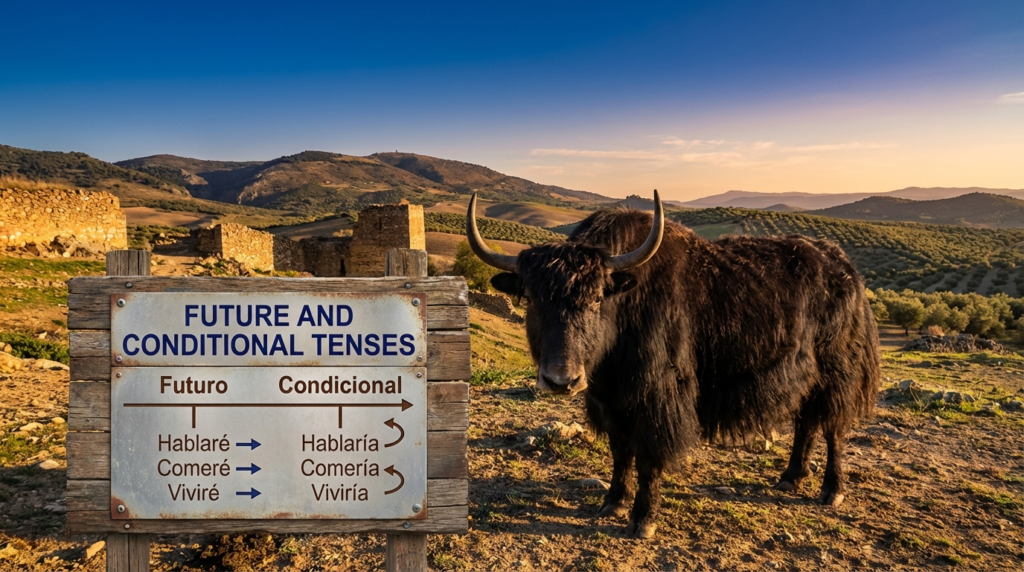
Spanish Future And Conditional Tenses (Without The Headache)
Want to say what you will do, what would happen, and how to sound politely confident (or politely unsure)? The Spanish future and conditional tenses do that job—fast.
Good news: they’re built from a super consistent pattern. One set of endings + a few common irregular stems, and you’re in business.
Yak Box: The One-Sentence Trick
Future = “I will…” → infinitive + future endings.
Conditional = “I would…” → infinitive + conditional endings.
Yep, you keep the whole infinitive (hablar, comer, vivir) and just snap endings onto it.
Future Tense: “Will”
Use it for: plans, predictions, promises, and also “probably” guesses about the present.
- Te llamaré mañana. (I’ll call you tomorrow.)
- El paquete llegará el viernes. (The package will arrive on Friday.)
- ¿Dónde está Luis? Estará en el trabajo. (Where’s Luis? He’s probably at work.)
Conditional Tense: “Would”
Use it for: hypotheticals, polite requests, advice, and “probably” guesses about the past.
- Yo iría contigo, pero trabajo. (I would go with you, but I work.)
- ¿Podrías ayudarme? (Could you help me?)
- ¿Dónde estaba Luis? Estaría en una junta. (Where was Luis? He was probably in a meeting.)
Regular Endings (The Easy Part)
These endings work for -ar, -er, and -ir verbs. Just attach them to the infinitive.
| Person | Future Ending | Conditional Ending |
|---|---|---|
| yo | -é | -ía |
| tú | -ás | -ías |
| él/ella/usted | -á | -ía |
| nosotros/as | -emos | -íamos |
| ellos/ellas/ustedes | -án | -ían |
Accent alert: Future has accents on é / ás / á / án. Conditional has an accent on ía forms. Those accents aren’t decoration—they change the word.
Build Some Right Now
Hablar (to speak)
- hablaré (I will speak) — Hablaré con ella hoy. (I’ll talk to her today.)
- hablarías (you would speak) — ¿Hablarías más despacio? (Would you speak more slowly?)
Comer (to eat)
- comerá (he/she will eat) — Él comerá en casa. (He’ll eat at home.)
- comeríamos (we would eat) — Comeríamos ahí, pero está lleno. (We’d eat there, but it’s full.)
Vivir (to live)
- vivirán (they will live) — Vivirán cerca del metro. (They’ll live near the metro.)
- viviría (I/he/she would live) — Yo viviría en la playa. (I’d live at the beach.)
Common Irregular Stems (Same Endings)
Irregular = you change the stem, but you keep the same future/conditional endings. These are the ones you’ll see constantly.
| Infinitive | Meaning | Irregular Stem | Future Example | Conditional Example |
|---|---|---|---|---|
| tener | to have | tendr- | Tendré tiempo mañana. (I’ll have time tomorrow.) | Tendría tiempo, pero no hoy. (I’d have time, but not today.) |
| venir | to come | vendr- | Vendrá más tarde. (He’ll come later.) | Vendría si pudiera. (He’d come if he could.) |
| poder | to be able to | podr- | Podré ayudarte. (I’ll be able to help you.) | ¿Podrías repetir? (Could you repeat?) |
| querer | to want | querr- | Querrás descansar. (You’ll want to rest.) | Querría un café. (I’d like a coffee.) |
| saber | to know | sabr- | Sabré la respuesta. (I’ll know the answer.) | No sabría decirte. (I wouldn’t know what to tell you.) |
| hacer | to do/make | har- | Haré la tarea. (I’ll do the homework.) | Haría eso, pero cuesta mucho. (I’d do that, but it costs a lot.) |
| decir | to say/tell | dir- | Te diré la verdad. (I’ll tell you the truth.) | Te diría, pero es secreto. (I’d tell you, but it’s a secret.) |
| salir | to leave/go out | saldr- | Saldré temprano. (I’ll leave early.) | Saldría contigo. (I’d go out with you.) |
Future Vs. “Ir A + Infinitive” (The Real-Life Choice)
Spanish has two super common ways to talk about the future:
- Ir a + infinitive = “going to” (very common for plans) — Voy a estudiar hoy. (I’m going to study today.)
- Simple future = “will” (often sounds more certain, formal, or prediction-y) — Estudiaré hoy. (I will study today.)
In everyday Spanish (including Mexico), ir a + infinitive is extremely common for plans. The simple future shines when you’re predicting, promising, or doing that “probably” guess thing.
The “Probably” Uses People Forget
Future = Probably (Now)
When you don’t know something, the future can mean “probably” about the present.
- ¿Qué hora es? Serán las tres. (What time is it? It’s probably three.)
- No contesta… Estará ocupado. (He’s not answering… he’s probably busy.)
- ¿Quién es? Será mi vecina. (Who is it? It’s probably my neighbor.)
Conditional = Probably (Then)
The conditional can mean “probably” about the past.
- No contestó… Estaría dormido. (He didn’t answer… he was probably asleep.)
- ¿Por qué llegó tarde? Tendría tráfico. (Why did he arrive late? He probably had traffic.)
- ¿Dónde estaban? Estarían en el súper. (Where were they? They were probably at the supermarket.)
Polite Spanish: Conditional Makes You Sound Like A Human
Want to ask for something without sounding like a robot with a clipboard? Use the conditional.
- ¿Podrías abrir la ventana? (Could you open the window?)
- ¿Me ayudarías un momento? (Would you help me for a moment?)
- Quisiera una mesa para dos. (I’d like a table for two.)
- Me gustaría un agua, por favor. (I’d like a water, please.)
- ¿Sería tan amable de…? (Would you be so kind as to…?)
“If” Sentences: Where Spanish Gets Picky
The classic pattern for hypotheticals is:
| Pattern | Meaning | Example |
|---|---|---|
| Si + imperfect subjunctive → conditional | If… would… | Si tuviera dinero, viajaría más. (If I had money, I would travel more.) |
| Si + present → present/future idea | If… (real) then… | Si tengo tiempo, te llamo. (If I have time, I’ll call you.) |
Big gotcha: After si, you don’t use the simple future. So it’s Si tengo tiempo, te llamo (not “si tendré tiempo…”).
Practice Time (Do These Out Loud)
Say them, write them, text them to yourself—whatever works. The goal is instant pattern recognition.
1) Conjugate These Verbs
- Yo __________ (salir) temprano mañana.
- ¿Tú __________ (poder) venir hoy?
- Ella __________ (hacer) la cena esta noche.
- Nosotros __________ (tener) más tiempo el fin de semana.
- Ustedes __________ (decir) la verdad.
2) Choose Future Or Conditional
- Si no llueve, nosotros __________ (ir) al parque. (real plan)
- Si no lloviera, nosotros __________ (ir) al parque. (hypothetical)
- No contesta… __________ (estar) en el gimnasio. (guess now)
- No contestó… __________ (estar) en el gimnasio. (guess then)
3) Make It Polite
Turn these into polite requests using the conditional:
- Abre la puerta.
- Repite eso.
- Ayúdame con esto.
Show Answers
1) Conjugate
1) saldré 2) podrías 3) hará 4) tendríamos 5) dirán
2) Choose
1) vamos / iremos (both can work; vamos a ir is also common) 2) iríamos 3) estará 4) estaría
3) Polite
1) ¿Podrías abrir la puerta?
2) ¿Podrías repetir eso?
3) ¿Me ayudarías con esto?
Common Mistakes And Fast Fixes
- Mistake: Dropping the infinitive (like trying to conjugate the stem).
Fix: Keep the whole infinitive: comer + é → comeré. - Mistake: Using future after si.
Fix: Use present: Si tengo tiempo, te llamo. - Mistake: Forgetting accents: hablare / hablaria.
Fix: Add them: hablaré, hablaría. - Mistake: Mixing irregular stems and regular stems: “teneré”.
Fix: Use the irregular stem: tendré, tendría.
Quick Reference Summary
| You Want To Say… | Use This | Spanish | Meaning |
|---|---|---|---|
| “I will do it.” | Future | Lo haré. | I’ll do it. |
| “I would do it.” | Conditional | Lo haría. | I would do it. |
| “He’s probably busy.” | Future (guess now) | Estará ocupado. | He’s probably busy. |
| “He was probably busy.” | Conditional (guess then) | Estaría ocupado. | He was probably busy. |
| “If I had time, I would go.” | Si + imperfect subj. → conditional | Si tuviera tiempo, iría. | If I had time, I’d go. |
| Polite request | Conditional | ¿Podrías ayudarme? | Could you help me? |
FAQ (Quick And Useful)
Do I have to use the simple future to talk about the future?
Nope. Ir a + infinitive is super common for plans: Voy a salir (I’m going to leave). The simple future often feels more like a prediction or a firm promise: Saldré (I will leave).
Why does the future tense mean “probably” sometimes?
It’s a built-in “educated guess” vibe. Estará en casa is like “He’ll be at home… I assume.” It’s extremely normal and very useful.
What are the top irregulars I should memorize first?
Start with: tendr- (tener), podr- (poder), har- (hacer), dir- (decir), saldr- (salir), vendr- (venir), querr- (querer), sabr- (saber).
Final Yak
If you remember one thing, remember this: future = infinitive + é/ás/á/emos/án, conditional = infinitive + ía/ías/ía/íamos/ían. Then learn the handful of irregular stems, and you can suddenly talk about plans, polite requests, and “probably” guesses like you’ve been doing it forever.