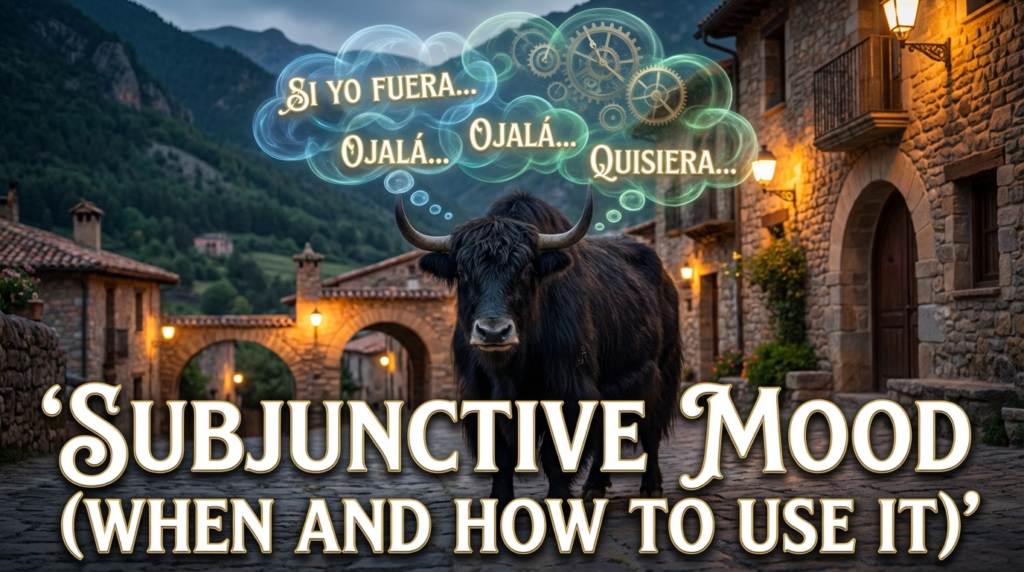
Subjunctive Mood (When And How To Use It)
The Spanish subjunctive isn’t “hard.” It’s just Spanish’s way of saying: this is not a confirmed fact. Learn the main triggers, copy the patterns, and you’ll start sounding natural fast.
The Subjunctive In One Sentence
Indicative = facts and certainty. Subjunctive = wishes, emotions, doubts, recommendations, and anything that’s not guaranteed.
Indicative (Fact)
Sé que = I know that
Sé que vienes hoy.
English: I know you’re coming today.
Subjunctive (Not Certain)
No sé si / Dudo que = I don’t know if / I doubt that
Dudo que vengas hoy.
English: I doubt you’re coming today.
Yak Box: The Fast “Should I Use Subjunctive?” Test
- If it’s real and confirmed → usually indicative.
- If it’s a wish, emotion, doubt, recommendation, or not-yet-real → often subjunctive.
- Huge cheat code: If there are two different subjects connected by que, subjunctive shows up a lot.
Quiero ir (same subject → infinitive).
Quiero que vayas (different subjects → subjunctive).
When To Use The Subjunctive
Here are the most common real-life triggers in Spanish. Each one includes the meaning and copy-paste-ready sentences.
Wishes And Requests (Querer / Pedir / Esperar + Que)
Querer que = to want (someone) to
Quiero que me ayudes.
English: I want you to help me.
No quiero que llegues tarde.
English: I don’t want you to arrive late.
Pedir que = to ask (someone) to
Te pido que me digas la verdad.
English: I’m asking you to tell me the truth.
El doctor pide que descanses.
English: The doctor asks that you rest.
Esperar que = to hope that
Espero que tengas un buen día.
English: I hope you have a good day.
Esperamos que todo salga bien.
English: We hope everything turns out well.
Emotions (Alegrarse / Molestar / Tener Miedo + Que)
- Me alegra que… = I’m glad that…
Me alegra que estés aquí. English: I’m glad you’re here. - Me molesta que… = It bothers me that…
Me molesta que no escuches. English: It bothers me that you don’t listen. - Tengo miedo de que… = I’m afraid that…
Tengo miedo de que se enoje. English: I’m afraid he/she will get mad.
Doubt, Denial, And Uncertainty
Dudar que = to doubt that
Dudo que sea cierto.
English: I doubt it’s true.
Dudamos que puedan venir.
English: We doubt they can come.
No creer que = to not believe that
No creo que tengas razón.
English: I don’t think you’re right.
No creemos que funcione.
English: We don’t think it works.
Es posible que = it’s possible that
Es posible que llueva.
English: It’s possible it’ll rain.
Puede que sea tarde.
English: It might be late.
Nuance that saves you: Creo que usually takes indicative because it sounds like a belief/statement.
Creo que es verdad. = I think it’s true.
No creo que sea verdad. = I don’t think it’s true. (subjunctive)
Impersonal Expressions (It’s Important / Necessary / Good + Que)
- Es importante que = It’s important that
Es importante que lo hagas hoy. English: It’s important that you do it today. - Es necesario que = It’s necessary that
Es necesario que traigan identificación. English: It’s necessary that they bring ID. - Es mejor que = It’s better that / You’d better
Es mejor que te vayas. English: You’d better leave.
Recommendations And Advice (Recomendar / Sugerir / Aconsejar + Que)
- Te recomiendo que = I recommend that you
Te recomiendo que descanses. English: I recommend that you rest. - Sugiero que = I suggest that
Sugiero que lo revisen otra vez. English: I suggest you all check it again. - Te aconsejo que = I advise you to/that
Te aconsejo que no manejes cansado. English: I advise you not to drive tired.
Ojalá (The Subjunctive Magnet)
Ojalá = hopefully / I really hope (it’s basically “please universe”). It’s almost always followed by subjunctive.
Ojalá que todo salga bien.
English: Hopefully everything goes well.
Ojalá no se me olvide.
English: Hopefully I don’t forget.
Non-Existent Or Unknown Things (Searching For “A… That…”)
If you’re talking about something that may not exist (or you’re not sure), Spanish often uses subjunctive.
- Busco a alguien que hable inglés.
English: I’m looking for someone who speaks English. (maybe that person exists… maybe not) - No hay nadie que me entienda.
English: There’s no one who understands me. - ¿Tienes un cargador que funcione?
English: Do you have a charger that works?
Time Clauses: “When” The Future Isn’t Here Yet
With words like cuando (when), en cuanto (as soon as), hasta que (until), después de que (after), Spanish uses subjunctive when the action is in the future (not completed yet).
Future / Not Done Yet → Subjunctive
Cuando llegues, me llamas.
English: When you arrive, call me.
Te aviso en cuanto sepa algo.
English: I’ll let you know as soon as I know something.
Habit / Past Fact → Indicative
Cuando llegas, siempre traes café.
English: When you arrive, you always bring coffee.
En cuanto llegó, me marcó.
English: As soon as he/she arrived, he/she called me.
“Although” (Aunque): Depends On Reality
Aunque can be indicative or subjunctive depending on whether the information is real/known.
- Aunque está caro, lo voy a comprar.
English: Although it’s expensive (it really is), I’m going to buy it. - Aunque esté caro, lo voy a comprar.
English: Even if it’s expensive (not sure yet), I’m going to buy it.
How To Form The Subjunctive (Present)
This is the version you’ll use constantly in daily Spanish. The formula is surprisingly clean.
The 3-Step Formula
- Start with the yo form of the present indicative.
- Drop the -o.
- Add the opposite endings:
- -AR verbs take -E endings.
- -ER / -IR verbs take -A endings.
hablo → habl- → hable
como → com- → coma
vivo → viv- → viva
Present Subjunctive Endings
| Verb Type | Yo | Tú | Él/Ella/Usted | Nosotros/Nosotras | Ellos/Ellas/Ustedes |
|---|---|---|---|---|---|
| -AR | e | es | e | emos | en |
| -ER / -IR | a | as | a | amos | an |
Mexican Spanish note: You’ll hear ustedes for “you all” (not vosotros). So that -en / -an line matters a lot.
Must-Know Irregulars (The Usual Suspects)
| Infinitive | Subjunctive (Yo) | Meaning | Example |
|---|---|---|---|
| ser | sea | to be | Espero que sea fácil. (I hope it’s easy.) |
| ir | vaya | to go | Quiero que vayas conmigo. (I want you to go with me.) |
| estar | esté | to be (state) | Me alegra que estés bien. (I’m glad you’re okay.) |
| haber | haya | to have (aux.) | Es posible que haya tráfico. (It’s possible there’s traffic.) |
| saber | sepa | to know | Dudo que sepa la respuesta. (I doubt he/she knows the answer.) |
| dar | dé | to give | Te pido que me des un minuto. (I’m asking you to give me a minute.) |
Spelling Changes (To Keep The Sound)
These aren’t random. Spanish is trying to keep pronunciation consistent.
| Change | Meaning | Example (Subjunctive) | English |
|---|---|---|---|
| -car → -qu | keep the “k” sound | buscar → busque | I look for / (that) I look for |
| -gar → -gu | keep the “g” sound | llegar → llegue | (that) I arrive |
| -zar → -c | soften “z” to “c” | empezar → empiece | (that) I start |
Copy-ready sentences:
Es importante que llegues temprano. English: It’s important that you arrive early.
Quiero que busques el recibo. English: I want you to look for the receipt.
Es mejor que empieces hoy. English: It’s better that you start today.
Stem-Changers In The Subjunctive (Quick Reality Check)
If a verb changes in the present tense (like tener → tengo), it often keeps that change in the subjunctive… because you’re still building from the yo form.
- tener → tenga
Espero que tengas tiempo. English: I hope you have time. - poder → pueda
Dudo que pueda ir. English: I doubt I can go. - querer → quiera
Quiero que me quieras. English: I want you to love me. - pedir → pida
Me molesta que me pidas eso. English: It bothers me that you ask me for that.
Practice: Make Your Brain Stop Panicking
Try these quick drills. Don’t aim for perfection—aim for “I can spot the pattern.”
Drill 1: Choose Indicative Or Subjunctive
- Creo que (es / sea) verdad.
- No creo que (es / sea) verdad.
- Cuando (llegas / llegues), me mandas un mensaje.
- Me alegra que (estás / estés) aquí.
- Busco un lugar que (tiene / tenga) buena comida.
Answers
1) es
2) sea
3) llegues
4) estés
5) tenga
Drill 2: Swap The Subject (Infinitive → Subjunctive)
Change each sentence so it has two different subjects and uses que + subjunctive.
- Quiero salir.
- Prefiero quedarme en casa.
- Espero terminar temprano.
- Me gusta comer aquí.
Possible Answers
Quiero que tú salgas. (I want you to go out.)
Prefiero que te quedes en casa. (I prefer you stay home.)
Espero que ellos terminen temprano. (I hope they finish early.)
Me gusta que comas aquí. (I like that you eat here.)
Drill 3: Build 5 Real Sentences You’ll Actually Use
- Espero que…
- Quiero que…
- Me alegra que…
- Es importante que…
- Cuando… (future)
Starter ideas:
Espero que no haya tráfico. (I hope there isn’t traffic.)
Es importante que me digas la verdad. (It’s important that you tell me the truth.)
Common Mistakes (And The Fix)
- Mistake: Using subjunctive with Creo que (affirmative).
Fix: Creo que es… (indicative). Only switch with negation/uncertainty: No creo que sea… - Mistake: Using subjunctive when it’s the same subject.
Fix: Same subject → infinitive: Quiero dormir. Different subjects → que + subjunctive: Quiero que duermas. - Mistake: Saying Cuando llegas for a future “when.”
Fix: Future/not done yet → Cuando llegues. - Mistake: Forgetting the tiny accent that changes meaning: dé (from dar).
Fix: Te pido que me dé tiempo. (I’m asking him/her to give me time.)
Quick Reference Cheat Sheet
Top Triggers
- Wishes/Requests: quiero que, pido que, espero que
- Emotions: me alegra que, me molesta que
- Doubt/Denial: dudo que, no creo que, es posible que
- Impersonal: es importante que, es necesario que
- Time (future): cuando, hasta que, en cuanto
- Ojalá
Formation
- Use present yo form
- Drop -o
- -AR → -E endings
- -ER/-IR → -A endings
hablo → hable
como → coma
vivo → viva
Mini FAQ
Do I Always Need “Que” To Use Subjunctive?
Not always, but a lot of beginner-friendly subjunctive patterns are built around que: Quiero que…, Es importante que…, Dudo que…. There are also patterns like Ojalá (often with que, sometimes without) and time clauses like cuando + subjunctive for future situations.
Is The Subjunctive “Formal” Spanish?
Nope. It’s normal everyday Spanish. People use it constantly: wishes, advice, emotions, “when you arrive…,” “I don’t think…,” “it’s possible…,” etc.
What Should I Learn First: Triggers Or Conjugations?
Learn a small set of triggers first (quiero que, espero que, es importante que, no creo que, cuando + future). Then learn the present subjunctive endings. After that, add irregulars like sea, vaya, esté, haya.
Final Yak
If you remember just one thing: subjunctive = not guaranteed reality. Then slap on a trigger phrase and let the endings do their job. You’re not “doing advanced grammar.” You’re just speaking Spanish like people actually speak it.