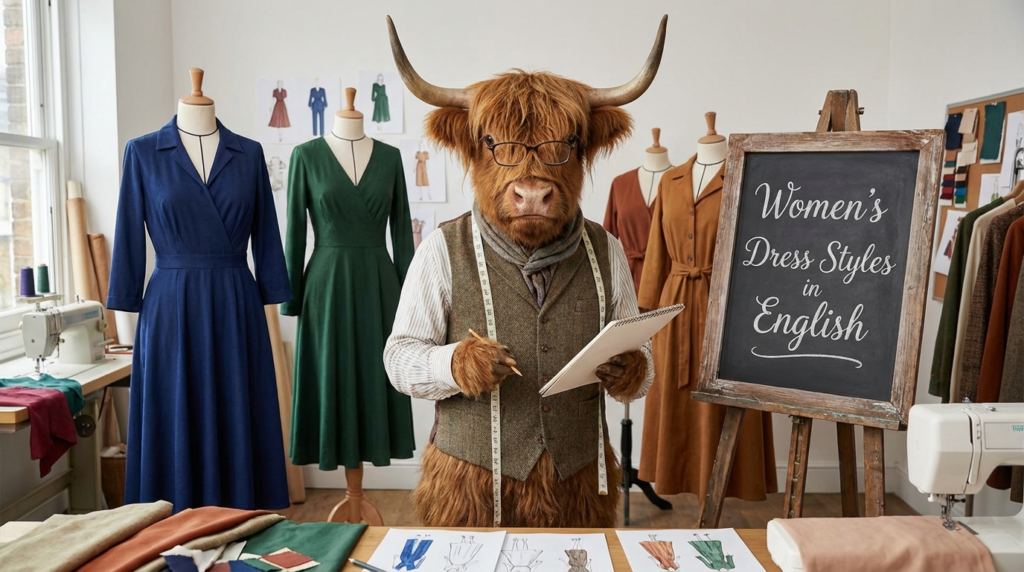
Women’s Dress Styles in English (With Real-Life Examples)
Dress shopping in English can feel like a fashion quiz you didn’t study for. “Is this a sheath or a shift?” “Why does midi sound like a music file?”
You’ll learn the most common women’s dress style names in American English—plus necklines, sleeves, lengths, fabrics, and occasion words. Every term includes a clear meaning and real sentences you can actually say out loud.
Yak Box: The Fast Way To Describe A Dress
- Silhouette (shape): A-line, sheath, fit-and-flare, bodycon…
- Length: mini, midi, maxi…
- Neckline: V-neck, square, off-the-shoulder…
- Sleeves/straps: puff sleeve, spaghetti straps, strapless…
- Fabric: satin, chiffon, jersey…
- Occasion: cocktail dress, sundress, evening gown…
Put them together: “A wrap dress, midi length, V-neck, in satin.” Boom. You sound like you own a closet and a plan.
Quick Visual Cards: 8 Super-Common Dress Styles
A-Line Dress
Meaning: Narrow at the top, wider at the hem (like the letter “A”).
Example: “I want an A-line dress because it’s comfy and flattering.”
Sheath Dress
Meaning: A straight, fitted dress that follows your shape (often office-friendly).
Example: “She wore a navy sheath dress to the interview.”
Shift Dress
Meaning: A simple, straight dress that hangs loosely (not tight at the waist).
Example: “A shift dress is my go-to when it’s hot out.”
Wrap Dress
Meaning: The front wraps across your body and ties at the side or waist.
Example: “Do you have a wrap dress that ties on the left?”
Fit-And-Flare Dress
Meaning: Fitted at the waist, flares out at the skirt (twirl-friendly).
Example: “This fit-and-flare dress looks great with heels.”
Bodycon Dress
Meaning: “Body-conscious” = very tight and form-fitting.
Example: “I love the color, but I don’t want a bodycon dress.”
Maxi Dress
Meaning: A long dress that usually reaches your ankles (or close).
Example: “I need a maxi dress for a beach wedding.”
Midi Dress
Meaning: A mid-length dress (usually between the knee and ankle).
Example: “A midi dress feels dressy without being too formal.”
Slip Dress
Meaning: A simple, drapey dress (often satin) that looks like a slip.
Example: “She layered a slip dress over a white T-shirt.”
Useful Phrases For Shopping And Talking About Dresses
- “I’m looking for a ____ dress.”
Meaning: You want that type of dress.
Example: “I’m looking for a wrap dress for work.” - “Do you have this in a different size/color?”
Meaning: Ask for another option.
Example: “Do you have this in a medium and in black?” - “Can I try this on?”
Meaning: Ask to wear it in the fitting room.
Example: “Can I try this on in a size 6?” - “It runs small/large.”
Meaning: The sizing is smaller/bigger than usual.
Example: “This brand runs small, so I size up.” - “It’s too tight around the bust/waist/hips.”
Meaning: One area is uncomfortably tight.
Example: “It’s too tight around the hips when I sit.” - “It’s too loose in the shoulders.”
Meaning: The top area doesn’t fit well.
Example: “It’s cute, but it’s too loose in the shoulders.” - “The hem is too long/short.”
Meaning: The bottom edge (hem) isn’t the right length.
Example: “The hem is too long—I might get it altered.” - “Can you alter it?”
Meaning: Ask to change the fit/length (tailoring).
Example: “Can you alter it to hit just above the knee?” - “I want something more flattering.”
Meaning: You want a shape that looks better on you.
Example: “I want something more flattering at the waist.” - “It’s see-through.”
Meaning: You can see through the fabric.
Example: “This white dress is a little see-through in sunlight.” - “It needs a slip/lining.”
Meaning: It needs an extra layer inside.
Example: “It needs a lining so it doesn’t cling.” - “It’s dressy, but not too formal.”
Meaning: Nice, but not fancy like a gala.
Example: “I need something dressy, but not too formal.”
Dress Silhouettes And Types
| Vocabulary | Meaning | Example 1 | Example 2 | Example 3 |
|---|---|---|---|---|
| A-line dress | Narrow at the top, wider at the hem | “An A-line dress is easy to wear all day.” | “She chose an A-line dress for the wedding.” | “Do you have an A-line in navy?” |
| Fit-and-flare dress | Fitted at the waist, flares out at the skirt | “This fit-and-flare dress looks great with flats.” | “I like fit-and-flare because it’s comfy.” | “That fit-and-flare is perfect for dancing.” |
| Sheath dress | Slim and fitted, usually structured | “A sheath dress works well for the office.” | “She wore a sheath dress with a blazer.” | “I need a sheath dress for a meeting.” |
| Shift dress | Simple, straight, not tight at the waist | “A shift dress is great in warm weather.” | “This shift dress doesn’t cling.” | “I want a shift dress with pockets.” |
| Wrap dress | Wraps across the front and ties at the waist | “Wrap dresses are easy to adjust.” | “I like a wrap dress with a V-neck.” | “That wrap dress has a secure tie.” |
| Bodycon dress | Very tight, form-fitting (“body-conscious”) | “That dress is too bodycon for my taste.” | “She wore a bodycon dress with boots.” | “Do you have a less fitted option?” |
| Empire waist dress | High waistline under the bust, flowy skirt | “An empire waist dress feels airy.” | “The empire waist sits right under my bust.” | “This empire waist style is flattering.” |
| Skater dress | Fitted top with a short, flared skirt | “A skater dress looks cute with sneakers.” | “She wore a skater dress to brunch.” | “I want a skater dress in a bright color.” |
| Peplum dress | Has a short flounce/ruffle at the waist | “The peplum detail adds shape.” | “She picked a peplum dress for the party.” | “I like peplum, but not too much ruffle.” |
| Slip dress | Drapey, often satin; looks like a slip | “A slip dress layers well with a jacket.” | “She wore a slip dress with a cardigan.” | “This slip dress has a cowl neck.” |
| Vocabulary | Meaning | Example 1 | Example 2 | Example 3 |
|---|---|---|---|---|
| Shirt dress | Looks like a long button-up shirt | “I wear a shirt dress with a belt.” | “This shirt dress is perfect for work.” | “Do you have a linen shirt dress?” |
| Sweater dress | Knit dress that feels like a sweater | “A sweater dress is cozy in winter.” | “She paired a sweater dress with tights.” | “This sweater dress is soft, not itchy.” |
| Tea dress | Classic, often floral; usually midi length | “A tea dress looks great with sandals.” | “She wore a tea dress to a garden party.” | “I want a tea dress with short sleeves.” |
| Smock dress | Loose, often gathered; relaxed fit | “Smock dresses are super comfortable.” | “This smock dress doesn’t feel tight at all.” | “I want a smock dress for travel.” |
| Tent dress | Very loose, wide shape from shoulders down | “A tent dress is breezy in summer.” | “She wore a tent dress with chunky sandals.” | “That tent dress has a fun print.” |
| Mermaid dress | Fitted to the knees, flares at the bottom | “A mermaid dress is dramatic.” | “She tried on a mermaid dress for prom.” | “I can’t walk fast in this mermaid style.” |
| Trumpet dress | Similar to mermaid, but flares a bit higher and softer | “A trumpet dress gives you shape without feeling stuck.” | “That trumpet dress moves better than a mermaid.” | “I want a trumpet dress in satin.” |
| Ball gown | Fitted bodice + very full skirt | “She wore a ball gown to the gala.” | “A ball gown needs big energy.” | “That ball gown has layers of tulle.” |
| Column dress | Long, narrow silhouette; not very flared | “A column dress looks sleek.” | “She chose a column dress for a formal event.” | “This column dress has a high slit.” |
Dress Lengths And Hemlines
| Vocabulary | Meaning | Example 1 | Example 2 | Example 3 |
|---|---|---|---|---|
| Micro-mini | Extremely short mini length | “That’s a micro-mini—it’s not for me.” | “She wore a micro-mini with tights.” | “I need something longer than that.” |
| Mini dress | Short dress above the knee | “I’m wearing a mini dress with boots.” | “This mini dress feels a bit short when I sit.” | “Do you have this mini in a size 4?” |
| Knee-length | Hits around the knee | “Knee-length is great for work.” | “She prefers knee-length dresses.” | “That knee-length dress looks polished.” |
| Midi dress | Between knee and ankle | “A midi dress is easy to dress up.” | “This midi hits mid-calf on me.” | “I want a midi with sleeves.” |
| Maxi dress | Long dress, usually ankle length | “A maxi dress is perfect for vacation.” | “This maxi dress is flowy and light.” | “I need a maxi that isn’t too long.” |
| Floor-length | Touches (or almost touches) the floor | “The gown is floor-length.” | “Floor-length works best with heels.” | “It’s dragging—I need it hemmed.” |
| High-low hem | Shorter in front, longer in back | “I like a high-low hem for summer.” | “Her dress had a high-low hemline.” | “This high-low hem shows off the shoes.” |
| Asymmetrical hem | Hem is uneven (different lengths) | “The asymmetrical hem makes it fun.” | “That asymmetrical hem looks modern.” | “I want an asymmetrical hem, not ruffles.” |
| Handkerchief hem | Points/dips like a handkerchief shape | “The handkerchief hem moves nicely.” | “She wore a handkerchief hem dress to dinner.” | “I like it, but I want it less floaty.” |
| High slit | A tall opening in the skirt | “This dress has a high slit on the side.” | “A high slit makes it easier to walk.” | “I want a slit, but not that high.” |
Necklines And Bodice Details
| Vocabulary | Meaning | Example 1 | Example 2 | Example 3 |
|---|---|---|---|---|
| V-neck | Neckline shaped like a “V” | “I like V-necks—they’re flattering.” | “This V-neck isn’t too low.” | “Do you have a V-neck version?” |
| Scoop neck | Rounded, wider neckline | “A scoop neck feels casual.” | “That scoop neck shows a little collarbone.” | “I prefer scoop neck over crew neck.” |
| Crew neck | High, round neckline (like a T-shirt) | “A crew neck dress looks simple and clean.” | “This crew neck is great for layering.” | “I want a crew neck with long sleeves.” |
| Square neck | Neckline with squared corners | “Square necklines are trendy.” | “This square neck looks vintage.” | “Do you have a square neck in black?” |
| Sweetheart neckline | Heart-shaped curve at the bust | “The sweetheart neckline is really pretty.” | “She chose a sweetheart bodice for prom.” | “I want a sweetheart neckline with straps.” |
| Halter neck | Straps go around the neck, shoulders open | “A halter dress shows off your shoulders.” | “This halter neck needs a strapless bra.” | “I’m looking for a halter maxi dress.” |
| Off-the-shoulder | Neckline sits below the shoulders | “Off-the-shoulder dresses feel romantic.” | “This off-the-shoulder top keeps slipping.” | “I want off-the-shoulder with sleeves.” |
| One-shoulder | Only one shoulder strap/sleeve | “A one-shoulder dress looks dramatic.” | “She wore a one-shoulder cocktail dress.” | “I want one-shoulder in a solid color.” |
| Boat neck | Wide neckline that runs near the collarbone | “Boat necks look elegant.” | “This boat neck shows my shoulders a bit.” | “I like a boat neck with a midi length.” |
| Cowl neck | Draped, folded fabric at the neckline | “That cowl neck looks soft and classy.” | “A cowl neck slip dress is very ‘90s.” | “I want a cowl neck in satin.” |
| Keyhole neckline | A small cutout opening near the chest | “The keyhole neckline adds detail.” | “This keyhole is subtle, not flashy.” | “I like the keyhole, but not the glitter.” |
Sleeves, Straps, And Extra Details
| Vocabulary | Meaning | Example 1 | Example 2 | Example 3 |
|---|---|---|---|---|
| Sleeveless | No sleeves | “It’s sleeveless, so I’ll bring a jacket.” | “I want a sleeveless midi dress.” | “Do you have this sleeveless in blue?” |
| Cap sleeves | Very short sleeves that cover the shoulder top | “Cap sleeves are cute but snug.” | “This dress has cap sleeves and a V-neck.” | “I prefer cap sleeves over sleeveless.” |
| Short sleeves | Sleeves that stop above the elbow | “I need short sleeves for summer.” | “This short-sleeve dress is breathable.” | “Short sleeves make it more casual.” |
| 3/4 sleeves | Sleeves that stop between elbow and wrist | “3/4 sleeves are perfect for spring.” | “This dress has 3/4 sleeves and a belt.” | “I like 3/4 sleeves for the office.” |
| Puff sleeves | Full, puffy sleeves (often at the shoulder) | “Puff sleeves make it look playful.” | “This puff sleeve is a little too big.” | “I want puff sleeves, but not extreme.” |
| Bell sleeves | Sleeves that flare out near the wrist | “Bell sleeves feel boho.” | “Her bell-sleeve dress looked vintage.” | “Bell sleeves can get in the way when you eat.” |
| Bishop sleeves | Full sleeves gathered at the wrist | “Bishop sleeves look soft and elegant.” | “This bishop sleeve has a tight cuff.” | “I want bishop sleeves in chiffon.” |
| Spaghetti straps | Very thin straps | “It has spaghetti straps, so I need a strapless bra.” | “I like spaghetti straps in summer.” | “Do you have wider straps?” |
| Strapless | No straps; held up by the bodice | “This strapless dress keeps sliding down.” | “She wore a strapless gown.” | “I prefer straps for comfort.” |
| Backless | Open back | “It’s backless, so I need the right bra.” | “That backless dress is stunning.” | “I want a backless look, but not too open.” |
| Cutouts | Intentional openings in the fabric | “The cutouts make it more daring.” | “This dress has small waist cutouts.” | “I want cutouts, but just a little.” |
| Ruching | Gathered fabric that creates texture | “Ruching can hide a belly a bit.” | “The ruching on the side is flattering.” | “I want ruching, not sequins.” |
Fabrics And Occasion Dress Names
| Vocabulary | Meaning | Example 1 | Example 2 | Example 3 |
|---|---|---|---|---|
| Chiffon | Light, sheer, flowy fabric | “This chiffon dress moves beautifully.” | “Chiffon can be a little see-through.” | “I want chiffon with a lining.” |
| Satin | Smooth, shiny fabric | “Satin looks fancy in photos.” | “This satin dress wrinkles easily.” | “I want a satin slip dress.” |
| Jersey knit | Stretchy, soft knit fabric | “Jersey knit is comfy for travel.” | “This jersey dress doesn’t wrinkle much.” | “I want jersey, not stiff fabric.” |
| Lace | Decorative fabric with open patterns | “The lace sleeves feel romantic.” | “This lace dress needs a nude slip.” | “I like lace details, not full lace.” |
| Velvet | Soft fabric with a plush surface | “Velvet feels perfect for winter.” | “She wore a velvet dress to the holiday party.” | “This velvet looks darker in low light.” |
| Sequins | Shiny, reflective discs on fabric | “Sequins make it party-ready.” | “That sequin dress sparkles on the dance floor.” | “I want sequins, but not head-to-toe.” |
| Sundress | Light casual summer dress | “I live in sundresses all summer.” | “This sundress is perfect for a picnic.” | “Do you have a cotton sundress?” |
| Cocktail dress | Semi-formal party dress (often knee-length) | “It’s a cocktail dress code tonight.” | “She wore a black cocktail dress.” | “I need a cocktail dress with sleeves.” |
| Evening gown | Very formal long dress | “The invitation says evening gowns.” | “She rented an evening gown for the gala.” | “I want a simple evening gown, not sparkly.” |
| Little black dress (LBD) | Classic simple black dress for many events | “A little black dress always works.” | “My LBD is my emergency outfit.” | “I want an LBD with a square neck.” |
| Work dress | Office-appropriate dress | “I need a work dress that isn’t too tight.” | “This work dress looks great with a blazer.” | “I want a work dress with pockets.” |
| Prom dress | Formal dress for a prom | “She’s shopping for a prom dress.” | “This prom dress has a high slit.” | “I want a prom dress that’s comfortable.” |
Curious Bit: US Vs UK Words That Can Confuse You
American English is the focus here, but if you watch UK shows, you’ll hear different words. Here are a few that love to cause chaos.
| Word | Meaning | Example |
|---|---|---|
| Jumper (UK) / Sweater (US) | UK “jumper” usually means a sweater; US “jumper” can mean a jumper dress (worn over a shirt) | “In the US, a jumper dress can look like a pinafore.” |
| Pinafore (UK) | A sleeveless dress worn over a top (similar idea to a US “jumper dress”) | “She wore a pinafore over a striped shirt.” |
| Frock (UK, old-fashioned) | A dress (sounds a bit old-school) | “My grandma calls every dress a frock.” |
Quick Practice: Say It Like A Real Person
- Make a full description: “I want a ____ dress, ____ length, with a ____ neckline.”
Example answer: “I want a wrap dress, midi length, with a V-neck.” - Swap the vibe: Change one word to change the style.
Example: “a shift dress” → “a sheath dress” (looser → more fitted) - Fix the fit: Add one fit sentence.
Example: “It’s cute, but it’s too tight around the hips.”
Final Yak
If you remember just one trick: describe the shape (A-line, sheath, wrap), then the length (mini/midi/maxi), then one detail (V-neck, puff sleeves, satin). That’s enough to shop, text a friend, or survive a dress code without panicking.
And yes—“It has pockets” is a complete sentence. A joyful one.