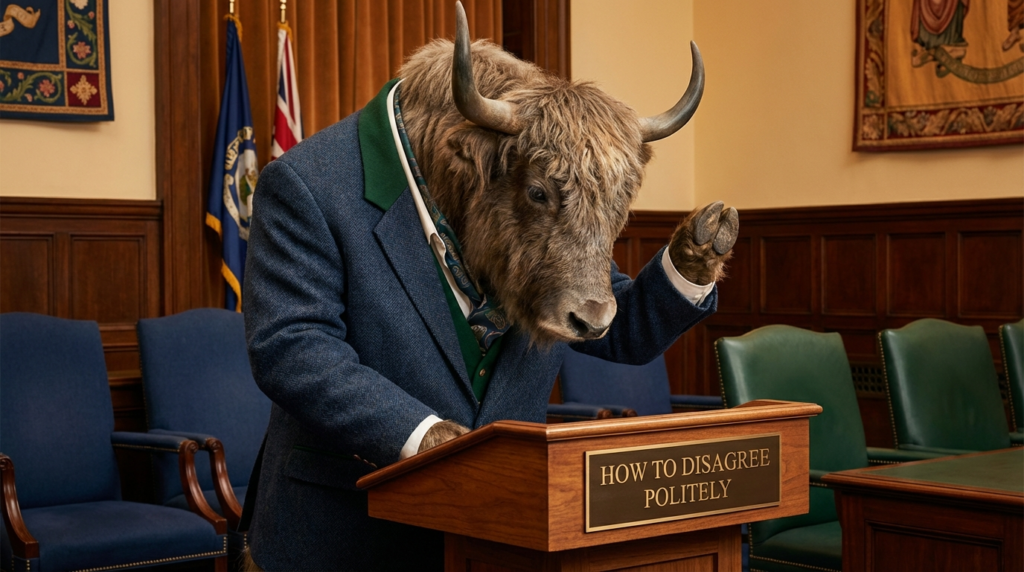
How To Disagree Politely In English
Disagreeing isn’t rude. Sounding like you’re trying to win a cage match is rude. Let’s upgrade your “nope” into calm, clear, and respectful English—without turning into a robot.
You’ll learn 60 ready-to-use phrases (with meanings + examples), plus a simple formula you can use in meetings, emails, and real-life conversations.
Yak Tip: The Polite Disagreement Formula
- Start warm (show respect): “That’s a fair point…”
- Soften the edge (don’t sound absolute): “I’m not sure…” / “It seems…”
- Say your view (clear, not aggressive): “I see it differently.”
- Offer a next step (helpful, not combative): “Could we try…?”
American English note: “I’d respectfully disagree” is common in U.S. workplaces. In very formal British English, you may hear “I’m afraid I disagree,” which can sound extra polite (and a little dramatic) in the U.S.
Quick Tone Rules That Keep You Sounding Polite
Do
- Use “I” language: “I think…” “I’m not sure…”
- Keep it specific: disagree with the idea, not the person
- Add a solution: “Could we consider…?”
Avoid
- “You’re wrong.” (ouch)
- “Obviously…” (sounds smug)
- “Actually…” (can sound like a correction slap)
Visual Cards: 8 High-Utility Phrases
“I See Your Point, But…”
Meaning: You acknowledge their idea, then add your view.
Example: “I see your point, but I think the timeline is too tight.”
“I’m Not Sure I Agree.”
Meaning: A gentle, respectful disagreement.
Example: “I’m not sure I agree—our data suggests the opposite.”
“That’s A Fair Point. However…”
Meaning: You validate them, then introduce a concern.
Example: “That’s a fair point. However, the cost could be higher than we expect.”
“From My Perspective…”
Meaning: You share your view without claiming it’s the only truth.
Example: “From my perspective, we need more time to test this.”
“I Hear You. I Just Think…”
Meaning: Warm + honest disagreement.
Example: “I hear you. I just think we should start smaller.”
“I Might Be Wrong, But…”
Meaning: A soft “hedge” that reduces tension.
Example: “I might be wrong, but I don’t think this solves the main issue.”
“Could We Consider…?”
Meaning: You disagree by inviting a better option.
Example: “Could we consider running a small pilot first?”
“Let’s Meet In The Middle.”
Meaning: You propose a compromise.
Example: “Let’s meet in the middle—two weeks to test, then we decide.”
60 Polite Disagreement Phrases (With Meanings And Examples)
Pick phrases that match your situation. In general: softer for sensitive topics, clearer for decisions, and solution-focused for work.
Soft Starters (Warm And Respectful)
| Phrase | Meaning | Example |
|---|---|---|
| I see what you mean, but… | Acknowledge their point, then disagree gently. | I see what you mean, but I think the risk is higher than it looks. |
| I hear you, but… | Shows you listened before you disagree. | I hear you, but I don’t think that’s the best use of our time. |
| That’s a good point. Still… | Validate them, then add your concern. | That’s a good point. Still, we need a backup plan. |
| I get where you’re coming from. However… | Respect their perspective while offering a different one. | I get where you’re coming from. However, the timing isn’t great. |
| I understand your concern. At the same time… | Agree with the feeling, not necessarily the conclusion. | I understand your concern. At the same time, we can’t skip testing. |
| You might be right, but… | Softens disagreement by admitting possibility. | You might be right, but I think we should check the numbers first. |
| I can see how that would seem that way. But… | Shows empathy and reduces tension. | I can see how that would seem that way. But the context is different now. |
| I agree up to a point, but… | Partial agreement + polite disagreement. | I agree up to a point, but the budget is the real problem. |
Gentle Disagreement (Clear, Not Combative)
| Phrase | Meaning | Example |
|---|---|---|
| I’m not sure I agree. | A soft, common way to disagree. | I’m not sure I agree—this could confuse customers. |
| I don’t think that’s quite right. | Disagree without calling someone “wrong.” | I don’t think that’s quite right; the report says we missed the deadline. |
| I see it a little differently. | Signals a different viewpoint. | I see it a little differently—I think quality matters more than speed here. |
| I’m not convinced. | Says you need stronger reasons or proof. | I’m not convinced this will solve the problem long-term. |
| I have a different take on that. | Professional, neutral disagreement. | I have a different take on that; I think the market is slowing down. |
| I’d respectfully disagree. | Polite, formal disagreement (common at work). | I’d respectfully disagree—the data doesn’t support that conclusion. |
| I’m not certain that’s the best approach. | Disagree with the plan, not the person. | I’m not certain that’s the best approach; it could create more steps. |
| I’d push back on that a bit. | Mild, workplace-friendly disagreement. | I’d push back on that a bit; we haven’t tried the simpler option yet. |
Asking Questions (Disagree Without Starting A Fight)
| Phrase | Meaning | Example |
|---|---|---|
| What makes you say that? | Ask for reasons (curious, not aggressive). | What makes you say that? I’m seeing different feedback. |
| How did you arrive at that conclusion? | Ask about the thinking process. | How did you arrive at that conclusion? I want to understand the steps. |
| Could you walk me through your thinking? | Invites explanation calmly. | Could you walk me through your thinking? I may be missing something. |
| What evidence are we basing that on? | Request proof politely. | What evidence are we basing that on? Let’s make sure it’s solid. |
| Are we assuming that…? | Highlights a hidden assumption. | Are we assuming that customers will pay more for this feature? |
| What would happen if we tried…? | Suggests a test instead of arguing. | What would happen if we tried a smaller rollout first? |
| Have we considered…? | Introduces another angle gently. | Have we considered the support team’s workload? |
| Could it be that…? | Offers an alternative explanation. | Could it be that the issue is the onboarding, not the price? |
Offering Alternatives (Disagree + Be Helpful)
| Phrase | Meaning | Example |
|---|---|---|
| What if we did a pilot first instead? | Suggests a safer first step. | What if we did a pilot first instead, just to confirm demand? |
| Another option could be… | Presents a different choice. | Another option could be postponing the launch by one week. |
| I’d suggest we try… | Gives a practical alternative. | I’d suggest we try improving the FAQ before changing the pricing. |
| Maybe we could… | A soft way to propose an idea. | Maybe we could simplify the form to reduce drop-offs. |
| We could also consider… | Adds another path without rejecting theirs harshly. | We could also consider adding this feature in phase two. |
| A possible compromise is… | Finds middle ground. | A possible compromise is to keep the feature, but limit it to premium users. |
| How about meeting in the middle? | Proposes a balanced solution. | How about meeting in the middle—shorter timeline, but fewer features? |
| Could we combine both ideas? | Shows collaboration. | Could we combine both ideas—start small now and expand next month? |
Meetings And Work (Professional And Direct)
| Phrase | Meaning | Example |
|---|---|---|
| I’d like to offer a different perspective. | Signals a respectful alternative view. | I’d like to offer a different perspective: our customers value reliability most. |
| Let’s unpack that a bit. | Slow down and examine the idea. | Let’s unpack that a bit—what problem are we solving exactly? |
| I’m concerned that… | Raises a worry without blaming. | I’m concerned that this could increase churn. |
| I worry that… might… | Softens a criticism as a risk. | I worry that rushing might create more bugs. |
| I’d recommend we revisit… | Suggests a review rather than rejection. | I’d recommend we revisit the requirements before we commit. |
| I’m not aligned on that yet. | Workplace phrase meaning “I don’t agree (right now).” | I’m not aligned on that yet; I need to see the impact on operations. |
| I’m hesitant to move forward with that. | Polite resistance to a decision. | I’m hesitant to move forward with that without legal review. |
| I think we should challenge that assumption. | Questions the logic behind the idea. | I think we should challenge that assumption that users will upgrade automatically. |
Email And Writing (Polite, Clear, Documented)
| Phrase | Meaning | Example |
|---|---|---|
| I’m not sure we’re on the same page. | Signals a mismatch in understanding. | I’m not sure we’re on the same page about the deadline—can we confirm it? |
| I see a potential issue with… | Flags a problem without sounding harsh. | I see a potential issue with the current plan: it depends on a vendor response. |
| I’d like to propose an adjustment. | Suggests a change politely. | I’d like to propose an adjustment to the rollout schedule. |
| Could we reconsider…? | Asks to rethink a decision. | Could we reconsider removing that step? It protects data quality. |
| I’d recommend a slight change to… | Soft, practical correction. | I’d recommend a slight change to the wording to avoid confusion. |
| I’m not comfortable with… as written. | Sets a boundary politely. | I’m not comfortable with this claim as written; it could be misleading. |
| I’d like to clarify one point. | Gentle correction. | I’d like to clarify one point: the contract ends in June, not July. |
| Here’s an alternative approach we can try. | Moves from disagreement to solution. | Here’s an alternative approach we can try: start with the top three use cases. |
Friends And Family (Honest, Still Kind)
| Phrase | Meaning | Example |
|---|---|---|
| I’m not sure that’s true. | Soft disagreement about a fact. | I’m not sure that’s true—I remember it differently. |
| I don’t see it that way. | Simple, calm disagreement. | I don’t see it that way; I think he was trying to help. |
| I disagree, but I respect your opinion. | Disagree while showing respect. | I disagree, but I respect your opinion, and I get why you feel that way. |
| Let’s agree to disagree. | End the debate peacefully. | Let’s agree to disagree and move on—we’re not going to solve it tonight. |
| I love you, but I don’t agree. | Warm disagreement with someone close. | I love you, but I don’t agree that quitting is the best option. |
| That’s not how I remember it. | Disagree about a memory or story. | That’s not how I remember it—we left early because it started raining. |
Stronger But Still Polite (When You Need A Clear Line)
| Phrase | Meaning | Example |
|---|---|---|
| I have to disagree. | Firm but not insulting. | I have to disagree—this would create more work for the team. |
| I don’t think that works for me. | Sets a personal boundary. | I don’t think that works for me; I can’t commit to weekends. |
| I can’t go along with that. | Firm disagreement with a decision. | I can’t go along with that because it isn’t fair to customers. |
| I’m going to have to say no. | A clear refusal (still polite). | I’m going to have to say no—we don’t have the resources right now. |
| I don’t support that plan. | Direct, professional disagreement. | I don’t support that plan unless we add security checks. |
| That crosses a line for me. | Strong boundary for unacceptable behavior. | That crosses a line for me—please don’t speak to me that way. |
Politeness Toolkit: 10 Softener Words That Reduce Tension
These don’t change your opinion. They change your tone.
| Word/Phrase | Meaning | Example |
|---|---|---|
| Maybe | Makes your suggestion less forceful. | Maybe we should check the budget first. |
| Perhaps | A slightly more formal “maybe.” | Perhaps we can try a smaller test. |
| I think | Shows it’s your opinion, not a command. | I think we’re missing one key detail. |
| I feel | Focuses on your experience, not blame. | I feel uneasy about skipping that step. |
| A bit | Softens criticism. | This is a bit risky for a first launch. |
| Kind of | Makes a statement less absolute (casual). | That’s kind of expensive for what we get. |
| Not exactly | Gentle correction. | Not exactly—the policy says we need approval. |
| At the moment | Disagree “for now,” not forever. | At the moment, I don’t think we should expand. |
| In my opinion | Clear “this is my view.” | In my opinion, the simpler design is better. |
| From what I’ve seen | Grounds your opinion in experience. | From what I’ve seen, this approach works best. |
Useful Phrases In Real-Life Mini Dialogues
- A: “Let’s launch tomorrow.” B: “I hear you, but I’m concerned that we haven’t tested payments.”
- A: “This will be easy.” B: “I’m not convinced—what evidence are we basing that on?”
- A: “Cut support hours.” B: “That’s a fair point. However, it could hurt customers.”
- A: “Everyone wants this feature.” B: “Could it be that only power users want it?”
- A: “Let’s do the expensive option.” B: “I see it a little differently. Another option could be the mid-tier plan.”
- A: “You’re overthinking it.” B: “I get where you’re coming from. Still, I’d like to clarify one point.”
- A: “Do it my way.” B: “Could we combine both ideas? We might get the best result.”
- A: “This isn’t a big deal.” B: “From my perspective, it is—because it affects safety.”
- A: “Say yes to the client.” B: “I’m hesitant to move forward with that without a signed contract.”
- A: “Stop talking about it.” B: “Let’s agree to disagree and take a break.”
- A: “Just do it.” B: “I’m going to have to say no—this crosses a line for me.”
Practice: Turn Rude Into Polite
Rewrite these sentences using a polite phrase from the tables above.
- “You’re wrong.” → Your polite version: ____________________
- “That idea is stupid.” → Your polite version: ____________________
- “No. Bad plan.” → Your polite version: ____________________
- “That’ll never work.” → Your polite version: ____________________
- “Stop doing that.” → Your polite version: ____________________
Quick Answer Key (Sample Polite Rewrites)
- “I’m not sure I agree—here’s why.”
- “I see it differently. I’m concerned that it could cause problems.”
- “I’m hesitant to move forward with that. Could we consider another option?”
- “I’m not convinced. What evidence are we basing that on?”
- “That crosses a line for me. Please don’t do that.”
Common Mistakes And Fast Fixes
Mistake
- “You’re wrong.”
- “Actually…” (too sharp)
- “That’s ridiculous.”
- “No.” (with no explanation)
Fix
- “I don’t think that’s quite right.”
- “I’d like to clarify one point…”
- “I’m concerned that…”
- “I’m not aligned on that yet—could we revisit it?”
Quick Reference Summary
| Goal | Best Patterns | Sample Phrase |
|---|---|---|
| Be very soft | Acknowledge + hedge | That’s a good point. Still, I’m not sure this solves it. |
| Be clear (neutral) | I-language + reason | I see it differently because the data shows a drop. |
| Challenge logic | Question + assumption | Are we assuming users will upgrade automatically? |
| Offer solutions | Alternative + compromise | Another option could be a pilot first. |
| Set a boundary | Firm + respectful | I’m going to have to say no. That crosses a line for me. |
Quick FAQs
Is “I Disagree” Rude?
Not by itself, but it can sound blunt. Softer options like “I’m not sure I agree” or “I see it differently” usually feel more polite.
What’s The Most Professional Phrase For Meetings?
Try “I’d like to offer a different perspective” or “I’m concerned that…” because they sound calm and solution-focused.
How Do I Disagree With A Boss?
Start warm, be specific, and offer a next step: “That’s a fair point. However, I’m concerned about X. Could we consider Y?”
Final Yak
Polite disagreement is basically: respect + clarity + a better next step. You’re not “being fake.” You’re being effective. And yes, it feels powerful.
If you want one “magic” sentence that works almost anywhere, steal this: “That’s a fair point. However, I’m concerned that… Could we consider…?”