Chinese Result Complements (Verb + Result): The “I Actually Finished It” Upgrade
Topic Name: 結果補語 (jiéguǒ bǔyǔ) — “result complements”
In Traditional Chinese (Taiwan Mandarin), a result complement is the little add-on after a verb that tells you the outcome: did you understand it, finish it, find it, fix it, clean it… or not? Once you get Verb + Result, your sentences instantly sound more real-life and less like a textbook crying for help.
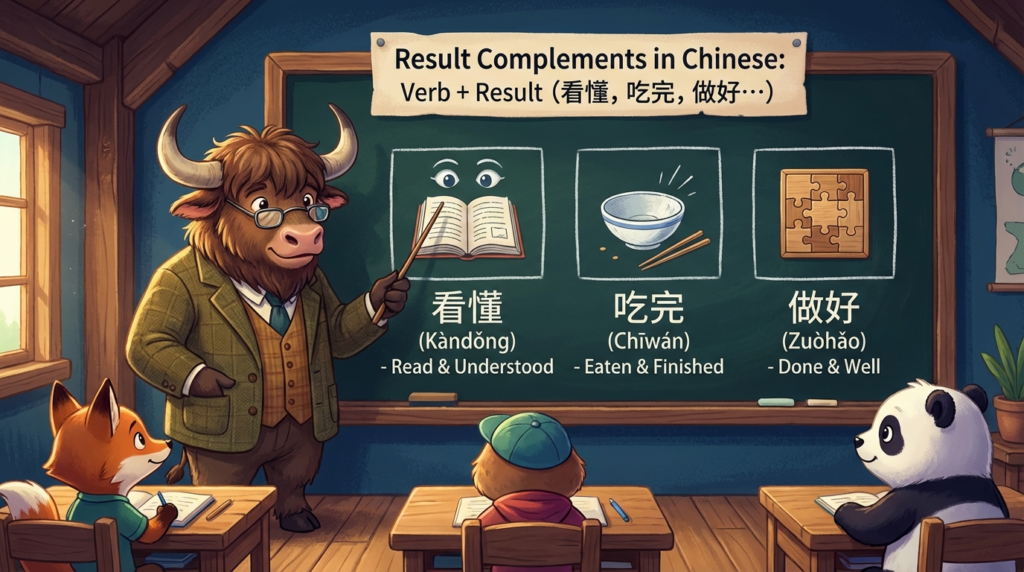
Core idea: 動作(verb) + 結果(result). Like: 看懂 (kàn dǒng) “read and understand,” 吃完 (chī wán) “eat and finish,” 做好 (zuò hǎo) “do and get it done well.”
Yak Snark Box: If you only say 我看書 (Wǒ kàn shū) “I read books,” people still don’t know if you understood anything or just stared dramatically at paper. Result complements fix that. You’re welcome.
What Result Complements Do
A result complement answers: What happened after the action? It’s not just “do the verb,” it’s “do the verb and reach a result.”
Basic Pattern: V + R
看懂 (kàn dǒng) = 看 (kàn) “to read/look” + 懂 (dǒng) “to understand” → “read and understand”
吃完 (chī wán) = 吃 (chī) “to eat” + 完 (wán) “to finish” → “eat it up / finish eating”
做好 (zuò hǎo) = 做 (zuò) “to do” + 好 (hǎo) “done well / ready” → “finish properly”
Quick Visual Cards: 8 High-Utility Verb + Result Combos
看懂 (kàn dǒng)
understand what you read
我終於看懂說明書了。
Wǒ zhōngyú kàn dǒng shuōmíngshū le.
I finally understood the manual.
聽懂 (tīng dǒng)
understand what you hear
你剛剛說的我沒聽懂。
Nǐ gānggāng shuō de wǒ méi tīng dǒng.
I didn’t understand what you just said.
吃完 (chī wán)
finish eating
我三分鐘就吃完了。
Wǒ sān fēnzhōng jiù chī wán le.
I finished eating in three minutes.
寫完 (xiě wán)
finish writing
我還沒寫完作業。
Wǒ hái méi xiě wán zuòyè.
I haven’t finished my homework yet.
做好 (zuò hǎo)
finish properly / get ready
我已經做好準備了。
Wǒ yǐjīng zuò hǎo zhǔnbèi le.
I’m ready (I’ve made the preparations well).
找到 (zhǎo dào)
find (successfully)
我終於找到鑰匙了。
Wǒ zhōngyú zhǎo dào yàoshi le.
I finally found the keys.
記住 (jì zhù)
remember (and keep it)
這句話你要記住。
Zhè jù huà nǐ yào jì zhù.
You need to remember this sentence.
學會 (xué huì)
learn (successfully)
我終於學會騎腳踏車了。
Wǒ zhōngyú xué huì qí jiǎotàchē le.
I finally learned how to ride a bike.
The 3 Must-Know Forms: Affirmative, Negative, Potential
| Form | Pattern | Meaning | Example (ZH) | Example (Pinyin) | Translation (EN) |
|---|---|---|---|---|---|
| Affirmative | V + R | Did it and got the result | 我看懂了。 | Wǒ kàn dǒng le. | I understood it. |
| Negative (past) | 沒(有) + V + R | Didn’t achieve the result (yet / at all) | 我沒看懂。 | Wǒ méi kàn dǒng. | I didn’t understand it. |
| Potential | V 得 R / V 不 R | Can / can’t achieve the result | 我看得懂 / 我看不懂。 | Wǒ kàn de dǒng / Wǒ kàn bù dǒng. | I can / can’t understand (by reading). |
Key tip: Use 沒(有) for “didn’t (happen)” in the past. Use 不 for general “won’t / don’t / can’t (as a fact or habit).”
我今天太累了,所以看不懂。
Wǒ jīntiān tài lèi le, suǒyǐ kàn bù dǒng.
I’m too tired today, so I can’t understand it (right now).
Useful Result Complements You’ll Use Constantly
Understanding & Learning
- 懂 (dǒng) — understand
看懂 (kàn dǒng) — understand what you read
這一段我還是看不懂。
Zhè yí duàn wǒ háishì kàn bù dǒng.
I still can’t understand this paragraph. - 清楚 (qīngchǔ) — clearly
聽清楚 (tīng qīngchǔ) — hear clearly
你可以再說一次嗎?我沒聽清楚。
Nǐ kěyǐ zài shuō yí cì ma? Wǒ méi tīng qīngchǔ.
Can you say it again? I didn’t hear clearly. - 明白 (míngbái) — understand (get it)
弄明白 (nòng míngbái) — figure it out
我一定要把規則弄明白。
Wǒ yídìng yào bǎ guīzé nòng míngbái.
I must figure out the rules. - 會 (huì) — know how to / be able to
學會 (xué huì) — learn (successfully)
我希望你今天就學會這個用法。
Wǒ xīwàng nǐ jīntiān jiù xué huì zhège yòngfǎ.
I hope you learn this usage today.
Finishing & Completing
- 完 (wán) — finish (up)
吃完 (chī wán) — finish eating
我還沒吃完,你先走。
Wǒ hái méi chī wán, nǐ xiān zǒu.
I haven’t finished eating; you go first. - 好 (hǎo) — done well / ready
做好 (zuò hǎo) — get it done properly / get ready
報告我已經做好了。
Bàogào wǒ yǐjīng zuò hǎo le.
I’ve finished the report (properly). - 到 (dào) — reach / obtain (result reached)
買到 (mǎi dào) — manage to buy (successfully)
我終於買到票了!
Wǒ zhōngyú mǎi dào piào le!
I finally managed to buy the ticket! - 住 (zhù) — hold steady / keep (often for “remember/stop/hold”)
記住 (jì zhù) — remember and keep it
這個電話號碼你記得住嗎?
Zhège diànhuà hàomǎ nǐ jì de zhù ma?
Can you remember this phone number?
Finding, Fixing, Cleaning, Breaking (Real Life Stuff)
- 到 (dào) — reach/obtain
找到 (zhǎo dào) — find (successfully)
你找到停車位了嗎?
Nǐ zhǎo dào tíngchēwèi le ma?
Did you find a parking spot? - 好 (hǎo) — fixed/ready
修好 (xiū hǎo) — fix (successfully)
手機修好了,你可以來拿。
Shǒujī xiū hǎo le, nǐ kěyǐ lái ná.
The phone is fixed; you can come pick it up. - 乾淨 (gānjìng) — clean
擦乾淨 (cā gānjìng) — wipe clean
桌子你擦乾淨了嗎?
Zhuōzi nǐ cā gānjìng le ma?
Did you wipe the table clean? - 破 (pò) — broken (into pieces / damaged)
打破 (dǎ pò) — break (something) accidentally
我不小心把杯子打破了。
Wǒ bù xiǎoxīn bǎ bēizi dǎ pò le.
I accidentally broke the cup. - 壞 (huài) — broken (not working / ruined)
弄壞 (nòng huài) — mess up / break (something)
別亂按,會把它弄壞。
Bié luàn àn, huì bǎ tā nòng huài.
Don’t press randomly; you’ll break it. - 錯 (cuò) — wrong
寫錯 (xiě cuò) — write incorrectly
我把日期寫錯了。
Wǒ bǎ rìqí xiě cuò le.
I wrote the date wrong.
10+ Real-Life Sentences You Can Steal Immediately
1) 看懂 (kàn dǒng) — understand what you read
我看懂你的意思了。
Wǒ kàn dǒng nǐ de yìsi le.
I understand what you mean.
2) 聽懂 (tīng dǒng) — understand what you hear
不好意思,我真的聽不懂。
Bù hǎoyìsi, wǒ zhēn de tīng bù dǒng.
Sorry, I really don’t understand.
3) 說清楚 (shuō qīngchǔ) — explain clearly
你可以說清楚一點嗎?
Nǐ kěyǐ shuō qīngchǔ yìdiǎn ma?
Can you explain a bit more clearly?
4) 想起來 (xiǎng qǐlái) — remember suddenly
我突然想起來了!
Wǒ tūrán xiǎng qǐlái le!
I suddenly remembered!
5) 記住 (jì zhù) — remember and keep it
密碼你一定要記住。
Mìmǎ nǐ yídìng yào jì zhù.
You must remember the password.
6) 找到 (zhǎo dào) — find (successfully)
你終於找到工作了,太好了!
Nǐ zhōngyú zhǎo dào gōngzuò le, tài hǎo le!
You finally found a job—awesome!
7) 看到 (kàn dào) — see / catch sight of
我剛剛看到他走進去。
Wǒ gānggāng kàn dào tā zǒu jìnqù.
I just saw him walk in.
8) 做完 (zuò wán) — finish doing
你做完再休息。
Nǐ zuò wán zài xiūxí.
Rest after you finish.
9) 寫好 (xiě hǎo) — finish writing / write it well and ready
我把地址寫好了。
Wǒ bǎ dìzhǐ xiě hǎo le.
I’ve written the address down (it’s ready).
10) 準備好 (zhǔnbèi hǎo) — get fully ready
你準備好了嗎?我們要出發了。
Nǐ zhǔnbèi hǎo le ma? Wǒmen yào chūfā le.
Are you ready? We’re leaving.
11) 吃飽 (chī bǎo) — eat until full
我吃飽了,不用再點。
Wǒ chī bǎo le, búyòng zài diǎn.
I’m full; no need to order more.
12) 睡著 (shuì zháo) — fall asleep (successfully)
他太累了,一下就睡著了。
Tā tài lèi le, yíxià jiù shuì zháo le.
He was so tired; he fell asleep immediately.
13) 站住 (zhàn zhù) — stop (and stay stopped) / “Stop!”
站住!你還沒付錢。
Zhàn zhù! Nǐ hái méi fù qián.
Stop! You haven’t paid yet.
14) 拿出來 (ná chūlái) — take out (and bring it out)
請把證件拿出來。
Qǐng bǎ zhèngjiàn ná chūlái.
Please take out your ID.
15) 刪掉 (shān diào) — delete (remove completely)
這個檔案我不小心刪掉了。
Zhège dǎng’àn wǒ bù xiǎoxīn shān diào le.
I accidentally deleted this file.
Curious Bit: “到” vs “好” vs “完” (Why So Many?)
完 (wán) focuses on finishing the action: 吃完、寫完、做完 (finish eating/writing/doing).
好 (hǎo) focuses on “done properly / ready”: 做好、準備好、修好、寫好 (done well, ready to use).
到 (dào) focuses on successfully reaching/obtaining: 找到、買到、聽到、看到 (managed to find/buy/hear/see).
Tables Of Words (Grouped, Not A Giant Mess)
Group 1: Understanding & Clarity
| Hanzi | Pinyin | Meaning | Example (ZH) | Example (Pinyin) | Translation (EN) |
|---|---|---|---|---|---|
| 看懂 | kàn dǒng | understand (by reading) | 我終於看懂了。 | Wǒ zhōngyú kàn dǒng le. | I finally understood. |
| 聽懂 | tīng dǒng | understand (by listening) | 他講太快,我聽不懂。 | Tā jiǎng tài kuài, wǒ tīng bù dǒng. | He talks too fast; I can’t understand. |
| 說清楚 | shuō qīngchǔ | explain clearly | 請你說清楚一點。 | Qǐng nǐ shuō qīngchǔ yìdiǎn. | Please explain more clearly. |
| 弄明白 | nòng míngbái | figure out | 我想把這題弄明白。 | Wǒ xiǎng bǎ zhè tí nòng míngbái. | I want to figure this question out. |
Group 2: Finishing & Readiness
| Hanzi | Pinyin | Meaning | Example (ZH) | Example (Pinyin) | Translation (EN) |
|---|---|---|---|---|---|
| 吃完 | chī wán | finish eating | 我還沒吃完。 | Wǒ hái méi chī wán. | I haven’t finished eating. |
| 寫完 | xiě wán | finish writing | 我今晚一定寫完。 | Wǒ jīnwǎn yídìng xiě wán. | I’ll definitely finish writing tonight. |
| 做好 | zuò hǎo | do well / get ready | 我都做好了。 | Wǒ dōu zuò hǎo le. | I’ve got it all done. |
| 準備好 | zhǔnbèi hǎo | be fully ready | 我們準備好了。 | Wǒmen zhǔnbèi hǎo le. | We’re ready. |
Group 3: Success, Fixing, Cleaning, Mistakes
| Hanzi | Pinyin | Meaning | Example (ZH) | Example (Pinyin) | Translation (EN) |
|---|---|---|---|---|---|
| 找到 | zhǎo dào | find successfully | 我找到你要的資料了。 | Wǒ zhǎo dào nǐ yào de zīliào le. | I found the info you wanted. |
| 買到 | mǎi dào | manage to buy | 我沒買到票。 | Wǒ méi mǎi dào piào. | I didn’t manage to buy tickets. |
| 修好 | xiū hǎo | fix successfully | 電腦修好了。 | Diànnǎo xiū hǎo le. | The computer is fixed. |
| 擦乾淨 | cā gānjìng | wipe clean | 請把桌子擦乾淨。 | Qǐng bǎ zhuōzi cā gānjìng. | Please wipe the table clean. |
| 寫錯 | xiě cuò | write wrong | 你把名字寫錯了。 | Nǐ bǎ míngzi xiě cuò le. | You wrote the name wrong. |
Optional Variants Table: Potential Forms You’ll Hear Everywhere
| Type | Hanzi | Pinyin | Meaning | Example (ZH) | Example (Pinyin) | Translation (EN) |
|---|---|---|---|---|---|---|
| Can | 看得懂 | kàn de dǒng | can understand (by reading) | 這本書我看得懂。 | Zhè běn shū wǒ kàn de dǒng. | I can understand this book. |
| Can’t | 看不懂 | kàn bù dǒng | can’t understand | 醫生寫的字我看不懂。 | Yīshēng xiě de zì wǒ kàn bù dǒng. | I can’t read the doctor’s handwriting. |
| Can | 記得住 | jì de zhù | can remember (and keep it) | 這串數字我記得住。 | Zhè chuàn shùzì wǒ jì de zhù. | I can remember this string of numbers. |
| Can’t | 記不住 | jì bù zhù | can’t remember | 我真的記不住名字。 | Wǒ zhēn de jì bù zhù míngzi. | I really can’t remember names. |
Practice: Quick Drills (No Tears Needed)
Drill 1: Choose 完, 好, or 到
- 我還沒吃____。
Wǒ hái méi chī ____.
(Answer: 完 wán) - 我終於買____票了。
Wǒ zhōngyú mǎi ____ piào le.
(Answer: 到 dào) - 報告我已經做____了。
Bàogào wǒ yǐjīng zuò ____ le.
(Answer: 好 hǎo)
Drill 2: Turn It Into Potential (Can/Can’t)
Rewrite using V 得 R / V 不 R:
- 我看懂這篇文章。
Wǒ kàn dǒng zhè piān wénzhāng.
→ 我______這篇文章。
→ Wǒ ____ zhè piān wénzhāng.
(Possible answers: 看得懂 / 看不懂) - 我記住他的電話。
Wǒ jì zhù tā de diànhuà.
→ 我______他的電話。
→ Wǒ ____ tā de diànhuà.
(Possible answers: 記得住 / 記不住)
Common Mistakes (And The Fast Fix)
- Mistake: Using 不 for a past result you didn’t achieve.
Fix: Use 沒(有).
我不看懂。 (odd for past) → 我沒看懂。
Wǒ bù kàn dǒng. → Wǒ méi kàn dǒng.
I didn’t understand. - Mistake: Forgetting the result and sounding vague.
Fix: Add the result complement.
我寫了報告。→ 我把報告寫完了。
Wǒ xiě le bàogào. → Wǒ bǎ bàogào xiě wán le.
I wrote the report. → I finished the report. - Mistake: Mixing “finish” and “ready.”
Fix: 完 = finished; 好 = done properly/ready.
飯吃完了。
Fàn chī wán le.
The meal is finished.
都準備好了。
Dōu zhǔnbèi hǎo le.
Everything is ready.
Quick Reference Summary
- Verb + Result = action + outcome (看懂、吃完、做好)
- Past negative: 沒(有) + V + R (沒看懂、沒買到)
- Potential: V 得 R / V 不 R (看得懂 / 看不懂)
- 完 = finished; 好 = done well/ready; 到 = successfully reached/obtained
Final Yak Box: Want to sound natural fast? Stop saying “I did X” and start saying “I did X and here’s what happened.” That’s the whole magic of 結果補語 (jiéguǒ bǔyǔ). Next time you study, try upgrading three boring verbs into result complements: 看→看懂, 寫→寫完, 做→做好.
If you want, pick 5 verbs you use every day (eat, read, buy, find, remember) and pair each with a result complement. You’ll get useful sentences immediately—and yes, people will finally know whether you actually finished the thing.