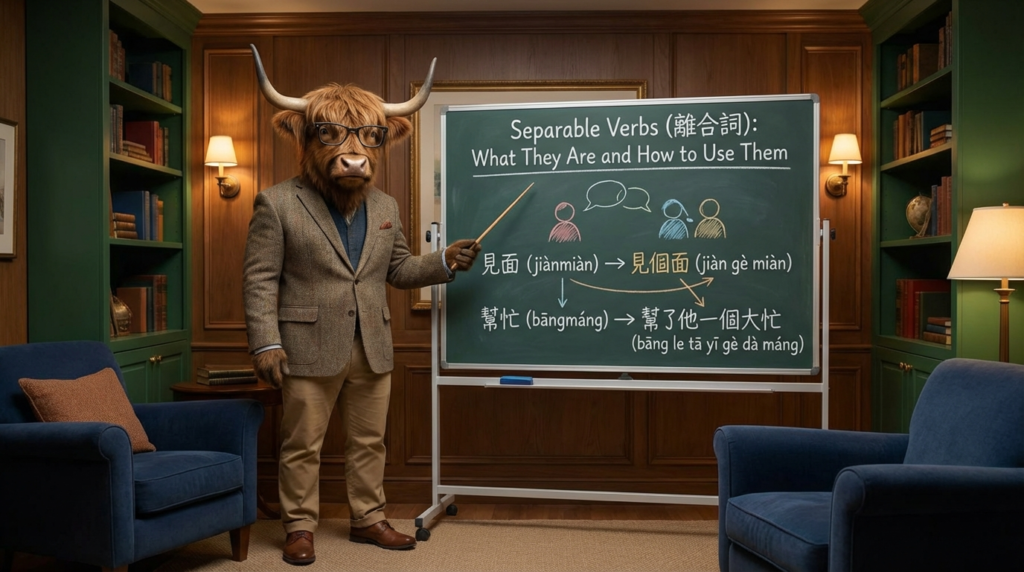
Separable Verbs (離合詞): What They Are and How to Use Them
Beginner-friendly explanation + tons of real sentences 離合詞(lí hé cí)
You’ll learn what “separable verbs” are, why 了 loves to jump into the middle, and how to sound natural with characters, pinyin, and examples you can steal.
Goal: split them correctly without memorizing grammar essays.
In Chinese, some two-syllable “verbs” are secretly verb + object glued together. They look like one word, but grammar treats them like a tiny phrase.
Those are 離合詞 (separable verbs).
The payoff: once you know the split, you can use 了 / 過 / 著, add numbers, add “a little bit,” and talk like a real human—using Traditional Chinese, pinyin, and copy-ready sentences.
Yak Snark
If you’ve ever said something like “我洗澡了” and felt vaguely guilty (even though people say it), welcome.
离合詞 are basically Chinese saying: “Yes, it’s one word… except when it isn’t.” Cool. Cool cool cool.
What separable verbs (離合詞) really are
A separable verb is a fixed combo like 洗澡 (wash + bath) or 睡覺 (sleep + sleep). The second character behaves like an object.
That’s why you often put grammar stuff between the two characters.
Common inserts: 了 / 過 / 著
Also inserts: 一下 / 一點 / 數量詞
Often needed: 個 / 次 / 頓 / 覺 / 盤…
我洗了澡就睡覺。
Wǒ xǐ le zǎo jiù shuì jiào.
I took a shower and then went to sleep.
我洗澡了就睡覺。
Wǒ xǐ zǎo le jiù shuì jiào.
You may hear this, but the safer “textbook-correct” pattern is putting 了 in the middle: 洗了澡.
Quick rule of thumb: if you can naturally say things like “one time / one meal / for two hours” with it, you’re probably dealing with a separable verb.
Quick wins: 8 separable verbs you’ll use daily
Tap the audio buttons to hear the Hanzi in Taiwan Mandarin (zh-TW).
我先洗個澡。
Wǒ xiān xǐ gè zǎo.
I’ll take a quick shower first.
我昨晚睡了一覺就好多了。
Wǒ zuó wǎn shuì le yí jiào jiù hǎo duō le.
After sleeping, I felt much better.
我們先吃頓飯再聊。
Wǒ men xiān chī dùn fàn zài liáo.
Let’s eat first, then talk.
我六點起了床。
Wǒ liù diǎn qǐ le chuáng.
I got up at six.
我剛打了電話給他。
Wǒ gāng dǎ le diàn huà gěi tā.
I just called him.
我們週末見個面吧。
Wǒ men zhōu mò jiàn gè miàn ba.
Let’s meet up this weekend.
我今天開了兩個會。
Wǒ jīn tiān kāi le liǎng gè huì.
I had two meetings today.
我們下午逛了逛街。
Wǒ men xià wǔ guàng le guàng jiē.
We browsed around (went shopping) this afternoon.
How to use separable verbs without face-planting
The “split” happens when you add grammar or extra info. Here are the patterns you’ll use constantly.
洗了澡
Xǐ le zǎo
Pattern: V + 了 + O (completed action)
Meaning: “took a shower.”
睡了一覺
Shuì le yí jiào
Pattern: V + 了 + 一 + 量詞 + O (one “unit”)
Meaning: “slept once / took a nap.”
吃了頓飯
Chī le dùn fàn
Pattern: V + 了 + 量詞 + O (countable event)
Meaning: “ate a meal.”
見過面
Jiàn guò miàn
Pattern: V + 過 + O (have done before)
Meaning: “have met before.”
聊了一會兒天
Liáo le yí huìr tiān
Pattern: V + 了 + 時間 + O (duration)
Meaning: “chatted for a while.”
幫了我一個忙
Bāng le wǒ yí gè máng
Pattern: V + 了 + 人 + 量詞 + O (who you did it for)
Meaning: “did me a favor.”
道個歉
Dào gè qiàn
Pattern: V + 個 + O (do it once, casually)
Meaning: “apologize (quickly).”
排了半小時隊
Pái le bàn xiǎo shí duì
Pattern: V + 了 + 時間 + O (yes, line-waiting counts)
Meaning: “queued for half an hour.”
Two ultra-practical “don’t overthink it” tips
1) If you want to add 了, put it between the two characters when possible.
2) If the action feels countable, add a measure word (個 / 次 / 頓 / 覺 / 盤…).
我洗了個熱水澡。
Wǒ xǐ le yí gè rè shuǐ zǎo.
I took a hot shower.
我吃了兩頓飯。
Wǒ chī le liǎng dùn fàn.
I ate two meals.
More separable verbs (grouped, with examples)
Every item below includes Traditional Chinese, pinyin, meaning, and a sentence that shows the split in real life.
Daily routine
| Traditional Chinese | Pinyin | Meaning (EN) | Example (ZH) | Translation (EN) | Audio |
|---|---|---|---|---|---|
做夢 zuò mèng | zuò mèng | to dream | 我昨晚做了一個怪夢。Wǒ zuó wǎn zuò le yí gè guài mèng. | I had a weird dream last night. | |
洗臉 xǐ liǎn | xǐ liǎn | to wash one’s face | 我起床後先洗了臉。Wǒ qǐ chuáng hòu xiān xǐ le liǎn. | After getting up, I washed my face first. | |
刷牙 shuā yá | shuā yá | to brush teeth | 出門前我刷了牙。Chū mén qián wǒ shuā le yá. | I brushed my teeth before going out. | |
洗手 xǐ shǒu | xǐ shǒu | to wash hands | 進門先洗了手。Jìn mén xiān xǐ le shǒu. | Wash your hands first when you come in. | |
洗頭 xǐ tóu | xǐ tóu | to wash hair | 我今天洗了頭。Wǒ jīn tiān xǐ le tóu. | I washed my hair today. | |
梳頭 shū tóu | shū tóu | to comb hair | 她梳了頭就出門了。Tā shū le tóu jiù chū mén le. | She combed her hair and then went out. | |
理髮 lǐ fà | lǐ fà | to get a haircut | 我週末理了個髮。Wǒ zhōu mò lǐ le gè fà. | I got a haircut on the weekend. | |
刮鬍子 guā hú zi | guā hú zi | to shave (beard) | 他早上刮了鬍子。Tā zǎo shàng guā le hú zi. | He shaved in the morning. | |
化妝 huà zhuāng | huà zhuāng | to put on makeup | 她化了妝,看起來很精神。Tā huà le zhuāng, kàn qǐ lái hěn jīng shén. | She put on makeup and looks energized. | |
卸妝 xiè zhuāng | xiè zhuāng | to remove makeup | 回家後我先卸了妝。Huí jiā hòu wǒ xiān xiè le zhuāng. | After getting home, I removed my makeup first. | |
換衣服 huàn yī fu | huàn yī fu | to change clothes | 我換了衣服再出門。Wǒ huàn le yī fu zài chū mén. | I’ll change clothes before going out. | |
上廁所 shàng cè suǒ | shàng cè suǒ | to use the restroom | 我去上個廁所。Wǒ qù shàng gè cè suǒ. | I’m going to the restroom. | |
睡午覺 shuì wǔ jiào | shuì wǔ jiào | to take a nap | 我中午睡了個午覺。Wǒ zhōng wǔ shuì le gè wǔ jiào. | I took a nap at noon. | |
發呆 fā dāi | fā dāi | to space out | 他在窗邊發了會兒呆。Tā zài chuāng biān fā le huìr dāi. | He spaced out by the window for a while. |
Food & around the house
| Traditional Chinese | Pinyin | Meaning (EN) | Example (ZH) | Translation (EN) | Audio |
|---|---|---|---|---|---|
做飯 zuò fàn | zuò fàn | to cook (a meal) | 我今晚做了飯,別點外送。Wǒ jīn wǎn zuò le fàn, bié diǎn wài sòng. | I cooked tonight—no delivery. | |
買菜 mǎi cài | mǎi cài | to buy groceries | 我下班後買了菜。Wǒ xià bān hòu mǎi le cài. | I bought groceries after work. | |
點菜 diǎn cài | diǎn cài | to order food | 你先點個菜,我去拿水。Nǐ xiān diǎn gè cài, wǒ qù ná shuǐ. | You order first; I’ll get water. | |
結帳 jié zhàng | jié zhàng | to pay / check out | 我來結個帳。Wǒ lái jié gè zhàng. | I’ll pay the bill. | |
洗碗 xǐ wǎn | xǐ wǎn | to wash dishes | 吃完飯我洗了碗。Chī wán fàn wǒ xǐ le wǎn. | I washed the dishes after eating. | |
打掃 dǎ sǎo | dǎ sǎo | to clean / tidy up | 週末我們打掃了房間。Zhōu mò wǒ men dǎ sǎo le fáng jiān. | We cleaned the room on the weekend. |
Work & school
| Traditional Chinese | Pinyin | Meaning (EN) | Example (ZH) | Translation (EN) | Audio |
|---|---|---|---|---|---|
上班 shàng bān | shàng bān | to go to work | 我八點上了班。Wǒ bā diǎn shàng le bān. | I started work at 8. | |
下班 xià bān | xià bān | to get off work | 我六點下了班。Wǒ liù diǎn xià le bān. | I got off work at 6. | |
加班 jiā bān | jiā bān | to work overtime | 這週我加了三天班。Zhè zhōu wǒ jiā le sān tiān bān. | I worked overtime three days this week. | |
請假 qǐng jià | qǐng jià | to take leave | 我今天請了假。Wǒ jīn tiān qǐng le jià. | I took leave today. | |
放假 fàng jià | fàng jià | to have a holiday / be off | 公司下週放三天假。Gōng sī xià zhōu fàng sān tiān jià. | The company is off for three days next week. | |
上課 shàng kè | shàng kè | to attend class | 我早上上了兩節課。Wǒ zǎo shàng shàng le liǎng jié kè. | I had two classes in the morning. | |
下課 xià kè | xià kè | to finish class | 下了課我們去吃飯。Xià le kè wǒ men qù chī fàn. | After class, we went to eat. | |
上學 shàng xué | shàng xué | to go to school | 他七點半上了學。Tā qī diǎn bàn shàng le xué. | He went to school at 7:30. | |
放學 fàng xué | fàng xué | to get out of school | 放了學我就回家。Fàng le xué wǒ jiù huí jiā. | I went home after school. | |
考試 kǎo shì | kǎo shì | to take an exam | 我剛考了試,腦袋空空。Wǒ gāng kǎo le shì, nǎo dài kōng kōng. | I just took an exam—my brain is empty. | |
做作業 zuò zuò yè | zuò zuò yè | to do homework | 我做了作業才睡覺。Wǒ zuò le zuò yè cái shuì jiào. | I slept only after doing my homework. | |
交作業 jiāo zuò yè | jiāo zuò yè | to hand in homework | 我已經交了作業。Wǒ yǐ jīng jiāo le zuò yè. | I already handed in the homework. | |
翹課 qiào kè | qiào kè | to skip class | 他昨天翹了一堂課。Tā zuó tiān qiào le yì táng kè. | He skipped one class yesterday. | |
報名 bào míng | bào míng | to sign up / register | 我上週報了名。Wǒ shàng zhōu bào le míng. | I registered last week. | |
報到 bào dào | bào dào | to check in / report | 我到了就先報了到。Wǒ dào le jiù xiān bào le dào. | I checked in as soon as I arrived. | |
簽名 qiān míng | qiān míng | to sign (name) | 請在這裡簽個名。Qǐng zài zhè lǐ qiān gè míng. | Please sign here. | |
蓋章 gài zhāng | gài zhāng | to stamp (a seal) | 麻煩在這裡蓋個章。Má fán zài zhè lǐ gài gè zhāng. | Please stamp here. |
Social & communication
| Traditional Chinese | Pinyin | Meaning (EN) | Example (ZH) | Translation (EN) | Audio |
|---|---|---|---|---|---|
聊天 liáo tiān | liáo tiān | to chat | 我跟朋友聊了半小時天。Wǒ gēn péng yǒu liáo le bàn xiǎo shí tiān. | I chatted with a friend for half an hour. | |
發短信 fā duǎn xìn | fā duǎn xìn | to text / send an SMS | 我給他發了短信。Wǒ gěi tā fā le duǎn xìn. | I texted him. | |
留言 liú yán | liú yán | to leave a message/comment | 我在貼文下面留了言。Wǒ zài tiē wén xià miàn liú le yán. | I left a comment under the post. | |
打招呼 dǎ zhāo hu | dǎ zhāo hu | to greet / say hi | 我們見面先打了招呼。Wǒ men jiàn miàn xiān dǎ le zhāo hu. | We greeted each other when we met. | |
握手 wò shǒu | wò shǒu | to shake hands | 他跟我握了手。Tā gēn wǒ wò le shǒu. | He shook my hand. | |
道歉 dào qiàn | dào qiàn | to apologize | 他已經道了歉。Tā yǐ jīng dào le qiàn. | He already apologized. | |
吵架 chǎo jià | chǎo jià | to argue | 他們昨天吵了一架。Tā men zuó tiān chǎo le yí jià. | They had an argument yesterday. | |
約會 yuē huì | yuē huì | to go on a date | 我們週五約個會吧。Wǒ men zhōu wǔ yuē gè huì ba. | Let’s go on a date Friday. | |
求婚 qiú hūn | qiú hūn | to propose (marriage) | 他在海邊求了婚。Tā zài hǎi biān qiú le hūn. | He proposed by the sea. | |
結婚 jié hūn | jié hūn | to get married | 他們去年結了婚。Tā men qù nián jié le hūn. | They got married last year. | |
離婚 lí hūn | lí hūn | to divorce | 他們兩年前離了婚。Tā men liǎng nián qián lí le hūn. | They divorced two years ago. | |
談戀愛 tán liàn ài | tán liàn ài | to date / be in a relationship | 他們談了戀愛就很低調。Tā men tán le liàn ài jiù hěn dī diào. | After they started dating, they kept it low-key. | |
幫忙 bāng máng | bāng máng | to help | 你能幫個忙嗎?Nǐ néng bāng gè máng ma? | Can you help me out? | |
請客 qǐng kè | qǐng kè | to treat (pay for others) | 他請了客,我們就別搶付錢。Tā qǐng le kè, wǒ men jiù bié qiǎng fù qián. | He treated us, so don’t fight to pay. | |
送禮 sòng lǐ | sòng lǐ | to give a gift | 我送了禮就走。Wǒ sòng le lǐ jiù zǒu. | I gave the gift and left. | |
借錢 jiè qián | jiè qián | to borrow money | 他又借了錢。Tā yòu jiè le qián. | He borrowed money again. | |
還錢 huán qián | huán qián | to pay back money | 他終於還了錢。Tā zhōng yú huán le qián. | He finally paid back the money. | |
敬酒 jìng jiǔ | jìng jiǔ | to toast (offer a drink) | 他敬了酒,大家都笑了。Tā jìng le jiǔ, dà jiā dōu xiào le. | He made a toast and everyone laughed. | |
拜年 bài nián | bài nián | to pay New Year visits | 過年我們去拜了年。Guò nián wǒ men qù bài le nián. | We paid New Year visits during the holiday. | |
鼓掌 gǔ zhǎng | gǔ zhǎng | to applaud | 大家鼓了掌。Dà jiā gǔ le zhǎng. | Everyone applauded. | |
鞠躬 jū gōng | jū gōng | to bow | 他鞠了躬表示感謝。Tā jū le gōng biǎo shì gǎn xiè. | He bowed to show thanks. |
Leisure & getting around
| Traditional Chinese | Pinyin | Meaning (EN) | Example (ZH) | Translation (EN) | Audio |
|---|---|---|---|---|---|
散步 sàn bù | sàn bù | to take a walk | 我們晚飯後散了步。Wǒ men wǎn fàn hòu sàn le bù. | We took a walk after dinner. | |
爬山 pá shān | pá shān | to hike / climb a mountain | 週末我爬了山,腿超酸。Zhōu mò wǒ pá le shān, tuǐ chāo suān. | I hiked on the weekend—my legs are so sore. | |
游泳 yóu yǒng | yóu yǒng | to swim | 我昨天下午游了泳。Wǒ zuó tiān xià wǔ yóu le yǒng. | I swam yesterday afternoon. | |
跑步 pǎo bù | pǎo bù | to run / jog | 我早上跑了步。Wǒ zǎo shàng pǎo le bù. | I went for a run this morning. | |
跳舞 tiào wǔ | tiào wǔ | to dance | 他們跳了舞到很晚。Tā men tiào le wǔ dào hěn wǎn. | They danced until late. | |
唱歌 chàng gē | chàng gē | to sing | 我們唱了兩首歌。Wǒ men chàng le liǎng shǒu gē. | We sang two songs. | |
打球 dǎ qiú | dǎ qiú | to play ball (sports) | 我們打了球才回家。Wǒ men dǎ le qiú cái huí jiā. | We went home after playing. | |
踢球 tī qiú | tī qiú | to play soccer / kick a ball | 小孩在公園踢了球。Xiǎo hái zài gōng yuán tī le qiú. | The kid played soccer in the park. | |
下棋 xià qí | xià qí | to play chess (or board games) | 爺爺跟我下了一盤棋。Yé ye gēn wǒ xià le yì pán qí. | Grandpa played a game with me. | |
打牌 dǎ pái | dǎ pái | to play cards | 他們打了兩圈牌。Tā men dǎ le liǎng quān pái. | They played two rounds of cards. | |
拍照 pāi zhào | pāi zhào | to take photos | 我們在這裡拍了照。Wǒ men zài zhè lǐ pāi le zhào. | We took a photo here. | |
照相 zhào xiàng | zhào xiàng | to take a picture (more “camera-ish”) | 需要幫你們照個相嗎?Xū yào bāng nǐ men zhào gè xiàng ma? | Want me to take a picture for you? | |
開車 kāi chē | kāi chē | to drive | 我開了兩小時車。Wǒ kāi le liǎng xiǎo shí chē. | I drove for two hours. | |
搭車 dā chē | dā chē | to take a ride / take transport | 我搭了車去捷運站。Wǒ dā le chē qù jié yùn zhàn. | I took a ride to the MRT station. | |
坐飛機 zuò fēi jī | zuò fēi jī | to fly (take a plane) | 我坐了飛機來台北。Wǒ zuò le fēi jī lái Táiběi. | I flew to Taipei. | |
上車 shàng chē | shàng chē | to get on a vehicle | 大家上了車就出發。Dà jiā shàng le chē jiù chū fā. | Everyone got in and we left. | |
下車 xià chē | xià chē | to get off a vehicle | 到站我們就下了車。Dào zhàn wǒ men jiù xià le chē. | We got off at the stop. |
Errands, health & tech
| Traditional Chinese | Pinyin | Meaning (EN) | Example (ZH) | Translation (EN) | Audio |
|---|---|---|---|---|---|
看病 kàn bìng | kàn bìng | to see a doctor | 我今天去看了病。Wǒ jīn tiān qù kàn le bìng. | I went to see a doctor today. | |
掛號 guà hào | guà hào | to register (clinic) | 我先掛了號再排隊。Wǒ xiān guà le hào zài pái duì. | I registered first, then queued up. | |
打針 dǎ zhēn | dǎ zhēn | to get an injection | 我剛打了針。Wǒ gāng dǎ le zhēn. | I just got a shot. | |
吃藥 chī yào | chī yào | to take medicine | 你吃了藥沒?Nǐ chī le yào méi? | Did you take your medicine? | |
排隊 pái duì | pái duì | to line up / queue | 我排了半小時隊才買到。Wǒ pái le bàn xiǎo shí duì cái mǎi dào. | I queued for half an hour before I could buy it. | |
買票 mǎi piào | mǎi piào | to buy a ticket | 我已經買了票。Wǒ yǐ jīng mǎi le piào. | I already bought the ticket. | |
訂票 dìng piào | dìng piào | to book tickets | 我先訂了票。Wǒ xiān dìng le piào. | I booked the tickets first. | |
退票 tuì piào | tuì piào | to refund a ticket | 行程變了,我退了票。Xíng chéng biàn le, wǒ tuì le piào. | Plans changed, so I refunded the ticket. | |
訂房 dìng fáng | dìng fáng | to book a room | 我在網路上訂了房。Wǒ zài wǎng lù shàng dìng le fáng. | I booked a room online. | |
換錢 huàn qián | huàn qián | to exchange money | 出國前我換了錢。Chū guó qián wǒ huàn le qián. | I exchanged money before going abroad. | |
付錢 fù qián | fù qián | to pay | 我用卡付了錢。Wǒ yòng kǎ fù le qián. | I paid by card. | |
找錢 zhǎo qián | zhǎo qián | to give change | 店員找了錢給我。Diàn yuán zhǎo le qián gěi wǒ. | The clerk gave me change. | |
上網 shàng wǎng | shàng wǎng | to go online | 我上了網就回你。Wǒ shàng le wǎng jiù huí nǐ. | I’ll reply as soon as I’m online. | |
充電 chōng diàn | chōng diàn | to charge (a device) | 我先充個電。Wǒ xiān chōng gè diàn. | I’ll charge it first. | |
打字 dǎ zì | dǎ zì | to type | 我打了字又刪掉了。Wǒ dǎ le zì yòu shān diào le. | I typed it, then deleted it. | |
遛狗 liù gǒu | liù gǒu | to walk a dog | 我剛遛了狗。Wǒ gāng liù le gǒu. | I just walked the dog. | |
搬家 bān jiā | bān jiā | to move (house) | 我們上個月搬了家。Wǒ men shàng gè yuè bān le jiā. | We moved last month. | |
退貨 tuì huò | tuì huò | to return goods | 不合適我就退個貨。Bù hé shì wǒ jiù tuì gè huò. | If it doesn’t fit, I’ll return it. | |
換貨 huàn huò | huàn huò | to exchange goods | 尺寸不對,我換了貨。Chǐ cùn bù duì, wǒ huàn le huò. | The size was wrong, so I exchanged it. |
Common measure words & handy add-ons
If separable verbs had a love language, it would be measure words. Here are the most useful ones.
| Use with… | Common measure word | Meaning (EN) | Use it like (ZH + pinyin) | Translation (EN) | Audio |
|---|---|---|---|---|---|
洗澡 / 見面 / 道歉 xǐ zǎo / jiàn miàn / dào qiàn | 個 (gè) | a quick “one time” unit | 我去洗個澡。Wǒ qù xǐ gè zǎo. | I’m going to take a quick shower. | |
吃飯 chī fàn | 頓 (dùn) | a meal-counting unit | 我今天只吃了一頓飯。Wǒ jīn tiān zhǐ chī le yí dùn fàn. | I only ate one meal today. | |
睡覺 shuì jiào | 覺 (jiào) | one “sleep session” | 我想睡一覺。Wǒ xiǎng shuì yí jiào. | I want to sleep (take a nap). | |
吵架 chǎo jià | 架 (jià) | one argument/fight | 他們又吵了一架。Tā men yòu chǎo le yí jià. | They argued again. | |
下棋 xià qí | 盤 (pán) | one game (board/chess) | 我們下了一盤棋。Wǒ men xià le yì pán qí. | We played one game. | |
排隊 / 聊天 / 開車 pái duì / liáo tiān / kāi chē | 一會兒 (yí huìr) / 時間詞 | duration | 我聊了一會兒天就走。Wǒ liáo le yí huìr tiān jiù zǒu. | I chatted for a bit and then left. |
Yak Snark
If you remember just one thing: put 了 in the middle and add a measure word when it feels “countable.”
Congratulations. You now know more about 離合詞 than your past self who bravely said “我洗澡了” and hoped nobody noticed.