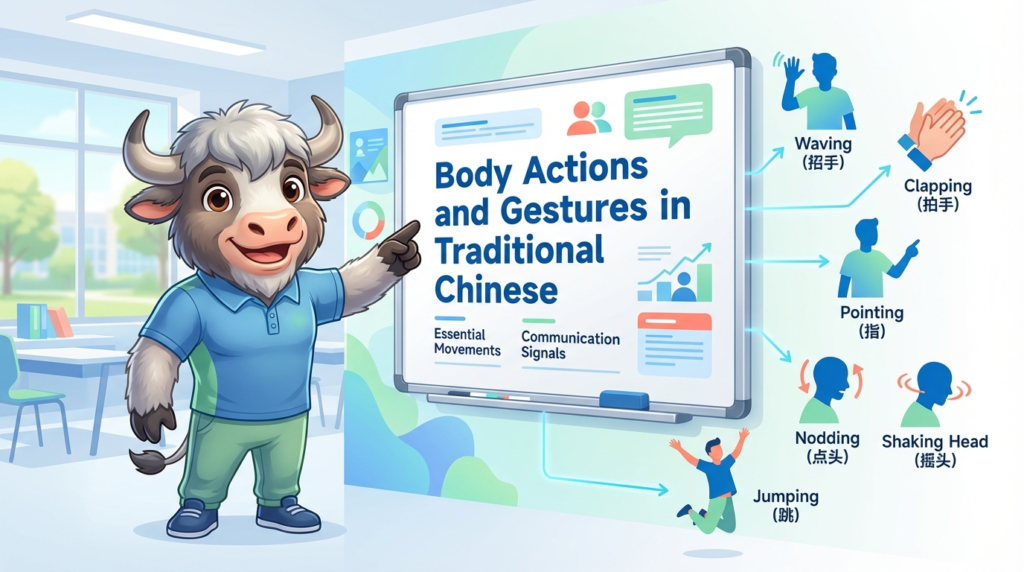
Body Actions and Gestures in Traditional Chinese
Learn the words people actually say when someone waves, nods, shrugs, or does that “what are you doing?” hand thing.
Traditional Chinese topic: 身體動作與手勢 (Shēntǐ dòngzuò yǔ shǒushì)
Here’s your practical, real-life list of Traditional Chinese body actions and gestures. Every item comes with characters, pinyin (tone marks), a clear meaning, and an example you can steal immediately.
Tap the audio buttons to hear Taiwan Mandarin (zh-TW). Your goal: stop relying on interpretive dance when you run out of words.
Quick Visual Cards
These are the high-utility moves you’ll see daily. Learn these first.
揮手
to wave
Tā zài chēzhàn duì wǒ huīshǒu.
He waved to me at the station.
點頭
to nod
Nǐ diǎntóu biǎoshì tóngyì.
You nod to show you agree.
搖頭
to shake your head
Tā yìzhí yáotóu, shuō bùxíng.
She kept shaking her head, saying “no.”
指著
to point at
Bié yòng shǒu zhǐzhe rén.
Don’t point at people.
鼓掌
to applaud
Dàjiā dōu wèi tā gǔzhǎng.
Everyone applauded for him.
擁抱
to hug
Tā gěi wǒ yí ge yǒngbào.
She gave me a hug.
眨眼
to blink / wink
Tā duì wǒ zhǎyǎn, biǎoshì méi wèntí.
He winked at me to show it’s fine.
招手
to beckon / wave someone over
Lǎobǎn zhāoshǒu jiào wǒmen jìnlái.
The boss beckoned us to come in.
Useful Phrases You’ll Actually Say
These are ready-to-use mini lines. Copy-paste them into real life (with your face attached).
揮手打招呼
Huīshǒu dǎ zhāohū
Wave hello / greet with a wave.
招手叫你過來
Zhāoshǒu jiào nǐ guòlái
Beckon you to come over.
點頭表示同意
Diǎntóu biǎoshì tóngyì
Nod to show agreement.
搖頭表示不同意
Yáotóu biǎoshì bù tóngyì
Shake your head to disagree.
伸出手握手
Shēnchū shǒu wòshǒu
Offer a handshake.
攤手表示不知道
Tānshǒu biǎoshì bù zhīdào
Open your hands to say “I don’t know.”
聳肩說「我不知道」
Sǒngjiān shuō “wǒ bù zhīdào”
Shrug and say “I don’t know.”
皺眉問「什麼意思?」
Zhòuméi wèn “shénme yìsi?”
Frown and ask “What does it mean?”
拍拍他的肩安慰他
Pāipai tā de jiān ānwèi tā
Pat his shoulder to comfort him.
退一步讓我過
Tuì yí bù ràng wǒ guò
Step back and let me pass.
靠近一點說話
Kàojìn yìdiǎn shuōhuà
Come a bit closer to talk.
別用手指著人
Bié yòng shǒu zhǐzhe rén
Don’t point at people.
在照片裡比V字手勢
Zài zhàopiàn lǐ bǐ V zì shǒushì
Flash a V sign in photos.
鞠躬道謝
Jūgōng dàoxiè
Bow to say thanks.
別比中指
Bié bǐ zhōngzhǐ
Don’t flip the middle finger. (Yes, it needs saying.)
A small but mighty Chinese detail
指 is “to point.” 指著 adds 著, which often feels like “pointing (at it / ongoing).” That’s why 別指著人 sounds like “don’t keep pointing at people.” Also, 比 in gestures (比V字手勢、比OK手勢、比中指) is basically “to make/show” with your hand—not the math “compare” vibe.
Word Tables
The rest of the useful vocabulary, grouped so your brain doesn’t rage-quit.
Hands & Arms
| Traditional Chinese | Pinyin | Meaning (EN) | Example (ZH) | Translation (EN) | Audio |
|---|---|---|---|---|---|
| 握手 | wòshǒu | to shake hands | 第一次見面,先握手。Dì yī cì jiànmiàn, xiān wòshǒu. | When meeting for the first time, shake hands first. | |
| 豎起大拇指 | shùqǐ dà mǔzhǐ | to give a thumbs-up | 他豎起大拇指說「很棒」。Tā shùqǐ dà mǔzhǐ shuō “hěn bàng”. | He gave a thumbs-up and said “Great.” | |
| OK手勢 | ōu kēi shǒushì | OK hand sign | 你比個OK手勢就好。Nǐ bǐ ge ōu kēi shǒushì jiù hǎo. | Just make an OK sign. | |
| V字手勢 | vī zì shǒushì | V sign (peace sign) | 拍照時她比V字手勢。Pāizhào shí tā bǐ vī zì shǒushì. | She flashed a V sign when taking a photo. | |
| 擺手 | bǎishǒu | to wave a hand (often “no / no need”) | 他擺手表示不用。Tā bǎishǒu biǎoshì búyòng. | He waved his hand to say “no need.” | |
| 拍手 | pāishǒu | to clap (general) | 小朋友拍手很開心。Xiǎopéngyǒu pāishǒu hěn kāixīn. | The kid clapped happily. | |
| 擊掌 | jīzhǎng | to high-five | 我們成功後擊掌慶祝。Wǒmen chénggōng hòu jīzhǎng qìngzhù. | We high-fived to celebrate after succeeding. | |
| 拍拍肩膀 | pāipai jiānbǎng | to pat someone’s shoulder | 老師拍拍我的肩膀。Lǎoshī pāipai wǒ de jiānbǎng. | The teacher patted my shoulder. | |
| 拍背 | pāi bèi | to pat someone’s back | 他咳嗽時,我輕輕拍背。Tā késòu shí, wǒ qīngqīng pāi bèi. | When he coughed, I gently patted his back. | |
| 牽手 | qiānshǒu | to hold hands | 他們在路上牽手走。Tāmen zài lùshàng qiānshǒu zǒu. | They walked holding hands. | |
| 摟住 | lǒuzhù | to put an arm around / hold close | 朋友摟住我拍照。Péngyǒu lǒuzhù wǒ pāizhào. | My friend put an arm around me for a photo. | |
| 抱住 | bàozhù | to hold / hug tightly | 她抱住孩子不放。Tā bàozhù háizi bù fàng. | She held the child and wouldn’t let go. | |
| 推開 | tuīkāi | to push away / push open | 他把門推開了。Tā bǎ mén tuīkāi le. | He pushed the door open. | |
| 拉住 | lāzhù | to pull / grab and hold | 我拉住他,免得他跌倒。Wǒ lāzhù tā, miǎnde tā diēdǎo. | I grabbed him so he wouldn’t fall. | |
| 伸出手 | shēnchū shǒu | to hold out your hand | 他伸出手要我把票給他。Tā shēnchū shǒu yào wǒ bǎ piào gěi tā. | He held out his hand for me to give him the ticket. | |
| 勾手指 | gōu shǒuzhǐ | to curl a finger (beckon) | 她勾手指叫我過去。Tā gōu shǒuzhǐ jiào wǒ guòqù. | She curled her finger to call me over. | |
| 握拳 | wòquán | to clench your fist | 他緊張得一直握拳。Tā jǐnzhāng de yìzhí wòquán. | He was so nervous he kept clenching his fists. | |
| 攤手 | tānshǒu | to spread your hands (“I don’t know”) | 我攤手表示不知道。Wǒ tānshǒu biǎoshì bù zhīdào. | I spread my hands to show I didn’t know. | |
| 交叉手指 | jiāochā shǒuzhǐ | to cross your fingers | 我交叉手指,希望有好消息。Wǒ jiāochā shǒuzhǐ, xīwàng yǒu hǎo xiāoxi. | I crossed my fingers, hoping for good news. | |
| 捂嘴 | wǔzuǐ | to cover your mouth | 她捂嘴偷笑。Tā wǔzuǐ tōuxiào. | She covered her mouth and giggled. | |
| 摀耳朵 | wū ěrduo | to cover your ears | 小孩摀耳朵,不想聽。Xiǎohái wū ěrduo, bù xiǎng tīng. | The kid covered his ears, not wanting to listen. | |
| 摸頭 | mōtóu | to touch someone’s head | 別隨便摸頭,會很失禮。Bié suíbiàn mōtóu, huì hěn shīlǐ. | Don’t randomly touch someone’s head; it’s rude. | |
| 搔頭 | sātóu | to scratch your head | 他一邊搔頭一邊想。Tā yìbiān sātóu yìbiān xiǎng. | He scratched his head while thinking. | |
| 指指點點 | zhǐzhǐ diǎndiǎn | to point and gossip / nitpick | 別在背後指指點點。Bié zài bèihòu zhǐzhǐ diǎndiǎn. | Don’t point and gossip behind people’s backs. |
Face & Head Expressions
| Traditional Chinese | Pinyin | Meaning (EN) | Example (ZH) | Translation (EN) | Audio |
|---|---|---|---|---|---|
| 微笑 | wēixiào | to smile | 她對客人微笑。Tā duì kèrén wēixiào. | She smiled at the guest. | |
| 大笑 | dàxiào | to laugh loudly | 聽到笑話他大笑。Tīngdào xiàohuà tā dàxiào. | He laughed loudly at the joke. | |
| 苦笑 | kǔxiào | to give an awkward / bitter smile | 他只能苦笑。Tā zhǐ néng kǔxiào. | He could only give an awkward smile. | |
| 皺眉 | zhòuméi | to frown | 我一聽就皺眉。Wǒ yì tīng jiù zhòuméi. | I frowned as soon as I heard it. | |
| 挑眉 | tiāoméi | to raise an eyebrow | 她挑眉問我「真的?」Tā tiāoméi wèn wǒ “zhēn de?” | She raised an eyebrow and asked “Really?” | |
| 翻白眼 | fān báiyǎn | to roll your eyes | 他聽完就翻白眼。Tā tīng wán jiù fān báiyǎn. | He rolled his eyes after hearing it. | |
| 眯眼 | mīyǎn | to squint | 太陽太亮,他眯眼看路。Tàiyáng tài liàng, tā mīyǎn kàn lù. | The sun was too bright; he squinted to see the road. | |
| 盯著 | dīngzhe | to stare at | 別一直盯著我看。Bié yìzhí dīngzhe wǒ kàn. | Don’t stare at me nonstop. | |
| 使眼色 | shǐ yǎnsè | to signal with your eyes | 她對我使眼色,要我別說。Tā duì wǒ shǐ yǎnsè, yào wǒ bié shuō. | She signaled me with her eyes not to speak. | |
| 嘟嘴 | dūzuǐ | to pout | 小孩不開心就嘟嘴。Xiǎohái bù kāixīn jiù dūzuǐ. | Kids pout when they’re unhappy. | |
| 撇嘴 | piězuǐ | to curl your lip (disdain) | 他撇嘴表示不屑。Tā piězuǐ biǎoshì bùxiè. | He curled his lip to show disdain. | |
| 抿嘴 | mǐnzuǐ | to press your lips together | 她抿嘴忍住笑。Tā mǐnzuǐ rěnzhù xiào. | She pressed her lips to hold back a laugh. | |
| 咬嘴唇 | yǎo zuǐchún | to bite your lip | 他緊張得咬嘴唇。Tā jǐnzhāng de yǎo zuǐchún. | He was so nervous he bit his lip. | |
| 吐舌頭 | tǔ shétou | to stick out your tongue | 她吐舌頭跟我開玩笑。Tā tǔ shétou gēn wǒ kāi wánxiào. | She stuck out her tongue joking with me. | |
| 打哈欠 | dǎ hāqian | to yawn | 他一直打哈欠,看起來很累。Tā yìzhí dǎ hāqian, kàn qǐlái hěn lèi. | He kept yawning; he looked tired. | |
| 嘆氣 | tànqì | to sigh | 我聽到價格就嘆氣。Wǒ tīngdào jiàgé jiù tànqì. | I sighed when I heard the price. | |
| 皺鼻子 | zhòu bízi | to wrinkle your nose | 他聞到味道就皺鼻子。Tā wéndào wèidào jiù zhòu bízi. | He wrinkled his nose at the smell. | |
| 張大嘴 | zhāng dà zuǐ | to open your mouth wide | 他驚訝得張大嘴。Tā jīngyà de zhāng dà zuǐ. | He opened his mouth in surprise. | |
| 咧嘴笑 | liězuǐ xiào | to grin | 看到狗狗她咧嘴笑。Kàndào gǒugǒu tā liězuǐ xiào. | She grinned when she saw the dog. | |
| 撐著下巴 | chēngzhe xiàbā | to rest your chin (on your hand) | 他撐著下巴發呆。Tā chēngzhe xiàbā fādāi. | He rested his chin and zoned out. | |
| 擠眉弄眼 | jǐméi nòngyǎn | to make faces / pull silly expressions | 別對鏡頭擠眉弄眼。Bié duì jìngtóu jǐméi nòngyǎn. | Don’t make silly faces at the camera. |
Posture & Movement
| Traditional Chinese | Pinyin | Meaning (EN) | Example (ZH) | Translation (EN) | Audio |
|---|---|---|---|---|---|
| 起身 | qǐshēn | to stand up | 我起身去開門。Wǒ qǐshēn qù kāi mén. | I stood up to open the door. | |
| 坐下 | zuòxià | to sit down | 請先坐下。Qǐng xiān zuòxià. | Please sit down first. | |
| 站直 | zhànzhí | to stand straight | 拍照時站直一點。Pāizhào shí zhànzhí yìdiǎn. | Stand a bit straighter for the photo. | |
| 蹲下 | dūnxià | to squat down | 他蹲下綁鞋帶。Tā dūnxià bǎng xiédài. | He squatted down to tie his shoelaces. | |
| 跪下 | guìxià | to kneel down | 他跪下求婚。Tā guìxià qiúhūn. | He knelt down to propose. | |
| 轉身 | zhuǎnshēn | to turn around | 聽到名字他立刻轉身。Tīngdào míngzì tā lìkè zhuǎnshēn. | He turned around immediately when he heard his name. | |
| 轉頭 | zhuǎn tóu | to turn your head | 別一直轉頭看手機。Bié yìzhí zhuǎn tóu kàn shǒujī. | Don’t keep turning your head to look at your phone. | |
| 前進 | qiánjìn | to move forward | 聽到口令就前進。Tīngdào kǒulìng jiù qiánjìn. | Move forward when you hear the command. | |
| 後退 | hòutuì | to step back | 地上滑,小心後退。Dìshàng huá, xiǎoxīn hòutuì. | The floor is slippery—be careful stepping back. | |
| 走近 | zǒu jìn | to walk closer | 你可以走近一點嗎?Nǐ kěyǐ zǒu jìn yìdiǎn ma? | Can you come a bit closer? | |
| 走開 | zǒu kāi | to move away | 我請他走開一點。Wǒ qǐng tā zǒu kāi yìdiǎn. | I asked him to move away a bit. | |
| 退一步 | tuì yí bù | to step back (one step) | 人太多了,先退一步。Rén tài duō le, xiān tuì yí bù. | It’s too crowded—step back first. | |
| 讓開 | ràngkāi | to move aside | 不好意思,請讓開。Bù hǎoyìsi, qǐng ràngkāi. | Excuse me, please move aside. | |
| 跺腳 | duòjiǎo | to stamp your feet | 她氣得跺腳。Tā qì de duòjiǎo. | She stamped her feet in anger. | |
| 踮腳 | diǎnjiǎo | to stand on tiptoe | 他踮腳拿上面的書。Tā diǎnjiǎo ná shàngmiàn de shū. | He stood on tiptoe to reach the book. | |
| 彎腰 | wānyāo | to bend over | 進門要彎腰。Jìn mén yào wānyāo. | You have to bend over to enter. | |
| 伸懶腰 | shēnlǎnyāo | to stretch (your body) | 早上起來我會伸懶腰。Zǎoshang qǐlái wǒ huì shēnlǎnyāo. | I stretch when I get up in the morning. | |
| 抱臂 | bàobì | to cross your arms | 他抱臂站著,看起來很冷。Tā bàobì zhànzhe, kàn qǐlái hěn lěng. | He stood with arms crossed; he looked cold. | |
| 叉腰 | chāyāo | hands on hips | 她叉腰質問我。Tā chāyāo zhìwèn wǒ. | She put her hands on her hips and questioned me. | |
| 盤腿 | pántuǐ | to sit cross-legged | 他盤腿坐在地上。Tā pántuǐ zuò zài dìshàng. | He sat cross-legged on the floor. | |
| 聳肩 | sǒngjiān | to shrug | 他聳肩說他不知道。Tā sǒngjiān shuō tā bù zhīdào. | He shrugged and said he didn’t know. | |
| 靠近 | kàojìn | to move closer / lean in | 太吵了,靠近一點說。Tài chǎo le, kàojìn yìdiǎn shuō. | It’s too noisy—come closer and talk. | |
| 躲開 | duǒkāi | to dodge / move out of the way | 球飛來時他趕快躲開。Qiú fēi lái shí tā gǎnkuài duǒkāi. | When the ball flew over, he quickly dodged. | |
| 跳起來 | tiào qǐlái | to jump up | 聽到結果她跳起來。Tīngdào jiéguǒ tā tiào qǐlái. | She jumped up when she heard the result. | |
| 搖擺 | yáobǎi | to sway | 他跟著音樂左右搖擺。Tā gēnzhe yīnyuè zuǒyòu yáobǎi. | He swayed left and right with the music. |
Social & Etiquette Gestures
| Traditional Chinese | Pinyin | Meaning (EN) | Example (ZH) | Translation (EN) | Audio |
|---|---|---|---|---|---|
| 鞠躬 | jūgōng | to bow | 他鞠躬表示尊重。Tā jūgōng biǎoshì zūnzhòng. | He bowed to show respect. | |
| 敬禮 | jìnglǐ | to salute | 他對長官敬禮。Tā duì zhǎngguān jìnglǐ. | He saluted the officer. | |
| 合掌 | hézhǎng | palms together (polite / thankful) | 他合掌說「謝謝」。Tā hézhǎng shuō “xièxie”. | He put his palms together and said “Thanks.” | |
| 雙手合十 | shuāngshǒu héshí | hands clasped together (pray / beg / thank) | 她雙手合十祈禱。Tā shuāngshǒu héshí qídǎo. | She clasped her hands to pray. | |
| 作揖 | zuòyī | traditional greeting gesture (hands together, slight bow) | 他雙手作揖向大家問好。Tā shuāngshǒu zuòyī xiàng dàjiā wènhǎo. | He greeted everyone with a traditional gesture. | |
| 行禮 | xínglǐ | to bow respectfully (do a formal greeting) | 小孩向老師行禮。Xiǎohái xiàng lǎoshī xínglǐ. | The child bowed respectfully to the teacher. | |
| 拜拜 | bàibài | bye-bye (often with a wave) | 我跟她說拜拜就走了。Wǒ gēn tā shuō bàibài jiù zǒu le. | I said bye-bye and left. | |
| 比中指 | bǐ zhōngzhǐ | to flip the middle finger | 在公共場合別比中指。Zài gōnggòng chǎnghé bié bǐ zhōngzhǐ. | Don’t do that in public. | |
| 手勢 | shǒushì | gesture (hand sign) | 他的手勢很誇張。Tā de shǒushì hěn kuāzhāng. | His gestures are very exaggerated. | |
| 打手勢 | dǎ shǒushì | to gesture (with your hands) | 別一直打手勢打斷我。Bié yìzhí dǎ shǒushì dǎduàn wǒ. | Don’t keep gesturing and interrupting me. | |
| 示意 | shìyì | to signal / gesture to indicate | 他用眼神示意我安靜。Tā yòng yǎnshén shìyì wǒ ānjìng. | He signaled me with his eyes to be quiet. | |
| 招呼 | zhāohū | to greet / acknowledge | 他對鄰居點點頭算是招呼。Tā duì línjū diǎndiǎn tóu suàn shì zhāohū. | He nodded to the neighbor as a greeting. | |
| 手語 | shǒuyǔ | sign language | 她會用手語溝通。Tā huì yòng shǒuyǔ gōutōng. | She can communicate using sign language. | |
| 暗示 | ànshì | to hint (often with actions) | 他用動作暗示我快走。Tā yòng dòngzuò ànshì wǒ kuài zǒu. | He hinted with his movements for me to leave quickly. | |
| 拍桌子 | pāi zhuōzi | to slap the table (anger / emphasis) | 他生氣得拍桌子。Tā shēngqì de pāi zhuōzi. | He was so angry he slapped the table. | |
| 鞠躬道歉 | jūgōng dàoqiàn | to bow and apologize | 她鞠躬道歉,很有誠意。Tā jūgōng dàoqiàn, hěn yǒu chéngyì. | She bowed to apologize; it felt sincere. |
Optional Variants (Same Body, Different Vibes)
| Main idea | Common options | Quick note | Audio |
|---|---|---|---|
| Wave | 揮手 huīshǒu 招手 zhāoshǒu 擺手 bǎishǒu | 揮手 = wave; 招手 = wave someone over; 擺手 often means “no / no need.” | |
| Hug | 擁抱 yǒngbào 抱住 bàozhù 摟住 lǒuzhù | 擁抱 = the noun/verb “hug”; 抱住 = hold tight; 摟住 = arm around. | |
| Point | 指 zhǐ 指著 zhǐzhe 指給你看 zhǐ gěi nǐ kàn | 指 = point; 指著 = pointing at (ongoing); 指給你看 = “I’ll show you (by pointing).” | |
| Clap | 拍手 pāishǒu 鼓掌 gǔzhǎng | 拍手 = clap; 鼓掌 = applaud (more “congrats / well done”). |