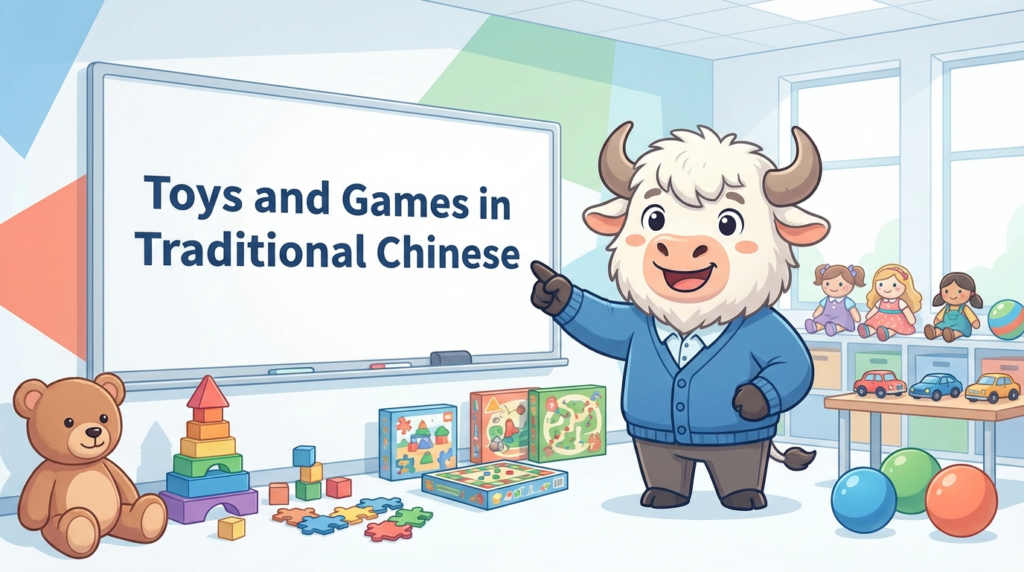
Toys and Games in Traditional Chinese
Quick, useful vocab you’ll actually say — with pinyin, meanings, and real examples. 玩具和遊戲
Here’s your go-to list for talking about toys, games, and all the little moments that happen when people actually play (yes, including “your turn” and “don’t cheat”).
Every item has Traditional Chinese, pinyin with tone marks, an English meaning, and a sentence you can steal for real life. Tap the speaker buttons to hear Taiwan Mandarin (zh-TW).
If you only learn one thing today: Chinese has multiple verbs for “play.” English says “play” for everything; Mandarin says “pick a lane.” You’ll survive. Probably.
Quick Visual Cards
High-utility words first. These show up everywhere: toy stores, playgrounds, and living rooms full of LEGO… sorry, 積木.
“`我買了一個新玩具。
Wǒ mǎi le yí gè xīn wánjù.
I bought a new toy.
這個遊戲很好玩。
Zhège yóuxì hěn hǎowán.
This game is really fun.
他用積木蓋了一座塔。
Tā yòng jīmù gài le yí zuò tǎ.
He built a tower with blocks.
我們一起拼圖吧。
Wǒmen yìqǐ píntú ba.
Let’s do the puzzle together.
這個娃娃有一頂小帽子。
Zhège wáwa yǒu yì dǐng xiǎo màozi.
This doll has a little hat.
你會玩撲克牌嗎?
Nǐ huì wán pūkèpái ma?
Do you know how to play cards?
他很愛下棋。
Tā hěn ài xià qí.
He really likes playing board games/chess.
週末我想打電玩。
Zhōumò wǒ xiǎng dǎ diànwán.
I want to play video games this weekend.
Useful Play Phrases You’ll Actually Say
Steal these for game night, playground time, or “I’m totally not competitive” situations.
“`一起玩!
Let’s play together!
一起玩拼圖,好嗎?
Yìqǐ wán píntú, hǎo ma?
Let’s do the puzzle together, okay?
你想玩什麼?
What do you want to play?
你想玩桌遊還是打電玩?
Nǐ xiǎng wán zhuōyóu háishì dǎ diànwán?
Do you want to play a board game or play video games?
我們玩這個吧。
Let’s play this one.
這個規則很簡單,我們玩這個吧。
Zhège guīzé hěn jiǎndān, wǒmen wán zhège ba.
The rules are simple—let’s play this one.
你先。
You go first.
你先擲骰子。
Nǐ xiān zhì tóuzi.
You roll the dice first.
我先。
I’ll go first.
我先發牌,你幫我洗牌。
Wǒ xiān fāpái, nǐ bāng wǒ xǐpái.
I’ll deal first; help me shuffle.
輪到你了。
It’s your turn.
輪到你了,快點!
Lúndào nǐ le, kuài diǎn!
Your turn—hurry up!
這是我的回合。
It’s my turn.
等一下,這是我的回合。
Děng yíxià, zhè shì wǒ de huíhé.
Wait a sec, it’s my turn.
別作弊。
Don’t cheat.
要公平一點,別作弊。
Yào gōngpíng yìdiǎn, bié zuòbì.
Be fair—don’t cheat.
再來一局!
One more round!
這局太快了,再來一局!
Zhè jú tài kuài le, zàilái yì jú!
That round was too fast—one more!
我贏了!
I won!
我贏了,但你也打得很好。
Wǒ yíng le, dàn nǐ yě dǎ de hěn hǎo.
I won, but you played really well too.
我輸了。
I lost.
我輸了,下一局我會更專心。
Wǒ shū le, xià yì jú wǒ huì gèng zhuānxīn.
I lost—next round I’ll focus more.
平手!
It’s a tie!
這局平手,我們再來一次。
Zhè jú píngshǒu, wǒmen zàilái yí cì.
This round is a tie—let’s do it again.
你準備好了嗎?
Are you ready?
你準備好了嗎?我們要開始了。
Nǐ zhǔnbèi hǎo le ma? Wǒmen yào kāishǐ le.
Are you ready? We’re starting.
規則很簡單。
The rules are simple.
規則很簡單,你看一次就懂。
Guīzé hěn jiǎndān, nǐ kàn yí cì jiù dǒng.
The rules are simple—you’ll get it after watching once.
The “Play” Trio: 玩 / 打 / 下
English says “play” for everything. Mandarin splits it up: 玩 is for playing with toys or for fun in general, 打 is often for sports or video games, and 下 is for board games like chess and Go.
Tiny cheatsheet: 玩玩具 (play with toys), 打電玩 (play video games), 下象棋 (play Chinese chess). Your brain may complain. Ignore it.
Table of Words
Grouped by theme so your brain doesn’t rage-quit.
“`Classic Toys and Indoor Fun
| Traditional Chinese | Pinyin | Meaning (EN) | Example (ZH) | Translation (EN) | Audio |
|---|---|---|---|---|---|
玩具熊 | wánjùxióng | teddy bear | 她抱著玩具熊睡覺。Tā bào zhe wánjùxióng shuìjiào. | She sleeps hugging a teddy bear. | |
玩偶 | wán’ǒu | plush toy / doll | 這個玩偶很柔軟。Zhège wán’ǒu hěn róuruǎn. | This plush toy is very soft. | |
洋娃娃 | yángwáwa | doll (often “fashion” style) | 我小時候很喜歡洋娃娃。Wǒ xiǎoshíhou hěn xǐhuān yángwáwa. | I liked dolls a lot when I was little. | |
機器人 | jīqìrén | robot | 這個機器人會走路。Zhège jīqìrén huì zǒulù. | This robot can walk. | |
拼裝模型 | pīnzhuāng móxíng | model kit (assemble-it-yourself) | 他花了兩小時拼裝模型。Tā huā le liǎng xiǎoshí pīnzhuāng móxíng. | He spent two hours assembling a model kit. | |
彩色黏土 | cǎisè niántǔ | modeling clay | 我們用彩色黏土做小動物。Wǒmen yòng cǎisè niántǔ zuò xiǎo dòngwù. | We use modeling clay to make little animals. | |
蠟筆 | làbǐ | crayons | 孩子用蠟筆畫彩虹。Háizi yòng làbǐ huà cǎihóng. | The kid draws a rainbow with crayons. | |
畫筆 | huàbǐ | paintbrush | 請把畫筆洗乾淨。Qǐng bǎ huàbǐ xǐ gānjìng. | Please wash the paintbrush clean. | |
著色本 | zhuósèběn | coloring book | 這本著色本很可愛。Zhè běn zhuósèběn hěn kě’ài. | This coloring book is very cute. | |
手偶 | shǒu’ǒu | hand puppet | 他用手偶講故事。Tā yòng shǒu’ǒu jiǎng gùshì. | He uses a hand puppet to tell a story. |
Outdoor Toys and Playground Stuff
| Traditional Chinese | Pinyin | Meaning (EN) | Example (ZH) | Translation (EN) | Audio |
|---|---|---|---|---|---|
風箏 | fēngzhēng | kite | 今天風很大,適合放風箏。Jīntiān fēng hěn dà, shìhé fàng fēngzhēng. | It’s windy today—good for flying a kite. | |
泡泡 | pàopào | bubbles | 小朋友在吹泡泡。Xiǎopéngyǒu zài chuī pàopào. | The kids are blowing bubbles. | |
泡泡棒 | pàopào bàng | bubble wand | 這支泡泡棒可以吹很大的泡泡。Zhè zhī pàopào bàng kěyǐ chuī hěn dà de pàopào. | This bubble wand can make huge bubbles. | |
水槍 | shuǐqiāng | water gun / squirt gun | 夏天打水槍很涼快。Xiàtiān dǎ shuǐqiāng hěn liángkuài. | Playing with water guns feels refreshing in summer. | |
跳繩 | tiàoshéng | jump rope | 她每天跳繩十分鐘。Tā měitiān tiàoshéng shí fēnzhōng. | She jumps rope for ten minutes every day. | |
呼拉圈 | hūlāquān | hula hoop | 我轉呼拉圈轉得不錯。Wǒ zhuǎn hūlāquān zhuǎn de búcuò. | I’m pretty good at spinning a hula hoop. | |
溜溜球 | liūliūqiú | yo-yo | 他會用溜溜球做花式。Tā huì yòng liūliūqiú zuò huāshì. | He can do tricks with a yo-yo. | |
陀螺 | tuóluó | spinning top | 這個陀螺可以轉很久。Zhège tuóluó kěyǐ zhuǎn hěn jiǔ. | This spinning top can spin for a long time. | |
彈珠 | dànzhū | marbles | 他收集了很多顆彈珠。Tā shōují le hěn duō kē dànzhū. | He collected lots of marbles. | |
盪鞦韆 | dàngqiūqiān | swing | 我們去公園盪鞦韆。Wǒmen qù gōngyuán dàngqiūqiān. | Let’s go to the park and swing. | |
翹翹板 | qiàoqiàobǎn | seesaw | 兩個人一起玩翹翹板。Liǎng gè rén yìqǐ wán qiàoqiàobǎn. | Two people play on the seesaw together. |
Board Games and Card Games
| Traditional Chinese | Pinyin | Meaning (EN) | Example (ZH) | Translation (EN) | Audio |
|---|---|---|---|---|---|
桌遊 | zhuōyóu | board game(s) | 今晚我們玩桌遊。Jīnwǎn wǒmen wán zhuōyóu. | Tonight we’re playing board games. | |
棋盤 | qípán | game board | 把棋盤放在桌上。Bǎ qípán fàng zài zhuō shàng. | Put the board on the table. | |
棋子 | qízi | game pieces | 你的棋子在這裡。Nǐ de qízi zài zhèlǐ. | Your pieces are here. | |
象棋 | xiàngqí | Chinese chess (Xiangqi) | 我爸爸很會下象棋。Wǒ bàba hěn huì xià xiàngqí. | My dad is really good at Xiangqi. | |
圍棋 | wéiqí | Go | 他每週都去學圍棋。Tā měi zhōu dōu qù xué wéiqí. | He learns Go every week. | |
五子棋 | wǔzǐqí | gomoku (five-in-a-row) | 我們下五子棋,一局很快。Wǒmen xià wǔzǐqí, yì jú hěn kuài. | Let’s play gomoku—one round is quick. | |
跳棋 | tiàoqí | Chinese checkers | 你想玩跳棋嗎?Nǐ xiǎng wán tiàoqí ma? | Do you want to play Chinese checkers? | |
撲克牌 | pūkèpái | playing cards | 我帶了兩副撲克牌。Wǒ dài le liǎng fù pūkèpái. | I brought two decks of cards. | |
牌組 | páizǔ | deck (of cards) | 這個牌組有五十二張牌。Zhè ge páizǔ yǒu wǔshí’èr zhāng pái. | This deck has 52 cards. | |
洗牌 | xǐpái | shuffle (cards) | 先洗牌,再發牌。Xiān xǐpái, zài fāpái. | Shuffle first, then deal. | |
發牌 | fāpái | deal cards | 我來發牌,你來記分。Wǒ lái fāpái, nǐ lái jìfēn. | I’ll deal; you keep score. | |
骰子 | tóuzi | dice | 骰子掉到地上了。Tóuzi diào dào dìshàng le. | The dice fell on the floor. | |
擲骰子 | zhì tóuzi | roll the dice | 輪到你擲骰子。Lúndào nǐ zhì tóuzi. | It’s your turn to roll. | |
規則 | guīzé | rules | 先講清楚規則。Xiān jiǎng qīngchǔ guīzé. | Explain the rules clearly first. |
Kids’ Games and Playground Games
| Traditional Chinese | Pinyin | Meaning (EN) | Example (ZH) | Translation (EN) | Audio |
|---|---|---|---|---|---|
捉迷藏 | zhuōmícáng | hide-and-seek | 小朋友在玩捉迷藏。Xiǎopéngyǒu zài wán zhuōmícáng. | The kids are playing hide-and-seek. | |
鬼抓人 | guǐ zhuā rén | tag (Taiwan usage) | 你當鬼,我們玩鬼抓人。Nǐ dāng guǐ, wǒmen wán guǐ zhuā rén. | You’re “it”—let’s play tag. | |
猜拳 | cāiquán | rock-paper-scissors | 我們猜拳決定誰先。Wǒmen cāiquán juédìng shéi xiān. | Let’s decide who goes first with rock-paper-scissors. | |
剪刀石頭布 | jiǎndāo shítou bù | rock-paper-scissors (full chant) | 剪刀石頭布!一、二、三!Jiǎndāo shítou bù! Yī, èr, sān! | Rock-paper-scissors! One, two, three! | |
踢毽子 | tī jiànzi | kick shuttlecock | 我們在操場踢毽子。Wǒmen zài cāochǎng tī jiànzi. | We kick shuttlecock on the playground. | |
丟沙包 | diū shābāo | beanbag toss (game) | 他們在丟沙包,比誰丟得準。Tāmen zài diū shābāo, bǐ shéi diū de zhǔn. | They’re playing beanbag toss, seeing who’s more accurate. |
Video Games and Tech Stuff
| Traditional Chinese | Pinyin | Meaning (EN) | Example (ZH) | Translation (EN) | Audio |
|---|---|---|---|---|---|
電子遊戲 | diànzǐ yóuxì | electronic game(s) | 我比較喜歡合作的電子遊戲。Wǒ bǐjiào xǐhuān hézuò de diànzǐ yóuxì. | I prefer co-op electronic games. | |
遊戲機 | yóuxìjī | game console | 這台遊戲機是我生日禮物。Zhè tái yóuxìjī shì wǒ shēngrì lǐwù. | This console is my birthday gift. | |
主機 | zhǔjī | console (main unit) | 主機要接上電視。Zhǔjī yào jiē shàng diànshì. | The console needs to connect to the TV. | |
掌機 | zhǎngjī | handheld console | 我出門會帶掌機。Wǒ chūmén huì dài zhǎngjī. | I bring my handheld when I go out. | |
手把 | shǒubǎ | controller (Taiwan usage) | 手把沒電了,我去充電。Shǒubǎ méi diàn le, wǒ qù chōngdiàn. | The controller is out of battery—I’ll charge it. | |
搖桿 | yáogǎn | joystick | 這個搖桿手感很好。Zhège yáogǎn shǒugǎn hěn hǎo. | This joystick feels great. | |
遊戲卡 | yóuxìkǎ | game card / cartridge | 我的遊戲卡放在哪裡?Wǒ de yóuxìkǎ fàng zài nǎlǐ? | Where did I put my game card? | |
下載 | xiàzài | download | 我正在下載新遊戲。Wǒ zhèngzài xiàzài xīn yóuxì. | I’m downloading a new game. | |
更新 | gēngxīn | update | 遊戲需要更新才能玩。Yóuxì xūyào gēngxīn cái néng wán. | The game needs an update before you can play. | |
連線 | liánxiàn | connect / online | 今天網路很慢,連線一直斷。Jīntiān wǎnglù hěn màn, liánxiàn yìzhí duàn. | The internet is slow—my connection keeps dropping. | |
多人模式 | duōrén móshì | multiplayer mode | 這款遊戲的多人模式很有趣。Zhè kuǎn yóuxì de duōrén móshì hěn yǒuqù. | This game’s multiplayer mode is fun. | |
單人模式 | dānrén móshì | single-player mode | 我先玩單人模式練習。Wǒ xiān wán dānrén móshì liànxí. | I’ll practice in single-player mode first. | |
關卡 | guānqiǎ | level / stage | 這一關卡有點難。Zhè yì guānqiǎ yǒudiǎn nán. | This level is a bit hard. | |
任務 | rènwù | mission / quest | 我還沒完成今天的任務。Wǒ hái méi wánchéng jīntiān de rènwù. | I haven’t finished today’s quest yet. | |
隊友 | duìyǒu | teammate | 我的隊友很可靠。Wǒ de duìyǒu hěn kěkào. | My teammate is reliable. | |
合作 | hézuò | cooperate / co-op | 我們合作比較容易過關。Wǒmen hézuò bǐjiào róngyì guòguān. | Cooperating makes it easier to clear the level. |
Game Actions, Turns, and Results
| Traditional Chinese | Pinyin | Meaning (EN) | Example (ZH) | Translation (EN) | Audio |
|---|---|---|---|---|---|
玩 | wán | to play (general / with toys) | 下課後我們去玩。Xiàkè hòu wǒmen qù wán. | After class, we’re going to play. | |
打 | dǎ | to play (sports / video games) | 你要不要打籃球?Nǐ yào búyào dǎ lánqiú? | Do you want to play basketball? | |
下 | xià | to play (chess / Go) | 我們下象棋吧。Wǒmen xià xiàngqí ba. | Let’s play Xiangqi. | |
回合 | huíhé | turn (in a game) | 每個回合只能走一步。Měi gè huíhé zhǐ néng zǒu yí bù. | Each turn you can only move one step. | |
開始 | kāishǐ | start / begin | 準備好就開始。Zhǔnbèi hǎo jiù kāishǐ. | Start when you’re ready. | |
結束 | jiéshù | end / finish | 時間到了,遊戲結束。Shíjiān dào le, yóuxì jiéshù. | Time’s up—the game is over. | |
暫停 | zàntíng | pause | 等一下,我要暫停一下。Děng yíxià, wǒ yào zàntíng yíxià. | Hold on, I need to pause. | |
重新開始 | chóngxīn kāishǐ | restart | 按這個就能重新開始。Àn zhège jiù néng chóngxīn kāishǐ. | Press this to restart. | |
贏 | yíng | to win | 想贏就要冷靜。Xiǎng yíng jiù yào lěngjìng. | If you want to win, stay calm. | |
輸 | shū | to lose | 輸了也沒關係,重點是好玩。Shū le yě méi guānxì, zhòngdiǎn shì hǎowán. | Losing is fine—the point is to have fun. | |
作弊 | zuòbì | to cheat | 作弊不酷。Zuòbì bù kù. | Cheating isn’t cool. | |
耍賴 | shuǎlài | to be a sore loser / not admit defeat | 輸了別耍賴。Shū le bié shuǎlài. | If you lose, don’t be a sore loser. |
Optional Variants: Super Useful Measure Words
| Traditional Chinese | Pinyin | Meaning (EN) | Example (ZH) | Translation (EN) | Audio |
|---|---|---|---|---|---|
一個玩具 | yí gè wánjù | one toy (個 = general classifier) | 我想買一個玩具送你。Wǒ xiǎng mǎi yí gè wánjù sòng nǐ. | I want to buy a toy as a gift for you. | |
一副撲克牌 | yí fù pūkèpái | one deck of cards (副) | 你有沒有一副撲克牌?Nǐ yǒu méiyǒu yí fù pūkèpái? | Do you have a deck of cards? | |
一盤棋 | yì pán qí | one game (round) of chess/Go (盤) | 我們再下一盤棋。Wǒmen zài xià yì pán qí. | Let’s play one more game of chess/Go. | |
一台遊戲機 | yì tái yóuxìjī | one console (台) | 家裡只有一台遊戲機。Jiālǐ zhǐyǒu yì tái yóuxìjī. | There’s only one console at home. | |
一套拼圖 | yí tào píntú | one set of puzzles (套) | 這一套拼圖有一千片。Zhè yí tào píntú yǒu yì qiān piàn. | This puzzle set has 1,000 pieces. |
If someone says 下棋 and you reply 我也想玩棋, people will still understand… but they might silently file you under “cute beginner.” Aim for 下棋. Your future self will thank you.