Why “Hello” Matters
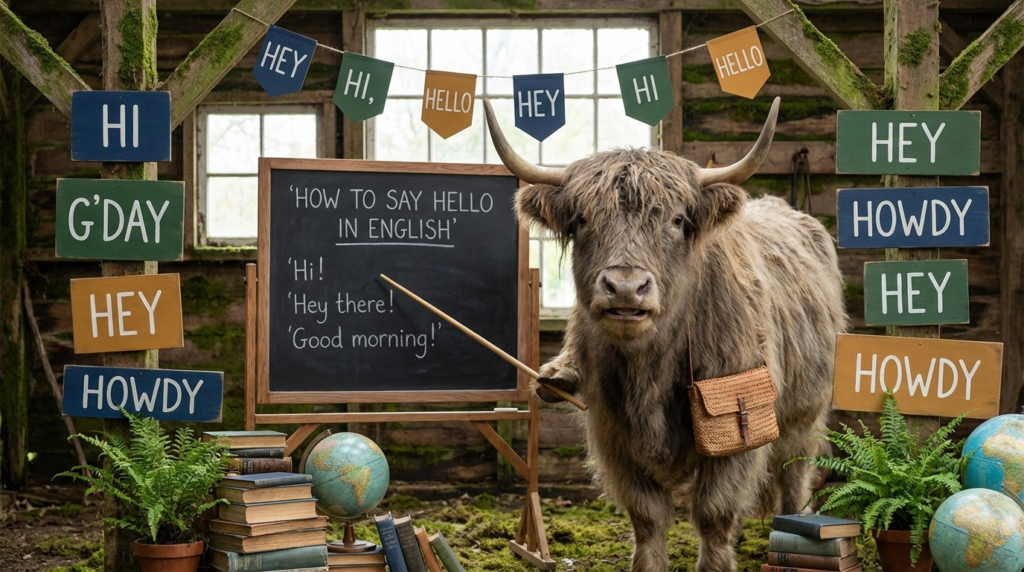
If you think about it, “hello” is a tiny word with a huge job. It’s your very first impression—your verbal handshake, your doorway into someone else’s day. And in English, that doorway comes in a ridiculous number of shapes: polite doors, casual doors, friendly doors, “hey-you-haven’t-texted-me-in-three-months” doors, business doors, awkward doors, even pirate doors. No matter who you are or where you’re from, English greetings are wonderfully flexible and endlessly adaptable.
For learners, that’s actually good news. You don’t need perfect grammar to start a conversation. You just need the right flavor of hello. And once you know which greeting fits which moment—meeting someone new, bumping into a friend, answering the phone, sliding into a chat—you suddenly sound natural, confident, and ready to talk.
So today, we’re exploring every corner of the English greeting universe. Pack your curiosity (I’ve packed my hooves), and let’s open all the doors English has to offer—one hello at a time.
The Classic Hello
The simplest greetings in English are used everywhere—at work, at school, in shops, on the street, in text messages, even by slightly confused yaks at airports. These are the bedrock of English greetings: short, clear, flexible, and instantly recognized in every English-speaking country.
If you only learn these, you can already greet anyone comfortably. The rest of the article just adds flavor.
The Everyday Essentials
These greetings work in every situation. They’re neutral, friendly, and safe for both casual and professional use. Think of them as the “white T-shirt” of English greetings: always appropriate, always welcome.
Common Everyday Greetings
| Greeting | Meaning / Tone | When You’d Use It |
| Hello | Standard, neutral, polite | Anytime, anywhere |
| Hi | Friendly, casual | Daily conversations, coworkers, friends |
| Hey | Warm, relaxed | Friends, peers, casual interactions |
| Hi there | Friendly, gentle | When you want to sound approachable |
| Hello there | Polite, slightly formal | Meeting someone new, polite settings |
| Hey there | Casual, soft, friendly | Quick greetings, warm interactions |
Mini-Explanations
- Hello is the safest greeting in the English universe. If English had a “default setting,” this would be it.
- Hi is the everyday go-to—friendly but not overly casual.
- Hey is what English speakers use with people they know or want to sound relaxed with.
- Hi there / Hey there add friendliness without adding formality. They’re especially common in customer service or friendly first-time meetings.
- Hello there sounds polite and a bit old-fashioned (in a charming way).
If you only memorize this set, you can already greet people smoothly in almost every scenario—your boss, your friend, your neighbor, or that mysterious person holding iced coffee at 8 a.m. who may or may not be awake yet.
Formal & Polite Greetings
Formal greetings are your “polished shoes” of English—clean, professional, respectful, and appropriate whenever you want to make a good impression. They’re used in workplaces, meetings, interviews, polite social events, and situations where you want to show courtesy or professionalism.
These greetings are especially helpful for learners, because they’re predictable, safe, and never too casual. When in doubt, formal greetings are always a good choice.
Business, Professional, and Polite Greetings
Here are the greetings native speakers use in workplaces, customer interactions, service roles, or polite first-time meetings.
Common Formal Greetings
| Greeting | Meaning / Tone | When You’d Use It |
| Good morning | Polite, professional | Before noon; workplace, meetings, phone calls |
| Good afternoon | Formal, respectful | After noon; business settings or polite encounters |
| Good evening | Polite, warm-formal | After about 5 p.m.; events, customers, introductions |
| It’s a pleasure to meet you | Very polite & positive | First-time meetings, interviews, formal events |
| How do you do? | Very formal, old-fashioned | Rare today; sometimes used at formal receptions |
| Nice to meet you | Standard polite greeting | First-time meetings, business or social |
| Welcome | Warm, polite | Welcoming guests, customers, visitors |
| Lovely to meet you | Polite and warm | Friendly professional or social introductions |
| Good to see you | Polite familiarity | When meeting someone you’ve seen before |
Mini-Explanations
- Good morning / afternoon / evening
These are the pillars of polite English greetings. They’re widely used in offices, customer service, restaurants, schools, and any professional setting.
Note: “Good night” is not a greeting—it’s a goodbye. - Nice to meet you
The standard greeting for someone you’re meeting for the first time. Very common in business and social settings. - It’s a pleasure to meet you
More polite than “nice to meet you.” Useful for interviews, clients, and important introductions. - How do you do?
Extremely formal and almost ceremonial. Many English speakers don’t use it, but it’s still recognized. - Welcome
A greeting used when you’re hosting someone—at a store, company, home, or event.
These formal greetings help you sound confident, respectful, and prepared—even if you’re secretly a yak in a tie hoping the meeting ends early so you can eat lunch.
Casual, Friendly, & Modern Greetings
Casual greetings are how English speakers actually talk in everyday life. These aren’t stiff or formal—they’re relaxed, friendly, and perfect for conversations with friends, neighbors, classmates, coworkers, gym buddies, and anyone who doesn’t require a professional tone.
Think of these as the “hoodie and sneakers” of English greetings: easy, comfortable, and universally understood. They’re short, simple, and often spoken with a smile or a subtle head nod that says “I like you enough to say words.”
Everyday Casual
These are the most common greetings you’ll hear in English-speaking environments. They’re informal, but totally safe to use with almost anyone except your boss during performance reviews.
Common Casual Greetings
| Greeting | Meaning / Tone | When You’d Use It |
| What’s up? | Casual, friendly | Friends, classmates, coworkers |
| What’s going on? | Relaxed, curious | Informal chats, daily life |
| How’s it going? | Friendly, conversational | Everyday interactions |
| How are you? | Neutral → casual | Daily conversations everywhere |
| Hey | Warm, informal | Friends, peers, coworkers your age |
| Yo | Very casual | Close friends only |
| Sup | Slangy “what’s up?” | Teens, relaxed situations |
| Hey man / Hey dude | Friendly, informal | Male-coded casual speech |
| Hey girl | Friendly, playful | Female-coded casual speech |
Mini-Explanations
- What’s up? / Sup
These don’t literally mean “tell me everything happening in your life.”
Standard reply: “Not much, you?” - How’s it going?
Used constantly. Meaning is basically “Hi, how are you?” but more relaxed. - Hey
The universal casual greeting. Works almost everywhere except formal settings. - Yo
Very informal. Common among close friends, especially younger speakers. - Hey man / Hey girl
Casual greetings flavored with friendliness or familiarity.
Casual greetings help you sound natural instead of textbook-ish, and they blend smoothly into daily English interactions.
Friendly Warmth
These greetings add extra friendliness, sweetness, or warmth to your hello. They’re often used with people you know well—or want to sound especially nice toward.
Warm & Friendly Greetings
| Greeting | Meaning / Tone | When You’d Use It |
| Hiya | Cute, friendly | UK/US casual settings |
| Heyyy | Warm, playful | Close friends or mildly flirty |
| Hi hi | Soft, friendly | Text/chat, casual situations |
| Morning! | Friendly short form | Passing coworkers/neighbors |
| Hey, stranger! | Light joke | When you haven’t seen someone in ages |
| You made it! | Warm & excited | Greeting someone who just arrived |
Mini-Explanations
- Hiya / Hi hi
Soft, approachable, commonly used in messaging. - Heyyy
The extra letters add warmth—or mild flirtation depending on context
(“Heyyyy Greg” ≠ “Hey Greg”). - Morning!
An ultra-short, cheerful greeting. Used constantly in offices and neighborhoods. - Hey, stranger!
Joke greeting meaning: “I haven’t seen you in forever!” - You made it!
Used when someone successfully arrives at an event, meeting, or hangout.
These greetings make conversations feel warmer and more personal—and they’re a great way to sound friendly without being overly formal.
Greetings for People You Haven’t Seen in a While
Some greetings do more than say hello—they communicate surprise, excitement, affection, or that “where have you been hiding?” feeling. English speakers use special expressions when reconnecting with someone they haven’t seen for weeks, months, or years.
These greetings are friendly and expressive, and they help you instantly create warmth and connection. They also make small talk easier because many of them naturally lead into conversation.
Joyful Reunion Greetings
These greetings show genuine happiness. They’re perfect for running into an old friend, seeing a classmate after a long break, or meeting a coworker after they’ve been away.
Common Reunion Greetings
| Greeting | Meaning / Tone | When You’d Use It |
| Long time no see | Classic reunion phrase | Seeing someone after a long gap |
| It’s been ages! | Happy, expressive | Very long time apart |
| Where have you been? | Friendly curiosity | When someone disappeared for a while |
| Look who it is! | Playful surprise | When the appearance is unexpected |
| Fancy seeing you here! | Lighthearted surprise | Random or unexpected encounters |
| I haven’t seen you in forever! | Warm exaggeration | When it feels like a very long time |
| You’re a sight for sore eyes! | Very warm, affectionate | Close friendships or family |
Mini-Explanations
- Long time no see
The most famous reunion greeting. Works in almost any casual situation. - It’s been ages!
A dramatic way of saying it’s been a long time. English speakers use exaggeration for humor and warmth. - Look who it is!
A playful greeting that shows surprise and happiness at the same time. - Where have you been?
Not an accusation—usually said with a smile. Means “I’ve missed you.” - Fancy seeing you here!
Very common in the UK and often used when you bump into someone in an unexpected place.
These greetings help conversations start naturally, because they express emotion and invite the other person to respond.
Greetings for Meeting Someone for the First Time
When you meet someone new in English, your greeting is part of your introduction. It shows politeness, friendliness, and confidence—all without needing complicated vocabulary. These greetings are perfect for interviews, networking events, classes, travel situations, or anytime two strangers first meet.
Think of these as your “first impression toolkit.” They’re formal enough to sound respectful but friendly enough to feel natural.
First-Time Meeting Greetings
These greetings pair naturally with introductions like “I’m…” or “My name is…”.
Common First-Time Meeting Greetings
| Greeting | Meaning / Tone | When You’d Use It |
| Nice to meet you | Standard polite | The most common greeting when meeting someone |
| Great to meet you | Warm, positive | When you want to show extra friendliness |
| Pleased to meet you | Polite, slightly formal | Business or social introductions |
| Lovely to meet you | Warm & polite | Friendly professional or social settings |
| It’s nice to finally meet you | Warm, expected | When you’ve talked online or been introduced before meeting |
| I’ve heard so much about you | Friendly, positive | Meeting someone others have mentioned |
| Thank you for meeting with me | Professional | Interviews, scheduled meetings, formal situations |
| I’m glad we get a chance to connect | Professional, modern | Networking, business, conferences |
Mini-Explanations
- Nice to meet you
The default, safest greeting for first-time meetings anywhere in the English world. - Great to meet you / Lovely to meet you
Slightly warmer variations. These make you sound friendly and genuine. - Pleased to meet you
A bit more formal. Useful in professional or polite situations. - It’s nice to finally meet you
Used when you already know the person by name or online but haven’t met face-to-face until now. - I’ve heard so much about you
A positive, welcoming greeting—often used when meeting someone important to a friend, colleague, or family member. - Thank you for meeting with me
A polite way to open job interviews, client meetings, or appointments. - I’m glad we get a chance to connect
A modern phrase often used in professional networking.
First-time meeting greetings help set the tone for the entire conversation—polite, warm, and ready to build rapport.
Greetings That Start a Conversation
Some greetings don’t just say “hi”—they invite the other person to talk. These are great when you want to be friendly, show interest, or open the door to a longer conversation. English speakers use these everywhere: offices, cafés, schools, elevators, parties, family dinners, and random life moments where small talk is expected.
Think of these as “conversation openers.” Instead of a simple greeting, they smoothly lead into the next sentence.
Active-Opener Greetings
These greetings include a question or an observation. They’re gentle ways to start talking without feeling forced.
Common Conversation-Starting Greetings
| Greeting | Meaning / Tone | When You’d Use It |
| How’s your day going? | Friendly, curious | Anytime you want to start a conversation naturally |
| What are you up to today? | Casual curiosity | Friends, coworkers, daily interactions |
| How have you been? | Warm, interested | When you already know the person |
| Everything good? | Casual check-in | Friendly workplaces, casual environments |
| Busy day? | Conversational soft opener | Offices, coffee lines, casual meetings |
| Beautiful weather today, isn’t it? | Classic small talk | Outdoor situations, polite conversation |
| How’s everything? | Warm, friendly | Broad question, works almost anywhere |
| How’s life? | Relaxed and personal | Friends or familiar contacts |
Mini-Explanations
- How’s your day going?
A perfect opener. Works in both casual and semi-professional situations.
Expected reply: short + positive (“Pretty good! And you?”). - What are you up to today?
Casual curiosity that encourages the other person to talk about their plans or mood. - How have you been?
Used when you already know the person but haven’t seen them in a bit. - Everything good?
Very common in workplaces. Sounds friendly and supportive. - Busy day?
A classic starter in offices, shops, or cafés. It’s polite and easy to answer. - Beautiful weather today, isn’t it?
The ultimate small-talk opener. Used to break silence or be friendly.
These greetings help you go beyond a simple “hello” and move into comfortable conversation—like throwing a small verbal bridge that invites the other person to walk across.
Greetings in Passing
Passing greetings are quick, light, and designed for moments when you’re not stopping to talk—just acknowledging someone as you walk by. These greetings are short, friendly, and often accompanied by a smile, nod, or quick wave.
Think of them as “drive-by hellos.” You’re saying hi, but you’re not committing to a full conversation. English speakers use them constantly at work, in neighborhoods, in hallways, or whenever two people cross paths.
Quick Drive-By Greetings
These greetings are fast and effortless. They’re perfect when you’re busy, in a rush, or simply keeping things polite.
Common Passing Greetings
| Greeting | Meaning / Tone | When You’d Use It |
| Morning! | Friendly, quick | Passing coworkers or neighbors early in the day |
| Afternoon! | Polite, short | Midday encounters when stopping isn’t expected |
| Evening! | Warm but brief | Seeing someone later in the day |
| Hey! | Friendly, simple | Anytime casual acknowledgement |
| Hi! | Neutral, universal | Works with anyone as you pass by |
| Hey there | Soft, warm | Slightly more friendly than “hey” |
| How’s it going? (quick tone) | Polite check-in | Used even when you don’t expect a full answer |
| How are ya? (casual tone) | Friendly, informal | Passing friends or coworkers |
Mini-Explanations
- Morning! / Afternoon! / Evening!
These “shortened” greetings are extremely common. They sound friendly and natural—especially in workplaces or residential areas. - Hey! / Hi!
Perfect when you want something very fast. Often paired with a quick smile. - How’s it going?
When said quickly while walking, this isn’t a real question—you’re not expected to stop and explain your entire day. - How are ya?
A casual, friendly variation used mainly in North America.
Passing greetings help maintain polite social connections—even when everyone is too busy for a full chat. They’re small gestures that keep relationships warm without requiring any extra time.
Phone, Text, and Online Greetings
Modern life means most greetings don’t happen face-to-face anymore—they happen through screens, headphones, and apps that ping at the wrong time. English has a whole set of greetings specifically for phone calls, texting, messaging, and online communication.
These greetings are shorter, faster, and more flexible than traditional ones. Tone matters a lot, and tiny changes (like extra letters or punctuation) can make the greeting feel formal, friendly, casual, or even flirtatious.
Let’s break them down.
Phone Greetings
Phone greetings need to be clear, polite, and easy to understand—even if the connection sounds like someone is calling from a cave.
Common Phone Greetings
| Greeting | Meaning / Tone | When You’d Use It |
| Hello? | Standard phone answer | The safest way to pick up any call |
| Hi, this is [Name]. | Polite & professional | When answering work or unknown calls |
| Good morning/afternoon/evening. | Polite, professional | Business calls, service roles |
| Hi! How can I help you? | Customer service tone | Anytime you’re assisting someone |
| Hey! | Casual | Friends or family calls |
| Hey, what’s up? | Friendly & informal | Personal calls only |
| Thanks for calling. | Polite, warm | Business or formal interactions |
Mini-Explanations
- Hello?
Still the #1 universal phone greeting. Clear, neutral, never wrong. - Hi, this is…
Used when you want to immediately identify yourself. Extremely common in the U.S. and Canada. - Good morning/afternoon/evening
A professional, polished way to begin a call in business settings. - Hey! / Hey, what’s up?
Only for people you know well. Very casual.
Phone greetings tend to be more polite than text greetings, because tone of voice carries more weight.
Text & Messaging Greetings
Text greetings are fast, flexible, and often shorter than spoken greetings. Tone is shown through punctuation, emojis (sparingly), or the number of letters.
Common Messaging Greetings
| Greeting | Meaning / Tone | When You’d Use It |
| Hey | Casual, friendly | Most common texting greeting |
| Hi | Neutral | Anytime, anyone |
| Heyyy | Warm, playful | Friends or soft/flirty tone |
| Yo | Casual, energetic | Close friends |
| Hi hi | Soft & friendly | Light, gentle conversation |
| GM / GN | “Good morning/night” | Internet slang, casual chats |
| Morning! | Friendly | Early-day messages |
| Hey you | Warm & familiar | Friends or partners |
| What’s up? | Casual opener | Everyday messaging |
| Sup | Very informal | Younger speakers, friends |
| Hello!! | Energetic | Excited tone |
Mini-Explanations
- Hey / Hi
The two pillars of messaging greetings. “Hey” = slightly warmer. - Heyyy
Extra letters add friendliness (or a hint of flirting depending on context). - Hi hi
Soft, bubbly greeting. Common in chat apps. - GM / GN
Used in casual online spaces—gaming, group chats, or social media. - Hey you
Very friendly; shows closeness. - Sup / Yo
Very casual and used mostly among younger people or close friends.
Text greetings tend to be shorter and more expressive because punctuation and length help show tone. “Hey.” feels different from “Hey!” and very different from “Heyyyyy”.
Emotional Tone Greetings
Sometimes the same “hello” means completely different things depending on tone, body language, or context. English speakers often use greetings that communicate emotion—excitement, warmth, awkwardness, confusion, or “I didn’t expect to see you here, but here we are.”
These greetings add personality and emotion to your hello, making them sound more natural and human.
Excited Greetings
These greetings show strong positive emotion—joy, enthusiasm, energy, or surprise. They’re perfect when you feel genuinely happy to see someone.
Common Excited Greetings
| Greeting | Meaning / Tone | When You’d Use It |
| OMG, hi! | Very excited | Friends you’re thrilled to see |
| There you are! | Relieved or excited | When someone finally arrives |
| You made it! | Happy + approving | Parties, events, gatherings |
| Hey you!! | Warm, enthusiastic | Close friends or partners |
| No way—hey! | Surprised + happy | Unexpected meetings |
| It’s so good to see you! | Very warm | Close friends or family |
| Look at you! | Playful excitement | Seeing someone after a long time or seeing them dressed nicely |
Mini-Explanations
- OMG, hi!
This isn’t literally about “shock”—it just expresses excitement. - There you are!
Used when you’ve been waiting for someone or couldn’t find them. - You made it!
Shows happiness that the person showed up (especially if you weren’t sure they would). - No way—hey!
Used for happy surprise, often with friends. - Look at you!
Friendly, playful, sometimes used when someone looks great or has changed.
These greetings make people feel welcomed immediately—they’re like throwing a cozy blanket of friendliness across the room.
Awkward or Unsure Greetings
English speakers also have greetings for situations that feel uncertain, tense, or slightly weird. Tone is key here—these aren’t rude unless said with bad intention. Usually they’re honest signals of confusion, hesitation, or cautious friendliness.
Common Awkward/Unsure Greetings
| Greeting | Meaning / Tone | When You’d Use It |
| Oh… hey. | Awkward surprise | Seeing someone unexpectedly |
| Hey? | Confused | Unsure if you know the person |
| Hi…? | Uncertain | When you’re not sure how to respond |
| So… hi. | Hesitant | Starting a conversation after something awkward |
| Uh, hey. | Nervous or unsure | Awkward social situations |
| Hi there… | Soft + unsure | When trying to be polite but things feel weird |
Mini-Explanations
- Oh… hey.
A very common, gentle reaction when you bump into someone unexpectedly. - Hey? / Hi…?
The question mark communicates confusion. It’s not rude—just honest. - So… hi.
Often used after an awkward pause or difficult topic. - Uh, hey.
Carries hesitation. Used when the social situation is unclear.
Awkward greetings are still greetings—they just show that humans (and yaks) sometimes feel unsure, and language reflects that.
Humorous or Playful Greetings
Sometimes English speakers use greetings that are intentionally silly, dramatic, theatrical, or just plain fun. These greetings add humor and personality to a conversation and are often used among friends, siblings, coworkers with a good sense of humor, or anyone who enjoys a bit of playful energy.
These are not for formal situations. They are for moments when you want to make someone smile.
Joke or Playful Greetings
These greetings are intentionally light, exaggerated, or quirky. They’re great for breaking the ice, softening the mood, or making someone laugh.
Common Humorous Greetings
| Greeting | Meaning / Tone | When You’d Use It |
| Greetings, Earthling. | Silly sci-fi humor | With friends who enjoy jokes |
| Ahoy! | Pirate-style greeting | Playful, theatrical moments |
| Howdy! | Country/western flavor | Friendly or humorous tone |
| Yo yo yo | Exaggerated casual | With close friends, joking tone |
| What’s cookin’? | Fun, playful | Used jokingly with friends or family |
| Top o’ the morning to ya! | Old-timey Irish-style greeting | Playful, rarely serious |
| Look alive! | Energetic, funny | Waking someone up or being silly |
| Welcome to the party! | Dramatic, humorous | When someone arrives unexpectedly |
| Ahoy there, matey! | Full pirate mode | Humor or roleplay situations |
| Hello, sunshine! | Warm + playful | Friendly teasing or cheerful greeting |
Mini-Explanations
- Greetings, Earthling.
Classic sci-fi joke used when you want to sound mock-serious. - Ahoy! / Ahoy there, matey!
Pirate-style greetings. Not serious. Great for fun social situations. - Howdy!
Genuine greeting in some regions, but often used jokingly elsewhere. - Yo yo yo
Exaggerated, playful version of “yo.” - What’s cookin’?
Means “What’s going on?” but with a humorous twist. - Hello, sunshine!
Friendly and cheerful; often used affectionately.
Playful greetings show confidence, creativity, and a sense of humor. They instantly make the conversation feel relaxed and friendly—perfect for people who enjoy being a little silly.
Regional Greetings Across English-Speaking Countries
English is spoken around the world, but greetings aren’t identical everywhere. Different countries—and even different regions within those countries—have their own unique hello traditions. Many of these greetings are fully understood worldwide, but some carry strong local flavor.
This section helps you understand how greetings shift depending on where you are in the English-speaking world.
United Kingdom & Ireland
The UK and Ireland have some of the warmest—and sometimes quirkiest—greetings. Many of them sound casual but are widely used in daily life.
Common UK & Ireland Greetings
| Greeting | Meaning / Tone | Notes |
| You alright? / Alright? | Casual hello | Means “hello,” not a real health question |
| Hiya | Friendly, cute | Very common everywhere |
| You good? | Casual check-in | Similar to “Everything good?” |
| How are you keeping? | Polite & warm | More common in Ireland |
| Cheers (as greeting) | Friendly hello | Also means thank you/goodbye |
| Morning! | Warm & short | Very common in neighborhoods |
Mini-note:
When someone in the UK says “You alright?”, they aren’t asking about your emotional well-being. It’s just a casual “hello.”
United States & Canada
North America tends to favor casual, friendly greetings that work with both strangers and friends.
Common U.S. & Canada Greetings
| Greeting | Meaning / Tone | Notes |
| What’s up? | Very common casual greeting | Often replied with “Not much” |
| Hey guys | Friendly group greeting | Used with mixed groups |
| Hey there | Soft, warm | Friendly without being too familiar |
| How’s it going? | Casual check-in | Extremely common |
| Morning! | Short & cheerful | Used everywhere |
| Howdy | Friendly/country tone | More common in the South, Texas |
Mini-note:
North American greetings are often paired with smiles, nods, or an upbeat tone.
Australia & New Zealand
Australian and Kiwi greetings are famously relaxed and friendly. They love shortening words and making everything sound breezy.
Common Australia / New Zealand Greetings
| Greeting | Meaning / Tone | Notes |
| G’day | Friendly, iconic | Equivalent of “Hello” |
| How ya going? | Casual check-in | Means “How are you doing?” |
| Hey mate | Friendly hello | “Mate” = friend |
| You right? | Casual, friendly | Similar to “Everything good?” |
| Hiya | Soft greeting | Used informally |
Mini-note:
“G’day” isn’t just a stereotype—it’s genuinely used, but often pronounced quickly (“guh-day”).
Other English-Speaking Regions
Many countries use greetings similar to the U.S. or U.K., but each region adds its own flavor.
Examples
| Region | Greeting | Meaning / Tone |
| South Africa | Howzit? | Very common casual hello |
| India (English-speaking contexts) | Hello, sir/ma’am | Formal & respectful |
| Caribbean nations | Wha gwan? | Casual, friendly (“What’s going on?”) |
| Singapore / Malaysia | Hello, hello! | Cheerful, fast-paced greeting |
Regional greetings are fun, full of character, and reflect local culture. Learning them isn’t required—but recognizing them helps you understand English in more global contexts.
How to Choose the Right Greeting
With so many ways to say hello in English, how do you know which greeting fits the moment? Choosing the right greeting isn’t about memorizing hundreds of phrases—it’s about matching formality, tone, and relationship to the context. This section helps you pick the perfect “hello” every time.
Think of it like choosing the right outfit: you wouldn’t wear pajamas to a job interview, and you probably wouldn’t wear a tuxedo to the supermarket. Greetings work the same way.
Choose by Formality
Formality is the fastest way to select a greeting. Here’s the simple rule:
Formal Situations → Use Polite Greetings
Use these when speaking to:
- supervisors
- customers or clients
- teachers
- new acquaintances
- older people (in some cultures)
Examples:
- Good morning
- Nice to meet you
- It’s a pleasure to meet you
- Good evening
Casual Situations → Use Relaxed Greetings
Use these with:
- friends
- classmates
- peers
- coworkers your age
Examples:
- Hey
- What’s up?
- Yo
- Hiya
Very Casual / Slang → Use Only With Close Friends
Examples:
- Sup
- Yo yo yo
- What’s cookin’?
Choose by Emotional Tone
Different greetings express different feelings. Use tone when you want your hello to send a message beyond the words.
Warm & Friendly
Use when you want to sound approachable and positive.
- Heyyy
- Hi hi
- Hey there
- It’s so good to see you!
Excited
Use when you’re genuinely happy to see someone.
- OMG, hi!
- You made it!
- There you are!
Neutral
Safe for almost all situations.
- Hello
- Hi
- Good morning
Awkward / Unsure
Use when the situation feels strange or unexpected.
- Oh… hey.
- Hi…?
- So… hi.
Choose by Relationship
How well you know the person matters. It changes the greeting completely.
First-Time Meetings
Polite and respectful.
- Nice to meet you
- Pleased to meet you
- Thanks for meeting with me
Friends & Close Contacts
Relaxed and expressive.
- What’s up?
- Hey you!
- Long time no see
Coworkers / Professional Contacts
Friendly but still appropriate.
- Hey there
- How’s your day going?
- Good morning
People You Haven’t Seen in a While
Show warmth or surprise.
- It’s been ages!
- Fancy seeing you here!
- Look who it is!
Choose by Setting
Sometimes the environment decides for you.
Workplace
Use polite or semi-casual greetings.
- Good morning
- How’s it going?
Online / Messaging
Short and flexible.
- Hey
- Hi
- What’s up?
Parties / Social Events
Friendly and energetic.
- You made it!
- Hey!!
Unexpected Encounters
Show surprise.
- Oh! Hey!
- No way—hey!
Choosing the right greeting means paying attention to the moment—not memorizing everything. After a while, it becomes instinctive.
Quick Greeting Table (40+ Items)
Below is a large, clean, easy-to-scan table containing over 40 greetings from the entire article. This gives learners a fast reference guide for all greeting styles—formal, casual, friendly, playful, regional, emotional, and digital.
Use this as the “master list” at the end of the article before the conclusion.
Master Greeting Table (40+ English Greetings)
| Greeting | Type / Tone | When You’d Use It |
| Hello | Neutral | Anytime, anywhere |
| Hi | Friendly | Daily conversations |
| Hey | Casual | Friends, coworkers |
| Hi there | Soft/approachable | Customer service, friendly chats |
| Hello there | Polite | New introductions |
| Hey there | Warm | Casual, friendly |
| Good morning | Formal | Before noon, work settings |
| Good afternoon | Formal | Professional or polite settings |
| Good evening | Polite | Late-day meetings or greetings |
| Nice to meet you | Polite | First-time meetings |
| Pleased to meet you | Formal | Business/social introductions |
| Lovely to meet you | Warm/polite | Friendly professional settings |
| It’s a pleasure to meet you | Very formal | Interviews, high-formality events |
| Good to see you | Friendly familiarity | Meeting someone again |
| What’s up? | Casual | Friends, peers |
| What’s going on? | Relaxed | Casual conversations |
| How’s it going? | Friendly | General use |
| How are you? | Neutral → casual | Daily interactions |
| Yo | Very casual | Close friends |
| Sup | Slang | Young or casual contexts |
| Hey man / Hey dude | Casual | Male-coded friendships |
| Hey girl | Friendly | Female-coded friendships |
| Hiya | Cute, friendly | UK, US casual |
| Heyyy | Warm/playful | Friendly or flirty |
| Hi hi | Soft | Texting, gentle tone |
| Morning! | Friendly passing | Workplaces, neighbors |
| Afternoon! | Polite passing | Midday encounters |
| Evening! | Warm passing | Later hours |
| Long time no see | Reunion | After time apart |
| It’s been ages! | Warm/excited | Long breaks |
| Look who it is! | Playful surprise | Unexpected meetings |
| Fancy seeing you here! | Light humor | Surprise encounters |
| Hey, stranger! | Friendly joke | Haven’t seen someone in a while |
| OMG, hi! | Very excited | Close friends |
| There you are! | Relieved | When finding someone |
| You made it! | Happy | Arrival at events |
| Hey you!! | Warm/excited | Close friends/partners |
| Oh… hey. | Awkward | Unexpected encounters |
| Hi…? | Unsure | Confusing situations |
| So… hi. | Hesitant | After awkward pauses |
| Greetings, Earthling. | Humorous | Sci-fi joke |
| Ahoy! | Playful/pirate | Fun situations |
| Howdy! | Friendly/regional | U.S. South, or humorous |
| What’s cookin’? | Playful | Jokingly with friends |
| G’day | Regional (AUS/NZ) | Everyday greeting |
| How ya going? | AUS/NZ casual | Means “How are you?” |
| You alright? / Alright? | UK/Ireland | Means hello, not “Are you okay?” |
| Howzit? | South Africa | Casual greeting |
| Wha gwan? | Caribbean | “What’s going on?” |
| Hello!! | Energetic | Warm intro, online |
| Hi, this is… | Professional | Phone greetings |
| Hey, what’s up? | Casual phone | Friends only |
| GM / GN | Online slang | Casual messaging |
Yak’s Final Chewables
If there’s one thing to take away from this guide, it’s that English greetings aren’t just words—they’re tiny social tools. Each one carries a mood, a tone, and a message. Some are warm, some are formal, some are casual, and a few are so silly they should probably come with a warning label. But together, they make English conversation flexible, friendly, and fun.
Learning greetings helps you do more than say hello. It helps you connect. It helps you start conversations, show warmth, build confidence, and navigate all kinds of situations—from meeting someone new to bumping into an old friend at the wrong time in the wrong place with the wrong haircut.
And the best part? You don’t need to memorize everything. Just choose the greetings that fit your personality, your context, and your comfort level. Use the formal ones when you need to impress, the casual ones when you want to relax, the excited ones when you’re happy, and the playful ones when you feel brave.
Soon these greetings won’t feel like vocabulary words—they’ll feel like second nature.
Here’s your final handful of yak wisdom:
- A good hello opens more doors than perfect grammar.
- Tone matters just as much as the words you choose.
- When you’re unsure, simple beats complicated.
- And every hello is a chance to make someone’s day a little better.
Now go out there and greet the world—one hello at a time.