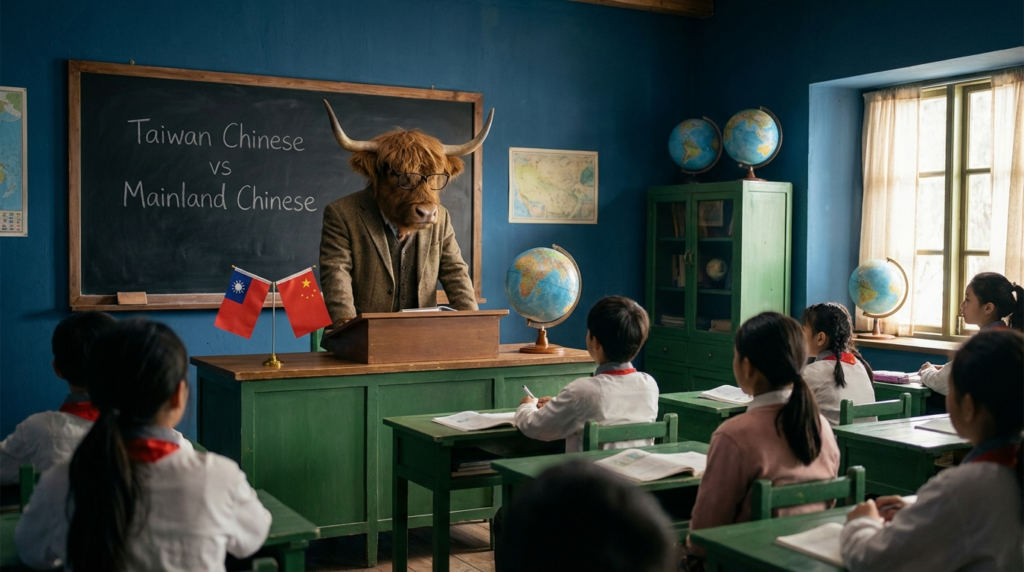
Taiwan Chinese vs Mainland Chinese: How To Sound Normal On Both Sides
Topic Name: 臺灣國語 vs 普通話
Táiwān Guóyǔ vs Pǔtōnghuà
You already “know Chinese,” and then someone says a totally normal word… and you blink like your brain just got a 404. This guide fixes that with the most common real-life differences in vocabulary, grammar habits, and colloquial vibe—with Traditional characters + pinyin you can actually use.
Quick truth: Taiwan Mandarin and Mainland Mandarin are highly mutually understandable. Most “differences” are really about which word is default, plus a few grammar habits and sentence-final particles that make you sound local. Also: Taiwan writes Traditional (繁體字 fántǐzì), Mainland usually writes Simplified (簡體字 jiǎntǐzì)—but speaking is where the fun confusion happens.
Yak Snark Box: If you say 地鐵 (dìtiě) in Taiwan, people won’t faint. If you say 捷運 (jiéyùn) in Beijing, people won’t call the police. But if you want to sound like you belong? Use the local default and sprinkle the local “vibe words.”
Quick “Most Useful” Difference Cards
捷運 / 地鐵
TW: 捷運 (jiéyùn) — metro
CN: 地鐵 (dìtiě) — subway
計程車 / 出租車
TW: 計程車 (jìchéngchē) — taxi
CN: 出租車 (chūzūchē) — taxi
便利商店 / 便利店
TW: 便利商店 (biànlì shāngdiàn) — convenience store
CN: 便利店 (biànlìdiàn) — convenience store
冷氣 / 空調
TW: 冷氣 (lěngqì) — air conditioning
CN: 空調 (kōngtiáo) — air conditioning
網路 / 網絡
TW: 網路 (wǎnglù) — internet
CN: 網絡 (wǎngluò) — internet/network
影片 / 視頻
TW: 影片 (yǐngpiàn) — video
CN: 視頻 (shìpín) — video
軟體 / 軟件
TW: 軟體 (ruǎntǐ) — software
CN: 軟件 (ruǎnjiàn) — software
行動電源 / 充電寶
TW: 行動電源 (xíngdòng diànyuán) — power bank
CN: 充電寶 (chōngdiànbǎo) — power bank
Everyday Vocabulary Differences (With Real Sentences)
Each entry shows the Taiwan default first (Traditional + pinyin). Then the Mainland default. Both are “correct”—they just signal different places.
Transport And City Life
1) Metro
TW: 捷運 (jiéyùn) — metro
CN: 地鐵 (dìtiě) — subway
Example (TW): 我們坐捷運去西門。
wǒmen zuò jiéyùn qù Xīmén.
We’re taking the metro to Ximen.
Mainland Version: 我們坐地鐵去那邊。
wǒmen zuò dìtiě qù nàbiān.
We’re taking the subway over there.
2) Taxi
TW: 計程車 (jìchéngchē) — taxi
CN: 出租車 (chūzūchē) — taxi
Example (TW): 太晚了,我們叫計程車吧。
tài wǎn le, wǒmen jiào jìchéngchē ba.
It’s too late—let’s call a taxi.
Mainland Version: 太晚了,我們打個出租車吧。
tài wǎn le, wǒmen dǎ ge chūzūchē ba.
It’s too late—let’s grab a taxi.
3) Bus
TW: 公車 (gōngchē) — bus
CN: 公交車 (gōngjiāochē) — bus
Example (TW): 這班公車會到車站嗎?
zhè bān gōngchē huì dào chēzhàn ma?
Does this bus go to the station?
Mainland Version: 這趟公交車到火車站嗎?
zhè tàng gōngjiāochē dào huǒchēzhàn ma?
Does this bus go to the train station?
4) Scooter / Motorcycle
TW: 機車 (jīchē) — scooter/motorbike
CN: 摩托車 (mótuōchē) — motorcycle
Example (TW): 台北很多人騎機車上班。
Táiběi hěn duō rén qí jīchē shàngbān.
In Taipei, lots of people ride scooters to work.
Mainland Version: 他平常騎摩托車通勤。
tā píngcháng qí mótuōchē tōngqín.
He usually commutes by motorcycle.
5) Bicycle
TW: 腳踏車 (jiǎotàchē) / 自行車 (zìxíngchē) — bicycle
CN: 自行車 (zìxíngchē) — bicycle
Example (TW): 我們租腳踏車去河濱騎。
wǒmen zū jiǎotàchē qù hébīn qí.
Let’s rent bikes and ride by the riverside.
Mainland Version: 我騎自行車去買菜。
wǒ qí zìxíngchē qù mǎi cài.
I’m biking to buy groceries.
6) Transit Card
TW: 悠遊卡 (Yōuyóu kǎ) / 一卡通 (Yīkǎtōng) — transit card
CN: 公交卡 (gōngjiāo kǎ) / 交通卡 (jiāotōng kǎ) — transit card
Example (TW): 你有悠遊卡嗎?刷一下比較快。
nǐ yǒu Yōuyóu kǎ ma? shuā yíxià bǐjiào kuài.
Do you have an EasyCard? Tapping is faster.
Mainland Version: 你有公交卡嗎?坐車要用。
nǐ yǒu gōngjiāo kǎ ma? zuò chē yào yòng.
Do you have a transit card? You’ll need it for buses.
7) Bus Stop
TW: 公車站 (gōngchēzhàn) — bus stop
CN: 公交站 (gōngjiāozhàn) — bus stop
Example (TW): 公車站在前面右轉。
gōngchēzhàn zài qiánmiàn yòuzhuǎn.
The bus stop is ahead—turn right.
Mainland Version: 公交站就在路口。
gōngjiāozhàn jiù zài lùkǒu.
The bus stop is right at the intersection.
8) Transfer
TW: 轉乘 (zhuǎnchéng) — transfer
CN: 換乘 (huànchéng) — transfer
Example (TW): 你要在中山站轉乘紅線。
nǐ yào zài Zhōngshān Zhàn zhuǎnchéng Hóng Xiàn.
You need to transfer to the Red Line at Zhongshan Station.
Mainland Version: 到下一站換乘二號線。
dào xià yì zhàn huànchéng Èr Hào Xiàn.
Transfer to Line 2 at the next stop.
Shopping And Money
9) Convenience Store
TW: 便利商店 (biànlì shāngdiàn) — convenience store
CN: 便利店 (biànlìdiàn) — convenience store
Example (TW): 我去便利商店買水,你要什麼?
wǒ qù biànlì shāngdiàn mǎi shuǐ, nǐ yào shénme?
I’m going to the convenience store for water—want anything?
Mainland Version: 我下樓去便利店買點東西。
wǒ xiàlóu qù biànlìdiàn mǎi diǎn dōngxi.
I’m going downstairs to the convenience store to buy a few things.
10) Receipt / Invoice (Same Word, Different Default Meaning)
TW: 發票 (fāpiào) — receipt (often with lottery number)
CN: 發票 (fāpiào) — tax invoice (official, for reimbursement)
Also Useful: 收據 (shōujù) — receipt / 小票 (xiǎopiào) — receipt slip
Example (TW): 可以給我發票嗎?我想對獎。
kěyǐ gěi wǒ fāpiào ma? wǒ xiǎng duìjiǎng.
Can I have the receipt? I want to check the lottery.
Mainland Version: 麻煩開發票,我要報銷。
máfan kāi fāpiào, wǒ yào bàoxiāo.
Please issue an invoice—I need to get reimbursed.
11) Sale / Promotion
TW: 特價 (tèjià) — special price
CN: 促銷 (cùxiāo) — promotion/sale
Example (TW): 這個今天特價,買一送一。
zhège jīntiān tèjià, mǎi yī sòng yī.
This is on special today—buy one get one free.
Mainland Version: 這週在做促銷,挺划算。
zhè zhōu zài zuò cùxiāo, tǐng huásuàn.
There’s a promotion this week—pretty worth it.
12) Change (Money)
TW: 找錢 (zhǎo qián) — give change
CN: 找零 (zhǎo líng) — give change
Example (TW): 不用找錢,謝謝。
búyòng zhǎo qián, xièxie.
No need to give change, thanks.
Mainland Version: 麻煩找零。
máfan zhǎo líng.
Please give me the change.
13) Cashier / Checkout
TW: 櫃台 (guìtái) — counter / checkout
CN: 收銀台 (shōuyíntái) — cashier counter
Example (TW): 你先去櫃台結帳,我拿袋子。
nǐ xiān qù guìtái jiézhàng, wǒ ná dàizi.
You go pay at the counter first—I’ll grab a bag.
Mainland Version: 去收銀台排隊結賬吧。
qù shōuyíntái páiduì jiézhàng ba.
Let’s line up at the cashier to pay.
14) Bag (When Shopping)
TW: 袋子 (dàizi) / 購物袋 (gòuwùdài) — bag
CN: 袋子 (dàizi) / 口袋 (kǒudài) — bag (regional/common usage varies)
Example (TW): 需要袋子嗎?我們要收一塊。
xūyào dàizi ma? wǒmen yào shōu yí kuài.
Need a bag? We charge one dollar.
Mainland Version: 需要袋子嗎?要另外付錢。
xūyào dàizi ma? yào lìngwài fù qián.
Need a bag? It’s an extra charge.
Food And Daily Life
15) Lunch Box / Boxed Meal
TW: 便當 (biàndāng) — lunch box
CN: 盒飯 (héfàn) — boxed meal
Example (TW): 我中午吃便當就好。
wǒ zhōngwǔ chī biàndāng jiù hǎo.
I’ll just have a lunch box for lunch.
Mainland Version: 我點個盒飯,省事。
wǒ diǎn ge héfàn, shěngshì.
I’ll order a boxed meal—easier.
16) Takeout
TW: 外帶 (wàidài) — to go
CN: 打包 (dǎbāo) — pack it up/to go
Example (TW): 這個我想外帶,謝謝。
zhège wǒ xiǎng wàidài, xièxie.
I’d like this to go, thanks.
Mainland Version: 這個幫我打包。
zhège bāng wǒ dǎbāo.
Pack this up for me.
17) Air Conditioning
TW: 冷氣 (lěngqì) — air conditioning
CN: 空調 (kōngtiáo) — air conditioning
Example (TW): 冷氣可以開小一點嗎?有點冷。
lěngqì kěyǐ kāi xiǎo yìdiǎn ma? yǒudiǎn lěng.
Can you turn the AC down a bit? It’s kinda cold.
Mainland Version: 空調別開太低,我會感冒。
kōngtiáo bié kāi tài dī, wǒ huì gǎnmào.
Don’t set the AC too low—I’ll catch a cold.
18) Tomato
TW: 番茄 (fānqié) — tomato
CN: 西紅柿 (xīhóngshì) — tomato
Example (TW): 我不太敢吃生番茄。
wǒ bú tài gǎn chī shēng fānqié.
I’m not that brave about eating raw tomatoes.
Mainland Version: 我買了點西紅柿做湯。
wǒ mǎi le diǎn xīhóngshì zuò tāng.
I bought some tomatoes to make soup.
19) Potato
TW: 馬鈴薯 (mǎlíngshǔ) — potato
CN: 土豆 (tǔdòu) — potato
Example (TW): 這家薯條很脆,是馬鈴薯香。
zhè jiā shǔtiáo hěn cuì, shì mǎlíngshǔ xiāng.
The fries here are super crispy—potato goodness.
Mainland Version: 我想吃土豆絲。
wǒ xiǎng chī tǔdòusī.
I want shredded potato stir-fry.
20) Pineapple
TW: 鳳梨 (fènglí) — pineapple
CN: 菠蘿 (bōluó) — pineapple
Example (TW): 鳳梨酥是我的最愛。
fènglí sū shì wǒ de zuì’ài.
Pineapple cakes are my favorite.
Mainland Version: 我買了個菠蘿,超甜。
wǒ mǎi le ge bōluó, chāo tián.
I bought a pineapple—super sweet.
21) Avocado
TW: 酪梨 (làolí) — avocado
CN: 牛油果 (niúyóuguǒ) — avocado
Example (TW): 這杯酪梨牛奶很濃。
zhè bēi làolí niúnǎi hěn nóng.
This avocado milk drink is really rich.
Mainland Version: 牛油果吐司很火。
niúyóuguǒ tǔsī hěn huǒ.
Avocado toast is super popular.
22) Yogurt
TW: 優格 (yōugé) — yogurt
CN: 酸奶 (suānnǎi) — yogurt
Example (TW): 我早餐吃優格加水果。
wǒ zǎocān chī yōugé jiā shuǐguǒ.
I have yogurt with fruit for breakfast.
Mainland Version: 我想喝一瓶酸奶。
wǒ xiǎng hē yì píng suānnǎi.
I want a bottle of yogurt.
23) Trash (Pronunciation Habit)
TW (common pronunciation): 垃圾 (lèsè) — trash
CN (common pronunciation): 垃圾 (lājī) — trash
Example (TW): 垃圾(lèsè)要記得拿去丟。
lèsè yào jìde ná qù diū.
Remember to take out the trash.
Mainland Version: 垃圾(lājī)別放門口。
lājī bié fàng ménkǒu.
Don’t leave the trash at the door.
Tech And The Internet
24) Internet
TW: 網路 (wǎnglù) — internet
CN: 網絡 (wǎngluò) — internet/network
Example (TW): 這裡網路有點慢欸。
zhèlǐ wǎnglù yǒudiǎn màn ēi.
The internet here is kinda slow, huh.
Mainland Version: 這兒網絡不太穩。
zhèr wǎngluò bú tài wěn.
The internet isn’t very stable here.
25) Video
TW: 影片 (yǐngpiàn) — video
CN: 視頻 (shìpín) — video
Example (TW): 你把影片傳給我,我晚點看。
nǐ bǎ yǐngpiàn chuán gěi wǒ, wǒ wǎndiǎn kàn.
Send me the video—I’ll watch later.
Mainland Version: 這個視頻太好笑了。
zhège shìpín tài hǎoxiào le.
This video is hilarious.
26) Software
TW: 軟體 (ruǎntǐ) — software
CN: 軟件 (ruǎnjiàn) — software
Example (TW): 這個軟體要更新一下。
zhège ruǎntǐ yào gēngxīn yíxià.
This software needs an update.
Mainland Version: 你裝了那個軟件嗎?
nǐ zhuāng le nàge ruǎnjiàn ma?
Did you install that software?
27) USB Drive
TW: 隨身碟 (suíshēndié) — USB drive
CN: U盤 (Yōu pán) — USB drive
Example (TW): 檔案在我的隨身碟裡。
dàng’àn zài wǒ de suíshēndié lǐ.
The files are on my USB drive.
Mainland Version: 你有U盤嗎?我拷一下。
nǐ yǒu Yōu pán ma? wǒ kǎo yíxià.
Do you have a USB drive? I’ll copy it.
28) Power Bank
TW: 行動電源 (xíngdòng diànyuán) — power bank
CN: 充電寶 (chōngdiànbǎo) — power bank
Example (TW): 你手機快沒電了?我有行動電源。
nǐ shǒujī kuài méi diàn le? wǒ yǒu xíngdòng diànyuán.
Your phone’s dying? I’ve got a power bank.
Mainland Version: 我忘帶充電寶了,完了。
wǒ wàng dài chōngdiànbǎo le, wán le.
I forgot my power bank—uh oh.
29) Mouse (Computer)
TW: 滑鼠 (huáshǔ) — mouse
CN: 鼠標 (shǔbiāo) — mouse
Example (TW): 這台電腦的滑鼠怪怪的。
zhè tái diànnǎo de huáshǔ guài guài de.
This computer’s mouse is acting weird.
Mainland Version: 鼠標沒反應,你重插一下。
shǔbiāo méi fǎnyìng, nǐ chóngchā yíxià.
The mouse isn’t responding—plug it in again.
School And Work
30) Grad School
TW: 研究所 (yánjiūsuǒ) — grad school
CN: 研究生院 (yánjiūshēngyuàn) — graduate school
Example (TW): 我明年想考研究所。
wǒ míngnián xiǎng kǎo yánjiūsuǒ.
I want to apply for grad school next year.
Mainland Version: 她在研究生院讀書。
tā zài yánjiūshēngyuàn dúshū.
She studies in grad school.
31) Presentation / Reporting
TW: 報告 (bàogào) — presentation/report
CN: 匯報 (huìbào) — to report (often workplace)
Example (TW): 我等一下要做報告,有點緊張。
wǒ děngyíxià yào zuò bàogào, yǒudiǎn jǐnzhāng.
I have to present in a bit—kinda nervous.
Mainland Version: 明天要向主管匯報進度。
míngtiān yào xiàng zhǔguǎn huìbào jìndù.
Tomorrow I need to report progress to my manager.
Colloquial “What? / Really?” Reactions
32) “Huh?” / “What?”
TW: 蛤?(há?) — huh?/what?
CN: 啥?(shá?) — what?
Example (TW): 蛤?你剛剛說什麼?
há? nǐ gānggāng shuō shénme?
Huh? What did you just say?
Mainland Version: 啥?我沒聽清。
shá? wǒ méi tīngqīng.
What? I didn’t hear clearly.
33) “Seriously?”
TW: 真的假的?(zhēn de jiǎ de?) — seriously? for real?
CN: 真的嗎?(zhēn de ma?) — really?
Example (TW): 真的假的?他要結婚了喔?
zhēn de jiǎ de? tā yào jiéhūn le ō?
Seriously? He’s getting married?
Mainland Version: 真的嗎?我還以為是玩笑。
zhēn de ma? wǒ hái yǐwéi shì wánxiào.
Really? I thought it was a joke.
Grammar And “Vibe” Differences That People Actually Notice
This is the stuff that makes you sound Taiwan-local or Mainland-local even when your vocabulary is fine. Each pattern includes a Taiwan-style sentence and a Mainland-style sentence.
1) Taiwan “有 + V” (Past Experience / Did It)
TW Pattern: 我有去 / 我有看 — “I did go / I did watch” (common in Taiwan speech)
CN Pattern: 我去了 / 我去過 — past action / past experience
Example (TW): 我有去那家店,真的不錯。
wǒ yǒu qù nà jiā diàn, zhēn de búcuò.
I did go to that shop—it’s really not bad.
Mainland Version: 我去過那家店,確實不錯。
wǒ qùguò nà jiā diàn, quèshí búcuò.
I’ve been to that shop—it’s indeed pretty good.
2) Request Style: “麻煩你… / 幫我…” vs “麻煩… / 給我…”
TW Habit: 麻煩你 (máfan nǐ) / 幫我 (bāng wǒ) — soft, polite, super common
CN Habit: 麻煩 (máfan) / 給我 (gěi wǒ) — direct request feel (still polite with tone)
Example (TW): 麻煩你幫我開一下門,謝謝。
máfan nǐ bāng wǒ kāi yíxià mén, xièxie.
Could you please open the door for me, thanks.
Mainland Version: 麻煩給我開一下門。
máfan gěi wǒ kāi yíxià mén.
Please open the door for me.
3) “一下” As A Politeness Softener
Key Phrase: 一下 (yíxià) — “a bit / for a sec” (often: make it sound less bossy)
Example (TW): 你等我一下喔,我拿個東西。
nǐ děng wǒ yíxià ō, wǒ ná ge dōngxi.
Wait for me a sec—I’ll grab something.
Mainland Version: 你等我一下,我拿點東西。
nǐ děng wǒ yíxià, wǒ ná diǎn dōngxi.
Wait for me a sec—I’ll grab something.
4) Sentence-Final Particles: Taiwan Loves Them (And Softeners)
TW Common: 啦 (la), 喔 (ō), 欸 (ēi), 耶 (yē) — friendly tone, softer vibe
CN Common: 啊 (a), 呢 (ne), 吧 (ba), (兒化)r sound in some regions
Example (TW): 沒關係啦,我自己來就好。
méi guānxi la, wǒ zìjǐ lái jiù hǎo.
It’s okay—I’ll do it myself.
Mainland Version: 沒事兒,我自己來吧。
méi shìr, wǒ zìjǐ lái ba.
No worries—I’ll do it myself.
5) “Can You…?”: 可以嗎 vs 行嗎
TW Common: 可以嗎?(kěyǐ ma?) — can it / is it okay?
CN Common: 行嗎?(xíng ma?) — is it okay / will it work?
Example (TW): 我坐這裡可以嗎?
wǒ zuò zhèlǐ kěyǐ ma?
Is it okay if I sit here?
Mainland Version: 我坐這兒行嗎?
wǒ zuò zhèr xíng ma?
Is it okay if I sit here?
6) “Pretty Okay”: 還好 vs 還行
TW Common: 還好 (háihǎo) — not bad / okay
CN Common: 還行 (háixíng) — okay / acceptable
Example (TW): 這家餐廳還好啦,沒有到很驚艷。
zhè jiā cāntīng háihǎo la, méiyǒu dào hěn jīngyàn.
This restaurant is okay—nothing mind-blowing.
Mainland Version: 這家還行,就是有點貴。
zhè jiā háixíng, jiùshì yǒudiǎn guì.
It’s fine—just a bit pricey.
7) Location Words: 這裡 / 那邊 vs 這兒 / 那兒 (And The “r” Sound)
TW Common: 這裡 (zhèlǐ), 那邊 (nàbiān)
CN Common: 這兒 (zhèr), 那兒 (nàr) — often with “兒化” (érhuà) in some regions
Example (TW): 你先坐那邊,我去點餐。
nǐ xiān zuò nàbiān, wǒ qù diǎncān.
You sit over there first—I’ll go order.
Mainland Version: 你先坐那兒,我去點菜。
nǐ xiān zuò nàr, wǒ qù diǎn cài.
You sit over there first—I’ll go order.
8) “Super” Intensifiers: 超… vs 挺… / 贼… (Very Colloquial)
TW Common: 超 (chāo) + adjective — super…
CN Common: 挺 (tǐng) + adjective — pretty… / 贼 (zéi) + adjective — super… (very colloquial)
Example (TW): 這家超好吃,我下次還要來。
zhè jiā chāo hǎochī, wǒ xiàcì hái yào lái.
This place is super tasty—I’m coming again.
Mainland Version: 這家挺好吃的,贼香。
zhè jiā tǐng hǎochī de, zéi xiāng.
This place is pretty good—like, insanely fragrant.
Quick Practice: Swap The “Locale”
Take the Taiwan sentence and make it sound more Mainland-style (or the other way around). Don’t overthink it—just swap the bolded part.
- TW: 我去便利商店買東西。
wǒ qù biànlì shāngdiàn mǎi dōngxi.
Try CN: ________ - TW: 你有行動電源嗎?
nǐ yǒu xíngdòng diànyuán ma?
Try CN: ________ - CN: 我坐地鐵去上班。
wǒ zuò dìtiě qù shàngbān.
Try TW: ________ - CN: 這個幫我打包。
zhège bāng wǒ dǎbāo.
Try TW: ________
Answers
1) CN: 我去便利店買點東西。
wǒ qù biànlìdiàn mǎi diǎn dōngxi.
2) CN: 你有充電寶嗎?
nǐ yǒu chōngdiànbǎo ma?
3) TW: 我坐捷運去上班。
wǒ zuò jiéyùn qù shàngbān.
4) TW: 這個我想外帶。
zhège wǒ xiǎng wàidài.
Tables Of Words (Grouped, Quick Reference)
Transport And City
| Hanzi | Pinyin | Meaning | Example (ZH) | Example (Pinyin) | Translation (EN) |
|---|---|---|---|---|---|
| 捷運 | jiéyùn | metro (TW) | 我坐捷運去西門。 | wǒ zuò jiéyùn qù Xīmén. | I take the metro to Ximen. |
| 地鐵 | dìtiě | subway (CN) | 我坐地鐵去上班。 | wǒ zuò dìtiě qù shàngbān. | I take the subway to work. |
| 計程車 | jìchéngchē | taxi (TW) | 我們叫計程車吧。 | wǒmen jiào jìchéngchē ba. | Let’s call a taxi. |
| 出租車 | chūzūchē | taxi (CN) | 我打個出租車。 | wǒ dǎ ge chūzūchē. | I’ll grab a taxi. |
| 公車 | gōngchē | bus (TW) | 這班公車到車站嗎? | zhè bān gōngchē dào chēzhàn ma? | Does this bus go to the station? |
| 公交車 | gōngjiāochē | bus (CN) | 這趟公交車到火車站嗎? | zhè tàng gōngjiāochē dào huǒchēzhàn ma? | Does this bus go to the train station? |
| 轉乘 | zhuǎnchéng | transfer (TW) | 你要在這站轉乘。 | nǐ yào zài zhè zhàn zhuǎnchéng. | You transfer at this stop. |
| 換乘 | huànchéng | transfer (CN) | 下一站換乘二號線。 | xià yì zhàn huànchéng Èr Hào Xiàn. | Transfer to Line 2 next stop. |
Food And Daily Life
| Hanzi | Pinyin | Meaning | Example (ZH) | Example (Pinyin) | Translation (EN) |
|---|---|---|---|---|---|
| 便當 | biàndāng | lunch box (TW) | 我中午吃便當。 | wǒ zhōngwǔ chī biàndāng. | I eat a lunch box at noon. |
| 盒飯 | héfàn | boxed meal (CN) | 我點個盒飯。 | wǒ diǎn ge héfàn. | I’ll order a boxed meal. |
| 外帶 | wàidài | to go (TW) | 這個我想外帶。 | zhège wǒ xiǎng wàidài. | I’d like this to go. |
| 打包 | dǎbāo | pack up (CN) | 這個幫我打包。 | zhège bāng wǒ dǎbāo. | Pack this up for me. |
| 番茄 | fānqié | tomato (TW) | 我買了番茄。 | wǒ mǎi le fānqié. | I bought tomatoes. |
| 西紅柿 | xīhóngshì | tomato (CN) | 我買了西紅柿。 | wǒ mǎi le xīhóngshì. | I bought tomatoes. |
| 鳳梨 | fènglí | pineapple (TW) | 鳳梨很甜。 | fènglí hěn tián. | The pineapple is sweet. |
| 菠蘿 | bōluó | pineapple (CN) | 菠蘿很甜。 | bōluó hěn tián. | The pineapple is sweet. |
Tech And Internet
| Hanzi | Pinyin | Meaning | Example (ZH) | Example (Pinyin) | Translation (EN) |
|---|---|---|---|---|---|
| 網路 | wǎnglù | internet (TW) | 這裡網路很慢。 | zhèlǐ wǎnglù hěn màn. | The internet is slow here. |
| 網絡 | wǎngluò | internet (CN) | 網絡不太穩。 | wǎngluò bú tài wěn. | The internet isn’t stable. |
| 軟體 | ruǎntǐ | software (TW) | 這個軟體要更新。 | zhège ruǎntǐ yào gēngxīn. | This software needs updating. |
| 軟件 | ruǎnjiàn | software (CN) | 那個軟件很方便。 | nàge ruǎnjiàn hěn fāngbiàn. | That software is handy. |
| 隨身碟 | suíshēndié | USB drive (TW) | 檔案在隨身碟裡。 | dàng’àn zài suíshēndié lǐ. | The files are on the USB drive. |
| U盤 | Yōu pán | USB drive (CN) | 我用U盤拷走。 | wǒ yòng Yōu pán kǎo zǒu. | I’ll copy it with a USB drive. |
| 行動電源 | xíngdòng diànyuán | power bank (TW) | 我帶了行動電源。 | wǒ dài le xíngdòng diànyuán. | I brought a power bank. |
| 充電寶 | chōngdiànbǎo | power bank (CN) | 我忘帶充電寶。 | wǒ wàng dài chōngdiànbǎo. | I forgot my power bank. |
Optional Variants Table (Polite, Casual, And “Local Flavor”)
| Use Case | Taiwan Common | Pinyin | Mainland Common | Pinyin | Meaning |
|---|---|---|---|---|---|
| Soft “No Worries” | 沒關係啦 | méi guānxi la | 沒事兒 | méi shìr | It’s fine / no worries |
| “Huh?” Reaction | 蛤? | há? | 啥? | shá? | What? |
| “Can I?” | 可以嗎? | kěyǐ ma? | 行嗎? | xíng ma? | Is it okay? |
| Very “Super” | 超… | chāo… | 挺… / 贼… | tǐng… / zéi… | Pretty / super (slang) |
Final Yak Box: The 3-Second Strategy
- Learn the local default nouns (捷運 jiéyùn vs 地鐵 dìtiě, 便當 biàndāng vs 盒飯 héfàn).
- Copy the local request style: Taiwan leans into 麻煩你 (máfan nǐ) + 一下 (yíxià). Mainland often uses 行嗎 (xíng ma) and “r” sounds in some places.
- Don’t panic: even if you mix them, people still understand you. You’ll just sound like you have stamps in your passport (which is honestly not a bad look).