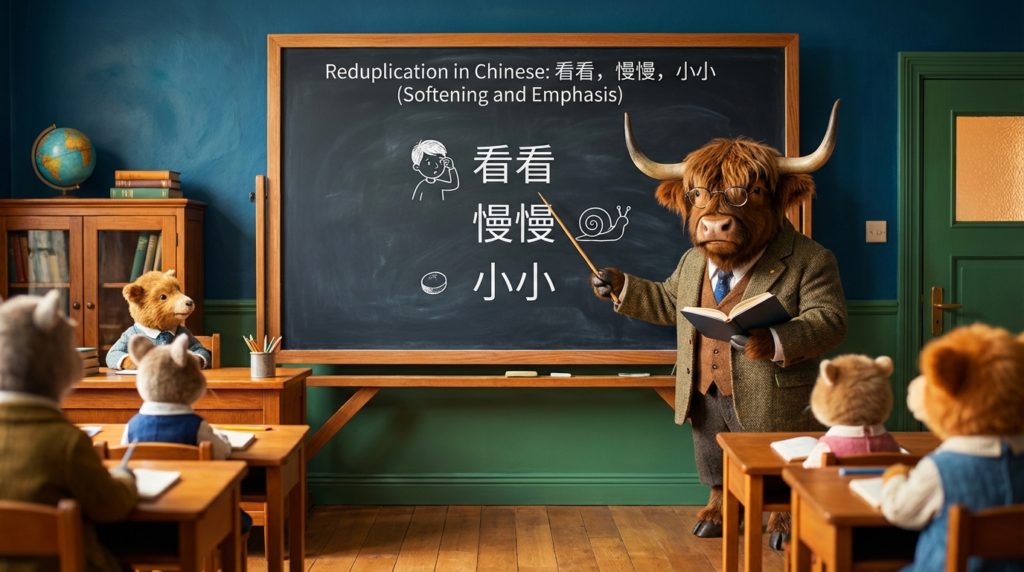
Chinese Reduplication: 看看, 慢慢, 小小 (Softening & Emphasis)
Topic in Chinese: 疊字 diézì / 重疊 chóngdié — repeating a word to sound less sharp, more casual, or extra on purpose.
In real-life Mandarin, being “grammatically correct” is not the same as sounding human. Reduplication is one of the easiest ways to make your Chinese feel softer, friendlier, and more natural—especially in Taiwan.
Today you’ll learn how 看看 kànkan, 慢慢 mànman, and 小小 xiǎoxiao work, when to use them, and how to avoid the most common “textbook robot” mistakes.
Yak Snark (Helpful Edition): If your sentence feels too direct, don’t panic—just… repeat something once. Congrats, you’re now 30% more polite.
What Reduplication Does
Reduplication (repeating a word) usually adds one of these feelings:
- Softening: sounds less like a command
- “Just a bit / briefly”: suggests doing something lightly or for a short time
- Warm emphasis: makes descriptions feel more vivid, affectionate, or intentional
Pronunciation note (super important): the second syllable is often a neutral tone in speech. That’s why you’ll see pinyin like kànkan (tone mark only on the first syllable).
The Two Most Useful Patterns
| Pattern | Common Use | Vibe | One Real Example |
|---|---|---|---|
| VV (verb + verb) 看看 kànkan | Try / take a quick look / do briefly | Softer, casual | 你先看看。 nǐ xiān kànkan. Take a quick look first. |
| AA (adj + adj) 慢慢 mànman | Slowly / gently / gradually | Friendly, soothing | 慢慢來。 mànman lái. Take your time. |
Visual Quick Cards
These are “high-utility” reduplications you’ll hear constantly. Each one includes a mini sentence you can steal immediately.
看看
kànkan — take a quick look / check briefly
你幫我看看這個。nǐ bāng wǒ kànkan zhège.
Can you take a look at this for me?
試試
shìshi — try (just a bit)
你可以試試看。nǐ kěyǐ shìshi kàn.
You can give it a try.
聊聊
liáoliao — chat a little
有空聊聊嗎?yǒu kòng liáoliao ma?
Free to chat for a bit?
想想
xiǎngxiang — think it over
你再想想。nǐ zài xiǎngxiang.
Think about it again.
慢慢
mànman — slowly / take your time
慢慢說。mànman shuō.
Speak slowly.
好好
hǎohāo — properly / seriously / well
好好休息。hǎohāo xiūxi.
Get some proper rest.
小小
xiǎoxiao — small / a little (often modest, cute, or polite)
這是小小的心意。zhè shì xiǎoxiao de xīnyì.
This is just a small token of appreciation.
甜甜
tiántián — sweet (taste or vibe)
這個味道甜甜的。zhège wèidào tiántián de.
This tastes kind of sweet.
Deep Dive: 看看 kànkan
看看 kànkan means “take a look (briefly)” and often makes requests sound less demanding.
| Form | Meaning | Example (ZH / Pinyin / EN) |
|---|---|---|
| 看看 kànkan | look briefly (casual) | 你幫我看看。 nǐ bāng wǒ kànkan. Can you check for me? |
| 看一看 kàn yí kàn | look a bit (slightly clearer / more “complete”) | 你先看一看再決定。 nǐ xiān kàn yí kàn zài juédìng. Take a look first, then decide. |
| 看看 + 吧 kànkan ba | soft suggestion | 你先看看吧。 nǐ xiān kànkan ba. Just take a look first. |
| 看看 + 就好 kànkan jiù hǎo | “just… is fine” (very soft) | 我看看就好,不用改。 wǒ kànkan jiù hǎo, bú yòng gǎi. I’ll just look—no need to change it. |
Deep Dive: 慢慢 mànman
慢慢 mànman can mean “slowly,” but it also works like a calming button: “take your time,” “no rush,” “gradually.”
| Use | What It Communicates | Example (ZH / Pinyin / EN) |
|---|---|---|
| Slowly | literal speed | 你走慢慢一點。 nǐ zǒu mànman yìdiǎn. Walk a bit slower. |
| Take your time | no pressure | 慢慢來,不急。 mànman lái, bù jí. Take your time, no rush. |
| Gradually | change over time | 天氣會慢慢變暖。 tiānqì huì mànman biàn nuǎn. The weather will gradually get warmer. |
| Gentle tone | softens advice | 你慢慢說,我聽得懂。 nǐ mànman shuō, wǒ tīngdedǒng. Speak slowly—I can understand. |
Deep Dive: 小小 xiǎoxiao
小小 xiǎoxiao is “small” with a warm, modest, or “not-a-big-deal” vibe. It’s common for gifts, favors, and polite self-minimizing (very culturally useful).
| Use | Meaning | Example (ZH / Pinyin / EN) |
|---|---|---|
| Small + cute | small-ish (often friendly) | 我想買一個小小的包。 wǒ xiǎng mǎi yí gè xiǎoxiao de bāo. I want to buy a small little bag. |
| Modesty | “just a little…” | 這只是小小的幫忙。 zhè zhǐshì xiǎoxiao de bāngmáng. This is just a small favor. |
| Polite gift | token / gesture | 小小禮物,請收下。 xiǎoxiao lǐwù, qǐng shōuxià. A small gift—please accept it. |
| Soft complaint | a tiny bit (gentler) | 我有一個小小的問題。 wǒ yǒu yí gè xiǎoxiao de wèntí. I have a small question. |
Useful Phrases You Can Use Today
Steal these in messages, meetings, and daily life. Each line is built to sound natural—not dramatic, not stiff.
Softening Requests (VV Verbs)
| Expression | Pinyin | Meaning | Example (ZH) | Example (Pinyin) | Translation (EN) |
|---|---|---|---|---|---|
| 看看 | kànkan | take a look | 你能看看這份檔案嗎? | nǐ néng kànkan zhè fèn dàng’àn ma? | Can you look at this file? |
| 聽聽 | tīngting | listen a bit | 你先聽聽看。 | nǐ xiān tīngting kàn. | Listen first. |
| 說說 | shuōshuo | talk a bit | 你跟我說說你的想法。 | nǐ gēn wǒ shuōshuo nǐ de xiǎngfǎ. | Tell me your thoughts. |
| 聊聊 | liáoliao | chat a little | 我們晚點聊聊? | wǒmen wǎndiǎn liáoliao? | Want to chat later? |
| 想想 | xiǎngxiang | think it over | 你回去想想再回我。 | nǐ huíqù xiǎngxiang zài huí wǒ. | Think about it and reply later. |
| 試試 | shìshi | try a bit | 你可以試試這個方法。 | nǐ kěyǐ shìshi zhège fāngfǎ. | You can try this method. |
| 問問 | wènwen | ask around | 我去問問看有沒有位子。 | wǒ qù wènwen kàn yǒu méiyǒu wèizi. | I’ll ask if there are seats. |
| 找找 | zhǎozhao | look for a bit | 我再找找看。 | wǒ zài zhǎozhao kàn. | I’ll look again. |
| 查查 | cháchá | check / look up | 我幫你查查資料。 | wǒ bāng nǐ cháchá zīliào. | I’ll look up the info for you. |
| 等等 | děngdeng | wait a bit | 你等等我,我快到了。 | nǐ děngdeng wǒ, wǒ kuài dào le. | Wait for me—I’m almost there. |
| 坐坐 | zuòzuo | sit for a bit | 進來坐坐吧。 | jìnlái zuòzuo ba. | Come in and sit for a bit. |
| 走走 | zǒuzou | take a walk | 我們出去走走。 | wǒmen chūqù zǒuzou. | Let’s go out for a walk. |
Warm Descriptions (AA / AABB Adjectives)
| Expression | Pinyin | Meaning | Example (ZH) | Example (Pinyin) | Translation (EN) |
|---|---|---|---|---|---|
| 慢慢 | mànman | slowly / take your time | 慢慢吃,別噎到。 | mànman chī, bié yē dào. | Eat slowly—don’t choke. |
| 好好 | hǎohāo | properly / well | 你要好好照顧自己。 | nǐ yào hǎohāo zhàogù zìjǐ. | Take good care of yourself. |
| 小小 | xiǎoxiao | small / a little (modest) | 我有個小小的請求。 | wǒ yǒu gè xiǎoxiao de qǐngqiú. | I have a small request. |
| 甜甜 | tiántián | sweet-ish | 這杯茶甜甜的,很順口。 | zhè bēi chá tiántián de, hěn shùnkǒu. | This tea is lightly sweet—goes down easy. |
| 冷冷 | lěngleng | a bit cold | 今天風冷冷的。 | jīntiān fēng lěngleng de. | The wind feels a bit cold today. |
| 熱熱 | rèrè | nice and warm | 湯要趁熱熱的喝。 | tāng yào chèn rèrè de hē. | Drink the soup while it’s warm. |
| 輕輕 | qīngqīng | gently | 你輕輕放在桌上。 | nǐ qīngqīng fàng zài zhuō shàng. | Put it down gently. |
| 乖乖 | guāiguāi | well-behaved / obedient (often to kids/pets) | 乖乖坐好。 | guāiguāi zuò hǎo. | Sit nicely. |
| 清清楚楚 | qīngqīngchǔchǔ | very clearly (AABB) | 請你清清楚楚講一遍。 | qǐng nǐ qīngqīngchǔchǔ jiǎng yí biàn. | Please explain it clearly once. |
| 乾乾淨淨 | gāngānjìngjìng | nice and clean (AABB) | 把桌子擦得乾乾淨淨。 | bǎ zhuōzi cā de gāngānjìngjìng. | Wipe the table clean. |
| 舒舒服服 | shūshūfúfú | comfortable (AABB) | 我想舒舒服服睡一覺。 | wǒ xiǎng shūshūfúfú shuì yí jiào. | I want to sleep really comfortably. |
| 簡簡單單 | jiǎnjiǎndāndān | simple and clean (AABB) | 我們就簡簡單單吃個飯。 | wǒmen jiù jiǎnjiǎndāndān chī gè fàn. | Let’s just have a simple meal. |
How To Choose Between Reduplication And 一下
Both can soften, but they feel a little different:
| Option | Feeling | Example (ZH / Pinyin / EN) |
|---|---|---|
| 看看 kànkan | casual, friendly, “just take a peek” | 你看看這個。 nǐ kànkan zhège. Take a look at this. |
| 看一下 kàn yíxià | quick action, slightly more “task-like” | 你看一下這個。 nǐ kàn yíxià zhège. Check this quickly. |
| 看一看 kàn yí kàn | neutral, slightly more complete / “proper” | 你看一看再說。 nǐ kàn yí kàn zài shuō. Take a look first, then we’ll talk. |
Practice: Make It Sound Less Bossy
Turn the “too direct” version into something softer using reduplication (or an AABB adjective when it fits).
- Direct: 你看這個。nǐ kàn zhège. (Look at this.)
- Direct: 你說清楚。nǐ shuō qīngchǔ. (Explain clearly.)
- Direct: 你慢一點。nǐ màn yìdiǎn. (Slower.)
- Direct: 你幫我查資料。nǐ bāng wǒ chá zīliào. (Help me check info.)
- Direct: 你坐。nǐ zuò. (Sit.)
- Direct: 你想再決定。nǐ xiǎng zài juédìng. (Think then decide.)
- Direct: 把桌子擦乾淨。bǎ zhuōzi cā gānjìng. (Wipe the table clean.)
- Direct: 你吃慢一點。nǐ chī màn yìdiǎn. (Eat slower.)
Answer Key (Tap To Reveal)
1) 你看看這個。nǐ kànkan zhège. — Take a look at this.
2) 你清清楚楚講一次。nǐ qīngqīngchǔchǔ jiǎng yí cì. — Explain it clearly once.
3) 你慢慢來。nǐ mànman lái. — Take your time.
4) 你幫我查查資料。nǐ bāng wǒ cháchá zīliào. — Help me check the info.
5) 你進來坐坐。nǐ jìnlái zuòzuo. — Come in and sit for a bit.
6) 你再想想再決定。nǐ zài xiǎngxiang zài juédìng. — Think it over again, then decide.
7) 把桌子擦得乾乾淨淨。bǎ zhuōzi cā de gāngānjìngjìng. — Wipe it nice and clean.
8) 你慢慢吃。nǐ mànman chī. — Eat slowly.
Common Mistakes And Quick Fixes
- Mistake: using reduplication to sound “more formal.”
Fix: reduplication is usually more casual and more human, not more formal. - Mistake: stacking softeners until the sentence collapses.
Fix: pick one: 看看 or 一下 or 吧. Example: 你看看吧。nǐ kànkan ba. (Perfect.) - Mistake: pronouncing the second syllable too strongly.
Fix: it’s often neutral: kànkan, mànman, liáoliao. - Mistake: reduplicating long, “heavy” adjectives randomly.
Fix: use common ones people actually say: 清清楚楚 qīngqīngchǔchǔ, 乾乾淨淨 gāngānjìngjìng, 舒舒服服 shūshūfúfú.
Quick Reference Summary
| If You Want To… | Use This | Template | Example |
|---|---|---|---|
| Soften a request | VV verbs | 你 + VV + (吧) | 你看看吧。nǐ kànkan ba. (Take a look.) |
| Suggest “try it” | 試試 shìshi | 你可以 + 試試 + 看 | 你可以試試看。nǐ kěyǐ shìshi kàn. |
| Say “take your time” | 慢慢 mànman | 慢慢 + 來 / 說 / 吃 | 慢慢來。mànman lái. |
| Be modest/polite | 小小 xiǎoxiao | 小小的 + 名詞 | 小小的心意。xiǎoxiao de xīnyì. |
| Emphasize a quality | AABB adjectives | AABB + 的 | 乾乾淨淨的。gāngānjìngjìng de. |
Final Yak Box: Your “Sound Natural” Shortcut
If you remember only one thing: VV (看看 / 試試 / 聊聊) softens actions, and AA (慢慢 / 好好 / 小小) softens descriptions and tone. When your Chinese feels too blunt, reduplication is the polite duct tape.
Want to level up fast? Start using 看看 kànkan in messages today, add 慢慢 mànman when you’re calming someone down, and keep 小小 xiǎoxiao for polite requests and modest gifts. Your Mandarin will instantly feel more Taiwan-real.