Pinyin Made Simple: Initials, Finals, And The Sounds That Love To Troll You
Topic name: 拼音 pīn yīn — “pinyin (Mandarin spelling)”
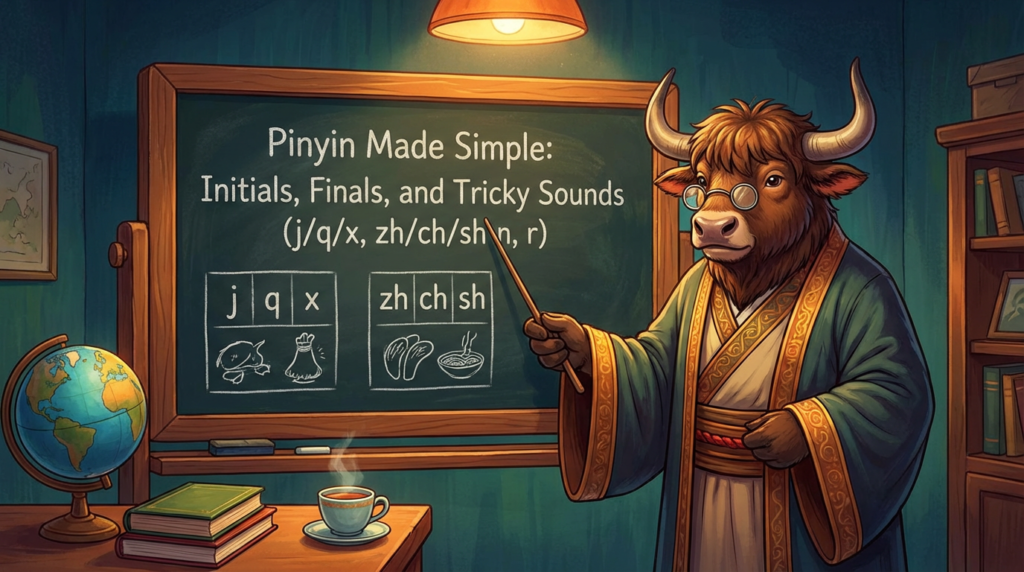
You don’t need a perfect “radio announcer accent” to speak Taiwanese Mandarin clearly. You do need a clean map: initials (starting sounds), finals (ending sounds), and a few spicy troublemakers: j / q / x, zh / ch / sh, and r.
By the end, you’ll be able to look at a pinyin syllable and know what your mouth should do—plus you’ll get real Traditional Chinese examples with tone marks, not vague “kinda like English” hand-waving.
Yak Box: If pinyin feels “random,” it’s usually because your brain keeps forcing English rules onto it. Pinyin is consistent… it just doesn’t care about your English feelings.
Pinyin Has Three Jobs
Think of one Mandarin syllable like a little LEGO build:
- Initial = the starter sound (often a consonant)
- Final = the vowel ending (sometimes with a nasal ending)
- Tone = the pitch shape (tone marks on the vowel)
聲母 shēng mǔ
Meaning: initial (starting sound)
這個字的聲母是 m。
Zhè ge zì de shēngmǔ shì m.
The initial of this character is m.
韻母 yùn mǔ
Meaning: final (vowel ending)
「mā」的韻母是 a。
“Mā” de yùnmǔ shì a.
The final of “mā” is a.
聲調 shēng diào
Meaning: tone
同一個拼音,不同聲調,意思會變。
Tóng yí ge pīnyīn, bù tóng shēngdiào, yìsi huì biàn.
Same pinyin, different tone—meaning changes.
Tones: The Five You Actually Need
Mandarin has four main tones plus a “neutral tone.” Tone marks sit on the main vowel of the final.
| Tone | Mark | Example Word | Meaning | Example Sentence |
|---|---|---|---|---|
| 1st | ¯ | 媽 mā | mom | 我愛我媽。 Wǒ ài wǒ mā. I love my mom. |
| 2nd | ´ | 麻 má | hemp / numb | 這個辣椒讓我嘴巴有點麻。 Zhè ge là jiāo ràng wǒ zuǐba yǒudiǎn má. This chili makes my mouth a bit numb. |
| 3rd | ˇ | 馬 mǎ | horse | 那匹馬很大。 Nà pǐ mǎ hěn dà. That horse is big. |
| 4th | ` | 罵 mà | to scold | 不要罵小孩。 Bú yào mà xiǎo hái. Don’t scold kids. |
| Neutral | (none) | 嗎 ma | question particle | 你累嗎? Nǐ lèi ma? Are you tired? |
Tone Sandhi Quick Reality Check (Yes, Tones Change)
Two common tone changes you’ll hear a lot:
- 不 bù → bú before a 4th tone: 不是 bú shì — “is not”
他不是老師。
Tā bú shì lǎo shī.
He’s not a teacher. - 一 yī → yí before a 4th tone, → yì before other tones: 一個 yí ge — “one (unit)”
我想買一個。
Wǒ xiǎng mǎi yí ge.
I want to buy one.
Initials: The Starter Sounds That Matter Most
If you learned English phonics, here’s the twist: some pinyin letters look familiar but behave differently. The biggest “clarity win” is aspiration (a burst of air), not voicing.
Unaspirated vs Aspirated
- b vs p
- d vs t
- g vs k
Rule of thumb: p/t/k = bigger puff of air. b/d/g = smaller puff.
Mini Pair Practice
爸 bà — dad
我爸在臺北。
Wǒ bà zài Táiběi.
My dad is in Taipei.
趴 pā — to lie face-down
狗狗趴在地上。
Gǒu gǒu pā zài dìshàng.
The dog is lying on the floor.
刀 dāo — knife
這把刀很利。
Zhè bǎ dāo hěn lì.
This knife is sharp.
套 tào — set / cover / to put on
我買了一套衣服。
Wǒ mǎi le yí tào yīfu.
I bought a set of clothes.
Finals: Vowel Endings Without The Drama
Finals are the vowel (or vowel combo) after the initial. Some are simple (a, o, i), some are combos (ai, ao), and some have nasal endings (-n, -ng).
| Final Type | Final | Example Word | Meaning | Example Sentence |
|---|---|---|---|---|
| Simple | a | 大 dà | big | 這杯很大。 Zhè bēi hěn dà. This cup is big. |
| Simple | i | 米 mǐ | rice | 我想吃米飯。 Wǒ xiǎng chī mǐ fàn. I want to eat rice. |
| Diphthong | ai | 愛 ài | to love | 我愛你。 Wǒ ài nǐ. I love you. |
| Diphthong | ou | 口 kǒu | mouth | 張開口。 Zhāng kāi kǒu. Open your mouth. |
| Nasal (-n) | an | 三 sān | three | 我要三個。 Wǒ yào sān ge. I want three. |
| Nasal (-ng) | ang | 忙 máng | busy | 我今天很忙。 Wǒ jīntiān hěn máng. I’m busy today. |
| Nasal (-n) | en | 很 hěn | very | 這裡很冷。 Zhèlǐ hěn lěng. It’s very cold here. |
| Nasal (-ng) | eng | 冷 lěng | cold | 外面很冷。 Wàimiàn hěn lěng. It’s cold outside. |
The Sneaky Spelling Shortcuts: iu / ui / un
These look short in pinyin, but they’re “compressed spellings”:
- iu = iou (written shorter after an initial): 六 liù — “six”
我有六張票。
Wǒ yǒu liù zhāng piào.
I have six tickets. - ui = uei: 貴 guì — “expensive”
這個太貴了。
Zhè ge tài guì le.
This is too expensive. - un = uen: 春 chūn — “spring”
我喜歡春天。
Wǒ xǐhuān chūntiān.
I like spring.
Tricky Sound Set 1: j / q / x (And The Secret ü)
j / q / x are made with the tongue close to the hard palate (front/“high” feeling). They often pair with i and ü.
Big rule: After j / q / x / y, the sound ü is written as u (yes, really).
去 qù — to go (this “u” is actually ü)
我們去吃麵。
Wǒmen qù chī miàn.
Let’s go eat noodles.
句 jù — sentence / clause
這一句很重要。
Zhè yí jù hěn zhòngyào.
This sentence is important.
需 xū — to need / need to
我需要幫忙。
Wǒ xūyào bāngmáng.
I need help.
j Sound
雞 jī — chicken
晚餐有雞湯。
Wǎncān yǒu jī tāng.
Dinner has chicken soup.
家 jiā — home / family
我想回家。
Wǒ xiǎng huí jiā.
I want to go home.
q Sound
七 qī — seven
我七點出門。
Wǒ qī diǎn chūmén.
I leave at seven.
請 qǐng — please / to invite
請進。
Qǐng jìn.
Please come in.
x Sound
西 xī — west
太陽從東邊升起,往西邊落下。
Tàiyáng cóng dōngbiān shēngqǐ, wǎng xībiān luòxià.
The sun rises in the east and sets in the west.
謝謝 xièxie — thanks
謝謝你今天幫我。
Xièxie nǐ jīntiān bāng wǒ.
Thanks for helping me today.
How To Feel ü (Without Panic)
ü sounds like “ee” but with rounded lips. Two super useful Taiwan-friendly words:
女 nǚ — woman / female
她是女生。
Tā shì nǚshēng.
She’s a female student.
綠 lǜ — green
我喜歡綠色。
Wǒ xǐhuān lǜsè.
I like green.
Tricky Sound Set 2: zh / ch / sh Vs z / c / s
This is a classic clarity trap.
- z / c / s = tongue closer to the teeth (flatter)
- zh / ch / sh = tongue slightly curled back (retroflex)
z / c / s
字 zì — character / word
這個字怎麼念?
Zhè ge zì zěnme niàn?
How do you pronounce this character?
次 cì — time (occurrence)
我去過兩次。
Wǒ qù guò liǎng cì.
I’ve been there twice.
四 sì — four
今天是四號。
Jīntiān shì sì hào.
Today is the 4th.
zh / ch / sh
知 zhī — to know
我知道。
Wǒ zhīdào.
I know.
吃 chī — to eat
你吃了嗎?
Nǐ chī le ma?
Have you eaten?
是 shì — to be
他是臺灣人。
Tā shì Táiwān rén.
He is Taiwanese.
The Weird “i” After These Sounds
In zi/ci/si and zhi/chi/shi/ri, the “i” is not a clear “ee.” It’s closer to a short, tight vowel you feel in the tongue position.
師 shī — teacher
我的中文老師很有耐心。
Wǒ de Zhōngwén lǎoshī hěn yǒu nàixīn.
My Chinese teacher is very patient.
絲 sī — silk / threads
這條圍巾是絲的。
Zhè tiáo wéijīn shì sī de.
This scarf is silk.
Tricky Sound Set 3: r (Not English R, Not French R)
Mandarin r is voiced and slightly retroflex (tongue a bit curled back). It’s softer than many English “r” sounds and doesn’t need big lip rounding.
人 rén — person
他是好人。
Tā shì hǎo rén.
He’s a good person.
熱 rè — hot
這碗湯很熱。
Zhè wǎn tāng hěn rè.
This soup is hot.
讓 ràng — to let / to allow
讓我想一下。
Ràng wǒ xiǎng yíxià.
Let me think for a moment.
日 rì — day / sun
日月潭很美。
Rìyuè Tán hěn měi.
Sun Moon Lake is beautiful.
Bonus Taiwan Note: “er” And 兒化 (Erhua)
你可能會聽到「兒化」ér huà — adding an “-r” flavor at the end in some accents. In Taiwan Mandarin, it’s usually lighter than in Beijing speech.
兒化 ér huà — erhua / “r-coloring”
在臺灣,兒化通常比較少。
Zài Táiwān, érhuà tōngcháng bǐjiào shǎo.
In Taiwan, erhua is usually less common.
Nasal Finals: -n Vs -ng (The “Back Of Mouth” Test)
-n ends more forward. -ng ends more in the back (you’ll feel the tongue/root area engage). Don’t overthink it—train the contrast.
林 lín — forest (surname too)
林先生在這裡。
Lín xiānshēng zài zhèlǐ.
Mr. Lin is here.
零 líng — zero
今天是零度嗎?
Jīntiān shì líng dù ma?
Is it zero degrees today?
身 shēn — body
保重身體。
Bǎozhòng shēntǐ.
Take care of your health.
生 shēng — to be born / raw / student (in compounds)
他是大學生。
Tā shì dàxuéshēng.
He’s a university student.
Real-Life Phrases You’ll Actually Use
These are perfect for drilling tricky sounds while learning useful Taiwanese Mandarin.
- 請再說一次 qǐng zài shuō yí cì — please say it one more time
請再說一次,我沒聽清楚。
Qǐng zài shuō yí cì, wǒ méi tīng qīngchǔ.
Please say it again, I didn’t hear clearly. - 你是住這裡嗎? nǐ shì zhù zhèlǐ ma — do you live here?
你是住這裡嗎?
Nǐ shì zhù zhèlǐ ma?
Do you live here? - 我想去洗手間 wǒ xiǎng qù xǐshǒujiān — I want to go to the restroom
我想去洗手間。
Wǒ xiǎng qù xǐshǒujiān.
I want to go to the restroom. - 這個真的很貴 zhè ge zhēn de hěn guì — this is really expensive
這個真的很貴。
Zhè ge zhēn de hěn guì.
This is really expensive. - 謝謝你幫我 xièxie nǐ bāng wǒ — thanks for helping me
謝謝你幫我。
Xièxie nǐ bāng wǒ.
Thanks for helping me. - 我知道了 wǒ zhīdào le — got it / I understand now
好,我知道了。
Hǎo, wǒ zhīdào le.
Okay, I got it. - 讓我試試看 ràng wǒ shìshi kàn — let me try
讓我試試看。
Ràng wǒ shìshi kàn.
Let me try. - 你今天忙不忙? nǐ jīntiān máng bù máng — are you busy today?
你今天忙不忙?
Nǐ jīntiān máng bù máng?
Are you busy today? - 我去吃雞肉飯 wǒ qù chī jīròu fàn — I’m going to eat chicken rice
我去吃雞肉飯。
Wǒ qù chī jīròu fàn.
I’m going to eat chicken rice. - 日月潭在哪裡? Rìyuè Tán zài nǎlǐ — where is Sun Moon Lake?
日月潭在哪裡?
Rìyuè Tán zài nǎlǐ?
Where is Sun Moon Lake?
Pinyin Punctuation: The Apostrophe That Saves Lives
The apostrophe breaks syllables so you don’t accidentally read them as one chunk.
西安 Xī’ān — Xi’an (city)
我去過西安。
Wǒ qù guò Xī’ān.
I’ve been to Xi’an.
Practice: Drill The Tricky Sets (With Real Words)
Read each pair slowly, then speed up while keeping the contrast.
| Target Contrast | Word A | Word B | Quick Sentence Pair |
|---|---|---|---|
| z vs zh | 字 zì — character | 知 zhī — to know | 我不認得這個字。 Wǒ bù rèndé zhè ge zì. I don’t recognize this character. 我知道你的意思。 Wǒ zhīdào nǐ de yìsi. I know what you mean. |
| c vs ch | 次 cì — time | 吃 chī — to eat | 我去過三次。 Wǒ qù guò sān cì. I’ve been three times. 我們去吃飯。 Wǒmen qù chī fàn. Let’s go eat. |
| s vs sh | 四 sì — four | 是 shì — to be | 我有四本書。 Wǒ yǒu sì běn shū. I have four books. 他是我的朋友。 Tā shì wǒ de péngyǒu. He is my friend. |
| j/q/x feel | 家 jiā — home | 請 qǐng — please | 我想回家。 Wǒ xiǎng huí jiā. I want to go home. 請坐。 Qǐng zuò. Please sit. |
| r clarity | 熱 rè — hot | 讓 ràng — to let | 咖啡很熱。 Kāfēi hěn rè. The coffee is hot. 讓我來。 Ràng wǒ lái. Let me do it. |
| -n vs -ng | 很 hěn — very | 冷 lěng — cold | 這裡很安靜。 Zhèlǐ hěn ānjìng. It’s very quiet here. 今天很冷。 Jīntiān hěn lěng. It’s cold today. |
Common Mistakes (And Fast Fixes)
- Mixing up j/q/x with zh/ch/sh: Keep j/q/x “front of mouth” (smile-ish lips), and zh/ch/sh “tongue slightly back.”
練習很重要。
Liànxí hěn zhòngyào.
Practice is important. - Forgetting ü: Remember “u after j/q/x/y is secretly ü.”
我想去旅行。
Wǒ xiǎng qù lǚxíng.
I want to travel. - Flattening -ng into -n: Make the back-of-mouth feeling for -ng.
風很強。
Fēng hěn qiáng.
The wind is strong. - Ignoring tone marks: Tones carry meaning. Learn them early with short, common words.
你罵我嗎?
Nǐ mà wǒ ma?
Are you scolding me?
Quick Reference Cheat Sheet
| Thing | What To Remember | Anchor Example | Mini Sentence |
|---|---|---|---|
| Initials | p/t/k have strong air; b/d/g have less air | 趴 pā — lie down | 狗狗趴著。 Gǒu gǒu pā zhe. The dog is lying down. |
| Finals | Final = vowel ending; nasal -n vs -ng matters | 忙 máng — busy | 我很忙。 Wǒ hěn máng. I’m busy. |
| j/q/x | Front-of-mouth feel; often with i/ü | 去 qù — go | 我們去吧。 Wǒmen qù ba. Let’s go. |
| zh/ch/sh | Tongue slightly back (retroflex) | 吃 chī — eat | 吃飯了。 Chī fàn le. Time to eat. |
| r | Voiced, slightly retroflex, softer than English R | 人 rén — person | 他是好人。 Tā shì hǎo rén. He’s a good person. |
| Tones | Mark on main vowel; tones change meaning | 你累嗎? Nǐ lèi ma? | 你累嗎? Nǐ lèi ma? Are you tired? |
Final Yak Box: Mastering pinyin isn’t “talent.” It’s tiny, repeatable mouth-movements. Pick one trouble set (j/q/x or zh/ch/sh or r), drill 5 minutes a day, and your listeners will suddenly stop guessing what word you meant. Magical.