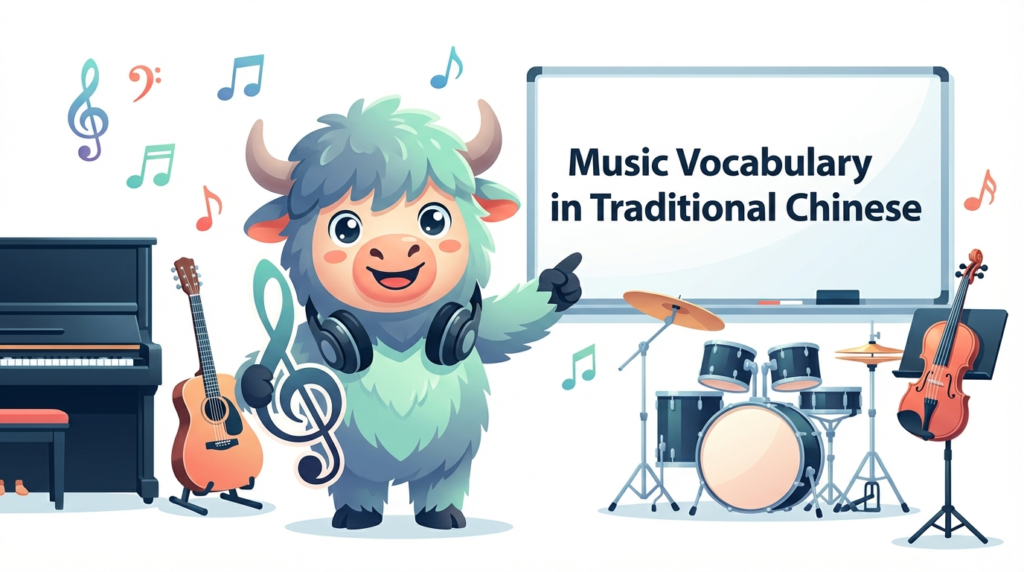
Traditional Chinese Music Vocabulary: 100+ Words (No Karaoke Panic)
Learn 音樂詞彙 (yīn yuè cí huì) in Traditional Chinese with pinyin and real sentences, so you can survive karaoke, chat about concerts, and politely say “小聲一點” without sounding like a textbook robot.
- 100+ music words in Traditional Chinese + pinyin + English
- Natural phrases for playlists, concerts, and “turn it down” moments
- Mini measure-word + fruit lesson so the grammar actually sticks
- Audio buttons for key examples (best effort browser voice)
Why Music Vocabulary In Traditional Chinese Matters
Music is where small talk gets real. Once you leave “你好,我叫…” level, people start asking what you listen to, who you like, and whether you sing at karaoke.
I once watched a student freeze at KTV. The screen said「再來一首」(Zài lái yì shǒu), everyone yelled “Encore!”, and he whispered to me, “Yak… how do I say this song is fire?” He knew 音樂 (yīn yuè), but not 歌詞 (gē cí), 節奏 (jié zòu), or any of the fun words.
This page gives you Traditional Chinese music vocabulary you’ll actually use: song names, playlists, instruments, genres, and those polite-but-serious “please turn it down” requests. Everything comes with pinyin and natural example sentences.
Must-Know Music Words (Core 8)
Start with these. If you only remember this little set, you can already survive most music conversations in Chinese.
Choose 一個歌手 (yí gè gē shǒu) and 一種音樂 (yì zhǒng yīn yuè), then say: 「我很喜歡 ___ 的歌,特別是 ___ 。」(Wǒ hěn xǐ huān ___ de gē, tè bié shì ___.)
Useful Music Phrases You Can Actually Say
These are the lines you’ll hear in chats, on LINE, and at KTV. Copy them, tweak one or two words, and they’re yours.
- 你喜歡聽什麼音樂? (Nǐ xǐ huān tīng shén me yīn yuè?) — What kind of music do you like to listen to?
- 這首歌很好聽。 (Zhè shǒu gē hěn hǎo tīng.) — This song sounds great.
- 你有推薦的歌單嗎? (Nǐ yǒu tuī jiàn de gē dān ma?) — Do you have a playlist you recommend?
- 我最近一直循環播放。 (Wǒ zuì jìn yì zhí xún huán bō fàng.) — I’ve been looping it nonstop lately.
- 可以把音量調小一點嗎? (Kě yǐ bǎ yīn liàng tiáo xiǎo yì diǎn ma?) — Could you turn the volume down a bit?
- 這段副歌很洗腦。 (Zhè duàn fù gē hěn xǐ nǎo.) — This chorus is super catchy (stuck in your head).
- 你會彈吉他嗎? (Nǐ huì tán jí tā ma?) — Can you play guitar?
- 我想去看演唱會。 (Wǒ xiǎng qù kàn yǎn chàng huì.) — I want to go to a concert.
- 這是現場錄音。 (Zhè shì xiàn chǎng lù yīn.) — This is a live recording.
- 我比較喜歡原唱。 (Wǒ bǐ jiào xǐ huān yuán chàng.) — I prefer the original version / original singer.
- 這首歌的歌詞很有感。 (Zhè shǒu gē de gē cí hěn yǒu gǎn.) — The lyrics really hit / feel relatable.
- 再來一首!(Zài lái yì shǒu!) — One more song! (Encore vibes.)
Answer 「你在聽什麼?」(Nǐ zài tīng shén me?) with: 「我在聽 流行音樂 (liú xíng yīn yuè),這首歌超洗腦。」 (Wǒ zài tīng liú xíng yīn yuè, zhè shǒu gē chāo xǐ nǎo.) Swap 流行音樂 for your favorite genre.
Mini Lesson:Measure Words & A Little Fruit Trick
Songs are like apples in Chinese: you don’t say “one song” directly. You say one measure-word + song.
For music, these measure words show up all the time, and they work just like simple fruit examples you probably already know.
首 (shǒu) is the default measure word for songs.
張 (zhāng) is used for flat things: CDs, records, photos.
段 (duàn) is a “section” of something: lyrics, chorus, dialogue.
場 (chǎng) is for events: concerts, games, performances.
You already do this with fruit: 一顆蘋果 (yì kē píng guǒ) = one apple, 一串葡萄 (yí chuàn pú táo) = one bunch of grapes. With music, just swap in 首、張、段、場.
- 我今天一直重播這首歌。 (Wǒ jīn tiān yì zhí chóng bō zhè shǒu gē.) — I’ve been replaying this song all day.
- 這張專輯每一首都很好聽。 (Zhè zhāng zhuān jí měi yì shǒu dōu hěn hǎo tīng.) — Every song on this album is good.
- 剛剛那段副歌超洗腦。 (Gāng gāng nà duàn fù gē chāo xǐ nǎo.) — That chorus section just now was super catchy.
- 這場演唱會的氣氛超好。 (Zhè chǎng yǎn chàng huì de qì fēn chāo hǎo.) — The vibe at this concert is amazing.
Try replacing 歌 / 專輯 with something you really listen to. Your brain remembers real favorites better than random examples.
Say these out loud back-to-back: 「一首歌」(yì shǒu gē) vs. 「一顆蘋果」(yì kē píng guǒ). Same pattern: number + measure word + noun.
100+ Traditional Chinese Music Vocabulary Words
Below you’ll find music words in categories: listening and controls, song parts, people, live shows, instruments, genres, theory, and “vibe” adjectives. All are in Traditional Chinese + pinyin + English + example sentence.
Use the search box to filter by English or Chinese. Try “guitar”, 「演唱會」, or “jazz”.
Listening, Controls, And Playlists
| Traditional + Pinyin | Meaning (EN) | Example (ZH + Pinyin + EN) |
|---|---|---|
| 聽 (tīng) | to listen | 我每天都聽音樂。 (Wǒ měi tiān dōu tīng yīn yuè.) I listen to music every day. |
| 聽歌 (tīng gē) | to listen to songs | 通勤時我會聽歌。 (Tōng qín shí wǒ huì tīng gē.) I listen to songs during my commute. |
| 播放 (bō fàng) | to play (audio) | 可以播放下一首嗎? (Kě yǐ bō fàng xià yì shǒu ma?) Can you play the next song? |
| 暫停 (zàn tíng) | to pause | 先暫停一下,我接電話。 (Xiān zàn tíng yí xià, wǒ jiē diàn huà.) Pause for a sec — I’m taking a call. |
| 音量 (yīn liàng) | volume | 音量有點大。 (Yīn liàng yǒu diǎn dà.) The volume is a bit loud. |
| 調大 (tiáo dà) | to turn up (volume) | 把音量調大一點。 (Bǎ yīn liàng tiáo dà yì diǎn.) Turn the volume up a bit. |
| 調小 (tiáo xiǎo) | to turn down (volume) | 可以調小一點嗎? (Kě yǐ tiáo xiǎo yì diǎn ma?) Could you turn it down a bit? |
| 重播 (chóng bō) | to replay | 這段太好聽了,重播! (Zhè duàn tài hǎo tīng le, chóng bō!) That part is so good — replay it! |
| 循環播放 (xún huán bō fàng) | to loop / repeat | 我把這首歌循環播放。 (Wǒ bǎ zhè shǒu gē xún huán bō fàng.) I loop this song. |
| 隨機播放 (suí jī bō fàng) | to shuffle | 我喜歡隨機播放歌單。 (Wǒ xǐ huān suí jī bō fàng gē dān.) I like shuffling my playlist. |
| 下載 (xià zài) | to download | 我先下載,離線聽。 (Wǒ xiān xià zài, lí xiàn tīng.) I’ll download it first and listen offline. |
| 串流 (chuàn liú) | streaming | 我用串流平台聽歌。 (Wǒ yòng chuàn liú píng tái tīng gē.) I use a streaming platform to listen to songs. |
| 歌單 (gē dān) | playlist | 我做了一個跑步歌單。 (Wǒ zuò le yí gè pǎo bù gē dān.) I made a running playlist. |
| 推薦 (tuī jiàn) | to recommend | 你能推薦幾首歌嗎? (Nǐ néng tuī jiàn jǐ shǒu gē ma?) Can you recommend a few songs? |
Song Formats, Versions, And Parts
| Traditional + Pinyin | Meaning (EN) | Example (ZH + Pinyin + EN) |
|---|---|---|
| 單曲 (dān qǔ) | single | 他的新單曲剛上線。 (Tā de xīn dān qǔ gāng shàng xiàn.) His new single just dropped online. |
| 專輯 (zhuān jí) | album | 這張專輯我整張都愛。 (Zhè zhāng zhuān jí wǒ zhěng zhāng dōu ài.) I love this whole album. |
| 迷你專輯 (mí nǐ zhuān jí) | EP / mini album | 他先出迷你專輯試水溫。 (Tā xiān chū mí nǐ zhuān jí shì shuǐ wēn.) He released an EP first to test the waters. |
| 曲目 (qǔ mù) | track (on an album) | 第五首曲目超好聽。 (Dì wǔ shǒu qǔ mù chāo hǎo tīng.) Track 5 is insanely good. |
| 前奏 (qián zòu) | intro (music) | 這首歌前奏很抓人。 (Zhè shǒu gē qián zòu hěn zhuā rén.) The intro really grabs you. |
| 間奏 (jiàn zòu) | interlude | 間奏的吉他超帥。 (Jiàn zòu de jí tā chāo shuài.) The guitar in the interlude is so cool. |
| 主歌 (zhǔ gē) | verse | 主歌很安靜,副歌爆發。 (Zhǔ gē hěn ān jìng, fù gē bào fā.) The verse is quiet, then the chorus explodes. |
| 副歌 (fù gē) | chorus / hook | 副歌一下就記住了。 (Fù gē yí xià jiù jì zhù le.) I remembered the chorus instantly. |
| 橋段 (qiáo duàn) | bridge | 橋段那裡特別有層次。 (Qiáo duàn nà lǐ tè bié yǒu céng cì.) The bridge is especially layered. |
| 版本 (bǎn běn) | version | 我喜歡現場版本。 (Wǒ xǐ huān xiàn chǎng bǎn běn.) I like the live version. |
| 原唱 (yuán chàng) | original singer / original version | 這首歌原唱比較有味道。 (Zhè shǒu gē yuán chàng bǐ jiào yǒu wèi dào.) The original version has more vibe. |
| 翻唱 (fān chàng) | cover (song) | 他翻唱得很溫柔。 (Tā fān chàng de hěn wēn róu.) His cover is really gentle. |
People And Roles
| Traditional + Pinyin | Meaning (EN) | Example (ZH + Pinyin + EN) |
|---|---|---|
| 樂團 (yuè tuán) | band | 這個樂團的現場很強。 (Zhè gè yuè tuán de xiàn chǎng hěn qiáng.) This band is amazing live. |
| 樂隊 (yuè duì) | band (also used) | 他在樂隊裡彈吉他。 (Tā zài yuè duì lǐ tán jí tā.) He plays guitar in the band. |
| 音樂人 (yīn yuè rén) | musician / music creator | 她是很有想法的音樂人。 (Tā shì hěn yǒu xiǎng fǎ de yīn yuè rén.) She’s a musician with strong ideas. |
| 樂手 (yuè shǒu) | instrumentalist | 這些樂手配合得很好。 (Zhè xiē yuè shǒu pèi hé de hěn hǎo.) These musicians work together really well. |
| 歌迷 (gē mí) | fan (of a singer/band) | 我是他多年的歌迷。 (Wǒ shì tā duō nián de gē mí.) I’ve been his fan for years. |
| 主唱 (zhǔ chàng) | lead vocalist | 主唱一開口全場尖叫。 (Zhǔ chàng yì kāi kǒu quán chǎng jiān jiào.) The moment the lead vocalist sang, everyone screamed. |
| 鼓手 (gǔ shǒu) | drummer | 鼓手的節奏很穩。 (Gǔ shǒu de jié zòu hěn wěn.) The drummer’s rhythm is steady. |
| 吉他手 (jí tā shǒu) | guitarist | 吉他手的獨奏太猛了。 (Jí tā shǒu de dú zòu tài měng le.) The guitarist’s solo was insane. |
| 作曲家 (zuò qǔ jiā) | composer | 這位作曲家的作品很細膩。 (Zhè wèi zuò qǔ jiā de zuò pǐn hěn xì nì.) This composer’s work is very delicate. |
| 製作人 (zhì zuò rén) | producer | 製作人把整體做得很乾淨。 (Zhì zuò rén bǎ zhěng tǐ zuò de hěn gān jìng.) The producer made the whole thing sound clean. |
Live Music And Events
| Traditional + Pinyin | Meaning (EN) | Example (ZH + Pinyin + EN) |
|---|---|---|
| 演唱會 (yǎn chàng huì) | concert (pop) | 我搶到演唱會票了! (Wǒ qiǎng dào yǎn chàng huì piào le!) I got concert tickets! |
| 音樂會 (yīn yuè huì) | concert (general / often classical) | 今晚有一場音樂會。 (Jīn wǎn yǒu yì chǎng yīn yuè huì.) There’s a concert tonight. |
| 音樂節 (yīn yuè jié) | music festival | 音樂節通常要站很久。 (Yīn yuè jié tōng cháng yào zhàn hěn jiǔ.) At festivals you usually stand for a long time. |
| 現場 (xiàn chǎng) | live / on-site | 現場比錄音更震撼。 (Xiàn chǎng bǐ lù yīn gèng zhèn hàn.) Live is more powerful than recordings. |
| 舞台 (wǔ tái) | stage | 舞台燈光超漂亮。 (Wǔ tái dēng guāng chāo piào liang.) The stage lighting is gorgeous. |
| 觀眾 (guān zhòng) | audience | 觀眾一直跟著唱。 (Guān zhòng yì zhí gēn zhe chàng.) The audience kept singing along. |
| 掌聲 (zhǎng shēng) | applause | 一唱完就全場掌聲。 (Yì chàng wán jiù quán chǎng zhǎng shēng.) The moment it ended, the whole crowd applauded. |
| 票 (piào) | ticket | 票太難買了。 (Piào tài nán mǎi le.) The tickets are so hard to get. |
| 安可 (ān kě) | encore | 大家一直喊安可! (Dà jiā yì zhí hǎn ān kě!) Everyone kept shouting “encore!” |
| 排練 (pái liàn) | to rehearse | 他們今天排練到很晚。 (Tā men jīn tiān pái liàn dào hěn wǎn.) They rehearsed until late today. |
Instruments And Gear
| Traditional + Pinyin | Meaning (EN) | Example (ZH + Pinyin + EN) |
|---|---|---|
| 鋼琴 (gāng qín) | piano | 我小時候學過鋼琴。 (Wǒ xiǎo shí hòu xué guò gāng qín.) I studied piano when I was a kid. |
| 吉他 (jí tā) | guitar | 他在房間彈吉他。 (Tā zài fáng jiān tán jí tā.) He’s playing guitar in the room. |
| 電吉他 (diàn jí tā) | electric guitar | 電吉他的音色很兇。 (Diàn jí tā de yīn sè hěn xiōng.) The electric guitar tone is fierce. |
| 貝斯 (bèi sī) | bass (guitar) | 貝斯一進來就很有律動。 (Bèi sī yí jìn lái jiù hěn yǒu lǜ dòng.) Once the bass comes in, it grooves. |
| 鼓 (gǔ) | drum(s) | 鼓點一出來就想跳。 (Gǔ diǎn yì chū lái jiù xiǎng tiào.) When the beat hits, I want to dance. |
| 小提琴 (xiǎo tí qín) | violin | 小提琴拉得很有情緒。 (Xiǎo tí qín lā de hěn yǒu qíng xù.) The violin is played with a lot of emotion. |
| 薩克斯風 (sà kè sī fēng) | saxophone | 薩克斯風一吹就很浪漫。 (Sà kè sī fēng yì chuī jiù hěn làng màn.) Saxophone instantly sounds romantic. |
| 小號 (xiǎo hào) | trumpet | 小號的聲音很亮。 (Xiǎo hào de shēng yīn hěn liàng.) The trumpet sounds bright. |
| 合成器 (hé chéng qì) | synthesizer | 合成器把氣氛拉滿。 (Hé chéng qì bǎ qì fēn lā mǎn.) The synth sets the mood hard. |
| 麥克風 (mài kè fēng) | microphone | 麥克風有點回音。 (Mài kè fēng yǒu diǎn huí yīn.) The mic has a bit of echo. |
| 耳機 (ěr jī) | headphones | 我忘了帶耳機。 (Wǒ wàng le dài ěr jī.) I forgot my headphones. |
| 喇叭 (lǎ bā) | speaker | 喇叭開太大會吵到人。 (Lǎ bā kāi tài dà huì chǎo dào rén.) Turning speakers up too loud bothers people. |
| 烏克麗麗 (wū kè lì lì) | ukulele | 烏克麗麗很適合入門。 (Wū kè lì lì hěn shì hé rù mén.) Ukulele is great for beginners. |
| 口琴 (kǒu qín) | harmonica | 他會吹口琴。 (Tā huì chuī kǒu qín.) He can play the harmonica. |
| 二胡 (èr hú) | erhu (Chinese fiddle) | 二胡一拉就很有味道。 (Èr hú yì lā jiù hěn yǒu wèi dào.) The erhu instantly sounds full of character. |
| 琵琶 (pí pá) | pipa (Chinese lute) | 琵琶的聲音很清脆。 (Pí pá de shēng yīn hěn qīng cuì.) The pipa sounds crisp. |
| 笛子 (dí zi) | Chinese flute | 笛子一吹就很空靈。 (Dí zi yì chuī jiù hěn kōng líng.) The flute sounds airy and ethereal. |
Genres And Styles
| Traditional + Pinyin | Meaning (EN) | Example (ZH + Pinyin + EN) |
|---|---|---|
| 流行音樂 (liú xíng yīn yuè) | pop music | 我平常聽流行音樂比較多。 (Wǒ píng cháng tīng liú xíng yīn yuè bǐ jiào duō.) I usually listen to pop music more. |
| 搖滾 (yáo gǔn) | rock | 我需要一點搖滾醒腦。 (Wǒ xū yào yì diǎn yáo gǔn xǐng nǎo.) I need some rock to wake my brain up. |
| 嘻哈 (xī hā) | hip hop | 他最近迷上嘻哈。 (Tā zuì jìn mí shàng xī hā.) He’s been into hip hop lately. |
| 爵士 (jué shì) | jazz | 下雨天很適合聽爵士。 (Xià yǔ tiān hěn shì hé tīng jué shì.) Jazz is perfect on rainy days. |
| 藍調 (lán tiáo) | blues | 藍調聽起來很有故事。 (Lán tiáo tīng qǐ lái hěn yǒu gù shì.) Blues sounds like it has a story. |
| 電子音樂 (diàn zǐ yīn yuè) | electronic music | 我運動時聽電子音樂。 (Wǒ yùn dòng shí tīng diàn zǐ yīn yuè.) I listen to electronic music when I work out. |
| 民謠 (mín yáo) | folk | 民謠很舒服,很耐聽。 (Mín yáo hěn shū fú, hěn nài tīng.) Folk is comfortable and easy to keep listening to. |
| 古典音樂 (gǔ diǎn yīn yuè) | classical music | 我讀書時放古典音樂。 (Wǒ dú shū shí fàng gǔ diǎn yīn yuè.) I put on classical music while studying. |
| 抒情 (shū qíng) | ballad / sentimental style | 今天我只想聽抒情歌。 (Jīn tiān wǒ zhǐ xiǎng tīng shū qíng gē.) Today I only want to listen to ballads. |
Music Theory And Production Basics
| Traditional + Pinyin | Meaning (EN) | Example (ZH + Pinyin + EN) |
|---|---|---|
| 音符 (yīn fú) | musical note | 這裡有一個高音音符。 (Zhè lǐ yǒu yí gè gāo yīn yīn fú.) There’s a high note here. |
| 樂譜 (yuè pǔ) | sheet music | 我把樂譜印出來了。 (Wǒ bǎ yuè pǔ yìn chū lái le.) I printed the sheet music. |
| 拍子 (pāi zi) | beat / time | 這首歌的拍子很穩。 (Zhè shǒu gē de pāi zi hěn wěn.) The beat of this song is steady. |
| 和弦 (hé xián) | chord | 這個和弦聽起來很溫暖。 (Zhè gè hé xián tīng qǐ lái hěn wēn nuǎn.) This chord sounds warm. |
| 調 (diào) | key (music) | 這首歌的調太高了。 (Zhè shǒu gē de diào tài gāo le.) The key is too high for this song. |
| 混音 (hùn yīn) | mixing | 這首歌的混音很乾淨。 (Zhè shǒu gē de hùn yīn hěn gān jìng.) The mixing on this track is clean. |
Describing How It Sounds (The “Vibe Words”)
| Traditional + Pinyin | Meaning (EN) | Example (ZH + Pinyin + EN) |
|---|---|---|
| 好聽 (hǎo tīng) | sounds good | 這首歌真的好聽。 (Zhè shǒu gē zhēn de hǎo tīng.) This song is genuinely good. |
| 難聽 (nán tīng) | sounds bad (blunt) | 我不說了,怕你覺得難聽。 (Wǒ bù shuō le, pà nǐ jué de nán tīng.) I won’t say it — I’m afraid you’ll think it sounds harsh. |
| 洗腦 (xǐ nǎo) | catchy / earworm | 這句副歌太洗腦了。 (Zhè jù fù gē tài xǐ nǎo le.) This chorus line is an earworm. |
| 感動 (gǎn dòng) | moving / touching | 聽到最後我有點感動。 (Tīng dào zuì hòu wǒ yǒu diǎn gǎn dòng.) By the end, I was a bit moved. |
| 放鬆 (fàng sōng) | relaxing | 這種音樂很放鬆。 (Zhè zhǒng yīn yuè hěn fàng sōng.) This kind of music is relaxing. |
| 熱血 (rè xuè) | hype / pumped / “blood-boiling” | 這首歌聽了很熱血。 (Zhè shǒu gē tīng le hěn rè xuè.) This song gets you pumped. |
| 震撼 (zhèn hàn) | powerful / shocking (in a good way) | 低音一來就很震撼。 (Dī yīn yì lái jiù hěn zhèn hàn.) When the bass hits, it’s powerful. |
| 走音 (zǒu yīn) | out of tune | 我今天唱歌有點走音。 (Wǒ jīn tiān chàng gē yǒu diǎn zǒu yīn.) I was a bit out of tune today. |
Natural Variants That Make You Sound Native-ish
| Use Case | Traditional + Pinyin | Meaning / When To Use |
|---|---|---|
| Measure word for songs | 一首歌 (yì shǒu gē) | “one song” — most common and safe measure word for songs. |
| Measure word for albums | 一張專輯 (yì zhāng zhuān jí) | “one album” — 張 is used for flat things like CDs and records. |
| Very casual love | 我超愛這首歌。 (Wǒ chāo ài zhè shǒu gē.) | “I’m obsessed with this song.” Friendly and casual. |
| Neutral “really like” | 我很喜歡這首歌。 (Wǒ hěn xǐ huān zhè shǒu gē.) | “I really like this song.” Safe for any situation. |
| Polite “too loud” | 可以小聲一點嗎? (Kě yǐ xiǎo shēng yì diǎn ma?) | “Could you lower it a bit?” Softer than saying 「太吵」. |
Level 1 (safe):「我很喜歡這首歌。」(Wǒ hěn xǐ huān zhè shǒu gē.)
Level 2 (fangirl / fanboy):「我超愛這首歌。」(Wǒ chāo ài zhè shǒu gē.)
Common Mistakes With Music Vocabulary
You don’t need perfect tones to talk about music. But avoid these small mistakes that make your Chinese sound “translated”.
- Using 個 (gè) for everything. 「一個歌」 sounds wrong. Use 一首歌 (yì shǒu gē) for songs and 一張專輯 (yì zhāng zhuān jí) for albums.
- Saying 玩音樂 (wán yīn yuè) for “listen to music”. 玩 is “to play (for fun)”. For listening, say 聽音樂 (tīng yīn yuè).
- Forgetting the measure word 首. 「這個歌」 is unnatural. Say 「這首歌」(Zhè shǒu gē) instead.
- Translating English phrases too literally. “This song is my jam” is not 「這首歌是我的果醬」. Try 「這首歌超對味。」(Zhè shǒu gē chāo duì wèi.) instead.
- Only using 好聽 / 不好聽. Level up with 洗腦 (xǐ nǎo), 感動 (gǎn dòng), 放鬆 (fàng sōng), 熱血 (rè xuè) to sound more natural.
Music Vocabulary In Traditional Chinese:FAQ
A super common question is 「你在聽什麼?」(Nǐ zài tīng shén me?) — “What are you listening to?” You can also say 「你喜歡聽什麼音樂?」(Nǐ xǐ huān tīng shén me yīn yuè?) to ask about general taste.
歌 (gē) is more casual and super common in speech. 歌曲 (gē qǔ) feels a bit more like you’re “talking about music” as a topic. Both are natural; use 歌 with friends if you’re not sure.
Try 「我最近超愛這首歌。」(Wǒ zuì jìn chāo ài zhè shǒu gē.) or 「我最近一直循環播放。」(Wǒ zuì jìn yì zhí xún huán bō fàng.) That sounds much more native than just “我喜歡這首歌”.
Two soft options: 「可以把音量調小一點嗎?」(Kě yǐ bǎ yīn liàng tiáo xiǎo yì diǎn ma?) or 「可以小聲一點嗎?」(Kě yǐ xiǎo shēng yì diǎn ma?). Both are polite and much kinder than 「太吵了!」(Tài chǎo le!).
Pick one song in Chinese. Read the 歌詞 (gē cí) with pinyin, sing along to the 副歌 (fù gē), and try to explain in Chinese why you like it: 「歌詞很有感」(gē cí hěn yǒu gǎn), 「旋律很洗腦」(xuán lǜ hěn xǐ nǎo), etc.
Absolutely not. Start with: 音樂、歌、歌詞、節奏、歌手、演唱會、流行音樂、好聽、洗腦. Then add the words that match your habits: instruments you play, genres you love, concerts you actually go to.
Wrap-Up:Let Chinese Be Part Of Your Soundtrack
You now have a full toolkit of Traditional Chinese music vocabulary: words for songs, playlists, instruments, genres, live shows, and even that one polite sentence for “please turn it down”.
Your next step: choose 3–5 words from this page, plus one sentence you really like. Use the audio buttons, sing along badly (on purpose if you’re shy), and let Chinese join the songs you already love. That’s how your listening practice turns into a real-life soundtrack.