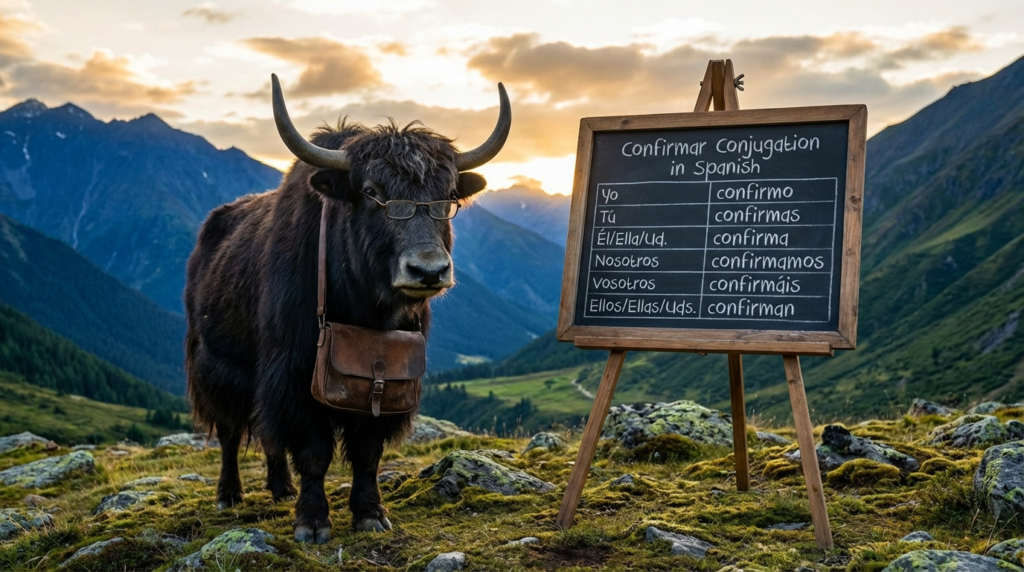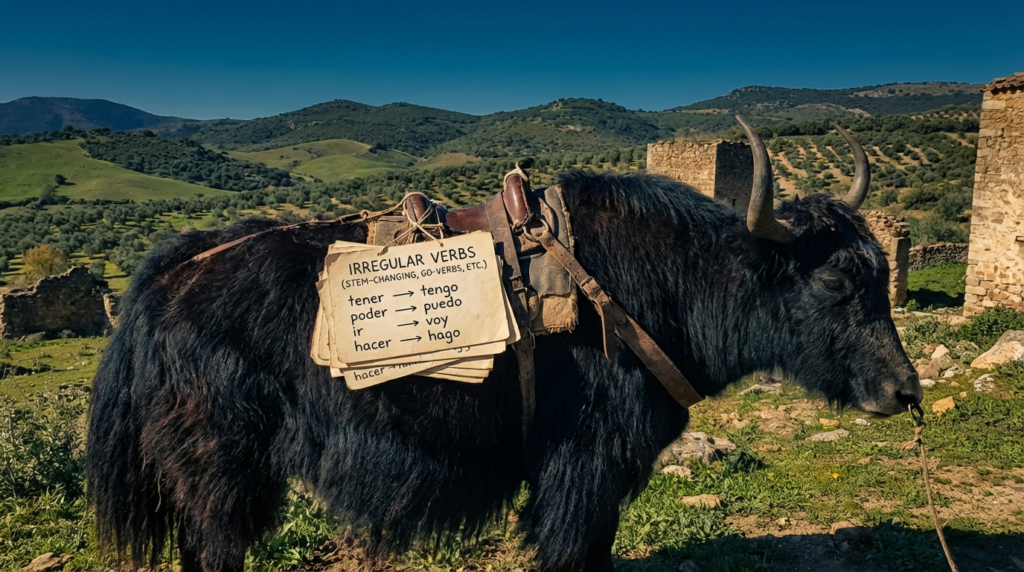
Irregular Verbs In Spanish (Stem-Changing, Go-Verbs, And Other Trouble-Makers)
Irregular verbs aren’t “random.” They’re just Spanish being… efficient. Learn the main patterns (stem-changers, yo-forms, and go-verbs), and you’ll instantly sound more natural in real conversations.
Yak Box: The Three Reasons Verbs “Go Irregular”
- Stem change: the middle of the verb shifts in the present tense (querer → quiero).
- Weird yo form: the yo form has its own special spelling (tener → tengo).
- Irregular past: the preterite (simple past) uses a different “stem” (tener → tuve).
Key Spanish terms you’ll see:
- verbo irregular = irregular verb. Ese es un verbo irregular. (That’s an irregular verb.)
- raíz = stem/root. La raíz cambia en el presente. (The stem changes in the present.)
- conjugación = conjugation. La conjugación de “ir” es irregular. (The conjugation of “to go” is irregular.)
Mexican Spanish note: You’ll mostly hear ustedes (not vosotros), so the tables here use ustedes.
Stem-Changing Verbs (The “Boot” Verbs)
Stem-changers change in the present tense for yo, tú, él/ella, and ustedes… but not for nosotros. (In charts, it looks like a boot shape—hence the nickname.)
| Change | Meaning | Starter Verb | Real Sentence |
|---|---|---|---|
| e → ie | “e” turns into “ie” | querer (to want) | Quiero un café, por favor. (I want a coffee, please.) |
| o → ue | “o” turns into “ue” | poder (to be able to) | ¿Puedes ayudarme? (Can you help me?) |
| e → i | “e” turns into “i” | pedir (to ask for / order) | Pido tacos de pastor. (I’m ordering pastor tacos.) |
| u → ue | “u” turns into “ue” | jugar (to play) | Jugamos fútbol los sábados. (We play soccer on Saturdays.) |
Model Verb: Querer (e → ie)
- yo: quiero = I want. Quiero dormir. (I want to sleep.)
- tú: quieres = you want. ¿Quieres agua? (Do you want water?)
- él/ella: quiere = he/she wants. Ella quiere aprender español. (She wants to learn Spanish.)
- nosotros: queremos = we want. Queremos irnos. (We want to leave.)
- ustedes: quieren = you all want. ¿Quieren la cuenta? (Do you all want the check?)
Model Verb: Poder (o → ue)
- yo: puedo = I can. Hoy no puedo. (I can’t today.)
- tú: puedes = you can. ¿Puedes venir? (Can you come?)
- él/ella: puede = he/she can. Él puede manejar. (He can drive.)
- nosotros: podemos = we can. Podemos hablar aquí. (We can talk here.)
- ustedes: pueden = you all can. Ustedes pueden pasar. (You all can come in.)
Fast reality check: Stem changes happen in the present. In the past tense, some verbs change differently (you’ll see a quick preterite cheat sheet below).
Ready-To-Use Lines (Say These Today)
- ¿Quieres…? = Do you want…? ¿Quieres ir conmigo? (Do you want to go with me?)
- No puedo. = I can’t. No puedo ahorita. (I can’t right now.)
- ¿Puedes repetir? = Can you repeat? ¿Puedes repetir, por favor? (Can you repeat, please?)
- Prefiero… = I prefer… Prefiero té. (I prefer tea.)
- Te pido un favor. = I’m asking you a favor. Te pido un favor: mándame el mensaje. (I’m asking you a favor: send me the message.)
- ¿A qué hora vuelves? = What time are you coming back? ¿A qué hora vuelves a casa? (What time are you coming back home?)
- Encuentro mis llaves. = I find my keys. Siempre encuentro mis llaves… al final. (I always find my keys… eventually.)
- Me siento bien. = I feel good. Hoy me siento mejor. (Today I feel better.)
- ¿Sigues aquí? = Are you still here? ¿Sigues aquí o ya te vas? (Are you still here or are you leaving?)
- Te digo la verdad. = I’ll tell you the truth. Te digo la verdad: no me acuerdo. (I’ll tell you the truth: I don’t remember.)
- Hago ejercicio. = I work out. Hago ejercicio en la mañana. (I work out in the morning.)
- Salgo en cinco minutos. = I’m leaving in five minutes. Salgo en cinco minutos, espérame. (I’m leaving in five minutes, wait for me.)
Go-Verbs (Present Tense “Yo” Ends In -go)
Go-verbs are the ones where the yo form ends in -go. The rest of the conjugation often looks more normal (sometimes with extra irregularity—because Spanish likes a plot twist).
| Infinitive | English Meaning | Yo Form | Real Sentence |
|---|---|---|---|
| tener | to have | tengo | Tengo hambre. (I’m hungry.) |
| venir | to come | vengo | Vengo de la tienda. (I’m coming from the store.) |
| salir | to leave / go out | salgo | Salgo tarde hoy. (I’m leaving late today.) |
| poner | to put / place | pongo | Pongo la música. (I put on the music.) |
| traer | to bring | traigo | Traigo efectivo. (I’m bringing cash.) |
| decir | to say / tell | digo | No digo nada. (I’m not saying anything.) |
| hacer | to do / make | hago | Hago la cena. (I’m making dinner.) |
| valer | to be worth | valgo | No valgo para eso. (I’m not good for that.) |
Double Trouble: Decir (Go-Verb + Stem Change)
decir = to say / tell.
- yo: digo. Digo “hola”. (I say “hi.”)
- tú: dices. ¿Qué dices? (What are you saying?)
- él/ella: dice. Ella dice que sí. (She says yes.)
- nosotros: decimos. Decimos la verdad. (We tell the truth.)
- ustedes: dicen. Ustedes dicen lo mismo. (You all say the same thing.)
Other Common Weird “Yo” Verbs (Not -go)
The “-zco” Crew
In the yo form, some verbs add -zco.
- conocer → conozco = to know (a person/place). Conozco a tu hermana. (I know your sister.)
- parecer → parezco = to seem. Parezco cansado. (I seem tired.)
- ofrecer → ofrezco = to offer. Te ofrezco agua. (I offer you water.)
- agradecer → agradezco = to appreciate/thank. Te agradezco mucho. (I really appreciate it.)
The Tiny Gang: Doy, Voy, Estoy, Soy
- dar → doy = to give. Te doy mi número. (I’ll give you my number.)
- ir → voy = to go. Voy al trabajo. (I’m going to work.)
- estar → estoy = to be (temporary). Estoy en casa. (I’m at home.)
- ser → soy = to be (identity). Soy de México. (I’m from Mexico.)
Bonus: saber → sé = to know (a fact). Sé la respuesta. (I know the answer.)
Preterite Irregulars (Quick And Dirty Cheat Sheet)
The preterite is the simple past (“I did,” “she went”). Many high-frequency verbs use an irregular preterite stem. Once you know the stem, you add these endings:
| Person | Regular Pattern | Meaning | Mini Example |
|---|---|---|---|
| yo | stem + e | I (did) | tuve (I had) |
| tú | stem + iste | you (did) | tuviste (you had) |
| él/ella | stem + o | he/she (did) | tuvo (he had) |
| nosotros | stem + imos | we (did) | tuvimos (we had) |
| ustedes | stem + ieron | you all (did) | tuvieron (you all had) |
Most-Useful Irregular Preterite Stems
- tener → tuv- (to have): Tuve tiempo. (I had time.)
- estar → estuv- (to be): Estuve en Guadalajara. (I was in Guadalajara.)
- venir → vin- (to come): Vine temprano. (I came early.)
- poder → pud- (to be able to): No pude ir. (I couldn’t go.)
- poner → pus- (to put): Puse la mesa. (I set the table.)
- saber → sup- (to know): No supe nada. (I didn’t know anything.)
- querer → quis- (to want/try): Quise ayudarte. (I wanted to help you.)
- hacer → hic-/hiz- (to do/make): Hice la tarea. (I did the homework.)
- decir → dij- (to say/tell): Dije la verdad. (I told the truth.)
- traer → traj- (to bring): Traje mi credencial. (I brought my ID.)
Heads-up: Verbs with -j- stems (dije, traje) use -eron (not -ieron): dijeron, trajeron.
Tables Of Words (Grouped Cheat Sheets)
Stem-Changers You’ll Hear All The Time
| Spanish | English Meaning | Example 1 | Example 2 | Example 3 |
|---|---|---|---|---|
| pensar | to think / plan | Pienso en ti. | ¿Qué piensas? | Pensamos igual. |
| querer | to want / love | Quiero dormir. | ¿Quieres café? | Queremos paz. |
| entender | to understand | No entiendo. | ¿Entiendes? | Entendemos todo. |
| empezar | to start | Empiezo hoy. | ¿A qué hora empiezas? | Empezamos mañana. |
| preferir | to prefer | Prefiero agua. | ¿Prefieres aquí? | Preferimos caminar. |
| cerrar | to close | Cierro la puerta. | Cierran a las ocho. | Cerramos temprano. |
| volver | to return / come back | Vuelvo luego. | ¿Vuelves hoy? | Volvemos en una hora. |
| encontrar | to find | Encuentro mi celular. | ¿Encuentras la entrada? | Encontramos un lugar. |
| recordar | to remember | Recuerdo tu nombre. | ¿Recuerdas eso? | Recordamos todo. |
| dormir | to sleep | Duermo tarde. | ¿Duermes bien? | Dormimos aquí. |
| pedir | to ask for / order | Pido la cuenta. | ¿Pides tacos? | Pedimos agua. |
| servir | to serve | Sirvo el café. | ¿Sirves tú? | Servimos primero. |
| seguir | to continue / follow | Sigo aquí. | ¿Sigues cansado? | Seguimos mañana. |
| repetir | to repeat | Repito la palabra. | ¿Repites? | Repetimos juntos. |
| jugar | to play | Juego ajedrez. | ¿Juegas hoy? | Jugamos los domingos. |
Go-Verbs And Friends (Present “Yo” Specials)
| Spanish | English Meaning | Example 1 | Example 2 | Example 3 |
|---|---|---|---|---|
| tener | to have | Tengo sueño. | ¿Tienes tiempo? | Tenemos prisa. |
| venir | to come | Vengo contigo. | ¿Vienes hoy? | Venimos temprano. |
| salir | to leave / go out | Salgo del trabajo. | ¿Sales a las seis? | Salimos juntos. |
| poner | to put | Pongo la mesa. | ¿Pones música? | Ponemos la tele. |
| traer | to bring | Traigo mi cartera. | ¿Traes agua? | Traemos regalos. |
| hacer | to do / make | Hago ejercicio. | ¿Haces la comida? | Hacemos planes. |
| decir | to say / tell | Digo la verdad. | ¿Qué dices? | Decimos “sí”. |
| valer | to be worth | Valgo mucho. | ¿Cuánto vale? | Valemos lo mismo. |
| conocer | to know (someone/place) | Conozco a tu papá. | ¿Conoces Puebla? | Conocemos el lugar. |
| parecer | to seem | Parezco nervioso. | Pareces feliz. | Parecemos listos. |
| ofrecer | to offer | Te ofrezco ayuda. | ¿Ofreces algo? | Ofrecemos café. |
| dar | to give | Te doy un abrazo. | ¿Me das tu correo? | Damos permiso. |
| ir | to go | Voy al súper. | ¿Vas conmigo? | Vamos en taxi. |
| estar | to be (temporary) | Estoy bien. | ¿Estás aquí? | Estamos listos. |
| ser | to be (identity) | Soy estudiante. | ¿Eres de aquí? | Somos amigos. |
| saber | to know (a fact) | Sé eso. | ¿Sabes la hora? | Sabemos la respuesta. |
| ver | to see | Veo la tele. | ¿Ves el mensaje? | Vemos una película. |
Irregular Preterite Verbs (Simple Past MVPs)
| Spanish | English Meaning | Example 1 | Example 2 | Example 3 |
|---|---|---|---|---|
| tener (tuve) | to have | Tuve una junta. | ¿Tuviste tiempo? | Tuvieron suerte. |
| estar (estuve) | to be | Estuve enfermo. | ¿Estuviste ahí? | Estuvieron en casa. |
| venir (vine) | to come | Vine solo. | ¿Viniste temprano? | Vinieron tarde. |
| poder (pude) | to be able to | No pude entrar. | ¿Pudiste llamar? | Pudieron pagar. |
| poner (puse) | to put | Puse gasolina. | ¿Pusiste la alarma? | Pusieron música. |
| saber (supe) | to find out / know | Supe la noticia. | ¿Supiste eso? | Supieron tarde. |
| querer (quise) | to want / try | Quise llamar. | ¿Quisiste venir? | Quisieron salir. |
| hacer (hice) | to do / make | Hice la comida. | ¿Hiciste tarea? | Hicieron ruido. |
| decir (dije) | to say / tell | Dije “no”. | ¿Dijiste eso? | Dijeron la verdad. |
| traer (traje) | to bring | Traje dinero. | ¿Trajiste tu ID? | Trajeron comida. |
| ser/ir (fui) | to be / to go | Fui al cine. | ¿Fuiste tú? | Fueron juntos. |
Practice Drills (Small, Fast, Actually Useful)
Say the answer out loud first. Then write it. Your brain loves drama.
Drill 1: Pick The Correct Present Form
- Yo ______ (querer) un café. → _____
- ¿Tú ______ (poder) venir hoy? → _____
- Nosotros ______ (dormir) aquí. → _____
- Ustedes ______ (decir) la verdad. → _____
- Yo ______ (tener) prisa. → _____
Drill 2: Switch To “Nosotros” (No Stem Change!)
- Yo quiero pizza. → Nosotros ______ pizza.
- Yo puedo pagar. → Nosotros ______ pagar.
- Yo pido la cuenta. → Nosotros ______ la cuenta.
- Yo vuelvo mañana. → Nosotros ______ mañana.
Drill 3: Irregular Preterite (Yesterday Mode)
- Ayer yo ______ (tener) tiempo. → _____
- Ayer nosotros ______ (poder) entrar. → _____
- El viernes ella ______ (venir) temprano. → _____
- Ellos ______ (decir) la verdad. → _____
Answer Key
Drill 1: quiero, puedes, dormimos, dicen, tengo
Drill 2: queremos, podemos, pedimos, volvemos
Drill 3: tuve, pudimos, vino, dijeron
Common Mistakes (And The Fix)
- Mistake: Stem-changing in nosotros (“queremos” → “quieremos”).
Fix: Nosotros is usually normal: queremos, podemos, pedimos, dormimos. - Mistake: Adding -go to every form (“tengo, tengas, tenga…”).
Fix: The -go is mainly a yo problem: tengo but tienes, tiene, tenemos, tienen. - Mistake: Mixing ser and estar randomly.
Fix: ser = identity/what it is (Soy Ana.) and estar = location/temporary state (Estoy cansado.). - Mistake: Seeing fui and panicking.
Fix: ser and ir share the same preterite: fui, fuiste, fue, fuimos, fueron. Context tells you which one: Fui al cine (went), Fui feliz (was).
Quick Reference Summary (Screenshot This)
- Stem-changers (present): e→ie (quiero), o→ue (puedo), e→i (pido), u→ue (juego).
- No stem change in nosotros: queremos, podemos, pedimos, dormimos.
- Go-verbs (yo): tengo, vengo, salgo, pongo, traigo, digo, hago.
- Mini irregular yo forms: doy, voy, estoy, soy, sé, veo.
- Irregular preterite stems: tuv-, estuv-, vin-, pud-, pus-, sup-, quis-, hic-, dij-, traj-.
Final Yak: Don’t memorize “irregular verbs.” Memorize patterns. Spanish is predictable… in its own chaotic way.