Spanish Dieresis: How To Use Ü Without Guessing
Those two little dots over the u are not decoration. In Spanish, they tell you one very specific thing: pronounce the u.
The first time I said vergüenza out loud in a café lesson in Mexico City, I skipped the ü and said something much closer to vergenza. My teacher smiled, grabbed a pen, wrote two dots over the u, and said, “That tiny mark is doing a lot of work.” She was right. Once you understand the Spanish dieresis, a bunch of “weird” words suddenly stop feeling weird.
This guide shows you what the Spanish dieresis is, when to use it, how to pronounce ü, which words you will see most often, and the mistakes that trip up beginners again and again. Tiny dots. Zero drama. Well, less drama.
Yak Tip: In Spanish, gue and gui normally have a silent u. When you see güe or güi, the u is pronounced.
What Is The Spanish Dieresis?
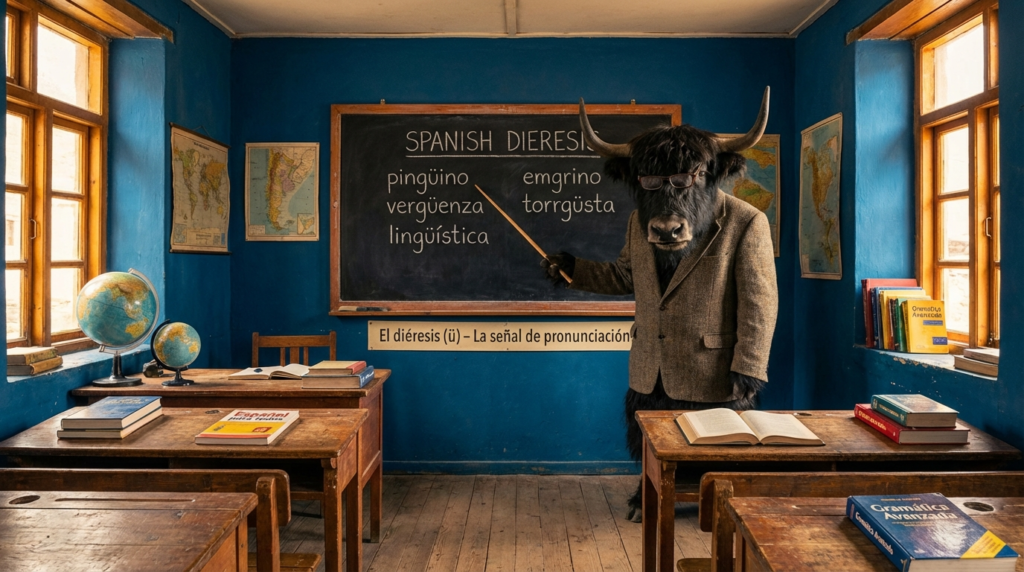
The Spanish dieresis is the mark with two dots: ¨. In Spanish, it is called diéresis. In everyday modern Spanish, its main job is very simple: it appears over the letter u in güe and güi to show that the u must be pronounced.
That means the dieresis is not the same thing as an accent mark like á, é, í, ó, ú. An accent mark usually helps with stress. The dieresis tells you whether the u is silent or heard. Different job, different attitude.
The One Rule You Actually Need
| Pattern | What Happens | Spanish Example | English Meaning |
|---|---|---|---|
| gue | The u is silent | guerra | war |
| gui | The u is silent | guitarra | guitar |
| güe | The u is pronounced | vergüenza | embarrassment, shame |
| güi | The u is pronounced | pingüino | penguin |
So if you see gue or gui, do not pronounce the u. If you see güe or güi, do pronounce it. That little sound is usually a quick gw glide, like gwen or gwee.
How To Pronounce Ü In Spanish
- Say the g sound first.
- Add a quick u sound, almost like the w in English.
- Move straight into e or i.
So vergüenza sounds like ver-gWEN-sa in Mexican Spanish, and pingüino sounds like peen-gWEE-no. You do not need to overdo the w. Just make sure the u is there. A small sound is enough.
Fast Ear Test: guerra = no u sound. vergüenza = yes u sound. That contrast is the whole game.
Common Spanish Words With Ü
vergüenza
Meaning: embarrassment, shame
Example: Me da vergüenza hablar en reuniones grandes.
I feel embarrassed speaking in big meetings.
bilingüe
Meaning: bilingual
Example: Mi jefa es bilingüe y cambia de idioma sin esfuerzo.
My boss is bilingual and switches languages easily.
pingüino
Meaning: penguin
Example: El pingüino nada mejor que yo, lo cual no es difícil.
The penguin swims better than I do, which is not hard.
desagüe
Meaning: drain
Example: El desagüe de la ducha está tapado otra vez.
The shower drain is clogged again.
antigüedad
Meaning: antiquity; antique; length of service, depending on context
Example: Esta tienda vende antigüedades mexicanas muy bonitas.
This shop sells very beautiful Mexican antiques.
nicaragüense
Meaning: Nicaraguan
Example: Mi vecino es nicaragüense y cocina increíble.
My neighbor is Nicaraguan and cooks incredibly well.
Verb Forms That Often Surprise Learners
Nouns get most of the attention, but some verb forms also use the Spanish dieresis. This happens a lot with verbs ending in -guar when the form puts the sound before e.
| Spanish Form | English Meaning | Example Sentence |
|---|---|---|
| averigüé | I found out | Ayer averigüé el horario correcto. — I found out the correct schedule yesterday. |
| averigüe | find out (formal command) / that I find out | Averigüe el precio antes de pagar. — Find out the price before paying. |
| averigüen | find out (plural command) / that they find out | Ojalá que averigüen la verdad. — I hope they find out the truth. |
| averigüemos | let’s find out | Averigüemos primero si hay boletos. — Let’s find out first if there are tickets. |
If you can hear that u before e or i, the dieresis usually needs to be there in writing. Spanish is being helpful for once.
Useful Phrases And Real-Life Sentences
- Qué vergüenza. — How embarrassing. Qué vergüenza llegar tarde a la entrevista. — How embarrassing to arrive late to the interview.
- Me da vergüenza preguntar. — I feel embarrassed to ask. A veces me da vergüenza preguntar en clase. — Sometimes I feel embarrassed to ask in class.
- Somos bilingües en casa. — We’re bilingual at home. Somos bilingües en casa desde que nacieron los niños. — We’ve been bilingual at home since the kids were born.
- El documento es bilingüe. — The document is bilingual. El contrato es bilingüe, así que nadie puede fingir sorpresa. — The contract is bilingual, so nobody can pretend to be surprised.
- El desagüe está tapado. — The drain is clogged. El desagüe está tapado y el baño ya parece piscina. — The drain is clogged and the bathroom already looks like a pool.
- Averigüé la dirección. — I found out the address. Por fin averigüé la dirección correcta del evento. — I finally found out the correct event address.
- Ojalá que averigüen eso hoy. — I hope they find that out today. Ojalá que averigüen eso hoy para cerrar el proyecto. — I hope they find that out today to close the project.
- Estudia lingüística. — He/She studies linguistics. Mi hermana estudia lingüística y siempre corrige mis mensajes. — My sister studies linguistics and always corrects my texts.
- La tienda vende antigüedades. — The shop sells antiques. Esa tienda vende antigüedades cerca del centro. — That shop sells antiques near downtown.
- Es nicaragüense. — He/She is Nicaraguan. La nueva compañera es nicaragüense y habla clarísimo. — The new coworker is Nicaraguan and speaks very clearly.
- Vi un pingüino en el acuario. — I saw a penguin at the aquarium. Vi un pingüino en el acuario y, sí, fue el más elegante del lugar. — I saw a penguin at the aquarium and, yes, it was the best dressed one there.
- La cigüeña hizo un nido. — The stork made a nest. La cigüeña hizo un nido en la torre vieja. — The stork made a nest in the old tower.
Common Mistakes And Fast Fixes
- Wrong: pinguino
Right: pingüino
The u is pronounced, so the dieresis must be there. - Wrong: verguenza
Right: vergüenza
Same reason: you hear the u, so you write the ü. - Wrong Idea: “I should add ü in agua or guapo.”
Fix: No. The dieresis is used with güe and güi, not with gua or guo. - Wrong Idea: “The dieresis changes the stressed syllable.”
Fix: No. It changes whether the u is pronounced. - Wrong: BILINGUE
Right: BILINGÜE
Capital letters keep the dieresis too. The dots do not take a vacation.
Quick Practice
Write the correct form with or without the dieresis:
- verguenza
- guitarra
- bilingue
- pinguino
- averigue el dato, por favor
Answers: vergüenza, guitarra, bilingüe, pingüino, averigüe el dato, por favor.
Now read these aloud and notice when the u is silent and when it is heard:
- guerra / vergüenza
- guitarra / pingüino
- seguir / desagüe
- guiso / bilingüe
Quick Reference Summary
| If You See | Do This | Example |
|---|---|---|
| gue | Do not pronounce the u | guerra |
| gui | Do not pronounce the u | guitarra |
| güe | Pronounce the u | vergüenza, desagüe |
| güi | Pronounce the u | pingüino, bilingüe |
| ALL CAPS | Keep the dieresis | BILINGÜE |
Is Ü An Accent Mark In Spanish?
No. The Spanish dieresis is different from an accent mark. The acute accent helps show stress, while the dieresis shows that the u must be pronounced in güe and güi.
Can Ü Appear In Gua Or Guo?
In normal modern Spanish spelling, no. The dieresis is used with güe and güi, not with gua or guo.
Do Capital Letters Keep The Dieresis?
Yes. Write BILINGÜE, not BILINGUE. The same rule applies in uppercase.
Final Yak
The Spanish dieresis looks tiny because Spanish enjoys pretending important rules are adorable. But now you know exactly what it does: in güe and güi, it tells you to pronounce the u. That is why guerra and vergüenza do not sound the same, and why pingüino keeps its dots.
If you hear a quick gw sound before e or i, start looking for ü. Your pronunciation will sound cleaner, your spelling will stop wobbling, and those two little dots will stop feeling random.