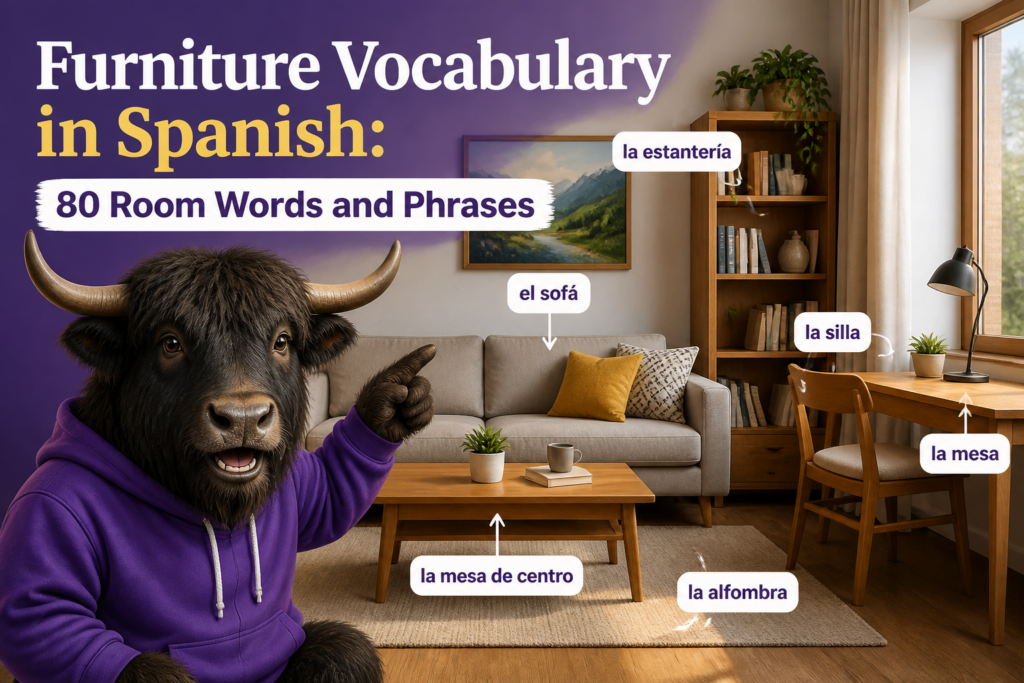
If you ever walked into a furniture store and suddenly forgot every word you knew, welcome to the club. Spanish furniture vocabulary is actually pretty friendly once you learn the core room words, the everyday objects, and a few handy phrases for asking where things go.
For the broader learning path, visit our parent guide.
In this guide, you’ll learn the Spanish words you actually need for homes, apartments, stores, and conversations about rooms and furniture. By the end, you’ll be able to describe a room, ask for furniture, and survive a showroom without making the salesperson do all the heavy lifting.
For a bigger base of everyday vocabulary, you can also check out 100 Essential Spanish Words & Phrases. And if you want to keep building practical vocabulary, these guides on colors in Spanish and technology devices in Spanish pair nicely with home words.
You’ll learn the most useful furniture and room words in standard Latin American Spanish, with notes when Spain Spanish differs.
Start With The Rooms
Before furniture, it helps to know the rooms themselves. Spanish often uses simple, everyday words here. Nothing fancy. No linguistic velvet ropes.
| Spanish | Pronunciation | Meaning | Example Sentence | Translation | Learner Note |
|---|---|---|---|---|---|
| la casa | LAH KAH-sah | house | La casa es pequeña. | The house is small. | Feminine noun: la. |
| el apartamento | el ah-pahr-tah-MEN-toh | apartment | Vivo en un apartamento grande. | I live in a big apartment. | Common in Latin America; Spain also uses piso. |
| el piso | el PEE-soh | apartment / floor | Mi piso tiene dos habitaciones. | My apartment has two bedrooms. | Very common in Spain. |
| la sala | LAH SAH-lah | living room | La sala tiene un sofá grande. | The living room has a big sofa. | Common in Latin America. |
| la sala de estar | LAH SAH-lah deh ehs-TAHR | living room | Pasamos mucho tiempo en la sala de estar. | We spend a lot of time in the living room. | More explicit and neutral. |
| el comedor | el koh-meh-DOR | dining room | El comedor está junto a la cocina. | The dining room is next to the kitchen. | Also means “dining room table area” in casual use. |
| la cocina | lah koh-SEE-nah | kitchen | La cocina es muy luminosa. | The kitchen is very bright. | Common, everyday word. |
| el dormitorio | el dor-mee-TOR-yoh | bedroom | Mi dormitorio tiene una cama grande. | My bedroom has a big bed. | Neutral and common. |
| la habitación | lah ah-bee-tah-SEE-ohn | room / bedroom | La habitación tiene un armario. | The room has a wardrobe. | Can mean any room, or a hotel room. |
| el baño | el BAH-nyoh | bathroom | El baño está al fondo. | The bathroom is at the back. | The ñ sounds like “ny” in “canyon.” |
| el pasillo | el pah-SEE-yoh | hallway | El pasillo es estrecho. | The hallway is narrow. | Double ll is usually “y” sound in Latin America. |
| el patio | el PAH-tyoh | patio / courtyard | Hay una mesa en el patio. | There is a table in the patio. | Very common for homes with outdoor space. |
One tiny cultural note: in many Latin American homes, sala is the go-to word for living room, while in Spain you’ll hear salón a lot too. Spanish likes options, because apparently one word is never quite enough.
Core Furniture Words
These are the big-ticket words you’ll hear in homes, apartments, listings, stores, and decorating conversations. Learn these first and the rest gets much easier.
| Spanish | Pronunciation | Meaning | Example Sentence | Translation | Learner Note |
|---|---|---|---|---|---|
| el sofá | el soh-FAH | sofa / couch | El sofá es muy cómodo. | The sofa is very comfortable. | Stress on the final syllable because of the accent mark. |
| el sillón | el see-lyohn | armchair / lounge chair | Mi abuelo siempre se sienta en el sillón. | My grandfather always sits in the armchair. | Can also mean a larger comfy chair. |
| la silla | LAH SEE-yah | chair | Necesito una silla para el escritorio. | I need a chair for the desk. | ll usually sounds like “y” in Latin America. |
| la mesa | LAH MEH-sah | table | La mesa es de madera. | The table is made of wood. | Very common, very useful, very non-dramatic. |
| la mesa de centro | LAH MEH-sah deh SEN-troh | coffee table | La mesa de centro está frente al sofá. | The coffee table is in front of the sofa. | Also mesa ratona in some regions. |
| la cama | LAH KAH-mah | bed | La cama es doble. | The bed is double. | Feminine noun. |
| el colchón | el kohl-CHON | mattress | El colchón es nuevo. | The mattress is new. | The ch is like “ch” in “chair.” |
| la almohada | lah al-moh-AH-dah | pillow | Necesito otra almohada. | I need another pillow. | The h is silent. |
| el armario | el ahr-MAH-ryoh | wardrobe / closet | La ropa está en el armario. | The clothes are in the wardrobe. | In some places, closet or ropero is also common. |
| el ropero | el roh-PEH-roh | wardrobe / clothes cabinet | El ropero tiene mucha ropa. | The wardrobe has a lot of clothes. | Very common in Latin America. |
| la cómoda | lah KOH-moh-dah | dresser / chest of drawers | Las camisetas están en la cómoda. | The T-shirts are in the dresser. | Be careful: cómoda means dresser, while cómodo means comfortable. |
| el escritorio | el ehs-kree-TOR-yoh | desk | Mi computadora está en el escritorio. | My computer is on the desk. | Useful for study and work vocabulary. |
| la estantería | lah ehs-tahn-teh-REE-ah | shelf / bookcase | Los libros están en la estantería. | The books are on the shelf/bookcase. | Can refer to a shelving unit. |
| el estante | el ehs-TAHN-teh | shelf | Puse las tazas en el estante. | I put the cups on the shelf. | Good for a single shelf. |
| la repisa | lah reh-PEE-sah | shelf / ledge | Hay una planta en la repisa. | There is a plant on the shelf. | Often a wall shelf or ledge. |
| la lámpara | LAH LAM-pah-rah | lamp | La lámpara está junto a la cama. | The lamp is next to the bed. | Accent mark keeps the stress on lám. |
| la alfombra | lah al-FOM-brah | rug / carpet | La alfombra es azul. | The rug is blue. | Great word for home descriptions. |
| las cortinas | lahs kor-TEE-nahs | curtains | Las cortinas bloquean la luz. | The curtains block the light. | Plural form is common because curtains usually come in pairs. |
| la puerta | lah PWEHR-tah | door | La puerta está abierta. | The door is open. | Useful in both home and store situations. |
| la ventana | lah ben-TAH-nah | window | La ventana da al jardín. | The window faces the garden. | Neutral everyday word. |
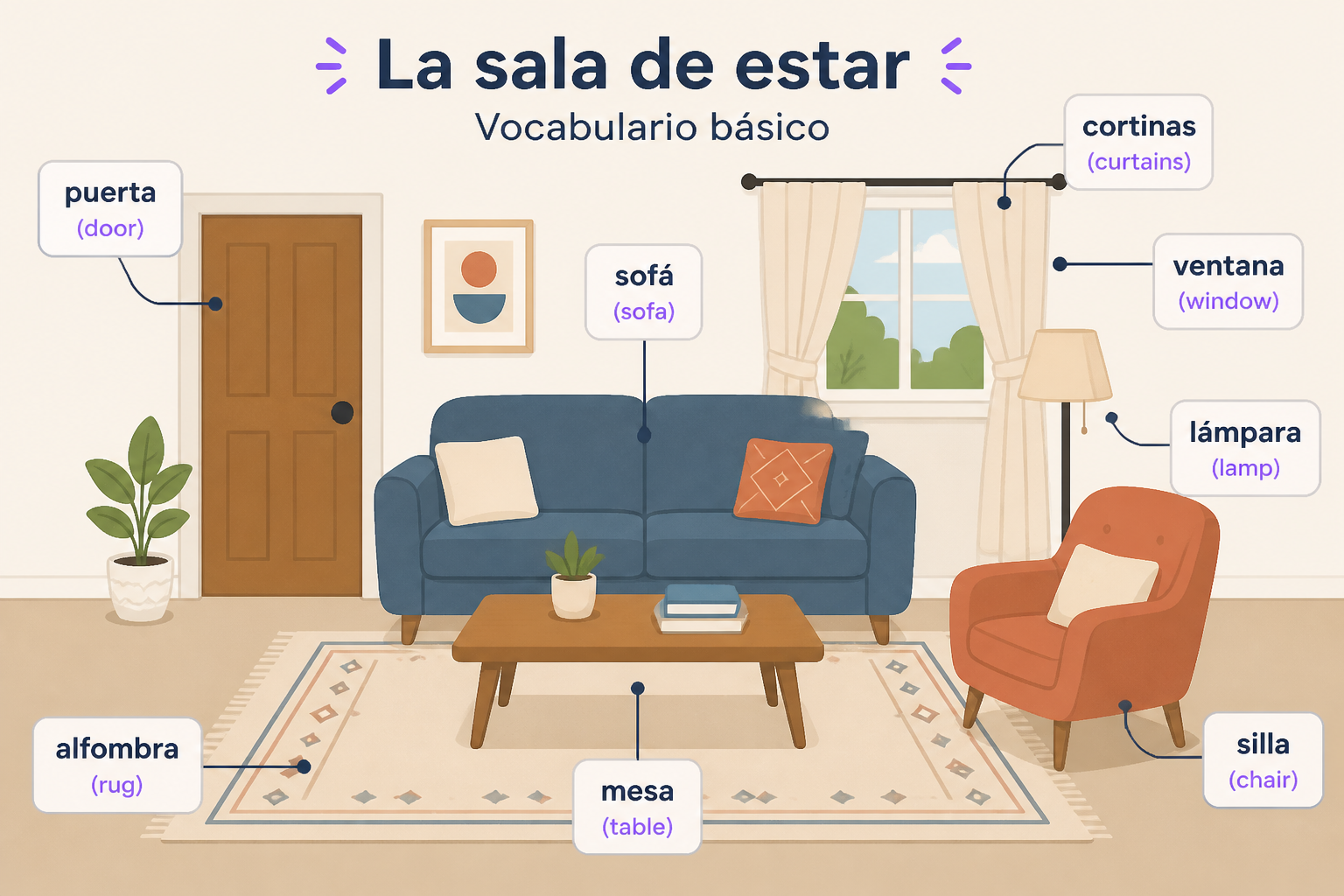
Need a visual memory trick? Picture a room and build it in Spanish from the floor up: alfombra, mesa, silla, sofá, lámpara, cortinas. It’s basically decorating, but with vocabulary.
More Furniture And Home Objects
Now let’s add more items you’ll hear in real homes, apartments, and furniture stores. Some are big furniture pieces, some are smaller useful objects, and some are the little details that make a room feel lived in instead of suspiciously empty.
| Spanish | Pronunciation | Meaning | Example Sentence | Translation | Learner Note |
|---|---|---|---|---|---|
| el mueble | el MWEH-bleh | piece of furniture | Ese mueble es muy antiguo. | That piece of furniture is very old. | Useful general word. |
| los muebles | lohs MWEH-blehs | furniture | Los muebles son modernos. | The furniture is modern. | Muebles is often used as a collective plural. |
| la butaca | lah boo-TAH-kah | armchair / easy chair | La butaca es de cuero. | The armchair is made of leather. | Can sound a bit more formal or design-oriented. |
| el taburete | el tah-boo-REH-teh | stool | Hay un taburete en la cocina. | There is a stool in the kitchen. | Common in kitchens and bars. |
| el banco | el BAHN-koh | bench | Nos sentamos en un banco del parque. | We sat on a bench in the park. | Can be a bench indoors or outdoors. |
| la mesa auxiliar | lah MEH-sah owk-see-lee-AHR | side table | La mesa auxiliar está junto al sofá. | The side table is next to the sofa. | Very useful for home shopping. |
| la mesita de noche | lah meh-SEE-tah deh NOH-cheh | nightstand | Mi libro está en la mesita de noche. | My book is on the nightstand. | Literally “little night table.” Cute and practical. |
| el tocador | el toh-kah-DOR | dressing table / vanity | La joya está sobre el tocador. | The jewelry is on the vanity. | Can also mean “dresser” in some regions. |
| el perchero | el pehr-CHEH-roh | coat rack / clothes rack | Deja el abrigo en el perchero. | Leave the coat on the coat rack. | Useful in entryways. |
| la ropa | LAH ROH-pah | clothes | La ropa está en el armario. | The clothes are in the wardrobe. | Not furniture, but extremely useful with furniture words. |
| el cajón | el kah-HON | drawer | Los cubiertos están en el cajón. | The cutlery is in the drawer. | The j is a harsh “h” sound. |
| la alacena | lah ah-lah-SEH-nah | cupboard / pantry cabinet | Guardo los platos en la alacena. | I keep the plates in the cupboard. | Very common in kitchens and older homes. |
| el clóset | el KLOH-set | closet | La ropa está en el clóset. | The clothes are in the closet. | More common in Latin America; borrowed from English. |
| la estufa | lah ehs-TOO-fah | stove | La estufa está apagada. | The stove is off. | Kitchen vocabulary, but often needed with home words. |
| el horno | el OR-noh | oven | El pan está en el horno. | The bread is in the oven. | The h is silent. |
| la nevera | lah neh-VEH-rah | fridge | La leche está en la nevera. | The milk is in the fridge. | Very common in Latin America. |
| el refrigerador | el reh-free-heh-rah-DOR | refrigerator | El refrigerador es muy grande. | The refrigerator is very big. | More formal; also common in writing. |
| el lavamanos | el lah-vah-MAH-nohs | sink / washbasin | Hay jabón junto al lavamanos. | There is soap next to the sink. | Common in bathrooms. |
| el espejo | el ehs-PEH-hoh | mirror | El espejo está sobre la cómoda. | The mirror is above the dresser. | The j sound is like a strong “h.” |
| la tele | LAH TEH-leh | TV | Vemos la tele en la sala. | We watch TV in the living room. | Very casual and common. |
Notice how a lot of furniture words are feminine: la silla, la mesa, la cama, la cómoda. Spanish nouns love gender, even when the object itself clearly does not care.
Useful Phrases For Describing A Room
These phrases help you go beyond naming objects. You can now say where things are, what a room has, and what you need. That’s when the vocabulary starts feeling useful instead of like a museum exhibit.
| Spanish | Pronunciation | Meaning | Example Sentence | Translation | Learner Note |
|---|---|---|---|---|---|
| Hay un/una… | ahy oon / oo-nah | There is a… | Hay una silla en la esquina. | There is a chair in the corner. | Use hay for “there is/are.” |
| Está en… | ehs-TAH ehn | It is in / on / at… | El libro está en la mesa. | The book is on the table. | Use estar for location. |
| Está junto a… | ehs-TAH HHOON-toh ah | It is next to… | La lámpara está junto al sofá. | The lamp is next to the sofa. | Junto a is very common and natural. |
| Está al lado de… | ehs-TAH al DAH-doh deh | It is beside… | La cocina está al lado del comedor. | The kitchen is beside the dining room. | Same idea asMore Spanish to explore |