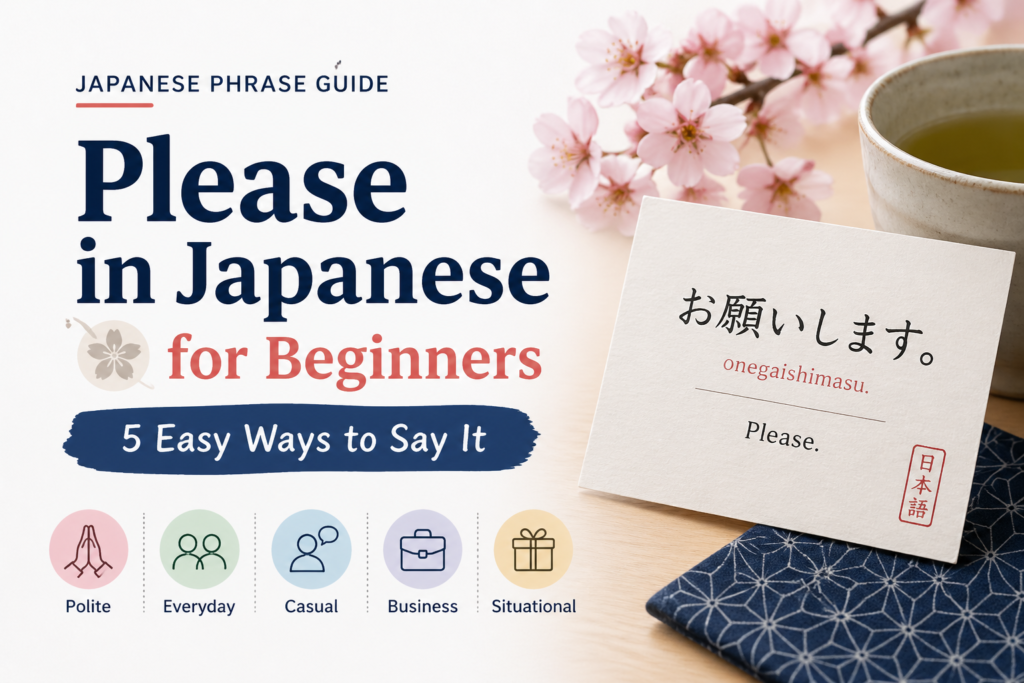
Please in Japanese is a tiny phrase with surprisingly big behavior. Say it one way, and you sound polite. Say it another way, and you sound casual. Say it the wrong way in the wrong moment, and… well, Japanese will not explode, but the vibe may get a little awkward. Humans are excellent at making simple words complicated. It is one of our best hobbies.
The good news? Japanese gives you several easy ways to say “please,” and each one has a clear job. Some are used when asking for something. Some are used when begging. Some are used when handing over a task with a polite little bow in the sentence. This guide keeps it simple, practical, and beginner-friendly.
If you only remember one thing today, remember this: in Japanese, “please” is not one single magic word. It is more like a small toolbox. And yes, Japanese loves a toolbox.
In English, “please” can work in many situations. In Japanese, the best word depends on what you are doing. Are you asking for an item? Making a request? Begging politely? Giving someone permission to do something? The Japanese language wants to know. Of course it does.
For beginners, the most useful words are お願いします Onegai shimasu and ください Kudasai. Those two will cover a lot of daily situations. The others are useful too, but they fit more specific moments.
Five Easy Ways To Say Please
- お願いします Onegai shimasu — Please / I request it / Nice to meet you in a polite way
- ください Kudasai — Please give me / Please do this
- どうぞ Douzo — Here you are / Please go ahead / Please take it
- お願いしますね Onegai shimasu ne — Please, okay? / Please take care of it
- 頼みます Tanomimasu — I’m counting on you / Please do it
Here is the simple version: お願いします is the safest all-purpose polite choice. ください is used when you want something or want someone to do something. どうぞ is often used when offering something or letting someone go first. The others are more specific, but still useful.
Useful Phrases And Real-Life Sentences
Below are common “please” expressions you will actually hear. Each one includes Kanji, Rōmaji, meaning, and a real example sentence. Because vocabulary without context is just decorative baggage.
お願いします
Onegai shimasu
Please / I ask for your help / Nice to meet you politely
例
これをお願いします。
Kore o onegai shimasu.
Please this one.
This is the polite all-rounder. Use it when asking for a service, a favor, or when handing something over politely.
ください
Kudasai
Please give me / Please do this
例
水をください。
Mizu o kudasai.
Please give me water.
This is one of the first “please” forms learners meet. It is direct, polite, and very common in shops, restaurants, and everyday requests.
どうぞ
Douzo
Please go ahead / Here you are / Please take it
例
どうぞ、お入りください。
Douzo, ohairi kudasai.
Please come in.
どうぞ is often used when offering something or giving permission. It is polite and friendly without sounding stiff.
お願いしますね
Onegai shimasu ne
Please, okay? / I’m counting on you
例
明日の準備、お願いしますね。
Ashita no junbi, onegai shimasu ne.
Please take care of tomorrow’s preparation.
The little ね ne softens the request. It can sound warm, lightly friendly, and a bit “we are on the same team here.”
頼みます
Tanomimasu
I’m counting on you / Please do it
例
この件、頼みます。
Kono ken, tanomimasu.
I’m counting on you for this matter.
This sounds stronger and more direct. It can feel serious, determined, or even a little dramatic, depending on context. Drama loves language. Language loves drama right back.
お願いします
Onegai shimasu
Please / I request your help
例
予約をお願いします。
Yoyaku o onegai shimasu.
Please make a reservation.
Yes, it appears twice. That is because it is that useful. In real life, this expression shows up everywhere from customer service to casual requests.
More Common “Please” Phrases You Will Hear
- お願いします。 Onegai shimasu. — Please / I request it.
- どうぞ。 Douzo. — Please go ahead / Here you are.
- ください。 Kudasai. — Please give me / Please do this.
- ちょっとお願いします。 Chotto onegai shimasu. — Please help me a little.
- こちらをお願いします。 Kochira o onegai shimasu. — Please this one.
- もう一度お願いします。 Mou ichido onegai shimasu. — Please one more time.
- 静かにしてください。 Shizuka ni shite kudasai. — Please be quiet.
- 待ってください。 Matte kudasai. — Please wait.
- 入ってください。 Haitte kudasai. — Please come in.
- お先にどうぞ。 Osaki ni douzo. — Please go ahead first.
Notice something interesting? Japanese often uses a full verb phrase instead of a tiny standalone “please.” So the request and the politeness travel together. Efficient, elegant, and just a little bossy when needed.
When To Use Kudasai And When To Use Onegai Shimasu
ください Kudasai is best when you ask for a thing or request a simple action.
お願いします Onegai shimasu is best when you want something more polite, formal, or service-like.
Quick comparison:
| Phrase | Best For | Example |
|---|---|---|
| ください Kudasai | Asking for an item, simple request | 水をください。 Mizu o kudasai. — Please give me water. |
| お願いします Onegai shimasu | Polite request, services, favors | 予約をお願いします。 Yoyaku o onegai shimasu. — Please make a reservation. |
If you are unsure, use お願いします Onegai shimasu. It is polite, widely accepted, and less likely to sound too blunt. That makes it the beginner’s safest bet.
Useful Everyday Situations
| Kanji | Rōmaji | Meaning | Example (Kanji) | Example (Rōmaji) | Translation (EN) |
|---|---|---|---|---|---|
| 水 | Mizu | Water | 水をください。 | Mizu o kudasai. | Please give me water. |
| 名前 | Namae | Name | 名前をお願いします。 | Namae o onegai shimasu. | Please give me your name / Please write the name. |
| 予約 | Yoyaku | Reservation | 予約をお願いします。 | Yoyaku o onegai shimasu. | Please make a reservation. |
| 少々 | Shoushou | A little / a moment | 少々お待ちください。 | Shoushou omachi kudasai. | Please wait a moment. |
| 待つ | Matsu | To wait | 少し待ってください。 | Sukoshi matte kudasai. | Please wait a little. |
| 入る | Hairu | To enter | どうぞ、お入りください。 | Douzo, ohairi kudasai. | Please come in. |
| 静か | Shizuka | Quiet | 静かにしてください。 | Shizuka ni shite kudasai. | Please be quiet. |
| 教える | Oshieru | To teach / tell | 教えてください。 | Oshiete kudasai. | Please tell me. |
Pronunciation Tips
How To Say Onegai Shimasu Naturally
お願いします Onegai shimasu has four parts in normal speech: o-ne-ga-i shi-ma-su. Do not rush it like you are late for the train. Japanese polite speech likes smooth rhythm.
The o at the beginning is a polite honorific sound. It helps the phrase feel respectful and natural. The word is often used by itself in shops, offices, and everyday life.
How To Use Kudasai Without Sounding Rude
ください Kudasai is not rude by itself, but it can sound direct if you use it too bluntly or without context. Often, the sentence becomes smoother with a polite setup, such as:
すみません、水をください。
Sumimasen, mizu o kudasai.
Excuse me, please give me water.
Practice: Swap The Word
Try changing the English idea into the Japanese phrase that fits best. Keep the sentence polite. No panic, just small steps.
- You want water at a café. → 水をください。 Mizu o kudasai.
- You want a reservation. → 予約をお願いします。 Yoyaku o onegai shimasu.
- You want someone to come in. → どうぞ、お入りください。 Douzo, ohairi kudasai.
- You want someone to wait a moment. → 少々お待ちください。 Shoushou omachi kudasai.
- You want someone to speak again. → もう一度お願いします。 Mou ichido onegai shimasu.
Now try making one of your own sentences with お願いします Onegai shimasu and one with ください Kudasai. That tiny contrast will help the patterns stick.
Common Mistakes And Easy Fixes
| Mistake | Better Version | Why |
|---|---|---|
| Using ください for every polite request | Use お願いします for service-style requests | ください is great, but not always the most natural choice |
| Dropping context and saying only ください | Add すみません Sumimasen first | It softens the request nicely |
| Using どうぞ when you really mean “please give me” | Use ください or お願いします | どうぞ often means “go ahead” or “here you are” |
| Being too direct with 頼みます | Use it only when the tone fits | It can sound stronger than beginners expect |
Quick Reference Summary
- お願いします Onegai shimasu — safest polite “please”
- ください Kudasai — please give me / please do this
- どうぞ Douzo — please go ahead / here you are
- お願いしますね Onegai shimasu ne — warm, soft request
- 頼みます Tanomimasu — strong “please do it” / I’m counting on you
If you want one beginner-friendly rule, here it is: use お願いします Onegai shimasu for polite requests, and ください Kudasai when asking for an item or asking someone to do something simple. That is the practical heart of “please” in Japanese.
For a plain-language reference on Japanese writing and language basics, this Japanese language overview is a decent starting point.
And that is the real trick: Japanese does not just say “please.” It chooses the right kind of polite. Once you get that, your requests stop sounding like a robot with manners and start sounding naturally Japanese. Which, admittedly, is much cooler.
More Japanese to explore

The Spider’s Thread: A2 Elementary Japanese Story with Audio

Golden Boy in Japanese: A1 Beginner Story with Audio, Tap-to-Translate Help & Free Lesson Notes

Learn Japanese with The Tale of the Bamboo Cutter – An A2 Graded Reader with Audio