


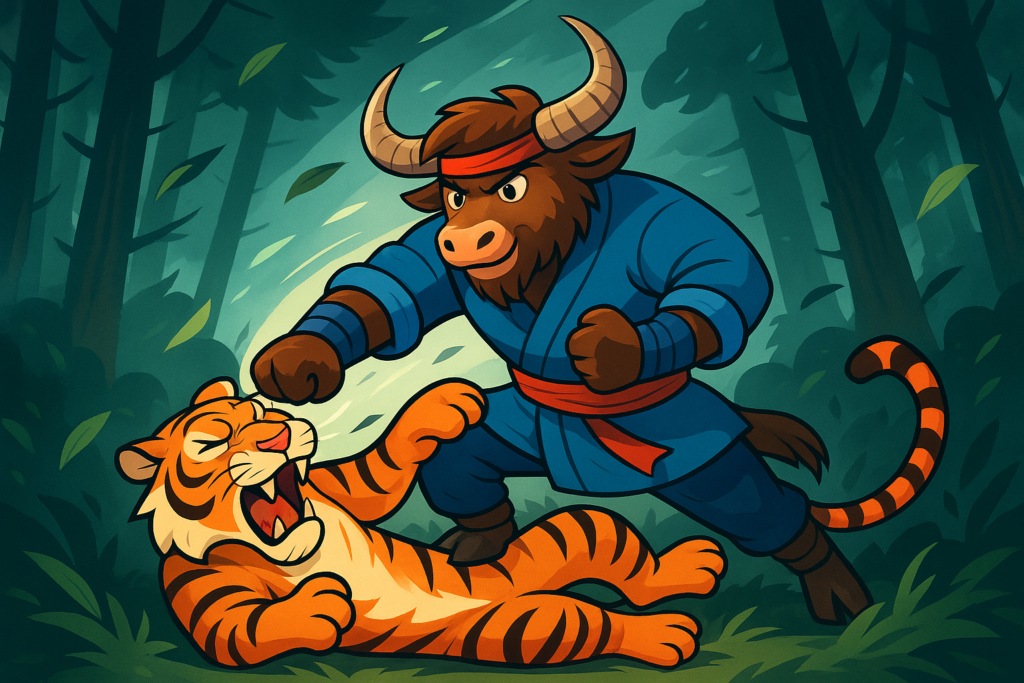
This B1 Intermediate retelling of 武松打虎 keeps the plot clear for learners while still giving the story some atmosphere and momentum.
This version teaches Simplified Chinese through English and includes clickable word help inside the story, full story audio, and lesson notes after the reading. It is free to use on Yak Yacker and is designed to feel natural, readable, and manageable for learners.
武松是个的。他,。
有一天,武松一个叫的地方。他前面有一家。
武松酒馆,对老板说:"快给我来些酒!"
老板酒来,说:"客官,我们的酒,您只能喝三碗。因为山上有老虎,可不敢上山。"
武松哈哈大笑:"我武松,还怕什么老虎?倒酒!"
他喝了十几碗,脸都红了。老板他:"天晚了,老虎会出来,您在这里吧。"
"不用!"武松,"我现在就去山上,那老虎!" 他哨棒就出门了。
武松景阳冈,太阳。树林里,风吹得树叶。
他的上来了,觉得有点。他看到一块大青石,想睡一觉。
忽然,扑过来,。武松听见一声,一只从树林里跳了出来!
"哎呀!"武松一惊,翻身坐起。老虎血盆大口,向他。
武松往后一跳,老虎。老虎又用尾巴他,武松又跳开了。
老虎,。武松,,跳到老虎身后。
他两只大手,老虎的,往下按。老虎,可武松的力气太大了。
武松用脚往老虎脸上踢,又拳头,打在老虎头上。老虎的眼睛、鼻子、耳朵都。
也不知打了多少拳,老虎终于。武松手,,看着死老虎,笑了。他,慢慢走下山去。从此,武松打虎的故事。
Wu Song was a brave, strapping man. He was tall and enormously strong.
One day, while walking, he passed a place called Jingyang Ridge. He saw a small tavern ahead.
Wu Song entered the tavern and said to the owner, "Quick, bring me some wine!"
The owner brought wine and said, "Sir, our wine is very strong. You can drink no more than three bowls. There's a tiger on the mountain; it's not safe to go up late."
Wu Song laughed heartily: "I, Wu Song, fear nothing in heaven or on earth. Why would I fear a tiger? Keep pouring!"
He drank over a dozen bowls in one breath, his face flushed. The owner urged, "It's late, the tiger will come out. Stay here for the night."
"No need!" Wu Song slapped the table. "I'll go up the mountain right now and see what that tiger looks like!" Grabbing his staff, he went out.
Wu Song climbed Jingyang Ridge as the sun set. The forest was gloomy, the wind rustling the leaves.
The wine's effect hit him, and he felt dizzy. He spotted a large bluestone and decided to lie down and sleep.
Suddenly, a fierce wind blew, swirling leaves everywhere. Wu Song heard a roar, and a big tiger with slanting eyes and a white forehead leaped out from the woods!
"Aiya!" Wu Song was startled and quickly sat up. The tiger opened its bloody mouth and pounced.
Wu Song jumped back, and the tiger missed. The tiger then swept its tail at him, and Wu Song dodged again.
The tiger grew frantic, pouncing and lunging. Wu Song ducked and dodged, then seized an opportunity to leap behind the tiger.
He reached out with both large hands, grabbed the tiger's head by the scalp, and pressed it down with all his might. The tiger struggled fiercely, but Wu Song was too strong.
Wu Song kicked the tiger in the face with his feet, then swung his fists like raindrops onto the tiger's head. Blood flowed from its eyes, nose, and ears.
After countless blows, the tiger finally stopped moving. Wu Song let go, breathed a sigh of relief, looked at the dead tiger, and smiled. He rested a while, then slowly walked down the mountain. From then on, the story of Wu Song beating the tiger spread far and wide.
Here are some colorful words and expressions from the story. Try using them in your own sentences to add more flavor.
- 壮汉 (zhuànghàn) - a strong, burly man (like Wu Song!)
- 惊人 (jīngrén) - astonishing, amazing (e.g., 力气大得惊人 - his strength was astonishing)
- 阴森森 (yīnsēnsēn) - gloomy, creepy (describing a dark forest)
- 血盆大口 (xuèpén dàkǒu) - blood-basin mouth, a vivid way to say a beast's gaping maw
When the tiger attacks, the story says 连扑带掀 (lián pū dài xiān) - 'both pouncing and flipping.' The pattern 连A带B is a vivid way to say 'both A and B' or 'doing A while also B.' It often adds a sense of rapid or rough action. You'll see it in spoken Chinese too.
Another example: 他连跑带跳地过来了 - 'He came running and jumping.' The structure is very handy for describing energetic or chaotic scenes.
- Pattern: 连 + verb1 + 带 + verb2
- It connects two actions happening almost at the same time or alternating quickly.
- Often used with single-character verbs, but can also appear with two-character verbs in longer forms.
This retelling of Wu Song's adventure keeps some of the flavor of traditional Chinese tales. Words like 酒馆 (tavern), 客官 (honored guest/customer), and 哨棒 (a wooden staff) give it an old-time feel. Even modern Chinese speakers recognize these as storytelling markers.
The rhythm also matters: you'll notice many four-character phrases (阴森森的树林, 乱叶满天飞, 雨点般打在) that create a dramatic, almost musical pace. This kind of phrasing is typical of classical novels.
- 客官 - a polite address used by innkeepers or waiters to customers.
- 吊睛白额大老虎 - a classic description of a tiger: 'slanted eyes, white forehead, big tiger.'
- Four-character expressions pack meaning and rhythm into a compact form.
You've understood a classic Chinese tale! Now try retelling it in your own words, using some of the new vocabulary. Pay attention to the action patterns - they'll make your storytelling more lively.
Look for more stories with 武松 or other heroes from Water Margin to see similar language in action. Each one is a little language workout.
武松打虎 comes from the Chinese / Water Margin tradition and is best known as a classic novel episode. This Yak Yacker article is an original learner retelling based on Water Margin, 14th century; public domain, so the wording here is simplified for modern learners rather than copied from one old edition.
Older printings, translations, and retellings of this story can vary quite a bit. The original audience was usually general, but this version is adapted for B1 Intermediate learners studying Simplified Chinese. Violence/drinking; can be simplified as action legend.
If you want to look into the source tradition, start with Project Gutenberg.
If you want to keep going, browse more in our Simplified Chinese section and review the HSK Level 1 Chinese Vocabulary. After that, try Essential Chinese Grammar Words for another useful next step.