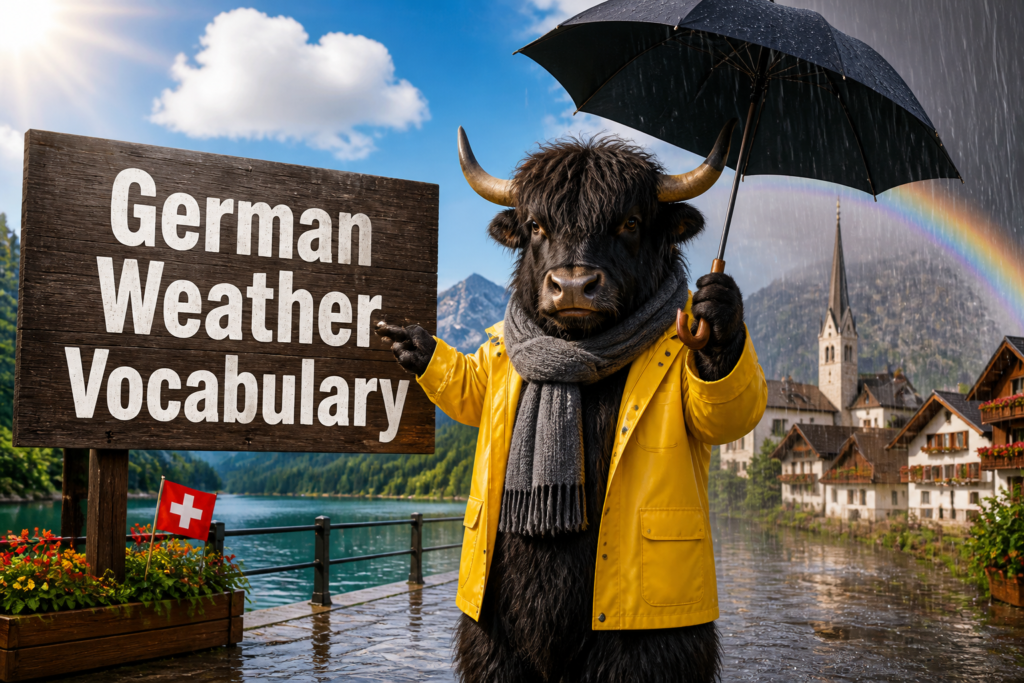
German weather vocabulary is wonderfully useful because, let’s be honest, weather talk is the national backup plan for small talk. Train delayed? Weather. Awkward silence at breakfast? Weather. Someone opens a window in winter and acts surprised? Also weather.
In this guide, you’ll learn practical German words and phrases for describing the weather, talking about seasons, and surviving the usual “Wie ist das Wetter?” question without staring into the middle distance like a lost umbrella.
By the end, you’ll be able to describe the sky, rain, wind, heat, cold, and a few very German weather complaints. Because of course there are a few.
Quick Weather Basics
The most common question is:
| German | Pronunciation | Meaning | Example Sentence | Translation | Learner Note |
|---|---|---|---|---|---|
| Wie ist das Wetter? | vee ist dahs vet-ter | How is the weather? | Wie ist das Wetter heute? | How is the weather today? | The standard, everyday question. Useful everywhere. |
| Es ist schön. | es ist shern | It’s nice. | Heute ist es schön. | It’s nice today. | schön can mean “nice,” “beautiful,” or “pleasant,” depending on context. |
| Es ist schlecht. | es ist shlekt | It’s bad. | Das Wetter ist schlecht. | The weather is bad. | Use for unpleasant weather, but people may also say something is generally “bad.” |
| Es ist warm. | es ist varm | It’s warm. | Im Zimmer ist es warm. | It’s warm in the room. | Simple adjective after es ist is very common. |
| Es ist kalt. | es ist kahlt | It’s cold. | Heute Morgen ist es kalt. | It’s cold this morning. | kalt is a core word. Learn it early. |
German learning guides can be a useful next stop once you’ve got the weather basics under control.
Core Weather Words
These are the weather words you’ll actually use in real life, not just in textbook fantasy land where everyone speaks in perfect complete sentences while standing politely under a rainbow.
| German | Pronunciation | Meaning | Example Sentence | Translation | Learner Note |
|---|---|---|---|---|---|
| die Sonne | dee zon-neh | sun | Die Sonne scheint. | The sun is shining. | Sonne is feminine: die. |
| scheinen | SHY-nen | to shine | Die Sonne scheint heute nicht. | The sun is not shining today. | Common with weather. Verb goes second in a normal sentence. |
| der Regen | RAY-gen | rain | Es regnet. | It’s raining. | Noun: der Regen. Verb: regnen. |
| regnen | RAYG-nen | to rain | Es regnet den ganzen Tag. | It rains all day. | Very common weather verb. |
| der Schnee | shneh | snow | Es schneit. | It’s snowing. | schneien = to snow; ch disappears here in the spelling but the pronunciation stays simple. |
| schneien | SHNY-en | to snow | Heute schneit es. | It’s snowing today. | Notice the weather subject es. |
| der Wind | vint | wind | Es ist windig. | It’s windy. | windig is the adjective, not Wind. |
| windig | VIN-dig | windy | Heute ist es sehr windig. | It’s very windy today. | Handy everyday adjective. |
| die Wolke | VOL-keh | cloud | Am Himmel sind viele Wolken. | There are many clouds in the sky. | Plural: die Wolken. |
| bewölkt | beh-VERLKT | cloudy | Es ist heute bewölkt. | It’s cloudy today. | Common adjective for weather forecasts. |
| das Gewitter | geh-VI-ter | thunderstorm | Heute Abend gibt es ein Gewitter. | There will be a thunderstorm this evening. | Neuter noun: das Gewitter. |
| es donnert | es DON-ert | it thunders | Es donnert schon. | It’s already thundering. | Weather verb. Very common with storms. |
| es blitzt | es BLITST | it flashes / lightning strikes | Es blitzt und donnert. | It flashes and thunders. | blitzen = to flash or lightning. |
| der Nebel | NAY-bel | fog | Am Morgen ist oft Nebel. | In the morning, there is often fog. | oft = often. Nice easy collocation. |
| das Eis | ice | ice | Auf der Straße ist Eis. | There is ice on the road. | Watch out for slippery winter roads. |
Useful Weather Phrases For Real Life
These phrases are the ones you’ll hear in conversations, apps, forecasts, and casual complaints from people who somehow expected German weather to behave itself.
| German | Pronunciation | Meaning | Example Sentence | Translation | Learner Note |
|---|---|---|---|---|---|
| Es regnet. | es RAYG-net | It’s raining. | Es regnet seit dem Morgen. | It’s been raining since morning. | Use seit for “since.” |
| Es nieselt. | es NEE-zelt | It’s drizzling. | Es nieselt nur leicht. | It’s only drizzling a little. | Great small-talk weather word. |
| Es schüttet. | es SHU-teht | It’s pouring. | Heute schüttet es den ganzen Tag. | It’s pouring all day today. | Informal, very common. Stronger than Es regnet. |
| Es ist trocken. | es ist TROK-en | It’s dry. | Endlich ist es trocken. | Finally, it’s dry. | Handy after rain. endlich = finally. |
| Es ist sonnig. | es ist ZON-ig | It’s sunny. | Morgen wird es sonnig. | Tomorrow it will be sunny. | Use for weather forecast talk. |
| Es ist bewölkt. | es ist beh-VERLKT | It’s cloudy. | Heute Nachmittag ist es bewölkt. | It will be cloudy this afternoon. | Common forecast language. |
| Es ist neblig. | es ist NAYB-lig | It’s foggy. | Am See ist es neblig. | It’s foggy by the lake. | Weather adjective from Nebel. |
| Es ist frostig. | es ist FROST-ig | It’s frosty. | Heute Morgen war es frostig. | It was frosty this morning. | Often used in colder months. |
| Es ist eisig. | es ist EYE-zig | It’s icy / freezing cold. | Es ist draußen eisig. | It’s icy outside. | Strong cold feeling. Good description word. |
| Es ist heiß. | es ist HICE | It’s hot. | Im Sommer ist es oft heiß. | In summer it’s often hot. | ß is pronounced like a sharp s. No need to fear it. It only wants attention. |
| Es ist schwül. | es ist shvuel | It’s humid and stuffy. | Heute ist es schwül. | It’s muggy today. | Very useful in summer. Not the same as just warm. |
| Es weht ein Wind. | es vait in vint | The wind is blowing. | Am Meer weht ein starker Wind. | A strong wind is blowing by the sea. | More descriptive than just es ist windig. |
| Es hat gefroren. | es hat geh-FRO-ren | It has frozen / there was frost. | In der Nacht hat es gefroren. | It froze overnight. | Past tense weather phrase. Very common in reports. |
| Es taut. | es touth | It’s thawing. | Am Nachmittag taut der Schnee. | The snow is melting in the afternoon. | tauen = to thaw, melt. |
Seasons, Temperature, And Forecast Talk
Weather conversations often include seasons and temperature. German uses these constantly in forecasts, plans, and those dramatic chats that start with “It’s supposed to…” and end with someone checking the app for the third time.
| German | Pronunciation | Meaning | Example Sentence | Translation | Learner Note |
|---|---|---|---|---|---|
| der Frühling | froo-ling | spring | Im Frühling wird es wärmer. | In spring it gets warmer. | Season nouns are capitalized in German. |
| der Sommer | ZOM-er | summer | Im Sommer fahren viele ans Meer. | In summer, many people go to the sea. | Very common seasonal word. |
| der Herbst | herpst | autumn / fall | Im Herbst wird es kühler. | In autumn it gets cooler. | Germany usually says Herbst, not “fall.” |
| der Winter | VIN-ter | winter | Im Winter schneit es oft. | In winter it often snows. | Common in weather talk and travel plans. |
| die Temperatur | tem-per-ah-TOOR | temperature | Die Temperatur liegt bei 20 Grad. | The temperature is 20 degrees. | Often used in weather reports. |
| Grad | graht | degrees | Es sind 18 Grad. | It’s 18 degrees. | Grad is usually the same in singular and plural in everyday use. |
| Null Grad | noohl graht | zero degrees | Heute sind es Null Grad. | It’s zero degrees today. | Use Null carefully: it can sound colder than you think. |
| unter null | oon-ter noohl | below zero | Nachts ist es unter null. | At night it’s below zero. | Very useful in winter. |
| über null | ue-ber noohl | above zero | Heute bleiben die Temperaturen über null. | Today temperatures stay above zero. | Good forecast phrase. |
| es wird wärmer | es virt VER-mer | it gets warmer | Am Nachmittag wird es wärmer. | It gets warmer in the afternoon. | wird is from werden, a key “becoming” verb. |
| es wird kälter | es virt KEL-ter | it gets colder | Am Abend wird es kälter. | It gets colder in the evening. | Useful with forecasts and daily conversation. |
| die Aussichten | OWS-sih-ten | the outlook / forecast | Die Aussichten sind gut. | The forecast is good. | Plural noun. Often used in weather reports. |
German weather words often love the little subject es: Es regnet. Es schneit. Es ist kalt. In English, “it” is also used for weather, so this part feels nicely familiar for once. Miracles happen.
Weather in German is usually impersonal: you say Es regnet, not “It rains” in a literal person-ish way. The sentence just means the weather is doing its weather thing.
Helpful Weather Adjectives
These adjectives help you sound much more natural. You can use them after es ist or with nouns like der Tag, das Wetter, or der Himmel.
| German | Pronunciation | Meaning | Example Sentence | Translation | Learner Note |
|---|---|---|---|---|---|
| sonnig | ZON-ig | sunny | Es ist sonnig und warm. | It’s sunny and warm. | Very common weather description. |
| bewölkt | beh-VERLKT | cloudy | Der Himmel ist bewölkt. | The sky is cloudy. | Good with sky descriptions. |
| heiter | HY-ter | bright, clear | Heute wird es heiter. | It will be clear today. | Forecast word; a bit more formal. |
| nass | nahs | wet | Meine Schuhe sind nass. | My shoes are wet. | Useful after rain. Very practical, sadly. |
| trocken | TROK-en | dry | Die Straße ist trocken. | The road is dry. | Common opposite of nass. |
| mild | milht | mild | Das Wetter ist mild. | The weather is mild. | Often used in spring and autumn. |
| kühl | kuhl | cool | Es ist heute kühl. | It’s cool today. | Notice the umlaut ü. |
| warm | varm | warm | Das Wasser ist warm. | The water is warm. | Simple and useful. |
| heiß | hice | hot | Im Juli ist es heiß. | It’s hot in July. | Final ß sounds like s. |
| kalt | kahlt | cold | Heute Nacht wird es kalt. | It will be cold tonight. | One of the first weather adjectives to learn. |
| windig | VIN-dig | windy | Es ist windig am Strand. | It’s windy at the beach. | Built from Wind. |
| schwül | shvuel | muggy, humid | Heute ist es schwül und drückend. | It’s humid and oppressive today. | Very useful in summer. There is no simple one-word English equivalent. |
Common Weather Verbs
Weather verbs are small but mighty. They help you describe action in the sky instead of just naming the weather like a very polite meteorology robot.
| German | Pronunciation | Meaning | Example Sentence | Translation | Learner Note |
|---|---|---|---|---|---|
| regnen | RAYG-nen | to rain | Es regnet den ganzen Nachmittag. | It rains all afternoon. | Used with es as the subject. |
| schneien | SHNY-en | to snow | Es schneit seit gestern. | It has been snowing since yesterday. | Weather verbs often use es. |
| scheinen | SHY-nen | to shine | Die Sonne scheint durch die Wolken. | The sun shines through the clouds. | Very useful for nature and weather descriptions. |
| donnern | DON-ern | to thunder | Es donnert laut. | It’s thundering loudly. | Often paired with blitzen. |
| blitzen | BLIT-tsen | to flash / lightning flashes | Es blitzt am Horizont. | It flashes on the horizon. | Can mean “to flash” generally, too. |
| wehen | VAY-en | to blow | Ein kalter Wind weht. | A cold wind is blowing. | Good for wind descriptions. |
| frieren | FREE-ren | to freeze | Mir friert die Nase. | My nose is freezing. | Can also mean “I’m cold.” Note the dative in mir. |
| schmelzen | SHMEL-tsen | to melt | Der Schnee schmilzt schnell. | The snow melts quickly. | Useful in spring weather. |
| tauen | TOW-en | to thaw, melt | Am Mittag taut der Schnee. | The snow thaws at noon. | Common when temperatures rise. |
Small But Important Grammar Notes
Weather sentences in German are often short and neat. That is helpful, because the weather itself is usually not short and neat at all.
| Pattern | Meaning | German Example | English Translation | Learner Note |
|---|---|---|---|---|
| Es + verb | Weather sentence | Es regnet. | It’s raining. | Very common structure for weather. |
| Es ist + adjective | It is … | Es ist kalt. | It’s cold. | Simple and flexible. |
| Es gibt + noun | There is / there are | Es gibt ein Gewitter. | There is a thunderstorm. | Useful for forecasts and general descriptions. |
| Am + time | At / on + time | Am Morgen ist es kühl. | In the morning it’s cool. | am = an dem here. |
| Im + season | In the … season | Im Winter schneit es oft. | In winter it often snows. | Use im with seasons. |
| Bei + weather | In / under weather conditions | Bei Regen bleibe ich zu Hause. | In the rain, I stay home. | Very natural phrase pattern. |
German spelling tip: nouns are capitalized, so you write Regen, Schnee, Wind, and Sommer with capital letters. Verbs and adjectives stay lowercase unless they start a sentence. German loves rules right up until it doesn’t.
Germany, Austria, And Switzerland: A Small Weather Note
Standard weather vocabulary is almost the same across German-speaking countries, which is convenient for once. In Switzerland, everyday speech often uses local dialects, but standard German weather words like Regen, Schnee, kalt, and sonnig are still fully understood. In Austria, the same standard words are also used, though casual local speech may sound different.
If you want a broader place-and-landscape vocabulary to go with weather, German geography vocabulary pairs nicely with this topic. Weather and place love to show up together, rude little duo that they are.
Pronunciation Tips For Weather Words
A few sounds show up a lot in weather vocabulary, so it helps to recognize them early.
| Sound | Example | Tip |
|---|---|---|
| sch | Schnee, schneien, schwül | Say it like English “sh.” |
| ch | kühl has no ch, but leicht and nichts may appear in weather talk | After i/e/ä/ö/ü, it is a softer throat sound. After a/o/u, it is stronger. |
| ei | heiß, scheinen, Regen does not have it | Usually sounds like English “eye.” |
| ie | frieren | Usually sounds like English “ee.” |
| ö | bewölkt | Round your lips a little. It is not English “o.” |
| ü | kühl, schwül | Again, round your lips. This vowel is a classic troublemaker. |
| final devoicing | kalt, Wind, schneit | Final consonants often sound voiceless at the end of words. That’s why Wind sounds more like “vint.” |
Duden’s entry for Wetter is a boring-but-helpful place to check spelling and standard usage if you want the official version without the drama.
Common Mistakes And Easy Fixes
| Wrong / Confusing | Correct | Why |
|---|---|---|
| Regen ist. | Es regnet. | Use the weather verb, not just the noun. |
| Es ist Regen. | Es regnet. / Es ist regnerisch. | German usually prefers the verb or adjective here. |
| Es ist heiße. | Es ist heiß. | Adjectives after es ist do not take an ending. |
| Im Sommer es ist warm. | Im Sommer ist es warm. | Verb goes in second position. |
| Die Wetter ist schön. | Das Wetter ist schön. | Wetter is neuter: das. |
| Es isst kalt. | Es ist kalt. | isst means “eats.” Tiny vowel, huge difference. |
| Es regnet seit zwei Stunden. | Es regnet seit zwei Stunden. | This one is actually correct — just here to prove weather sentences can be nice. |
Mini Practice
Try these quick drills. No pressure. The weather already does enough of that.
- Translate to German: “It’s cloudy today.”
- Translate to German: “It’s raining hard.”
- Translate to German: “In winter it’s cold.”
- Fill in the blank: Es ___ sonnig.
- Fill in the blank: Im Herbst wird es ___.
- Choose the correct word: bewölkt or schwül for “cloudy”?
- Choose the correct word: regnen or schneien for “to rain”?
- Say it out loud: Es schüttet.
- Say it out loud: Heute ist es kühl.
Answers
- Es ist heute bewölkt.
- Es regnet stark. or Es schüttet.
- Im Winter ist es kalt.
- ist
- kälter
- bewölkt
- regnen
If you want to compare weather with places, movement, and landscapes, the next logical detour is German geography vocabulary. Geography and weather are basically best friends with a shared obsession for clouds.
Yak Takeaway: The most useful German weather starters are Es regnet, Es ist kalt, Es ist sonnig, and Es ist bewölkt. Learn those first, then add stronger words like Es schüttet and Es schwül when you want to sound more natural than a weather app with better manners.