


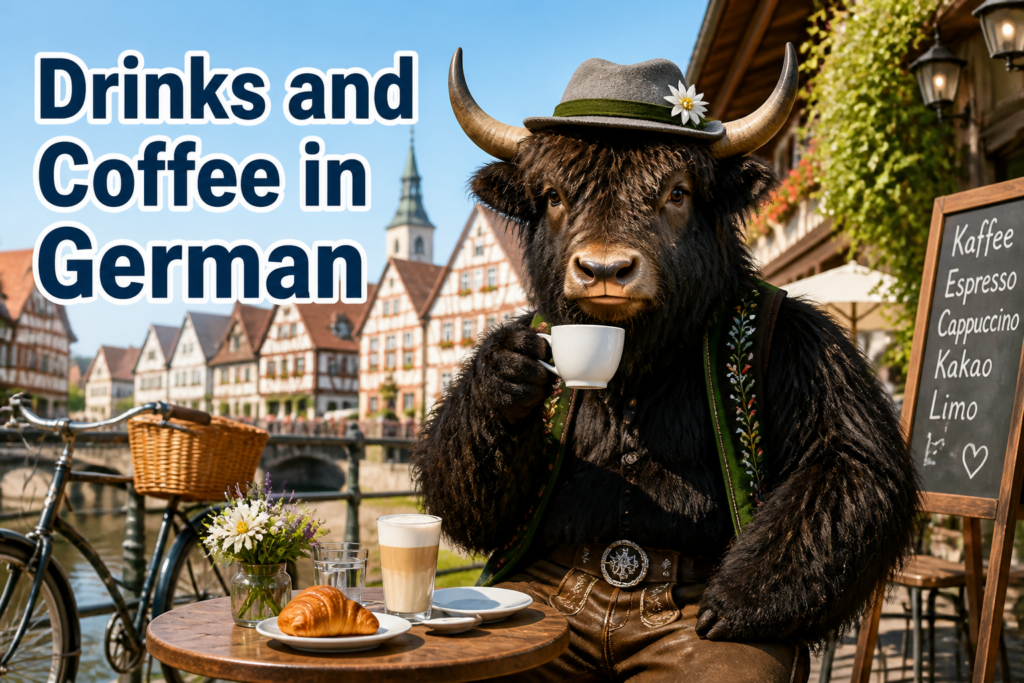
If you can order coffee in German, you are already doing one of the most useful things in the language. Honestly, people have survived worse situations with less vocabulary.
This guide gives you practical German for drinks and coffee: how to ask for a drink, order at a café, understand the menu, and avoid the classic learner moment of pointing at the counter like a lost tourist raccoon. The language here is mostly standard German used in Germany, with a few notes where Austria or Switzerland do things differently.
For more food-related German, you can also check the broader guide on German Food & Cuisine. And yes, drinks count as food-adjacent in the grand universe of useful vocabulary.
Yak tip: In German cafés, the sentence is often short, polite, and efficient. No need to deliver a theatrical monologue just to get a cappuccino.
Useful Drinks Vocabulary
Here are the most common drink words you’ll actually use in real life. The pronunciation help is simple and beginner-friendly, not a tiny phonetics seminar in a café apron.
| German | Pronunciation | Meaning | Example Sentence | Translation | Learner Note |
|---|---|---|---|---|---|
| das Wasser | VAH-ser | water | Ich möchte ein Wasser, bitte. | I’d like a water, please. | Very common. In cafés, “ein Wasser” often means one bottle or one glass, depending on context. |
| das stille Wasser | SHTIL-uh VAH-ser | still water | Haben Sie stilles Wasser? | Do you have still water? | “Stilles Wasser” means no bubbles. |
| das Sprudelwasser | SHPROO-del-VAH-ser | sparkling water | Ich trinke lieber Sprudelwasser. | I prefer sparkling water. | German people often drink sparkling water by default. The bubbles are very committed. |
| der Kaffee | KAH-fay | coffee | Ich trinke morgens Kaffee. | I drink coffee in the morning. | Common and useful. Plural is rare in everyday use. |
| der Tee | tay | tea | Ich nehme einen Tee. | I’ll have a tea. | Simple and polite. You can name the type: grüner Tee, schwarzer Tee. |
| die Milch | milkh | milk | Mit Milch, bitte. | With milk, please. | Use with coffee or tea. “Milch” is feminine. |
| der Saft | zaft | juice | Ich hätte gern einen Orangensaft. | I’d like an orange juice. | “Saft” can also mean “juice” in a broader sense, like apple juice. |
| die Limonade | lee-mo-NAH-deh | lemonade / soft drink | Für die Kinder gibt es Limonade. | There is lemonade for the children. | In Germany, “Limonade” can mean a sweet fizzy drink, not always plain lemon juice. |
| das Bier | beer | beer | Ein Bier, bitte. | A beer, please. | Very common in bars, beer gardens, and restaurants. |
| der Wein | vine | wine | Er trinkt gern Wein. | He likes drinking wine. | Good to know in restaurants. White = Weißwein, red = Rotwein. |
| die Schorle | SHOR-luh | spritzed drink, usually juice + sparkling water | Ich nehme eine Apfelschorle. | I’ll have an apple spritzer. | Very German. “Apfelschorle” is one of the safest, most useful drink words to know. |
| der Kakao | ka-KAO | hot chocolate / cocoa | Die Kinder trinken Kakao. | The children drink hot chocolate. | Can mean the drink or cocoa powder depending on context. |
Ordering Coffee In German
Coffee culture in German-speaking places is strong, but the wording is usually straightforward. You do not need fancy language unless you want to sound extra polished. Even then, German cafés appreciate clarity more than drama.
| German | Pronunciation | Meaning | Example Sentence | Translation | Learner Note |
|---|---|---|---|---|---|
| einen Kaffee, bitte | EYE-nen KAH-fay, BIT-teh | one coffee, please | Einen Kaffee, bitte. | One coffee, please. | Short and natural. If you want to be slightly more formal, add “ich hätte gern”. |
| Ich hätte gern einen Kaffee. | ikh HET-teh gern EYE-nen KAH-fay | I’d like a coffee. | Ich hätte gern einen Kaffee. | I’d like a coffee. | Polite and very common. “Hätte gern” is a safe ordering phrase. |
| Ich nehme einen Cappuccino. | ikh NAY-meh EYE-nen kap-poo-CHEE-noh | I’ll have a cappuccino. | Ich nehme einen Cappuccino. | I’ll have a cappuccino. | “Ich nehme …” is casual and natural when ordering. |
| einen Espresso | EYE-nen es-PRES-so | an espresso | Für mich einen Espresso, bitte. | An espresso for me, please. | “Für mich” is fine in spoken German at a café. |
| einen Latte Macchiato | EYE-nen LAH-teh mak-YAH-toh | a latte macchiato | Sie möchte einen Latte Macchiato. | She wants a latte macchiato. | Loanword, but the article still matters: einen. |
| mit Milch | mit milkh | with milk | Ich trinke den Kaffee mit Milch. | I drink the coffee with milk. | “Mit” takes the dative in German, but beginners can use it as a fixed phrase for now. |
| ohne Zucker | OH-nuh TSOOK-er | without sugar | Bitte den Tee ohne Zucker. | Please the tea without sugar. | “Ohne” is easy and very useful for café phrases. |
| mit Zucker | mit TSOOK-er | with sugar | Ich nehme den Kaffee mit Zucker. | I’ll take the coffee with sugar. | Simple contrast with “ohne Zucker.” |
| zum Mitnehmen | tsoom MIT-nay-men | to go | Den Kaffee bitte zum Mitnehmen. | The coffee to go, please. | Very common in cafés. Literally “for taking along.” |
| hier | heer | here / for here | Ich trinke den Kaffee hier. | I’ll drink the coffee here. | If needed, “hier” can signal you want to stay and drink it there. |
| noch einen Kaffee | nokh EYE-nen KAH-fay | another coffee | Ich hätte gern noch einen Kaffee. | I’d like another coffee. | Very natural when you are not ready to give up on caffeine. Sensible. |
| die Rechnung, bitte | dee REKH-noong, BIT-teh | the bill, please | Die Rechnung, bitte. | The bill, please. | Useful after drinks at a café or bar. “Rechnung” is feminine. |
Everyday Café Phrases
These are the phrases that make you sound like a real human ordering a drink instead of reading a phrasebook from 2009.
| German | Pronunciation | Meaning | Example Sentence | Translation | Learner Note |
|---|---|---|---|---|---|
| Was möchten Sie trinken? | vahs MÖKHT-en zee TRINK-en | What would you like to drink? | Was möchten Sie trinken? | What would you like to drink? | Formal “you” = Sie. Common in cafés and restaurants. |
| Ich hätte gern ein Wasser. | ikh HET-teh gern ine VAH-ser | I’d like a water. | Ich hätte gern ein Wasser. | I’d like a water. | Very useful. “Ein Wasser” is often okay, but the exact form depends on the menu. |
| Haben Sie etwas ohne Koffein? | HAH-ben zee ET-vahs OH-nuh kof-FAYN | Do you have anything without caffeine? | Haben Sie etwas ohne Koffein? | Do you have anything without caffeine? | Good if you want decaf tea or coffee. “Etwas” = something. |
| Ist der Kaffee stark? | ist der KAH-fay shtark | Is the coffee strong? | Ist der Kaffee stark? | Is the coffee strong? | Useful if you care about strength, which many people do, especially before speaking German. |
| Kann ich bitte noch Wasser haben? | kan ikh BIT-teh nokh VAH-ser HAH-ben | Can I please have more water? | Kann ich bitte noch Wasser haben? | Can I please have more water? | Polite and natural. “Noch” here means more / another. |
| Ist das mit Milch? | ist das mit milkh | Is that with milk? | Ist das mit Milch? | Is that with milk? | Handy for checking a drink you forgot to ask about. |
| Ohne Eis, bitte. | OH-nuh ICE, BIT-teh | Without ice, please. | Ohne Eis, bitte. | Without ice, please. | Ice is not as huge in German drinks as in some English-speaking countries. |
| Kann ich mit Karte zahlen? | kan ikh mit KAR-teh TSEH-len | Can I pay by card? | Kann ich mit Karte zahlen? | Can I pay by card? | Very practical. In Germany, card payment is not always automatic, so this matters. |
| Stimmt so. | shtimt zoh | keep the change / that’s fine | Stimmt so. | Keep the change. | Often used when tipping after a café visit. |
| Alles klar. | AH-les klahr | okay / all clear | Alles klar, danke. | Okay, thanks. | Very common in spoken German. Friendly and casual. |
Grammar That Helps At The Café
German drink orders are a great place to practice article forms. The good news: you do not need to become a grammar wizard. You just need the right little endings in the right place.
| Pattern | Meaning | German Example | English Translation | Learner Note |
|---|---|---|---|---|
| Ich hätte gern + accusative | I’d like + thing | Ich hätte gern einen Tee. | I’d like a tea. | After “hätte gern,” the thing ordered usually takes the accusative. That is why it is einen Tee, not ein Tee. |
| Ich nehme + accusative | I’ll take + thing | Ich nehme eine Apfelschorle. | I’ll take an apple spritzer. | Very common and simple for orders. |
| mit + dative | with + dative | mit Milch | with milk | In a phrase, the form often just feels fixed. Still, “mit” always takes the dative. |
| ohne + accusative | without + accusative | ohne Zucker | without sugar | Easy contrast with mit. |
| zum Mitnehmen | to go | Der Kaffee ist zum Mitnehmen. | The coffee is to go. | “Zum” = “zu dem.” This phrase is fixed and very common. |
| der / die / das | article gender | der Kaffee, die Milch, das Wasser | the coffee, the milk, the water | Drink nouns vary in gender, so it helps to learn the article with the noun from the start. |
A Quick Article Reminder
German nouns are capitalized, which is helpful because it lets you see the nouns immediately. The downside is that the article still matters, and German is not exactly famous for making things easy for no reason.
| Word | Gender | Plural | Example |
|---|---|---|---|
| der Kaffee | masculine | die Kaffees / rare in practice | Der Kaffee ist heiß. |
| die Milch | feminine | die Milch | Die Milch ist kalt. |
| das Wasser | neuter | die Wasser / usually “Wasser” as a mass noun | Das Wasser ist still. |
| der Tee | masculine | die Tees | Der Tee ist warm. |
| die Limonade | feminine | die Limonaden | Die Limonade ist süß. |
If you want to look up official word usage, Duden is a solid boring source. Boring is good here. Boring is what dictionaries are for.
Different Coffee Drinks In German
Menus often list coffee drinks by their German name or by the international café term. This section helps you decode both without needing a secret handshake.
| German | Pronunciation | Meaning | Example Sentence | Translation | Learner Note |
|---|---|---|---|---|---|
| der Filterkaffee | FIL-ter-KAH-fay | filter coffee / drip coffee | Ich trinke lieber Filterkaffee. | I prefer filter coffee. | Very normal in Germany, especially at home or in older cafés. |
| der Milchkaffee | MILKH-KAH-fay | coffee with a lot of milk | Ein Milchkaffee, bitte. | A café au lait, please. | Useful if you want something milky but not a giant milk bomb. |
| der Cappuccino | kap-poo-CHEE-noh | cappuccino | Der Cappuccino schmeckt gut. | The cappuccino tastes good. | Common in Germany and Austria. Same word, no drama. |
| der Latte Macchiato | LAH-teh mak-YAH-toh | layered milk coffee drink | Sie bestellt einen Latte Macchiato. | She orders a latte macchiato. | Usually served in a tall glass. |
| der Espresso | es-PRES-so | espresso | Nach dem Essen trinke ich einen Espresso. | After the meal I drink an espresso. | Common after meals in cafés and restaurants. |
| der Verlängerte (Austria) | fer-LENG-er-teh | espresso with hot water | In Wien trinkt man oft einen Verlängerten. | In Vienna, people often drink a Verlängerter. | Mostly Austrian. In Germany, the term is less common. |
| der Kaffee Crema | KAH-fay KREH-mah | long coffee from an espresso machine | Ich nehme einen Kaffee Crema. | I’ll have a coffee crema. | Very common in Germany. If you see “Café Crema,” this is usually what it means. |
| der Entkoffeinierte | ent-kof-fay-NEER-teh | decaf coffee | Haben Sie einen Entkoffeinierten? | Do you have a decaf? | A useful word, and yes, it is a mouthful. German likes efficiency and long words. |
Tea And Other Non-Coffee Drinks
Even if coffee is the star of the show, you still need words for tea, juice, and the usual menu suspects. Life is not all caffeine and noble suffering.
| German | Pronunciation | Meaning | Example Sentence | Translation | Learner Note |
|---|---|---|---|---|---|
| der Schwarztee | SHVARTS-tay | black tea | Ich trinke morgens Schwarztee. | I drink black tea in the morning. | Compound noun: black + tea. |
| der Grüntee | GREWN-tay | green tea | Haben Sie Grüntee? | Do you have green tea? | Sometimes menus write grüner Tee instead. |
| der Kräutertee | KROI-ter-tay | herbal tea | Ich trinke abends Kräutertee. | I drink herbal tea in the evening. | Useful in cafés and at home. |
| die heiße Schokolade | HYE-suh sho-ko-LAH-duh | hot chocolate | Für mich eine heiße Schokolade. | For me, a hot chocolate. | Often a children’s favorite, but adults are allowed to enjoy joy too. |
| der Apfelsaft | AP-fel-zaft | apple juice | Die Kinder trinken Apfelsaft. | The children drink apple juice. | Very common. “Apfel” + “Saft.” |
| der Orangensaft | oh-RAHN-gen-zaft | orange juice | Ich hätte gern Orangensaft. | I’d like orange juice. | Often served at breakfast. |
| die Cola | KOH-lah | cola | Eine Cola, bitte. | A cola, please. | Loanword, very common in casual speech. |
| die Apfelschorle | AP-fel-SHOR-luh | apple juice mixed with sparkling water | Eine Apfelschorle ist sehr beliebt. | An apple spritzer is very popular. | Arguably one of Germany’s most useful drink words. It appears everywhere. |
Useful Differences: Germany, Austria, And Switzerland
Most drink words are shared, but a few regional differences are worth knowing so your German does not suddenly wear a local costume without warning.
| Situation | Germany | Austria | Switzerland | Note |
|---|---|---|---|---|
| Sparkling water | Sprudelwasser / Wasser mit Sprudel | Sodawasser often appears too | Mineralwasser is very common | Different regions prefer different menu labels. |
| Espresso with water | sometimes Kaffee Americano | Verlängerter | Schale / Kaffee crème may appear depending on region | Menu language can change fast across borders. |
| Butter bread breakfast drink pairs | Kaffee, Tee, Saft | Kaffee, Tee, Orangensaft | Kaffee, Ovo, Schoggi drinks are more visible in some places | “Ovo” and “Schoggi” are more Swiss-flavored in many contexts. |
| Tap water | Leitungswasser is asked for, but not always free | Leitungswasser may be less standard in cafés | Tap water may be less automatic in restaurants | Always ask politely. Café customs vary. |
If you like this practical style, the main site hub at Learn German has more lessons in the same no-nonsense spirit. Because apparently language learning is more fun when it actually helps at a counter.
Small Pronunciation Tips That Matter
German drink words are often kind to learners, but a few sounds deserve a quick check.
- ch in ich is a soft sound, not a hard English k.
- ei in Milchkaffee is not the same as ee; in ein it sounds like “eye.”
- ö in höch or möchte needs rounded lips. Yes, your mouth gets a tiny workout.
- r is often softer than English r, especially in standard German speech.
- z sounds like ts, so Zucker starts like “TSOOK-er.”
- st at the start of a word often sounds like sht, as in stimmt.
Real-Life Mini Dialogues
Short dialogues are perfect for memorizing the rhythm of a café order. They also stop you from translating every sentence one word at a time like a suspicious robot.
| German | Pronunciation | Meaning | Example Sentence | Translation | Learner Note |
|---|---|---|---|---|---|
| — Was möchten Sie trinken? — Ich hätte gern einen Kaffee, bitte. | vahs MÖKHT-en zee TRINK-en? ikh HET-teh gern EYE-nen KAH-fay, BIT-teh | — What would you like to drink? — I’d like a coffee, please. | — Was möchten Sie trinken? — Ich hätte gern einen Kaffee, bitte. | — What would you like to drink? — I’d like a coffee, please. | Formal and safe. Use it in cafés, hotels, and restaurants. |
| — Mit Milch oder ohne? — Mit Milch, bitte. | mit milkh OH-der OH-nuh? mit milkh, BIT-teh | — With milk or without? — With milk, please. | — Mit Milch oder ohne? — Mit Milch, bitte. | — With milk or without? — With milk, please. | Very natural question. “Oder” = or. |
| — Zum Mitnehmen? — Nein, hier. | tsoom MIT-nay-men? nine, heer | — To go? — No, here. | — Zum Mitnehmen? — Nein, hier. | — To go? — No, here. | Extremely common in cafés. |
| — Noch etwas? — Nein, danke. Die Rechnung, bitte. | nokh ET-vahs? nine, DANG-kuh. dee REKH-noong, BIT-teh | — Anything else? — No, thanks. The bill, please. | — Noch etwas? — Nein, danke. Die Rechnung, bitte. | — Anything else? — No, thanks. The bill, please. | Good for restaurants and cafés. |
Common Mistakes And Easy Fixes
| Common Mistake | Better Version | Why |
|---|---|---|
| Ich möchte ein Kaffee. | Ich möchte einen Kaffee. | Kaffee is masculine, so the accusative article is einen. |
| Ich hätte gern ein Tee. | Ich hätte gern einen Tee. | Tee is masculine too. |
| Ich trinke Wasser mit. | Ich trinke Wasser mit Milch. | “Mit” needs something after it. |
| Ich nehme Kaffee to go. | Ich nehme Kaffee zum Mitnehmen. | “To go” is usually expressed as zum Mitnehmen in German. |
| Die Kaffee ist gut. | Der Kaffee ist gut. | Wrong article. Kaffee is masculine. |
| Ich möchte einen Wasser. | Ich möchte ein Wasser. | Wasser is neuter, so the article is ein. |
| Haben Sie Kaffee ohne Zucker? | Haben Sie Kaffee ohne Zucker? | Actually this one is fine. German occasionally does not sabotage you completely. |
Quick Practice
Try these quick drills. They are short on purpose. German likes repetition, but your attention span is not a renewable energy source.
- Say “I’d like a coffee, please” in German.
- Say “A sparkling water, please” in German.
- Say “With milk, please” in German.
- Say “Without sugar” in German.
- Say “The bill, please” in German.
- Change this sentence to use tee instead of kaffee: Ich hätte gern einen Kaffee.
- Change this sentence to use ohne Milch: Ich trinke den Kaffee mit Milch.
- Translate: Ich nehme eine Apfelschorle.
Answers: Ich hätte gern einen Kaffee, bitte. / Ein Sprudelwasser, bitte. / Mit Milch, bitte. / Ohne Zucker. / Die Rechnung, bitte. / Ich hätte gern einen Tee. / Ich trinke den Kaffee ohne Milch. / I’ll have an apple spritzer.
Extra Note: “Wasser” In Real Cafés
In Germany, asking for Leitungswasser means tap water. Some cafés will give it, some will not, and some will ask for a small fee. The safest phrase is: Kann ich bitte Leitungswasser haben?
Quick Reference Summary
- Ich hätte gern … = I’d like …
- Ich nehme … = I’ll take …
- mit = with
- ohne = without
- zum Mitnehmen = to go
- die Rechnung, bitte = the bill, please
- Apfelschorle = apple spritzer
- Sprudelwasser = sparkling water
- stilles Wasser = still water
- Kaffee = coffee
- Tee = tea
Yak Takeaway
For drinks and coffee in German, keep the orders short, learn the article with the noun, and remember Ich hätte gern … for polite requests. With that, you can survive cafés, menus, and the deeply serious business of choosing between Kaffee and Apfelschorle. Not bad for a language lesson with caffeine attached.