


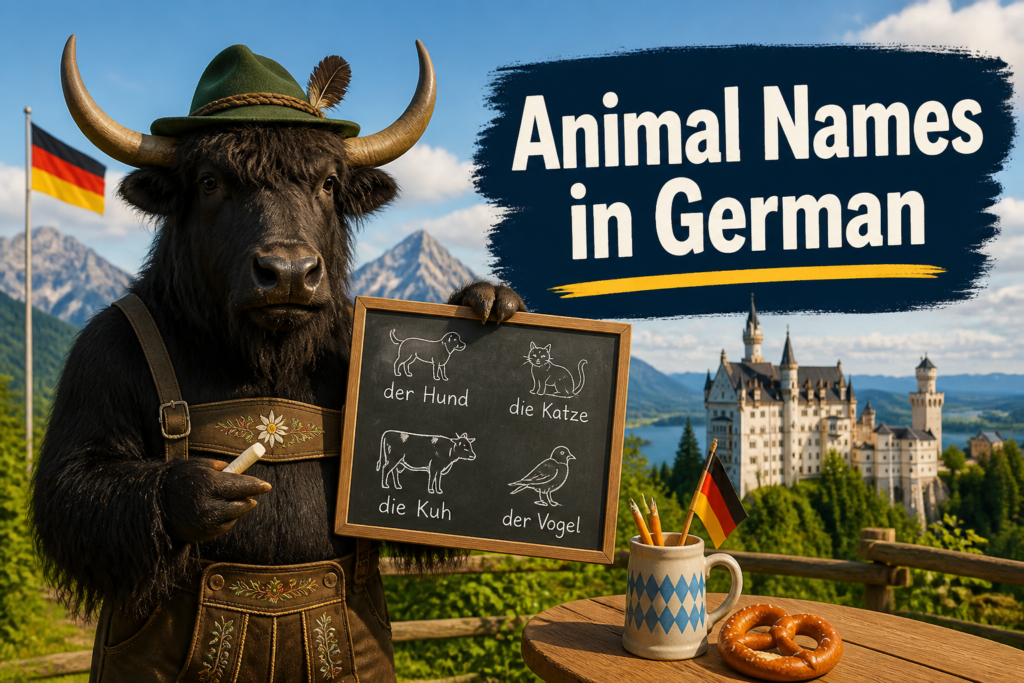
If you know a few animal names in German, suddenly the language gets a lot friendlier. You can talk about pets, wildlife, zoo visits, childhood stories, and the occasional neighbor’s very loud dog. Basically, useful stuff.
German animal words are also a nice way to practice noun gender, plural forms, and pronunciation without feeling like you’ve accidentally wandered into a grammar warehouse.
One tiny but important note: German capitalizes all nouns, so der Hund, die Katze, and das Pferd all get a capital letter. The language is polite like that, even when the cat is not.
For a quick general reference on German vocabulary and spelling, Duden is the boring-but-useful friend you want around.
Core Animal Names You’ll Actually Use
Below are the most useful animal names first. Pronunciation is written in simple English-style help, so you do not need to panic and invent your own sound system.
| German | Pronunciation | Meaning | Example Sentence | Translation | Learner Note |
|---|---|---|---|---|---|
| der Hund | hoont | dog | Der Hund schläft auf dem Sofa. | The dog is sleeping on the sofa. | Masculine. Very common word; final d sounds a bit like t. |
| die Katze | KAT-tsuh | cat | Die Katze sitzt am Fenster. | The cat is sitting at the window. | Feminine. tz sounds like a sharp ts. |
| das Pferd | fehrt | horse | Das Pferd läuft sehr schnell. | The horse runs very fast. | Neuter. The pf sound can be tricky at first. |
| die Kuh | kooh | cow | Die Kuh steht auf der Wiese. | The cow is standing on the meadow. | Feminine. Long u sound. |
| das Schwein | shvine | pig | Das Schwein frisst gern. | The pig likes to eat. | Neuter. sch = sh, ei = eye. |
| die Maus | mouse | mouse | Die Maus versteckt sich hinter dem Schrank. | The mouse is hiding behind the cupboard. | Feminine. Plural is die Mäuse. |
Notice the article pattern: der, die, das. German loves to make you learn the noun and the article together, like an annoying but helpful duo.
More Common Animal Names
| German | Pronunciation | Meaning | Example Sentence | Translation | Learner Note |
|---|---|---|---|---|---|
| der Vogel | FOH-guhl | bird | Der Vogel singt früh am Morgen. | The bird sings early in the morning. | Masculine. Useful general word for bird. |
| der Fisch | fish | fish | Der Fisch schwimmt im Wasser. | The fish swims in the water. | Masculine. Final sch sounds like sh. |
| der Hase | HAH-zuh | rabbit / hare | Der Hase läuft über das Feld. | The hare runs across the field. | Masculine. Often means hare; in everyday speech it can overlap with rabbit in some contexts. |
| das Kaninchen | kah-NEEN-khen | rabbit | Das Kaninchen frisst Karotten. | The rabbit eats carrots. | Neuter. More specific than der Hase. |
| der Vogel | FOH-guhl | bird | Ein Vogel sitzt auf dem Dach. | A bird is sitting on the roof. | Very useful general word; see bird names for more specific species. |
| der Bär | bair | bear | Der Bär lebt im Wald. | The bear lives in the forest. | Masculine. Long ä sounds like “air.” |
| der Wolf | volf | wolf | Der Wolf heult in der Nacht. | The wolf howls at night. | Masculine. Final f in pronunciation. |
| die Eule | OY-luh | owl | Die Eule sitzt still im Baum. | The owl sits still in the tree. | Feminine. eu sounds like oy. |
| der Fuchs | fooks | fox | Der Fuchs ist sehr schlau. | The fox is very clever. | Masculine. The ch sound is light and rough. |
| das Reh | ray | roe deer | Das Reh läuft vorsichtig durch den Wald. | The roe deer moves carefully through the forest. | Neuter. Good for nature descriptions. |
| der Elch | elkh | moose | Der Elch steht nahe am Fluss. | The moose is standing near the river. | Masculine. The final sound is not a hard English k. |
| die Giraffe | gih-RAH-fuh | giraffe | Die Giraffe hat einen langen Hals. | The giraffe has a long neck. | Feminine. Easy cognate, but remember the article. |
Some animal names are easy because they look like English. That’s the nice part. The less nice part is that German still wants its article, case, and spelling choices, because apparently peace was never the goal.
Pets, Farm Animals, And Zoo Favorites
These are the words you are most likely to need in real life: at home, at the zoo, or when somebody says, “No, really, this town has a very good pet store.”
| German | Pronunciation | Meaning | Example Sentence | Translation | Learner Note |
|---|---|---|---|---|---|
| der Hamster | HAM-stuhr | hamster | Mein kleiner Hamster schläft tagsüber. | My little hamster sleeps during the day. | Masculine. Common pet word. |
| das Meerschweinchen | MAIR-shvine-khen | guinea pig | Das Meerschweinchen frisst Salat. | The guinea pig eats lettuce. | Neuter. Long compound word; break it into Meer + Schweinchen even though the meaning is historical, not literal. |
| die Schildkröte | shilt-KRUR-tuh | turtle / tortoise | Die Schildkröte bewegt sich langsam. | The turtle moves slowly. | Feminine. ö is rounded, like “er” with lips forward. |
| das Schaf | shahf | sheep | Das Schaf steht auf der Weide. | The sheep is standing in the pasture. | Neuter. Plural is die Schafe. |
| das Huhn | hoon | chicken | Das Huhn legt ein Ei. | The hen lays an egg. | Neuter. Useful on farms and in food vocabulary. |
| die Ente | EN-tuh | duck | Die Ente schwimmt im Teich. | The duck is swimming in the pond. | Feminine. Very common and easy. |
| die Ziege | TSY-guh | goat | Die Ziege frisst Gras. | The goat eats grass. | Feminine. z sounds like ts. |
| das Schwein | shvine | pig | Das Schwein lebt auf dem Bauernhof. | The pig lives on the farm. | Neuter. Also appears in some idioms and expressions. |
Wild Animals And Nature Vocabulary
These words are useful for travel, documentaries, children’s books, and any conversation that suddenly turns into “Have you seen a fox in real life?”
| German | Pronunciation | Meaning | Example Sentence | Translation | Learner Note |
|---|---|---|---|---|---|
| der Löwe | LUR-vuh | lion | Der Löwe schläft in der Sonne. | The lion is sleeping in the sun. | Masculine. ö is rounded, not like English “law.” |
| der Tiger | TEE-gur | tiger | Der Tiger läuft durch das Gras. | The tiger walks through the grass. | Masculine. Very close to English. |
| der Elefant | eh-leh-FAHNT | elephant | Der Elefant hat große Ohren. | The elephant has big ears. | Masculine. Stress is on the last syllable. |
| das Nilpferd | NEEL-pfehrt | hippopotamus | Das Nilpferd steht im Wasser. | The hippo is standing in the water. | Neuter. Literally “Nile horse.” German loves a compound noun. |
| das Känguru | KEN-guh-roo | kangaroo | Das Känguru springt weit. | The kangaroo jumps far. | Neuter. Borrowed word with German spelling. |
| die Schlange | SHLAN-guh | snake | Die Schlange schlängelt sich durch das Gras. | The snake slithers through the grass. | Feminine. Nice example of a word family with schl. |
| das Krokodil | kroh-koh-DEEL | crocodile | Das Krokodil liegt am Ufer. | The crocodile is lying on the bank. | Neuter. Stress on the last syllable. |
| der Affe | AH-fuh | monkey / ape | Der Affe klettert auf den Baum. | The monkey climbs the tree. | Masculine. Common zoo word. |
| das Wildschwein | vilt-shvine | wild boar | Das Wildschwein läuft schnell davon. | The wild boar runs off quickly. | Neuter. Helpful in forest and hunting contexts. |
| der Hirsch | hirsH | deer / stag | Der Hirsch steht im Wald. | The deer is standing in the forest. | Masculine. The final sch is like a soft hiss. |
If you want to check more specific bird vocabulary later, the guide at Bird Names in German is the natural next stop. Same goes for Fish Names in German if the conversation has somehow become aquatic.
Animal Sounds In German
Animal names are useful, but animal sounds are where things get delightfully weird. German animal sounds often do not match English sound effects at all. Of course they don’t. That would be too easy.
| Animal | German Sound | Pronunciation | Meaning | Example Sentence | Translation |
|---|---|---|---|---|---|
| dog | Wau wau | wow wow | dog barking | Der Hund macht Wau wau. | The dog goes woof woof. |
| cat | Miau | mee-ow | cat meowing | Die Katze macht Miau. | The cat goes meow. |
| cow | Muh | moo | cow mooing | Die Kuh macht Muh. | The cow goes moo. |
| pig | Oink / Grunz | oink / groonts | pig sound | Das Schwein macht Grunz. | The pig grunts. |
| duck | Quak | kvahk | duck quacking | Die Ente macht Quak. | The duck goes quack. |
| bird | Piep | peep | bird chirping | Der Vogel macht Piep. | The bird goes peep. |
Learner note: in everyday speech, people also use verbs like bellen for dogs barking, miauen for cats meowing, and grunzen for pigs grunting. Those are handy when you want a sentence that sounds natural instead of like a children’s book audition.
Pronunciation Notes That Save You From Small Regret
German animal names give you a low-stakes way to practice some classic sounds.
- ch in Fuchs, Nachbar, and Schildkröte is usually a soft, airy sound, not a hard k.
- sch sounds like English sh, as in Schwein and Schlange.
- z sounds like ts, as in Ziege.
- ei sounds like eye, as in Schwein.
- eu and äu sound like oy, as in Eule.
- ä is often a fronted “eh” sound, like in Bär.
- Final consonants are often devoiced, so the end of Hund sounds closer to t than to voiced English d.
That last point matters more than it looks. If you say Hund with a very clear English d, Germans will still understand you, but the word may sound a bit off. German is not dramatic about it. Just mildly judgmental.
Yak wisdom: German pronunciation gets easier when you stop trying to force English into it. Let the words be German. They’re doing their best.
Useful Phrases With Animal Names
Here are practical phrases you can use in real conversations, at the zoo, in a pet store, or while making small talk with someone who really, really loves their dog.
| German | Pronunciation | Meaning | Example Sentence | Translation | Learner Note |
|---|---|---|---|---|---|
| Ich habe einen Hund. | ikh HAH-buh EYE-nen hoont | I have a dog. | Ich habe einen Hund und zwei Katzen. | I have a dog and two cats. | einen is accusative masculine because Hund is the direct object. |
| Wir haben eine Katze. | veer HAH-ben EYE-nuh KAT-tsuh | We have a cat. | Wir haben eine Katze zu Hause. | We have a cat at home. | eine matches feminine Katze. |
| Das ist mein Lieblingstier. | dass ist mine LEEP-lings-teer | That is my favorite animal. | Das ist mein Lieblingstier, weil es so ruhig ist. | That is my favorite animal because it is so calm. | Tier means animal; Liebling means favorite/dear one. |
| Welches Tier magst du? | VEL-khes teer mahlkst doo | Which animal do you like? | Welches Tier magst du am liebsten? | Which animal do you like best? | Informal du version. |
| Ich mag Katzen. | ikh mahk KAT-tsen | I like cats. | Ich mag Katzen, aber ich habe keine. | I like cats, but I don’t have any. | Plural noun. Notice keine for negation. |
| Der Hund ist freundlich. | hoont isst FROYND-likh | The dog is friendly. | Der Hund ist sehr freundlich. | The dog is very friendly. | freundlich is a common adjective for pets and people. |
| Die Katze ist scheu. | shey-uh | The cat is shy. | Die Katze ist scheu, wenn Besucher kommen. | The cat is shy when visitors come. | scheu means shy/skittish. |
| Das Tier ist wild. | dass teer isst vilt | The animal is wild. | Das Tier lebt in freier Natur. | The animal lives in the wild. | Tier is a very broad word for animal. |
| Im Zoo gibt es viele Tiere. | im tsoh giibt ess FEE-luh TEE-ruh | There are many animals in the zoo. | Im Zoo gibt es viele Tiere zu sehen. | There are many animals to see in the zoo. | Tiere is the plural of Tier. |
| Das Pferd läuft schnell. | feyrt lyoft shnell | The horse runs fast. | Das Pferd läuft schnell über die Wiese. | The horse runs quickly across the meadow. | läuft is from laufen, to run/walk. |
| Die Kuh macht Milch. | kooh makht milkh | The cow makes milk. | Die Kuh gibt Milch. | The cow gives milk. | More natural: Die Kuh gibt Milch. |
| Der Vogel singt schön. | foh-guhl zingt shurn | The bird sings nicely. | Der Vogel singt am Morgen schön. | The bird sings nicely in the morning. | schön means beautiful/nice/well, depending on context. |
If you want a short, authoritative overview of German vocabulary building, the Goethe-Institut has plenty of plain, practical material worth browsing when you’re ready for more.
German Plurals For Animal Words
Plurals are where German likes to keep things interesting. Some animal names add -e, some add -en, some add -s, and some change the vowel with an umlaut. Because why should one pattern be enough?
| Singular | Plural | Meaning | Example | Translation | Learner Note |
|---|---|---|---|---|---|
| der Hund | die Hunde | dog / dogs | Die Hunde laufen im Park. | The dogs are running in the park. | Common -e plural. |
| die Katze | die Katzen | cat / cats | Die Katzen schlafen auf dem Sofa. | The cats are sleeping on the sofa. | -en plural, very common for feminine nouns. |
| das Pferd | die Pferde | horse / horses | Die Pferde laufen über die Wiese. | The horses run across the meadow. | -e plural. |
| die Maus | die Mäuse | mouse / mice | Die Mäuse sind klein. | The mice are small. | Umlaut plural. Very useful pattern. |
| der Vogel | die Vögel | bird / birds | Die Vögel singen am Morgen. | The birds sing in the morning. | Umlaut plural plus -el. |
| das Schwein | die Schweine | pig / pigs | Die Schweine sind laut. | The pigs are loud. | -e plural. |
| das Tier | die Tiere | animal / animals | Die Tiere schlafen nachts. | The animals sleep at night. | Important broad noun: animal. |
| das Kaninchen | die Kaninchen | rabbit / rabbits | Die Kaninchen fressen Möhren. | The rabbits eat carrots. | Some neuter nouns do not change in the plural. |
Common Mistakes And Easy Fixes
Here are the mistakes English-speaking learners make most often, usually because English has spoiled everyone by being irregular in a different way.
- Wrong: Hund ist freundlich.
Right: Der Hund ist freundlich.
Why: German nouns usually need an article. - Wrong: Ich habe ein Hund.
Right: Ich habe einen Hund.
Why: Hund is masculine, and the direct object form is einen. - Wrong: Die Katzen ist schön.
Right: Die Katzen sind schön.
Why: Plural nouns need plural verbs. - Wrong: Das Katze
Right: Die Katze
Why: Katze is feminine, so the article is die. - Wrong: Ich mag keine Hund.
Right: Ich mag keine Hunde.
Why: After keine, plural nouns usually take the plural form. - Wrong: Das Tier sind wild.
Right: Das Tier ist wild.
Why: Singular Tier needs ist.
Need a more structured language refresher after this? The main German hub at Learn German keeps the next steps neat and not at all smug.
Quick Reference Summary
- Hund = dog
- Katze = cat
- Pferd = horse
- Kuh = cow
- Schwein = pig
- Maus = mouse
- Vogel = bird
- Fisch = fish
- Hase / Kaninchen = rabbit / hare
- Bär = bear
- Schlange = snake
- Löwe = lion
- Tier = animal
- Tiere = animals
When in doubt, learn the noun with its article: der Hund, die Katze, das Pferd. That tiny habit saves a lot of future headache and makes your German sound much more natural.
Yak takeaway: animal names in German are practical, memorable, and secretly excellent grammar practice. Learn the words, keep the article, and let the nouns do the heavy lifting while you enjoy not sounding like a confused field guide.