French Pronominal Verbs Explained
Learn how verbs like se laver, se lever, and s’habiller work in real French, without turning grammar into a personal enemy.
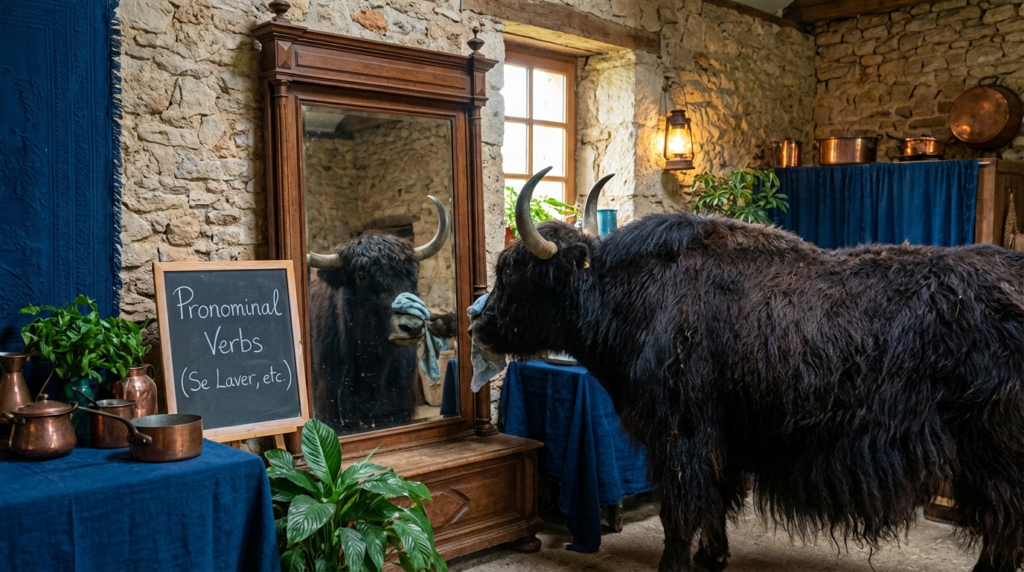
Pronominal verbs are one of those French topics that look dramatic at first and then turn out to be very manageable. They are verbs that come with a little reflexive pronoun like me, te, or se.
In plain English, they often mean someone is doing something to themselves, though not always. So yes, se laver is “to wash oneself,” but French also uses pronominal verbs for daily routines, feelings, and actions that English handles differently. Because of course it does.
The Yak Box: The Core Idea
A pronominal verb = reflexive pronoun + verb.
- je me lave = I wash myself
- tu te lèves = you get up
- elle s’habille = she gets dressed
- nous nous couchons = we go to bed
The pronoun changes with the subject. The verb still has to be conjugated normally. Tiny word, big job.
What Is A Pronominal Verb?
In French, the reflexive pronouns are:
| Subject | Reflexive Pronoun | Example | English Meaning |
|---|---|---|---|
| je | me | je me lave | I wash myself |
| tu | te | tu te couches | you go to bed |
| il / elle / on | se | elle se prépare | she gets ready |
| nous | nous | nous nous levons | we get up |
| vous | vous | vous vous reposez | you rest |
| ils / elles | se | ils se réveillent | they wake up |
Before a vowel or silent h, me, te, and se become m’, t’, and s’.
Je m’habille. = I get dressed.
Tu t’appelles comment ? = What is your name?
How To Build Them In The Present Tense
The formula is simple:
subject + reflexive pronoun + conjugated verb
Take se laver (“to wash oneself”):
| French | English Meaning | Example Sentence |
|---|---|---|
| je me lave | I wash myself | Je me lave avant le petit-déjeuner. = I wash myself before breakfast. |
| tu te laves | you wash yourself | Tu te laves les mains. = You wash your hands. |
| il se lave | he washes himself | Il se lave rapidement. = He washes himself quickly. |
| nous nous lavons | we wash ourselves | Nous nous lavons après le sport. = We wash ourselves after sports. |
| vous vous lavez | you wash yourself / yourselves | Vous vous lavez le visage. = You wash your face. |
| elles se lavent | they wash themselves | Elles se lavent avant de sortir. = They wash themselves before going out. |
Rule → Example
- Put the pronoun before the verb.
Je me couche à dix heures. = I go to bed at ten o’clock. - Conjugate the verb as usual.
Nous nous levons tôt. = We get up early. - Use contractions before vowels.
Elle s’habille vite. = She gets dressed quickly.
The Most Useful Pronominal Verbs
Se Laver
Meaning: to wash oneself
Je me lave le matin.
I wash myself in the morning.
Se Lever
Meaning: to get up
Nous nous levons à sept heures.
We get up at seven o’clock.
Se Réveiller
Meaning: to wake up
Elle se réveille très tôt.
She wakes up very early.
S’Habiller
Meaning: to get dressed
Tu t’habilles vite.
You get dressed quickly.
Se Coucher
Meaning: to go to bed
Je me couche tard le samedi.
I go to bed late on Saturday.
Se Reposer
Meaning: to rest
Vous vous reposez après le travail.
You rest after work.
More High-Utility Verbs
| French Verb | English Meaning | Example Sentence |
|---|---|---|
| se brosser les dents | to brush one’s teeth | Je me brosse les dents après le dîner. = I brush my teeth after dinner. |
| se préparer | to get ready | On se prépare pour la soirée. = We’re getting ready for the evening. |
| se dépêcher | to hurry | Dépêche-toi. = Hurry up. |
| s’asseoir | to sit down | Asseyez-vous. = Sit down. |
| se promener | to go for a walk | Ils se promènent dans le parc. = They are taking a walk in the park. |
| se sentir | to feel | Je me sens fatigué. = I feel tired. |
| se souvenir de | to remember | Tu te souviens de son nom ? = Do you remember his name? |
| se tromper | to make a mistake / be mistaken | Je me suis trompé de porte. = I went to the wrong door. |
A Very Common French Pattern: Body Parts
French often uses a pronominal verb plus a definite article for body parts. English says “my hands.” French often says the equivalent of “I wash myself the hands.” Elegant? Debatable. Normal? Absolutely.
| French | Natural English |
|---|---|
| Je me lave les mains. | I wash my hands. |
| Il se brosse les dents. | He brushes his teeth. |
| Elle se lave le visage. | She washes her face. |
| Nous nous cassons la tête. | We rack our brains. |
So when a body part appears, do not panic and add a possessive every time. French already knows whose teeth they are.
Useful Phrases You Can Actually Say
- Je me lève tôt en semaine. = I get up early on weekdays.
- Tu te couches à quelle heure ? = What time do you go to bed?
- Elle se maquille dans la salle de bain. = She puts on makeup in the bathroom.
- On se retrouve à huit heures. = Let’s meet at eight o’clock / We’ll meet at eight.
- Nous nous préparons pour le voyage. = We are getting ready for the trip.
- Vous vous reposez un peu ? = Are you resting a little?
- Ils se dépêchent pour le train. = They are hurrying for the train.
- Je me sens mieux aujourd’hui. = I feel better today.
- Tu te souviens de cette chanson ? = Do you remember that song?
- Elle se promène avec son chien. = She is walking with her dog.
- On s’appelle ce soir ? = Shall we call each other tonight?
- Je me trompe peut-être. = I may be mistaken.
Practice Section
Try these little drills before your brain wanders off.
Swap The Subject
- Je me lave → change it to nous
Nous nous lavons. - Tu te couches tôt → change it to elle
Elle se couche tôt. - Il se prépare → change it to vous
Vous vous préparez.
Translate Into French
- I get up at six.
Je me lève à six heures. - We remember the address.
Nous nous souvenons de l’adresse. - They are getting dressed.
Ils s’habillent.
Spot The Fix
- Je lave me. ❌
Je me lave. ✅ - Nous se levons. ❌
Nous nous levons. ✅ - Elle habille se vite. ❌
Elle s’habille vite. ✅
Common Mistakes And Fast Fixes
- Using the wrong pronoun.
Je se lève is wrong. Use je me lève. - Putting the pronoun after the verb.
Je lave me is wrong. Put it before the verb: je me lave. - Forgetting the contraction.
Use s’habiller, not se habiller. - Adding possessives with body parts every time.
Je me lave les mains is the natural French form. - Thinking every pronominal verb is literally reflexive.
Se souvenir de means “to remember,” not “to remember oneself.” French is being French again.
Quick Reference Summary
| Pattern | Meaning | Example 1 | Example 2 |
|---|---|---|---|
| me / te / se / nous / vous / se + verb | present tense pronominal verb structure | Je me repose. = I rest. | Ils se réveillent. = They wake up. |
| m’ / t’ / s’ + vowel sound | contraction | Je m’habille. = I get dressed. | Tu t’assois. = You sit down. |
| pronominal verb + body part | often uses le / la / les | Elle se lave les cheveux. = She washes her hair. | Je me brosse les dents. = I brush my teeth. |
| not always literally reflexive | some verbs have idiomatic meanings | Je me sens bien. = I feel good. | Tu te souviens ? = Do you remember? |
Mini FAQ On Pronominal Verbs
Do all pronominal verbs mean “oneself” in English?
No. Some do, like se laver. Others are just the natural French form, like se souvenir de for “to remember.”
Do I always need the reflexive pronoun?
Yes, when the verb is being used as a pronominal verb. Je lève la main means “I raise my hand,” but je me lève means “I get up.” Very different day.
Are these common in spoken French?
Extremely. Daily routine verbs love this pattern.
Final Yak
Pronominal verbs are not some terrifying secret grammar cult. They follow a very clear pattern: subject, reflexive pronoun, conjugated verb. Learn the common ones first, especially daily routine verbs like se lever, se laver, and s’habiller, and you will hear them everywhere.
Once that pattern feels normal, your French starts sounding much more natural. Which is nice, because “je lave me” was never going to win any beauty contests.