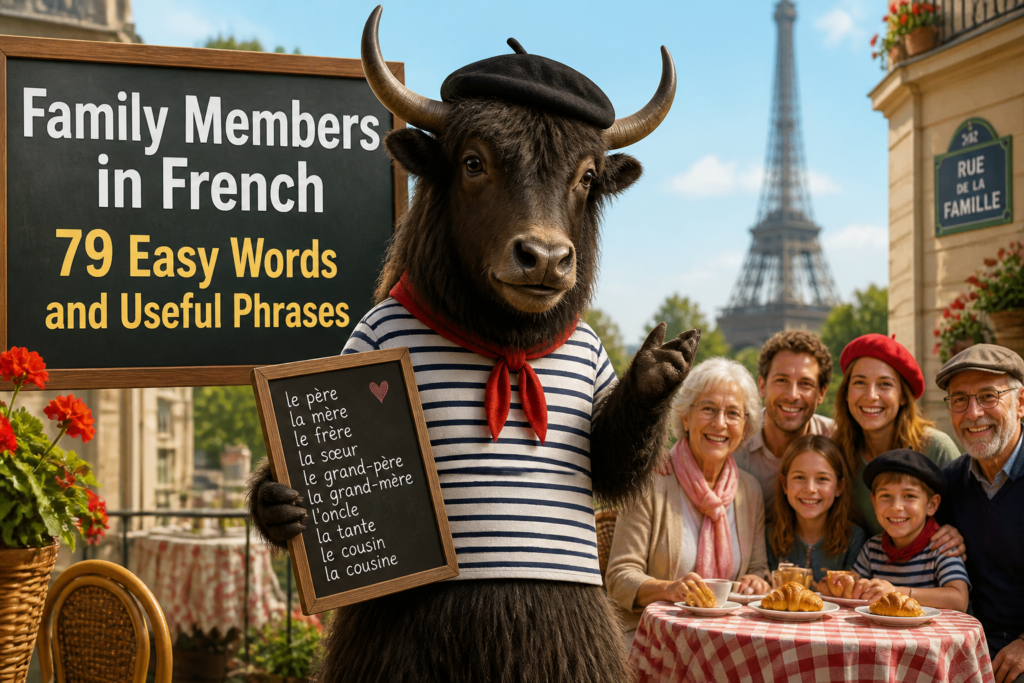
Talking about family is one of the first really useful things you learn in French. It comes up fast: introductions, small talk, holiday stories, emergency contact forms, awkward wedding speeches, and those lovely moments when someone asks if your cousin’s boyfriend is actually your husband. Language keeps life exciting.
In this guide, you’ll learn the most common family members in French, how to pronounce them, what they mean, and how to use them in natural sentences. We’ll keep it practical, clear, and very normal-human useful.
You’ll also get 15 everyday phrases, a few common mistakes to avoid, and a quick reminder that French family words often need articles and gender attention. Yes, the grammar is invited to dinner too.
If you want more beginner-friendly French guides, you can also explore Learn French.
How Family Words Work In French
French family vocabulary is pretty straightforward once you notice a few patterns:
- Many family words have masculine and feminine forms: un frère / une sœur.
- You often use a possessive adjective before family words: mon père, ma mère, mes parents.
- With close family, French often prefers my/your/his/her style wording instead of the.
- Some words change a lot in pronunciation, especially fille, fils, and petit-fils.
If possessives still feel slippery, this guide on French possessive adjectives and pronouns helps a lot.
Core Immediate Family Words
| French | Pronunciation | Meaning | Example Sentence | Translation | Learner Note |
|---|---|---|---|---|---|
| la famille | la fa-MEE-yuh | family | J’aime passer du temps avec ma famille. | I like spending time with my family. | Famille is feminine. |
| les parents | lay pah-RAHN | parents | Mes parents habitent à Lyon. | My parents live in Lyon. | Can also mean relatives in some contexts, but usually parents. |
| le père | luh pehr | father | Mon père travaille à la maison aujourd’hui. | My father is working from home today. | In everyday speech, papa is more common. |
| la mère | la mehr | mother | Ma mère adore cuisiner. | My mother loves cooking. | In everyday speech, maman is very common. |
| le papa | luh pa-PA | dad | Son papa vient le chercher à l’école. | His dad is coming to pick him up from school. | Warm and everyday. |
| la maman | la ma-MAHN | mom | Ma maman téléphone tous les dimanches. | My mom calls every Sunday. | Very common and natural. |
| le fils | luh fees | son | Leur fils a dix ans. | Their son is ten years old. | The final s is pronounced here. |
| la fille | la fee-yuh | daughter / girl | Leur fille joue du piano. | Their daughter plays piano. | Context decides whether it means daughter or girl. |
| le frère | luh frehr | brother | Mon frère vit à Paris. | My brother lives in Paris. | Masculine noun. |
| la sœur | la suhr | sister | Ma sœur est très drôle. | My sister is very funny. | Watch the spelling: œ. |
| les enfants | lay zahn-FAHN | children | Les enfants jouent dans le jardin. | The children are playing in the garden. | Liaison in speech: lay-zahn-fahn. |
| l’enfant | lahn-FAHN | child | Cet enfant est très calme. | This child is very calm. | Same form for masculine and feminine. |
Grandparents And Grandchildren
| French | Pronunciation | Meaning | Example Sentence | Translation | Learner Note |
|---|---|---|---|---|---|
| le grand-père | luh grahn-pehr | grandfather | Mon grand-père raconte de belles histoires. | My grandfather tells wonderful stories. | Hyphenated. |
| la grand-mère | la grahn-mehr | grandmother | Ma grand-mère fait un excellent gâteau. | My grandmother makes an excellent cake. | Hyphenated too. |
| les grands-parents | lay grahn-pah-RAHN | grandparents | Mes grands-parents vivent à la campagne. | My grandparents live in the countryside. | Plural keeps the hyphen. |
| le papi | luh pa-PEE | grandpa | Mon papi lit le journal tous les matins. | My grandpa reads the newspaper every morning. | Casual and affectionate. |
| la mamie | la ma-MEE | grandma | Ma mamie me prépare toujours du chocolat chaud. | My grandma always makes me hot chocolate. | Very common, warm tone. |
| le petit-fils | luh puh-TEE fees | grandson | Le petit-fils de Marie aime le football. | Marie’s grandson likes soccer. | Fils still sounds like fees. |
| la petite-fille | la puh-TEET fee-yuh | granddaughter | Sa petite-fille vient demain. | His granddaughter is coming tomorrow. | Don’t confuse with little girl; context matters. |
| les petits-enfants | lay puh-TEE-zahn-FAHN | grandchildren | Leurs petits-enfants passent l’été chez eux. | Their grandchildren spend the summer at their place. | Strong liaison in natural speech. |
Uncles, Aunts, Cousins, And The Rest
| French | Pronunciation | Meaning | Example Sentence | Translation | Learner Note |
|---|---|---|---|---|---|
| l’oncle | lon-kluh | uncle | Mon oncle habite en Bretagne. | My uncle lives in Brittany. | Starts with a vowel sound, so use mon oncle. |
| la tante | la tahnt | aunt | Ma tante travaille dans une librairie. | My aunt works in a bookstore. | Very common family word. |
| le cousin | luh koo-ZAN | male cousin | Mon cousin vient pour le week-end. | My cousin is coming for the weekend. | Masculine form. |
| la cousine | la koo-ZEEN | female cousin | Ma cousine étudie la médecine. | My cousin is studying medicine. | Feminine form. |
| le neveu | luh nuh-VUH | nephew | Mon neveu aime les dinosaures. | My nephew loves dinosaurs. | The ending sounds like vuh, not view. |
| la nièce | la nwee-ESS | niece | Ma nièce a six ans. | My niece is six years old. | The accent helps the sound. |
| le parrain | luh pa-RAHN | godfather | Mon parrain m’a offert ce livre. | My godfather gave me this book. | Also used outside religion in some families. |
| la marraine | la ma-REHN | godmother | Ma marraine habite près de Marseille. | My godmother lives near Marseille. | Common in family introductions. |
| le filleul | luh fee-YUHL | godson | Mon filleul commence l’école cette année. | My godson is starting school this year. | Less frequent, but useful. |
| la filleule | la fee-YUHL | goddaughter | Ma filleule adore dessiner. | My goddaughter loves drawing. | Spelling changes, pronunciation is close. |
Marriage, Partners, And In-Laws
| French | Pronunciation | Meaning | Example Sentence | Translation | Learner Note |
|---|---|---|---|---|---|
| le mari | luh ma-REE | husband | Son mari travaille à Toulouse. | Her husband works in Toulouse. | Neutral, everyday. |
| la femme | la fam | wife / woman | Sa femme est médecin. | His wife is a doctor. | Context matters: wife or woman. |
| l’époux | lay-POO | spouse / husband | L’époux signe le document. | The husband signs the document. | More formal. |
| l’épouse | lay-POOZ | spouse / wife | L’épouse arrive un peu plus tard. | The wife arrives a little later. | Formal or legal tone. |
| le conjoint | luh kon-ZWAN | partner / spouse | Veuillez indiquer le nom de votre conjoint. | Please give your partner’s name. | Common in forms and admin French. |
| la conjointe | la kon-ZWANT | female partner / spouse | Sa conjointe travaille dans la finance. | His partner works in finance. | More formal than boyfriend/girlfriend. |
| le compagnon | luh kom-pa-NYON | partner | Elle vient avec son compagnon. | She is coming with her partner. | Common for adult relationships. |
| la compagne | la kom-PAHN-yuh | partner | Il habite avec sa compagne. | He lives with his partner. | Natural and common. |
| le petit ami | luh puh-TEE ta-MEE | boyfriend | Claire présente son petit ami à sa famille. | Claire is introducing her boyfriend to her family. | The t links in speech before ami. |
| la petite amie | la puh-TEET ta-MEE | girlfriend | J’ai rencontré sa petite amie hier. | I met his girlfriend yesterday. | Same liaison idea. |
| le beau-père | luh boh-pehr | stepfather / father-in-law | Mon beau-père aime jardiner. | My stepfather / father-in-law likes gardening. | Context decides which meaning. |
| la belle-mère | la bel-mehr | stepmother / mother-in-law | Ma belle-mère cuisine très bien. | My stepmother / mother-in-law cooks very well. | Yes, same word for both. French keeps things spicy. |
| le beau-frère | luh boh-frehr | brother-in-law / stepbrother | Mon beau-frère vient dîner ce soir. | My brother-in-law is coming for dinner tonight. | Again, context decides. |
| la belle-sœur | la bel-suhr | sister-in-law / stepsister | Ma belle-sœur habite à Nantes. | My sister-in-law lives in Nantes. | One word family mystery, many meanings. |
| les beaux-parents | lay boh-pah-RAHN | parents-in-law | Nous déjeunons chez mes beaux-parents dimanche. | We’re having lunch at my in-laws’ place on Sunday. | Very common expression. |
Stepfamily And Blended Family Words
| French | Pronunciation | Meaning | Example Sentence | Translation | Learner Note |
|---|---|---|---|---|---|
| le demi-frère | luh duh-MEE frehr | half-brother | J’ai un demi-frère plus âgé que moi. | I have a half-brother older than me. | Precise and useful. |
| la demi-sœur | la duh-MEE suhr | half-sister | Ma demi-sœur vit en Belgique. | My half-sister lives in Belgium. | Same pattern. |
| le beau-fils | luh boh-fees | stepson / son-in-law | Son beau-fils travaille dans l’informatique. | Her stepson / son-in-law works in IT. | Context matters again. |
| la belle-fille | la bel-fee-yuh | stepdaughter / daughter-in-law | Sa belle-fille arrive demain. | His stepdaughter / daughter-in-law is arriving tomorrow. | Two meanings, one word. |
| la famille recomposée | la fa-MEE-yuh ruh-kom-poh-ZAY | blended family | Ils vivent dans une famille recomposée. | They live in a blended family. | Modern, useful phrase. |
| le beau-parent | luh boh-pah-RAHN | stepparent | Il est devenu un beau-parent très présent. | He became a very involved stepparent. | Useful when you want to be specific. |
| la belle-famille | la bel-fa-MEE-yuh | in-laws | Je m’entends bien avec ma belle-famille. | I get along well with my in-laws. | Very common phrase. |
Extended Family And Family Relationship Words
| French | Pronunciation | Meaning | Example Sentence | Translation | Learner Note |
|---|---|---|---|---|---|
| un ancêtre | uhn ahn-SEHTR | ancestor | Mes ancêtres venaient du sud de la France. | My ancestors came from the south of France. | Useful for history or genealogy. |
| un descendant | uhn day-son-DAHN | descendant | Il est un descendant de cette famille noble. | He is a descendant of that noble family. | More formal word. |
| un parent | uhn pah-RAHN | relative / parent | J’ai un parent qui habite à Montréal. | I have a relative who lives in Montreal. | Singular can mean relative. |
| un proche | uhn prosh | close relative / loved one | Elle a perdu un proche l’année dernière. | She lost a loved one last year. | Common in serious contexts. |
| la parenté | la pah-rahn-TAY | kinship / family relationship | Il existe un lien de parenté entre eux. | There is a family relationship between them. | Formal or legal tone. |
| la généalogie | la zhay-nay-ah-loh-ZHEE | genealogy | Ma grand-mère adore la généalogie. | My grandmother loves genealogy. | Useful hobby word. |
| la lignée | la lee-NYAY | lineage | Cette lignée remonte au XVIIIe siècle. | This lineage goes back to the 18th century. | More formal and historical. |
| l’héritier | lay-ray-TYAY | heir | Il est l’héritier de la maison familiale. | He is the heir to the family house. | Masculine form. |
| l’héritière | lay-ray-TYEHR | heiress | Elle est l’héritière de cette entreprise. | She is the heiress to that company. | Feminine form. |
| l’aîné | lay-NAY | eldest | Mon frère est l’aîné de la famille. | My brother is the eldest in the family. | Masculine; feminine is l’aînée. |
| le cadet | luh ka-DAY | younger child | Je suis le cadet de trois enfants. | I am the younger of three children. | Masculine; feminine is la cadette. |
Useful Descriptive Family Words
| French | Pronunciation | Meaning | Example Sentence | Translation | Learner Note |
|---|---|---|---|---|---|
| célibataire | say-lee-bah-TAIR | single | Ma sœur est célibataire. | My sister is single. | Same form for masculine and feminine. |
| marié | ma-RYAY | married | Mon cousin est marié depuis deux ans. | My cousin has been married for two years. | Feminine: mariée. |
| divorcé | dee-vor-SAY | divorced | Ses parents sont divorcés. | His parents are divorced. | Often used with être. |
| veuf | vuhf | widower | Mon grand-père est veuf depuis cinq ans. | My grandfather has been a widower for five years. | Feminine: veuve. |
| enceinte | ahn-SANT | pregnant | Ma cousine est enceinte de six mois. | My cousin is six months pregnant. | Used only for females. |
| adoptif | ah-dop-TEEF | adoptive | Il a un père adoptif très gentil. | He has a very kind adoptive father. | Feminine: adoptive. |
| biologique | bee-oh-loh-ZHEEK | biological | Elle cherche sa mère biologique. | She is looking for her biological mother. | Useful in family discussions. |
| jumeau | zhoo-MOH | twin (male) | Paul a un frère jumeau. | Paul has a twin brother. | Feminine: jumelle. |
| orphelin | or-feh-LAN | orphan (male) | Dans cette histoire, l’enfant devient orphelin. | In this story, the child becomes an orphan. | Feminine: orpheline. |
| unique | yoo-NEEK | only | Elle est fille unique. | She is an only child. | Fils unique or fille unique. |
More Family-Related Words To Reach 79
| French | Pronunciation | Meaning | Example Sentence | Translation | Learner Note |
|---|---|---|---|---|---|
| le bébé | luh bay-BAY | baby | Le bébé dort enfin. | The baby is finally sleeping. | Very common. |
| l’adolescent | la-doh-leh-SAHN | teenager (male) | Leur fils est adolescent. | Their son is a teenager. | Feminine: adolescente. |
| l’adulte | la-DULT | adult | Cet enfant veut déjà être adulte. | This child already wants to be an adult. | Same form for both genders in many contexts. |
| la nourrice | la noo-REESS | nanny / wet nurse | La nourrice s’occupe du bébé. | The nanny is taking care of the baby. | Somewhat old-fashioned depending on context. |
| la garde partagée | la gard par-ta-ZHAY | shared custody | Ils ont la garde partagée des enfants. | They have shared custody of the children. | Useful modern phrase. |
| la tutrice | la ty-TREESS | female guardian | Sa tante est sa tutrice légale. | His aunt is his legal guardian. | Masculine: le tuteur. |
| la maison familiale | la meh-ZON fa-mee-lyal | family home | Ils vendent la maison familiale. | They are selling the family home. | Very common phrase. |
| le foyer | luh fwah-YAY | household / home | Ce foyer compte quatre personnes. | This household has four people. | Useful in admin and survey language. |
| les proches | lay prosh | loved ones / close relatives | Il est entouré de ses proches. | He is surrounded by his loved ones. | Common and natural. |
| la descendance | la day-son-DAHNS | offspring / descendants | Il n’a pas de descendance. | He has no descendants. | More formal. |
| le clan | luh klahn | clan | Tout le clan est réuni ce soir. | The whole clan is together tonight. | Slightly informal or playful. |
| la tribu | la tree-BU | tribe / family bunch | On part en vacances avec toute la tribu. | We’re going on vacation with the whole family crew. | Playful, informal. |
| les jumeaux | lay zhoo-MOH | twins | Les jumeaux ont le même rire. | The twins have the same laugh. | Plural form. |
| la jumelle | la zhoo-MEHL | female twin | Sa jumelle habite à Nice. | Her twin lives in Nice. | Specific feminine form. |
| le tuteur | luh ty-TUHR | male guardian | Son oncle est son tuteur légal. | His uncle is his legal guardian. | Formal/legal word. |
| la bru | la bry | daughter-in-law | Sa bru vient souvent déjeuner. | His daughter-in-law often comes for lunch. | Correct but less common than belle-fille. |
| le gendre | luh zhan-dr | son-in-law | Mon gendre adore le jardinage. | My son-in-law loves gardening. | More precise than beau-fils. |
That gives you 79 useful family-related words and expressions, with the most common ones front and center where they belong.
15 Useful Family Phrases In French
| French Phrase | Pronunciation | Meaning | Example Sentence | Translation | Learner Note |
|---|---|---|---|---|---|
| Voici ma famille. | vwah-SEE ma fa-MEE-yuh | Here is my family. | Voici ma famille sur cette photo. | Here is my family in this photo. | Great for introductions. |
| Je suis fils unique. | zhuh swee fees yu-NEEK | I am an only child. (male) | Je suis fils unique, donc je n’ai pas de frère. | I’m an only child, so I don’t have a brother. | For a female: Je suis fille unique. |
| J’ai deux sœurs et un frère. | zhay duh suhr ay uhn frehr | I have two sisters and one brother. | J’ai deux sœurs et un frère, et la maison est toujours bruyante. | I have two sisters and one brother, and the house is always noisy. | Useful basic pattern: J’ai + number + family noun. |
| Mes parents sont mariés. | may pah-RAHN son ma-RYAY | My parents are married. | Mes parents sont mariés depuis vingt-cinq ans. | My parents have been married for twenty-five years. | Common family description. |
| Mes parents sont divorcés. | may pah-RAHN son dee-vor-SAY | My parents are divorced. | Mes parents sont divorcés, mais ils s’entendent bien. | My parents are divorced, but they get along well. | Very practical phrase. |
| Je vis avec mes grands-parents. | zhuh veez ah-VEK may grahn-pah-RAHN | I live with my grandparents. | Je vis avec mes grands-parents pendant mes études. | I live with my grandparents during my studies. | Vis is from vivre. |
| On se voit en famille ce week-end. | ohn suh vwah ahn fa-MEE-yuh suh wee-KEND | We’re seeing each other as a family this weekend. | On se voit en famille ce week-end pour l’anniversaire de ma mère. | We’re getting together with family this weekend for my mother’s birthday. | Very natural spoken French. |
| Je m’entends bien avec ma belle-famille. | zhuh mahn-TAHN byan ah-VEK ma bel-fa-MEE-yuh | I get along well with my in-laws. | Je m’entends bien avec ma belle-famille, heureusement. | I get along well with my in-laws, thankfully. | S’entendre bien avec = to get along well with. |
| Mon frère aîné habite à l’étranger. | mon frehr ay-NAY ah-BEET ah lay-trahn-ZHAY | My older brother lives abroad. | Mon frère aîné habite à l’étranger depuis trois ans. | My older brother has lived abroad for three years. | Aîné means eldest/older. |
| Ma petite sœur est encore au lycée. | ma puh-TEET suhr ayt ahn-KOR oh lee-SAY | My little sister is still in high school. | Ma petite sœur est encore au lycée, donc elle vit chez mes parents. | My little sister is still in high school, so she lives with my parents. | Petit/petite often means younger here, not literally small. |
| Nous avons trois enfants. | noo zah-VON trwah zahn-FAHN | We have three children. | Nous avons trois enfants et un chien très bruyant. | We have three children and a very noisy dog. | Notice the liaison in nous avons. |
| Elle attend un bébé. | el ah-TAHN uhn bay-BAY | She is expecting a baby. | Ma cousine attend un bébé pour septembre. | My cousin is expecting a baby in September. | A natural way to say someone is expecting. |
| Il ressemble à son père. | eel ruh-som-blah son pehr | He looks like his father. | Il ressemble beaucoup à son père quand il sourit. | He looks a lot like his father when he smiles. | Ressembler à takes à. |
| Elle tient de sa mère. | el tyan duh sa mehr | She takes after her mother. | Elle tient de sa mère pour le caractère. | She takes after her mother in personality. | A very natural phrase for resemblance. |
| On fête Noël en famille. | ohn fet no-EL ahn fa-MEE-yuh | We celebrate Christmas with family. | On fête Noël en famille tous les ans. | We celebrate Christmas with family every year. | En famille = as a family / with family. |
Common Mistakes English Speakers Make
- Saying “ma oncle” — wrong. Use mon oncle. Before a vowel sound, French often uses mon even with feminine patterns in related areas, and with masculine nouns like oncle, it is simply mon.
- Confusing “la fille” — it can mean the girl or the daughter. Context does the heavy lifting.
- Forgetting that “la femme” can mean wife — not just woman. Sa femme usually means his wife.
- Mixing up “parents” and “relatives” — les parents usually means parents, not all relatives.
- Using “beau-” words too literally — beau-père, belle-mère, beau-frère, and friends can mean in-laws or step-relatives. French likes context. Context likes job security.
When in doubt, use the simple common words first: mère, père, frère, sœur, oncle, tante, cousin, cousine. Fancy precision can come later.
Quick Reference Summary
- Mother / mom: la mère, la maman
- Father / dad: le père, le papa
- Brother / sister: le frère, la sœur
- Son / daughter: le fils, la fille
- Grandparents: les grands-parents
- Uncle / aunt: l’oncle, la tante
- Cousin: le cousin, la cousine
- In-laws: la belle-famille, les beaux-parents
- Stepfamily: often uses beau- or demi-
- With family: en famille
Practice Your Family French
Try answering these in French:
- How many brothers and sisters do you have?
- Do you live with your parents?
- Who is the oldest person in your family?
- Do you get along with your cousins?
- What do you do en famille on holidays?
If you want to check your level, try the French placement test CEFR. If you want to see whether these words actually stayed in your brain, the French vocabulary test is a good next step.
Yak takeaway: learn the close family words first, then expand to in-laws, stepfamily, and descriptive phrases. Once you can say mon frère, ma sœur, mes parents, and ma belle-famille without blinking, you’re already handling a surprising amount of real conversation.