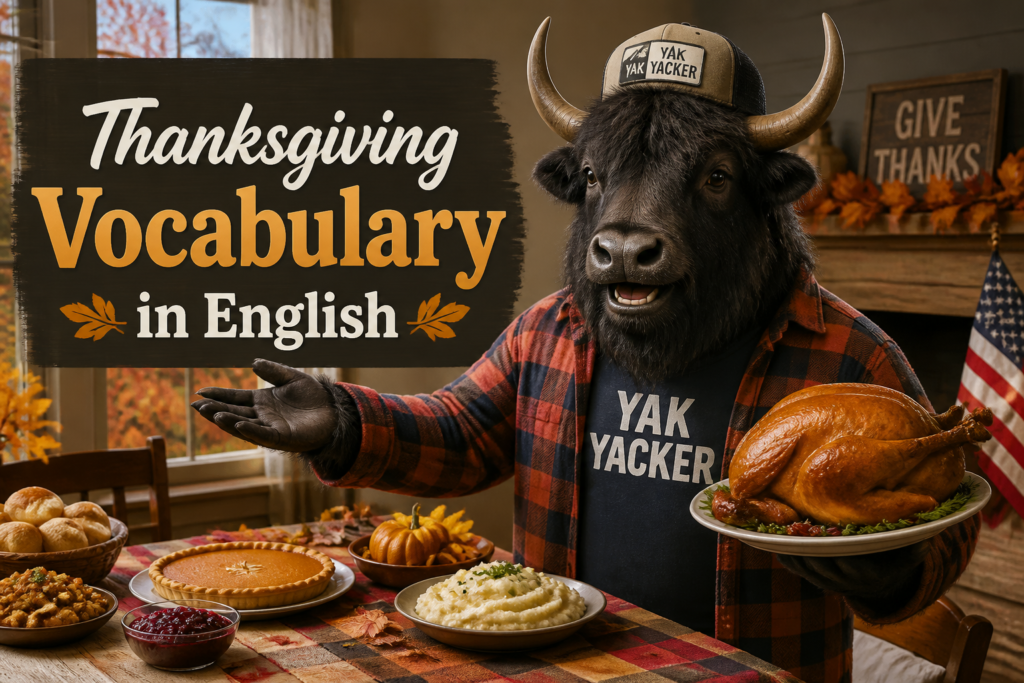
Thanksgiving in English is more than turkey, pie, and a food coma strong enough to erase your plans for the evening. It is also a great topic for learning real-life English: family talk, food words, holiday expressions, and a few phrases that show up in conversations, emails, and social media posts every November.
If you are learning English, Thanksgiving vocabulary is useful because it mixes everyday words with cultural language. You will hear people talk about the holiday, the meal, the parade, gratitude, and the classic question: “Are you bringing anything?” That one sentence can trigger an entire shopping trip.
In the United States, Thanksgiving is usually celebrated on the fourth Thursday in November. The holiday is about giving thanks, spending time with family and friends, and eating a lot. For a quick check of how to say some of these words correctly, you can also use a reliable dictionary like Cambridge Dictionary.
Let’s grab our turkey and learn the words people actually use.
Essential Thanksgiving Words
| English | Pronunciation | Meaning | Example Sentence | Learner Note |
|---|---|---|---|---|
| Thanksgiving | thanksgiv-ing | A U.S. holiday for giving thanks | We celebrate Thanksgiving with family every year. | Usually capitalized because it is the name of a holiday. |
| turkey | TER-kee | A large bird often eaten on Thanksgiving | My aunt roasted a big turkey. | Also used jokingly for a bad movie or bad idea in casual English. |
| stuffing | STUH-fing | A bread mixture cooked inside or with turkey | The stuffing tastes better with herbs. | In some places, people also call it dressing. |
| gravy | GRAY-vee | Warm sauce made from meat juices | Could you pass the gravy, please? | Very common at holiday meals. |
| cranberry sauce | KRAN-ber-ee sawss | Sweet-tart sauce made from cranberries | I put cranberry sauce on my turkey sandwich. | One of the classic Thanksgiving foods. |
| mashed potatoes | masht puh-TAY-tohz | Soft, crushed potatoes | The mashed potatoes were creamy and warm. | Often shortened to mashed potatoes, never “mash potatoes.” |
| dinner | DIN-er | The main evening meal | Thanksgiving dinner starts around 4 p.m. at our house. | In the U.S., “dinner” can mean the main meal of the day, not always nighttime. |
| feast | feest | A large, special meal | We had a real feast on Thanksgiving. | Formal or celebratory word. |
Useful Thanksgiving Phrases
These phrases are common in conversation, at the table, in text messages, and in holiday posts. They are simple, useful, and thankfully not written by a robot wearing a paper pilgrim hat.
| English | Pronunciation | Meaning | Example Sentence | Learner Note |
|---|---|---|---|---|
| Happy Thanksgiving! | HAP-ee thanksgiv-ing | A holiday greeting | Happy Thanksgiving! Enjoy your meal. | Very common greeting in the U.S. |
| Give thanks | giv thanks | Show gratitude | Many people give thanks before dinner. | Often used in a religious or traditional context. |
| Be thankful for | bee THANK-ful for | Appreciate something | I am thankful for my family and my health. | Useful in speeches and reflections. |
| Pass the ___ | pass the | Ask someone to give you food at the table | Pass the rolls, please. | Polite and very common during meals. |
| Bring a dish | bring uh dish | Bring food to share | I need to bring a dish to the party. | In American English, a dish here means a food item, not just a plate. |
| Potluck dinner | POT-luk DIN-er | A meal where everyone brings food | It is a potluck dinner, so everyone is bringing something. | Very common for family, work, and community events. |
| Set the table | set the TAY-buhl | Put plates, forks, and glasses on the table | Can you help set the table? | Useful household phrase. |
| Clean up | kleen up | Make the area tidy after a meal | After dinner, we all helped clean up. | Phrasal verb; very common in everyday English. |
| Go back for seconds | go back fer SEK-uhndz | Take a second serving of food | He always goes back for seconds on pie. | Seconds means another serving, not time. |
| Stuffed | stuft | Very full from eating | I am stuffed after that huge meal. | Casual and common. Not literally “filled with stuffing,” though Thanksgiving jokes are welcome. |
| What are you thankful for? | wut ar yoo THANK-ful for | A common holiday question about gratitude | At dinner, everyone shared what they were thankful for. | Often used in family conversations and classroom activities. |
| Enjoy the holiday | en-JOY the HOL-uh-day | Have a good holiday time | Enjoy the holiday and travel safely. | Friendly and natural in messages or emails. |
Food Vocabulary For The Table
Thanksgiving food words are extremely useful because people love describing what is on the table, what they ate, and what they want more of. Usually more of everything except the family argument. That one can stay outside.
| English | Pronunciation | Meaning | Example Sentence | Learner Note |
|---|---|---|---|---|
| rolls | rohlz | Small pieces of bread | The rolls were warm and soft. | Common side dish at holiday meals. |
| sweet potatoes | sweet puh-TAY-tohz | Orange-fleshed potatoes | We had sweet potatoes with dinner. | Sometimes made with marshmallows in the U.S. |
| pie | py | A baked dessert with filling | I saved room for pumpkin pie. | Very common Thanksgiving dessert. |
| pumpkin pie | PUMP-kin py | A pie made with pumpkin filling | Pumpkin pie is my favorite holiday dessert. | Classic American Thanksgiving food. |
| corn | korn | A yellow vegetable | We had corn with butter. | Simple, everyday word. |
| green beans | green beenz | Long green vegetables | The green beans were cooked with onions. | Often served as a side dish. |
| salad | SAL-ud | A dish made with vegetables, fruit, or both | She brought a fresh salad. | Spelling note: the final “d” is not strong in casual speech. |
| leftovers | LEFT-oh-verz | Food that remains after a meal | We ate leftovers for lunch the next day. | Very useful holiday word. |
People, Events, And Traditions
Thanksgiving is not only about food. It is also about people, traditions, and the things families do together every year, even when they pretend it is spontaneous.
- family gathering — a meeting of family members
- reunion — a time when people meet again after being apart
- host — the person who invites others and organizes the meal
- guest — a person invited to an event
- tradition — something people do regularly over time
- parade — a public event with people, floats, and music
- football game — an American Thanksgiving tradition for many families
- Black Friday — the shopping day after Thanksgiving in the U.S.
- holiday weekend — the long weekend around a holiday
- travel — to go from one place to another, often to visit family
Example sentences:
- Our family gathering is at my grandmother’s house.
- The host cooked most of the meal.
- Every family has a different tradition.
- Many people watch a parade on Thanksgiving morning.
- She has to travel across the country for the holiday.
Friendly Grammar And Usage Notes
Some Thanksgiving words are easier to use than others, so here are a few quick notes that save learners from awkward mistakes.
| Pattern | Meaning | Example | Learner Note |
|---|---|---|---|
| be thankful for + noun | Show gratitude for something | I am thankful for my friends. | Use for, not “about.” |
| go back for seconds | Take another serving | She went back for seconds on mashed potatoes. | Very natural at meals. |
| bring a dish | Bring food to a potluck | Can you bring a dish to the party? | In American English, this means food to share. |
| have leftovers | Still have food after the meal | We have lots of leftovers. | Leftovers is usually plural. |
| a slice of pie | One piece of pie | I want a slice of pumpkin pie. | Use a slice of for pie, cake, bread, and similar foods. |
One small but useful difference: in American English, people often say stuffing for the bread mixture served with turkey. In some British English contexts, you may hear stuffing too, but Thanksgiving itself is not a major British holiday. British learners may also notice that Black Friday now appears in shopping talk there, but the holiday tradition is still mainly American.
“At Thanksgiving, the most important skill is not cooking. It is surviving the food decisions with dignity.”
Mini Practice
Try these quick exercises. No pressure. Thanksgiving is stressful enough without making grammar cry in the corner.
- Fill in the blank: I am thankful ___ my family.
- Choose the correct word: We had a big holiday dinner / diner.
- Choose the correct phrase: Can you pass the gravy / pass a gravy?
- Rewrite with a more natural phrase: “I am full.” → “I am stuffed.”
- Complete the sentence: After the meal, we ate the ___ the next day.
- Make a sentence with Happy Thanksgiving.
Possible answers:
- I am thankful for my family.
- We had a big holiday dinner.
- Can you pass the gravy?
- I am stuffed.
- After the meal, we ate the leftovers the next day.
- Happy Thanksgiving! I hope you have a great day.
Quick Reference Summary
| Category | Key Words |
|---|---|
| Holiday | Thanksgiving, holiday, tradition, gratitude |
| Food | turkey, stuffing, gravy, cranberry sauce, pie, leftovers |
| Meal Actions | set the table, pass the ___, bring a dish, clean up |
| Social Phrases | Happy Thanksgiving, give thanks, be thankful for, what are you thankful for? |
| Common Events | family gathering, parade, potluck dinner, holiday weekend, Black Friday |
If you want to test more holiday words and everyday English, try the English Vocabulary Test or check your level with the English Placement Test CEFR. For a broader learning path, the Learn English page is a good place to keep going.
Yak Takeaway: Thanksgiving vocabulary is useful because it teaches food words, family phrases, and gratitude language all at once. Learn the core words, use them in simple sentences, and suddenly you sound like you belong at the table — even if your job is mostly passing the gravy.