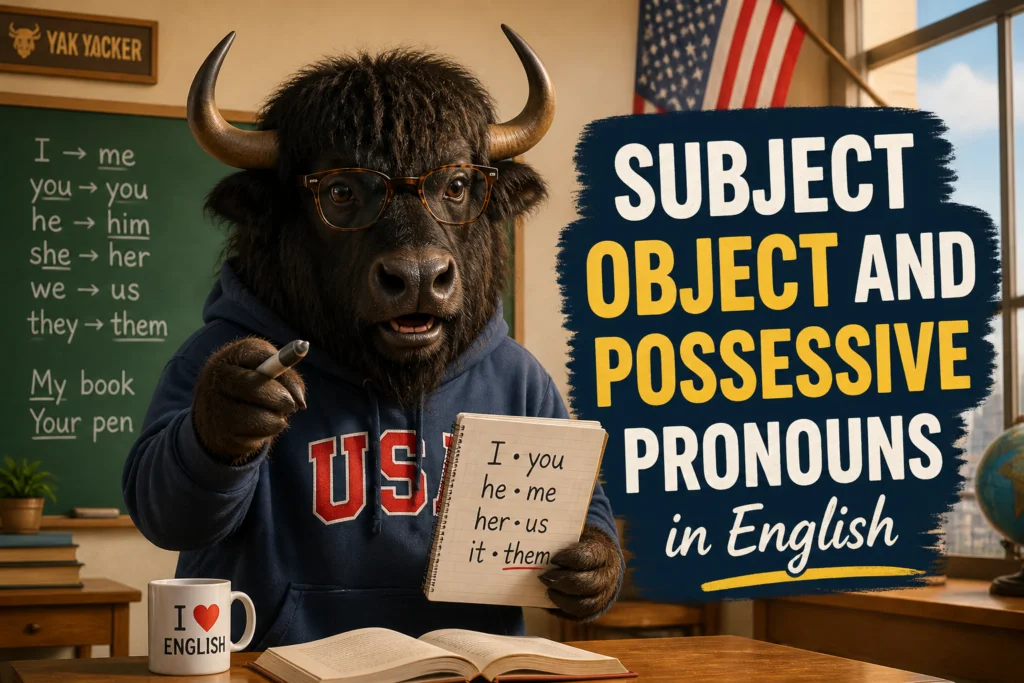
If English pronouns ever felt like they were hiding under the furniture, you are not alone. Words like I, me, my, and mine look small and innocent, then suddenly they start causing trouble in sentences. Classic English behavior.
For the broader learning path, visit our parent guide.
This guide breaks down Subject, Object, and Possessive Pronouns in English in a simple, practical way. By the end, you will know which pronoun to use, where it goes in a sentence, and how to avoid the most common mistakes.
You will also see real examples, learner notes, and a few tricky differences that often confuse English learners. No need for drama. Just clear grammar, finally doing its job.
What Pronouns Do
A pronoun is a word that takes the place of a noun. Instead of repeating a name again and again, English often uses a pronoun.
For example, instead of saying Maria is tired. Maria needs coffee, English usually says Maria is tired. She needs coffee.
Pronouns help English sound natural and smooth. Without them, every sentence would feel like a broken record.
The Main Pronoun Types
| Type | What It Does | Examples |
|---|---|---|
| Subject Pronouns | Do the action in the sentence | I, you, he, she, it, we, they |
| Object Pronouns | Receive the action | me, you, him, her, it, us, them |
| Possessive Pronouns | Show ownership or belonging | mine, yours, his, hers, ours, theirs |
| Possessive Adjectives | Describe a noun that belongs to someone | my, your, his, her, its, our, their |
That last row matters a lot. Many learners mix up possessive pronouns and possessive adjectives. They are related, but not the same. More on that soon, because English enjoys tiny traps.
Subject Pronouns
Subject pronouns are used when the pronoun is the subject of the sentence. In plain English: they do the action.
| Subject Pronoun | Pronunciation Help | Meaning | Example Sentence | Learner Note |
|---|---|---|---|---|
| I | eye | the speaker | I work from home. | Use I as the subject, not me. |
| You | yoo | the person spoken to | You look tired. | Same form for singular and plural. |
| He | hee | a male person | He drives to work. | Use for men and boys. |
| She | shee | a female person | She lives in Chicago. | Use for women and girls. |
| It | it | things, animals, ideas | It looks expensive. | Common for non-human singular nouns. |
| We | wee | speaker + other people | We need more time. | Use when you include yourself in a group. |
| They | thay | plural people or things | They are waiting outside. | Also used as a singular pronoun by many speakers today when gender is unknown or not important. |
Rule: Subject pronoun + verb.
Example: She likes tea. The pronoun she does the action, so it is a subject pronoun.
Example: They are playing soccer. Here, they is the subject.
Object Pronouns
Object pronouns are used when the pronoun receives the action.
Think of them as the ones being acted on. English can be very dramatic about this.
| Object Pronoun | Pronunciation Help | Meaning | Example Sentence | Learner Note |
|---|---|---|---|---|
| me | mee | the speaker | Call me later. | Use after a verb or preposition. |
| you | yoo | the person spoken to | I saw you at the station. | Same form as subject pronoun. |
| him | him | a male person | I called him yesterday. | Object form of he. |
| her | her | a female person | We invited her to dinner. | Object form of she. |
| it | it | things, animals, ideas | Did you open it? | Same form as subject pronoun. |
| us | uss | speaker + other people | They helped us. | Object form of we. |
| them | them | plural people or things | Please ask them. | Object form of they. |
Rule: Verb + object pronoun.
Example: The teacher called me. Here, me receives the action of called.
Example: Can you help us? In this question, us is the object.
Possessive Forms: Adjectives And Pronouns
This is where learners often slip on the grammar floor.
English has two kinds of possession words:
- Possessive adjectives: my, your, his, her, its, our, their
- Possessive pronouns: mine, yours, his, hers, ours, theirs
Possessive adjectives come before a noun.
Example: That is my phone.
Possessive pronouns do not need a noun after them.
Example: That phone is mine.
| Possessive Adjective | Possessive Pronoun | Example Pair | Learner Note |
|---|---|---|---|
| my | mine | It is my bag. / The bag is mine. | my goes before a noun; mine stands alone. |
| your | yours | Is this your seat? / Is this seat yours? | Same pattern for singular and plural you. |
| his | his | That is his jacket. / The jacket is his. | Same spelling for adjective and pronoun. |
| her | hers | This is her idea. / The idea is hers. | Do not confuse her with object pronoun her. |
| its | its | The company changed its policy. / The policy is its? | Possessive pronoun its is rare in normal English. |
| our | ours | Our car is old. / The car is ours. | Used for speaker + others. |
| their | theirs | Their house is big. / The house is theirs. | Used for plural people or things. |
Rule: Possessive adjective + noun. Possessive pronoun = noun replacement.
Example: This is our room. / This room is ours.
Example: Her brother is friendly. / The friendly brother is hers.
Easy Comparison: Subject vs Object vs Possessive
| Subject | Object | Possessive Adjective | Possessive Pronoun |
|---|---|---|---|
| I | me | my | mine |
| you | you | your | yours |
| he | him | his | his |
| she | her | her | hers |
| it | it | its | its |
| we | us | our | ours |
| they | them | their | theirs |
A quick memory trick:
- Subject = does the action
- Object = receives the action
- Possessive = shows ownership
Common Sentence Patterns
| Pattern | Meaning | Example | Learner Note |
|---|---|---|---|
| Subject + verb | The pronoun does the action | He works here. | Use subject pronouns before verbs. |
| Verb + object | The pronoun receives the action | I called her. | Use object pronouns after verbs. |
| Possessive adjective + noun | Shows ownership before a noun | My car is new. | Do not use a noun after a possessive adjective without another noun. |
| Noun + be + possessive pronoun | Shows ownership without repeating the noun | The car is mine. | Possessive pronouns replace the noun phrase. |
When Learners Mix Them Up
Here are the most common mistakes, with the clean fix.
| Wrong | Correct | Why |
|---|---|---|
| Me went to the store. | I went to the store. | I is the subject, so use the subject pronoun. |
| She gave the book to I. | She gave the book to me. | After a preposition like to, use an object pronoun. |
| That is mine car. | That is my car. | my needs a noun after it. |
| This phone is my. | This phone is mine. | mine can stand alone. |
| Her is late. | She is late. | her is not a subject pronoun. |
| Give it to he. | Give it to him. | After to, use the object form. |
Special Note: “They” And “Their”
They, them, their, and theirs are not only for groups. Many English speakers now use they for one person when the gender is unknown, not important, or the person prefers it.
Example: Someone left their umbrella.
This is normal in modern English, especially in everyday speech and writing. If you want a reliable grammar reference, Cambridge Dictionary’s pronouns guide is a solid place to check.
American And British English Notes
In both American and British English, the subject, object, and possessive pronoun system is basically the same. Good news: one less thing to panic about.
One small difference you may notice is in everyday style. British English sometimes sounds a little more formal in some contexts, but the pronoun forms themselves are the same.
Also, in both varieties, they is increasingly common as a singular pronoun for a person of unknown gender or a person who uses they/them pronouns.
Quick Practice
Try to choose the correct pronoun. Then check the answer in your head like a responsible language learner.
- 1. ___ am hungry. (I / me)
- 2. She called ___. (he / him)
- 3. That is ___ jacket. (my / mine)
- 4. The jacket is ___. (my / mine)
- 5. We saw ___ at the airport. (they / them)
- 6. ___ is late today. (He / Him)
- 7. Please give the note to ___. (she / her)
- 8. The bag is ___. (our / ours)
Answers: 1. I 2. him 3. my 4. mine 5. them 6. He 7. her 8. ours
Fill In The Blanks
Complete each sentence with the correct pronoun.
- 1. Maria is busy, so ___ cannot answer now.
- 2. The coffee is for John and ___.
- 3. I lost my keys. Have you seen ___?
- 4. This is not your seat. That seat is ___.
- 5. My parents are here. ___ are in the kitchen.
Answers: 1. she 2. me 3. them 4. yours 5. They
Pronunciation Tips
Most of these words are short and easy to say, but learners still mix them up because the sound changes are tiny.
- me and we sound different only in the first sound, so listen carefully.
- her and hers are related, but hers has an extra sound at the end.
- their, there, and they’re sound the same, but they mean different things.
- his is very short. Do not add an extra vowel sound.
- them starts with a soft th sound, not a t sound.
If you want more practice with English word forms and related vocabulary, you can try the English Vocabulary Test or check your level with the English Placement Test CEFR.
Quick Reference Summary
| Pronoun Type | Use It For | Example |
|---|---|---|
| Subject pronoun | Doing the action | She cooks dinner. |
| Object pronoun | Receiving the action | He called her. |
| Possessive adjective | Before a noun | This is my bag. |
| Possessive pronoun | Replacing a noun phrase | This bag is mine. |
Remember: subject = action, object = receives, possessive = ownership. That’s the whole game, just with a few English-style costume changes.
Yak takeaway: if the pronoun is doing the action, use the subject form; if it receives the action, use the object form; if it shows ownership, use a possessive form.