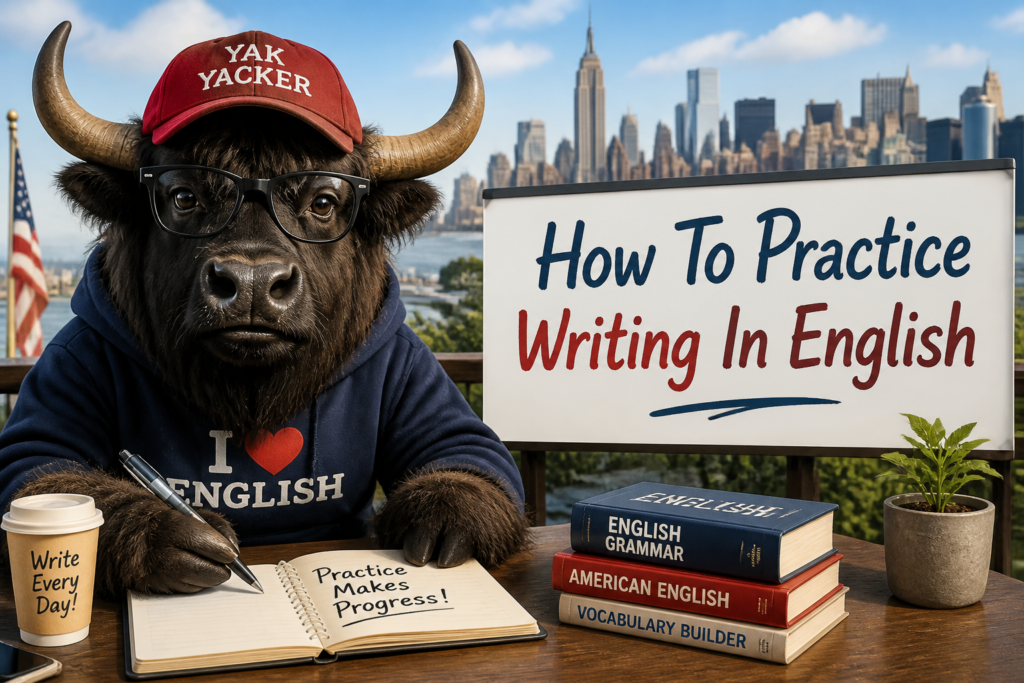
Writing in English gets easier when you stop waiting for “perfect” and start writing more often. Annoying, yes. Effective, also yes.
For the broader learning path, visit our parent guide.
This guide shows practical ways to build writing skill step by step: what to write, how to practice, and how to notice your mistakes without turning every sentence into a small drama.
By the end, you will know how to make a simple writing routine, choose useful topics, check your work, and improve faster with less stress. If you want a quick English level check first, try the English Placement Test CEFR. If you want to build vocabulary alongside writing, the English Vocabulary Test is a handy place to start.
Good writing practice does not mean writing long essays every day. Most learners improve faster with short, regular practice. Little by little. Boring? A bit. Useful? Very.
The Main Idea: Write Small, Write Often
If you want to improve writing in English, the best method is simple: write often, get feedback, fix mistakes, and write again. That cycle matters more than one perfect notebook full of beautiful sentences that never get used.
Better writing practice is short, regular, and focused. One good paragraph can teach you more than ten random pages.
You do not need to write like a novelist. You need to write like a real English user: emails, messages, notes, opinions, descriptions, and short stories from daily life.
Useful Writing Practice Methods
Here are practical ways to practice writing in English. Start with one or two methods and keep them simple.
| Method | What It Means | Example | Learner Note |
|---|---|---|---|
| Daily Journal | Write a few sentences about your day. | “Today I worked from home, answered emails, and cooked pasta.” | Good for routine practice and basic sentence control. |
| Sentence Expansion | Take a short sentence and make it longer. | “I studied.” → “I studied English for 20 minutes after dinner.” | Great for vocabulary and grammar. |
| Text Message Practice | Write short, casual messages in English. | “Sorry, I’m late. I’m on the bus now.” | Helps with natural everyday English. |
| Paragraph Practice | Write one short paragraph on one topic. | Describe your favorite food, city, or hobby. | Useful for organization and linking ideas. |
| Copy-And-Change | Copy a model sentence, then change it. | “I like coffee.” → “I like tea.” | Simple, but very effective for beginners. |
| Question And Answer Practice | Answer real questions in writing. | “What did you do yesterday?” | Good for speaking and writing together. |
| Mini Email Practice | Write short emails for common situations. | Request, apology, invitation, or update. | Very useful for work and school. |
| Picture Description | Write what you see in a photo or scene. | “There are three people in the kitchen. They are cooking dinner.” | Builds observation and sentence variety. |
| Story Starter | Write the beginning of a short story. | “When I opened the door, I heard a strange noise.” | Good for fun practice and creativity. |
| Correction Practice | Rewrite your own text more clearly. | Fix grammar, word order, and punctuation. | This is where real improvement happens. |
Step By Step: How To Practice Writing In English
Use this simple routine. It works for beginners and intermediate learners too.
- Choose one topic. Keep it small: your day, food, travel, work, family, or a hobby.
- Set a short time. Try 5 to 15 minutes. A short habit is easier to keep.
- Write without stopping. Do not check every word while you are writing. That kills momentum.
- Read your text once. Look for spelling, missing words, and grammar problems.
- Fix the biggest mistakes first. Focus on clear communication, not perfection.
- Rewrite one sentence. Make one sentence better using a new word or a stronger structure.
- Save your work. Comparing old and new writing shows real progress.
A tiny routine done every day beats a heroic two-hour session once a month. English loves consistency. A little rude, but true.
What To Write When You Practice
Pick topics that match your real life. That makes your writing more useful and easier to remember.
| Topic | Example Prompt | Why It Helps |
|---|---|---|
| Daily Life | What did you do today? | Uses common verbs and time words. |
| Food | Describe your favorite meal. | Good for adjectives and opinions. |
| Travel | Where would you like to go? | Useful for future tense and travel vocabulary. |
| Work Or School | What is a normal day like? | Helps with routine language and schedules. |
| Hobbies | How do you spend free time? | Good for present simple and activity words. |
| Opinions | Do you prefer city life or country life? | Builds argument and comparison skills. |
| Stories | What happened last weekend? | Practices past tense. |
| Plans | What will you do next week? | Practices future forms. |
If you do not know what to write, use a simple frame: what happened, how you felt, and why it mattered. Three parts. Nice and manageable.
Helpful Writing Phrases For Learners
These phrases help you start, connect ideas, and finish your writing in a natural way. They are simple, common, and useful. As a bonus, they stop your paragraphs from sounding like a robot wrote them after three cups of coffee.
| English Phrase | Pronunciation | Meaning | Example Sentence | Learner Note |
|---|---|---|---|---|
| For example | for ig-ZAM-pul | Used to give an example | I like simple practice. For example, I write five sentences every night. | Very common in essays and explanations. |
| In my opinion | in my uh-PIN-yun | This is what I think | In my opinion, short practice is better than rare long practice. | Polite and useful in opinion writing. |
| First of all | FURST uhv AWL | Used to start a list or explanation | First of all, choose a topic. | Good for organizing ideas. |
| Then | then | Next step in order | Then read your text again. | Simple but essential. |
| However | how-EV-er | Shows contrast | I wanted to write more. However, I was tired. | More formal than “but.” |
| Because | bih-KAWZ | Gives a reason | I practiced because I wanted to improve. | Very common in learner writing. |
| Also | AWL-soh | Adds another idea | I wrote a diary entry. I also checked my spelling. | Useful for adding information. |
| Finally | FYE-nuh-lee | Last point or last step | Finally, I saved my notes. | Good for conclusions and routines. |
| In addition | in uh-DIH-shun | Adds extra information | In addition, I learned three new words. | A bit more formal. |
| As a result | az uh ri-ZULT | Shows consequence | I practiced every day. As a result, my writing improved. | Useful for cause and effect. |
| On the other hand | on thee UTH-er hand | Shows a different side | Short writing is easy. On the other hand, long writing gives more practice. | Good for comparison. |
| To be honest | too bee ON-ist | Says what you really think | To be honest, I still make grammar mistakes. | Natural in spoken and written English. |
How To Make Your Writing Better
Writing improvement usually comes from noticing patterns. The same small mistakes appear again and again. Good news: that means you can fix them.
- Look for repeated mistakes. Do you often miss articles, verb endings, or prepositions?
- Read your sentence out loud. If it sounds strange, it probably needs fixing.
- Compare two versions. Keep your first draft and your corrected draft.
- Learn one new pattern at a time. For example: “I would like to…” or “I am interested in…”
- Use dictionaries carefully. Check meaning, pronunciation, and examples in a reliable source like Cambridge Dictionary.
- Study real examples. Good sentences teach better than isolated words.
- Write for a real purpose. A message, note, email, or post feels more useful than random sentences.
One more thing: do not collect new words like shiny rocks and never use them. If you learn a phrase today, try writing it tomorrow. Your brain likes repeated contact, not museum storage.
Simple Grammar To Practice In Writing
You do not need every grammar rule at once. Focus on the patterns that help you write clear, correct sentences.
| Pattern | Meaning | Example | Learner Note |
|---|---|---|---|
| I + verb | Basic sentence structure | I study every day. | Good starting point for beginners. |
| Subject + verb + object | Normal English sentence order | I write short sentences. | English usually follows this order. |
| Present simple | Routine or general truth | I practice writing on Mondays. | Great for habits and schedules. |
| Past simple | Finished action in the past | I wrote three paragraphs yesterday. | Useful for journals and stories. |
| Future with “will” | Future action or plan | I will write again tomorrow. | Simple and clear. |
| “Because” clause | Reason | I practiced because I had an exam. | Watch word order after “because.” |
| “Although” clause | Contrast | Although I was tired, I wrote a paragraph. | Good for slightly more advanced writing. |
| Articles: a / an / the | Small words before nouns | I wrote an email and a note. | Common learner problem. Practice often. |
If articles confuse you, remember this very simple idea: a/an for one thing not mentioned before, the for a specific thing. Not perfect, but useful enough to stop a lot of mistakes.
Practice Exercises
Try these short tasks. Write your answers on paper or in a notebook. The point is to produce language, not just admire the idea of producing language.
Exercise 2: Fill In The Blank
- I practice writing every day ____ I want to improve.
- ____ first, I wrote three sentences.
- I made mistakes, ____ I corrected them.
- ____ my opinion, short practice is best.
Possible answers: because, First of all, but, In.
Exercise 3: Rewrite For Clarity
- I very like write English.
- Yesterday I go to library and read book.
- My writing improve because I practice every day.
- I want learn English writing good.
Correct them into natural English. Focus on grammar, word order, and verb forms.
Exercise 4: One-Minute Journal
- Write three things you did today.
- Write one thing you learned.
- Write one question you still have.
- Write one sentence about tomorrow.
This is a strong beginner habit. Simple, fast, and surprisingly powerful.
Common Mistakes And Fixes
| Mistake | Better Version | Why |
|---|---|---|
| I very like English. | I like English very much. | “Very” does not usually go before “like” in this structure. |
| I am agree. | I agree. | “Agree” is a verb by itself. |
| He go to school every day. | He goes to school every day. | Third-person singular needs -s in the present simple. |
| I write in yesterday. | I wrote yesterday. | Use past tense for finished actions. |
| I have 20 years. | I am 20 years old. | English says age this way. |
| I want learn English. | I want to learn English. | “Want” is usually followed by “to” + verb. |
| The writing is difficult for me. | Writing is difficult for me. | General ideas often do not need “the.” |
| I made a homework. | I did my homework. | “Homework” is uncountable in standard English. |
When you fix mistakes, do not just change the answer. Ask why the original sentence was wrong. That is how the lesson sticks.
How To Get Feedback
Feedback is important because learners often cannot see their own mistakes clearly. That is normal. Everyone is blind to some of their own language habits. Very human. Very inconvenient.
- Use a teacher, tutor, or language partner. Ask for simple corrections and explanations.
- Join a study group. Trade short writing tasks and comments.
- Use online correction carefully. Automatic tools can help, but they are not always right.
- Ask for one focus area. For example: verb tense, articles, or word order.
- Save corrected sentences. Build your own “mistake notebook.”
Good feedback is not just “correct” or “incorrect.” It should help you understand the pattern so you can write it correctly next time.
A Simple Weekly Writing Plan
If you want structure, use this weekly plan. It is easy to follow and does not demand superhuman motivation.
| Day | Task |
|---|---|
| Monday | Write 5 sentences about your day. |
| Tuesday | Expand 3 sentences and add details. |
| Wednesday | Write a short paragraph about a hobby. |
| Thursday | Correct Tuesday or Wednesday’s writing. |
| Friday | Write a message, email, or text in English. |
| Saturday | Describe a photo or memory. |
| Sunday | Review your mistakes and rewrite one text better. |
If seven days feels like too much, cut it in half. Two or three focused days per week is still good practice.
American And British English Notes
Most writing practice works the same in American and British English. Still, a few differences matter.
- Spelling: American English often uses -or and -ize words like color and organize. British English often uses colour and organise.
- Vocabulary: Americans say trash, Britons often say rubbish. Americans say apartment, Britons often say flat.
- Grammar: Both are mostly the same for learner writing, so do not panic and start a spreadsheet.
Pick one variety and stay consistent in your writing. Mixing spellings too much can make your work look messy.
Quick Reference Summary
- Write a little every day.
- Use real-life topics.
- Start with short sentences.
- Expand one idea into a paragraph.
- Read your writing out loud.
- Correct the biggest mistakes first.
- Keep a mistake notebook.
- Use reliable dictionaries and examples.
- Get feedback when you can.
- Rewrite old texts to see improvement.
If you remember only one thing, make it this: practice writing in English should be frequent, simple, and useful. Fancy is optional. Consistent is not.
Yak Takeaway: Write often, write short, fix what matters, and write again. That is how English writing grows from awkward to useful, and then from useful to actually pretty good.