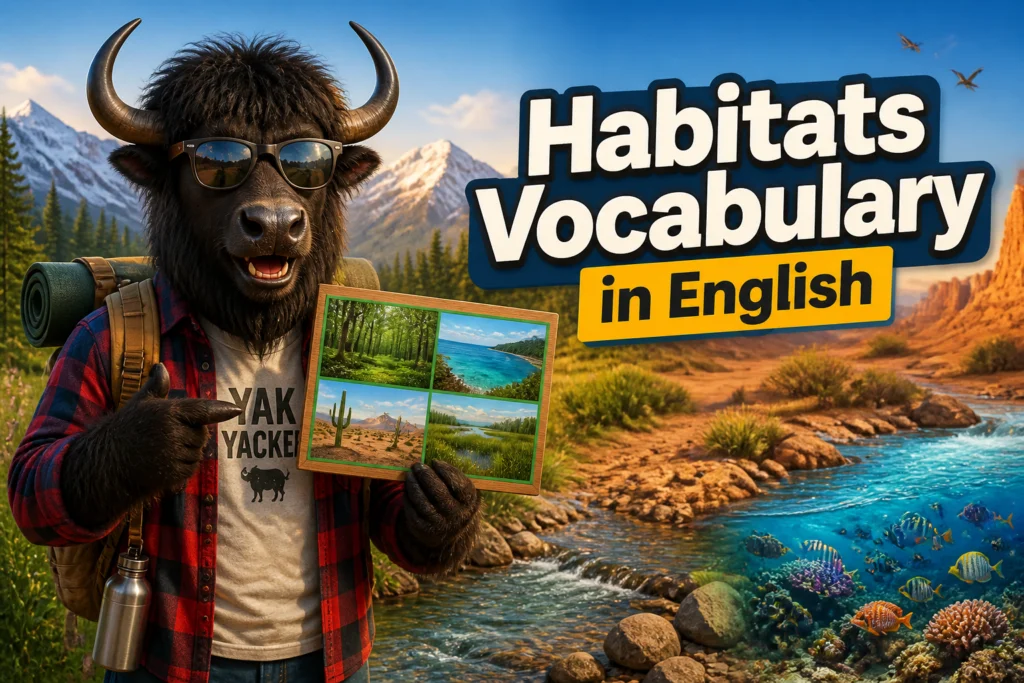
If you can name a habitat, you can talk about nature with a lot more confidence. Suddenly, “That animal lives in the forest” becomes “That species lives in a temperate rainforest,” which is the kind of sentence that makes you sound suspiciously prepared for a documentary.
In this guide, you’ll learn practical habitat vocabulary in English: common habitat names, related words, useful phrases, and a few important pronunciation notes. You’ll also see how English speakers talk about where plants and animals live in everyday life, school science, travel, and environmental conversations.
By the end, you’ll be able to describe habitats more clearly, understand basic ecology language, and avoid mixing up similar words like forest, woodland, and rainforest.
For a quick test after reading, try the English Vocabulary Test or check your level with the English Placement Test CEFR.
What Is A Habitat?
A habitat is the natural home of a plant or animal. It is the place where a living thing gets what it needs to survive: food, water, shelter, and space.
Simple example: a frog’s habitat is often a pond, wetland, or marsh. A camel’s habitat is a desert. A polar bear’s habitat is the Arctic. English loves these clean little facts. Very tidy. Very unromantic. Very useful.
Core Habitat Vocabulary
| English | Pronunciation | Meaning | Example Sentence | Learner Note |
|---|---|---|---|---|
| habitat | HAB-uh-tat | the natural home of a plant or animal | The panda’s habitat is the bamboo forest. | Common science word; countable: a habitat, habitats. |
| ecosystem | EE-koh-sis-təm | living things and their environment working together | The lake ecosystem includes fish, plants, and insects. | Broader than habitat. |
| environment | in-VY-ruhn-mənt | the natural world around plants, animals, or people | Pollution can damage the environment. | Very common in everyday and formal English. |
| biome | BY-ohm | a large natural region with a specific climate and life | The tundra is a cold biome. | More technical; common in science class. |
| species | SPEE-sheez | a group of plants or animals of the same kind | This species lives in tropical forests. | Singular and plural are both species. |
| wildlife | WILD-life | wild animals and plants in nature | The park is known for its wildlife. | Usually uncountable. |
| native | NAY-tiv | naturally found in a place | This plant is native to South America. | Often used with to: native to a place. |
| endangered | in-DAYN-jerd | in danger of disappearing | Many endangered animals need protected habitats. | Important environmental word. |
| extinct | ik-STINGKT | no longer living anywhere on Earth | Dodos are extinct. | Final /t/ sound is important. |
| conservation | kon-ser-VAY-shən | protecting nature and natural resources | Conservation helps protect habitats. | Formal but common in news and education. |
Common Habitat Types
These are some of the most useful habitat words in English. Learn the general idea first. Then the smaller details start behaving themselves.
| English | Pronunciation | Meaning | Example Sentence | Learner Note |
|---|---|---|---|---|
| forest | FOR-ist | a large area full of trees | Deer live in the forest. | Very common; broad word. |
| rainforest | RAYN-for-ist | a hot, wet forest with lots of rain | Monkeys live in the rainforest. | Often tropical; very biodiverse. |
| woodland | WOOD-land | land covered with trees | The walk goes through woodland. | More common in British English. |
| grassland | GRASS-land | a large area covered mostly with grass | Many animals live in grassland habitats. | Useful in science and geography. |
| savanna | suh-VAN-uh | grassland with some trees, usually in hot places | Lions and zebras live on the savanna. | Spelling has two n’s in English. |
| desert | DEZ-ert | a very dry area with little rain | Cacti are adapted to desert life. | Do not confuse with the sweet dessert. |
| tundra | TUN-druh | a very cold, treeless region | Only tough plants grow in the tundra. | Common in Arctic habitat lessons. |
| wetland | WET-land | land covered with water or very wet soil | Birds and frogs live in wetlands. | Very important environmental word. |
| marsh | MARSH | wet land with grass and plants | Many insects live in the marsh. | Related to swamp and wetland. |
| swamp | SWOMP | wet land with trees and muddy water | Alligators can live in swamps. | In the US, this is a common word. |
| pond | POND | a small body of still water | Frogs often live near a pond. | Smaller than a lake. |
| lake | LAYK | a large area of water surrounded by land | Many birds nest near the lake. | Freshwater or sometimes saltwater. |
| river | RIV-er | water that flows across land | Otters live in and near rivers. | Good word for habitat descriptions. |
| ocean | OH-shən | a very large area of salt water | Whales live in the ocean. | Often used with marine animals. |
| coast | KOHST | the land next to the sea | Seabirds live along the coast. | Useful for geography and travel. |
| reef | REEF | a line of rocks or coral under the sea | Colorful fish live around the reef. | Often refers to coral reef habitats. |
| coral reef | KOR-uhl reef | an underwater habitat built by coral | Coral reefs support many species. | Important marine habitat. |
| mountain | MOWN-tən | a very high natural area of land | Some goats live in mountain habitats. | Can be singular or plural: mountain/mountains. |
Useful Habitats Phrases
These phrases are the ones English speakers actually use when they talk about where animals and plants live. Grammar stays simple, which is nice for once.
| English | Pronunciation | Meaning | Example Sentence | Learner Note |
|---|---|---|---|---|
| live in | liv in | to have a home in a place | Koalas live in eucalyptus forests. | Very common with animals, people, and plants. |
| be found in | bee fownd in | to exist naturally in a place | This bird is found in wetlands. | Formal and scientific. |
| native to | NAY-tiv too | originally from a place | This flower is native to Europe. | Often used in nature articles. |
| adapted to | uh-DAP-tid too | suited to a habitat or condition | Penguins are adapted to cold climates. | Very important science phrase. |
| survive in | ser-VYV in | to stay alive in a place | Some plants can survive in dry deserts. | Use for difficult environments. |
| thrive in | THRYV in | to grow well and do very well | Many insects thrive in warm, humid places. | Positive, strong word. |
| protect the habitat | pruh-TEKT thuh HAB-uh-tat | to keep the natural home safe | People should protect the habitat of rare animals. | Common in environmental writing. |
| lose habitat | looz HAB-uh-tat | to lose the natural place where something lives | Animals lose habitat when forests are cut down. | Very common in conservation texts. |
| habitat destruction | HAB-uh-tat dih-STRUHK-shən | damage or destruction of natural homes | Habitat destruction is a major problem worldwide. | Formal but very useful. |
| natural habitat | NACH-er-uhl HAB-uh-tat | the place where something normally lives | It is better to see animals in their natural habitat. | Common phrase in documentaries and museums. |
| in the wild | in thuh WYLD | living naturally, not in captivity | These birds are hard to see in the wild. | Very common phrase. |
| endemic to | en-DEM-ik too | found only in one place | This frog is endemic to this island. | More advanced; common in geography and biology. |
Habitat Word Families And Related Terms
English learners often know the main noun but forget the related words. That makes your speech sound a little broken-up, like a puzzle with one missing piece.
| Word | Pronunciation | Meaning | Example Sentence | Learner Note |
|---|---|---|---|---|
| habitat | HAB-uh-tat | natural home | The habitat is shrinking. | Base word. |
| inhabit | in-HAB-it | to live in a place | Many species inhabit the island. | Verb form; more formal. |
| inhabited | in-HAB-it-id | lived in by people or animals | Birds inhabited the cliffs. | Past participle/adjective. |
| habitable | HAB-uh-tuh-buhl | good enough to live in | The cave is not habitable for humans. | Useful in science and space topics too. |
| uninhabited | un-in-HAB-it-id | with no people living there | The island is uninhabited. | Common in travel and geography. |
| inhabitant | in-HAB-ih-tənt | a person or animal that lives in a place | The mountain’s inhabitants include goats and birds. | More formal; often plural. |
Habitat Phrases In Real Life
Here are common sentences you might hear in class, in a nature article, or during a visit to a zoo or museum.
- This animal lives in… — This animal lives in the rainforest.
- This plant grows in… — This plant grows in wet soil.
- It is native to… — It is native to Australia.
- It is found in… — It is found in tropical regions.
- It needs… — It needs warm water and plenty of sunlight.
- It depends on… — It depends on clean rivers.
- It is adapted to… — It is adapted to dry weather.
- Its habitat is… — Its habitat is the savanna.
- Its natural habitat is… — Its natural habitat is the forest floor.
- Its habitat is being destroyed. — Its habitat is being destroyed by logging.
- It can survive in… — It can survive in cold conditions.
- It thrives in… — It thrives in shallow water.
American And British English Notes
Most habitat words are the same in American and British English. Still, a few choices sound more natural depending on the region.
| American English | British English | Note |
|---|---|---|
| woodland | woodland | Both use this word, but it feels a bit more common in British English. |
| swamp | marsh / wetland | American English often uses swamp more casually. |
| trash / garbage | rubbish | Not a habitat word, but useful in environmental topics about pollution. |
| environment | environment | Same word, same meaning, very useful everywhere. |
If you want a boring but reliable definition for one of these words, Cambridge Dictionary’s entry for “habitat” is a solid place to check.
Quick Pronunciation Help
- habitat — stress the first syllable: HAB-uh-tat.
- ecosystem — stress the second syllable: ee-KOH-sis-təm.
- endangered — stress the second syllable: in-DAYN-jerd.
- extinct — end with a clear k sound, not “extink.”
- desert — say DEZ-ert, not dessert.
- savanna — stress the second syllable: suh-VAN-uh.
- species — the ending sounds like “sheez,” not “spee-sees.”
Yak wisdom: in habitat English, the exact word matters. A forest is not the same as a rainforest, and a wetland is not just “some wet place.” English likes categories. Nature does not always cooperate.
Practice: Choose The Best Word
Fill in the blanks with the best habitat word or phrase from the lesson.
- 1. Penguins are adapted to a cold __________.
- 2. Frogs often live in __________ and ponds.
- 3. The tiger’s natural __________ is shrinking.
- 4. This bird is __________ in tropical forests.
- 5. Many sea animals live in the __________.
- 6. The cactus can survive in the __________.
- 7. This plant is __________ to North America.
- 8. Habitat __________ is a serious problem.
Answers: 1. habitat 2. wetlands 3. habitat 4. found 5. ocean 6. desert 7. native 8. destruction
Common Mistakes And Fixes
- Wrong: The animal lives in a habitat forest.
Correct: The animal lives in a forest.
“Habitat” already means natural home, so you usually do not need to pile extra words on top like that. - Wrong: The species are extinct.
Correct: The species is extinct.
“Species” is the same in singular and plural, so the verb depends on the meaning. - Wrong: It is native on Australia.
Correct: It is native to Australia.
Use to with native. - Wrong: Desert and dessert are the same.
Correct: No, they are not.
One is dry land, one is sweet food. English enjoys chaos. - Wrong: The penguin is adapted for cold weather.
Better: The penguin is adapted to cold weather.
Both can appear, but adapted to is very common.
Mini Reference: Habitat Verbs And Adjectives
| Form | Example | Meaning |
|---|---|---|
| verb: inhabit | Many birds inhabit the wetland. | live in |
| adjective: inhabited | The island is inhabited by birds. | lived in |
| adjective: uninhabited | The island is uninhabited. | not lived in |
| adjective: habitable | The cave is habitable. | safe or suitable for living |
Short Reading Tip
When you read science or nature articles, look for patterns like live in, found in, native to, and adapted to. These phrases appear again and again. Once you learn them, habitat writing becomes much easier to understand.
Also, if you want to learn more general English words and practice your level, the Learn English hub has more lessons that can help you keep going without falling asleep on the keyboard.
Yak Takeaway: A habitat is a living thing’s natural home, and English has lots of useful words for describing where life happens. Learn the big words first, then add the phrases, and suddenly you can talk about forests, reefs, wetlands, and deserts without sounding like you got lost on the way to biology class.