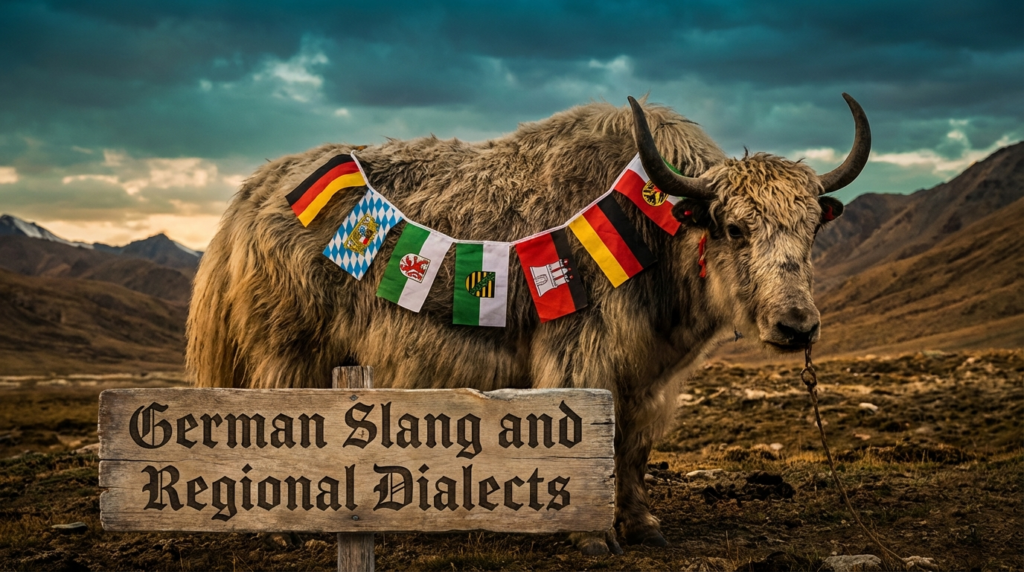
German Slang And Regional Dialects For Beginners
Want to understand real German without sounding like a dusty textbook exploded in your mouth? Good. This guide gives you common slang, regional words, and dialect shortcuts people actually use in Germany, Austria, and Switzerland.
You will learn what the words mean in English, where they are common, and how to use them in real sentences. The smart move is simple: learn standard German first, then sprinkle in slang like seasoning. Not like ketchup on everything.
Yak Box: Standard German helps you be understood everywhere. Slang makes you sound natural. Dialect makes you sound local. Mixing all three too early can get weird fast.
Quick Map Of What You Are Hearing
- Slang = informal words used in everyday speech across social groups.
- Regional words = normal local vocabulary, often understood in one area better than another.
- Dialect = a stronger local form of speech with different pronunciation, grammar, and vocabulary.
- Best beginner rule = understand a lot, use a little, and copy the people around you.
Visual Cards: 8 High-Utility Words To Learn First
Moin
English: hi / hello
Region: northern Germany
Example: Moin, alles klar? = Hi, everything good?
Krass
English: crazy / intense / wow
Region: widely used
Example: Das ist krass teuer. = That is insanely expensive.
Servus
English: hi / bye
Region: southern Germany, Austria
Example: Servus, bis morgen! = Bye, see you tomorrow!
Bock Haben
English: to feel like / be up for
Region: widely used
Example: Hast du Bock auf Pizza? = Do you feel like pizza?
Leiwand
English: awesome / great
Region: Austria
Example: Das Konzert war leiwand. = The concert was awesome.
Grüezi
English: hello
Region: Switzerland
Example: Grüezi, ich habe eine Frage. = Hello, I have a question.
Digga
English: dude / bro
Region: widely used, especially among younger speakers
Example: Digga, das glaub ich nicht. = Dude, I do not believe that.
Mei
English: well / oh dear / come on
Region: Bavaria, Austria
Example: Mei, ist das kalt heute. = Wow, it is cold today.
Useful Phrases And Real-Life Sentences
- Was geht? — what’s up?
Was geht heute Abend? = What’s up tonight? - Alles klar? — you good? / all good?
Hey, alles klar bei dir? = Hey, you good? - Kein Ding — no problem
Kein Ding, ich helfe dir. = No problem, I’ll help you. - Passt schon — it’s fine / no worries
Passt schon, du musst dich nicht entschuldigen. = It’s fine, you do not need to apologize. - Läuft bei dir — look at you / things are going well for you
Neue Wohnung, neuer Job? Läuft bei dir. = New apartment, new job? Nice, things are going well for you. - Nicht mein Ding — not my thing
Camping ist echt nicht mein Ding. = Camping really is not my thing. - Mach kein Stress — don’t stress / no pressure
Mach kein Stress, wir haben noch Zeit. = Don’t stress, we still have time. - Voll cool — really cool
Deine Idee ist voll cool. = Your idea is really cool. - Auf keinen Fall — no way / absolutely not
Auf keinen Fall gehe ich bei dem Wetter raus. = No way am I going outside in this weather. - Na ja — well… / meh
Der Film war na ja. = The movie was, well, meh.
General German Slang Table
These are widely useful in informal spoken German. Some are youth slang, some are just everyday casual speech, and a few can sound a little rough if you overdo them. So maybe do not walk into a job interview yelling Digga.
| German | English Meaning | Example 1 | Example 2 | Example 3 |
|---|---|---|---|---|
| krass | crazy / intense / wild | Das ist krass teuer. = That is insanely expensive. | Krass, das wusste ich nicht. = Wow, I did not know that. | Heute ist es krass heiß. = It is crazy hot today. |
| geil | awesome / great / cool | Das Lied ist echt geil. = That song is really awesome. | Wir hatten einen geilen Abend. = We had a great evening. | Der Ausdruck can also mean sexy in some contexts. |
| cool | cool | Das klingt cool. = That sounds cool. | Sie ist echt cool drauf. = She is really chill. | Cool, dann machen wir das. = Cool, then we will do that. |
| nervig | annoying | Der Lärm ist nervig. = The noise is annoying. | Das Update ist echt nervig. = That update is really annoying. | Hör auf, so nervig zu sein. = Stop being so annoying. |
| chillen | to relax / hang out | Wir chillen heute zu Hause. = We are chilling at home today. | Ich will nur kurz chillen. = I just want to relax for a bit. | Lass uns im Park chillen. = Let’s hang out in the park. |
| Bock haben | to feel like / be up for | Ich habe Bock auf Sushi. = I feel like sushi. | Hast du Bock mitzukommen? = Do you want to come along? | Heute habe ich keinen Bock. = I am not in the mood today. |
| abhängen | to hang out | Wir hängen am Wochenende zusammen ab. = We are hanging out together on the weekend. | Er hängt oft bei Freunden ab. = He often hangs out at friends’ places. | Wo wollt ihr heute abhängen? = Where do you want to hang out today? |
| Alter! | dude! / man! | Alter, das gibt’s doch nicht. = Dude, that cannot be true. | Alter, bist du schnell. = Man, you are fast. | Use it with friends, not with your professor. |
| Digga | dude / bro | Digga, hör mal zu. = Dude, listen. | Digga, das ist peinlich. = Bro, that is embarrassing. | Very casual and often youth-coded. |
| peinlich | embarrassing / awkward | Das war echt peinlich. = That was really embarrassing. | Mir ist das peinlich. = I am embarrassed about that. | Wie peinlich! = How embarrassing! |
| kein Ding | no problem | Kein Ding, ich mach das. = No problem, I’ll do it. | Danke! — Kein Ding. = Thanks! — No problem. | Kein Ding, passiert. = No problem, it happens. |
| läuft | it’s going well / nice | Bei dir läuft’s. = Things are going well for you. | Läuft bei uns heute. = Things are going well for us today. | Na, läuft? = So, how’s it going? |
| voll | really / super | Das ist voll schön. = That is really nice. | Ich bin voll müde. = I am super tired. | Der Laden ist voll gut. = That shop is really good. |
| mega | super / mega | Das Essen war mega. = The food was amazing. | Sie ist mega nett. = She is super nice. | Ich freue mich mega. = I am really excited. |
| na ja | well / meh | Na ja, es ging so. = Well, it was okay. | Der Film war na ja. = The movie was meh. | Na ja, wir sehen mal. = Well, we will see. |
Northern Germany And Berlin Flavor
These words pop up in the north and in big-city casual speech. Not every person says all of them, obviously, because Germany is not one giant TV script.
| German | English Meaning | Example 1 | Example 2 | Example 3 |
|---|---|---|---|---|
| moin | hi / hello | Moin, wie geht’s? = Hi, how are you? | Moin zusammen! = Hi everyone! | Used all day in many northern areas. |
| jo | yeah / yep | Jo, mache ich. = Yep, I’ll do it. | Jo, passt. = Yeah, that works. | Jo, klingt gut. = Yep, sounds good. |
| dit | that (Berlin dialect form of das) | Dit ist jut. = That is good. | Dit versteh ich nicht. = I do not understand that. | Mostly for recognition, not your first active target. |
| jut | good (Berlin dialect form of gut) | Alles jut. = All good. | Jut gemacht. = Well done. | Dit is jut gelaufen. = That went well. |
| icke | I / me (Berlin dialect form of ich) | Icke komme später. = I’m coming later. | Icke kenn den Laden. = I know that shop. | Strong Berlin flavor. |
| wat | what (dialect form of was) | Wat machst du? = What are you doing? | Wat ist los? = What is going on? | Often heard beyond Berlin too. |
| nö | nah / nope | Nö, heute nicht. = Nope, not today. | Nö, keine Ahnung. = Nah, no idea. | Nö, danke. = No thanks. |
| jwd | way out in the middle of nowhere | Der Bahnhof ist jwd. = The station is way out in the sticks. | Die Party war total jwd. = The party was really far away. | Berlin slang abbreviation with personality. |
| kiek mal | look / take a look | Kiek mal hier. = Look here. | Kiek mal, wie schön das ist. = Look how nice that is. | A Berlin-style version of guck mal. |
| gönn dir | treat yourself / go for it | Pizza zum Frühstück? Gönn dir. = Pizza for breakfast? Go for it. | Du willst frei nehmen? Gönn dir. = You want a day off? Treat yourself. | Playful and common online too. |
Southern Germany And Austria
Southern speech can sound softer, warmer, and occasionally like the grammar took a scenic route. These are useful for Bavaria and Austria.
| German | English Meaning | Example 1 | Example 2 | Example 3 |
|---|---|---|---|---|
| servus | hi / bye | Servus, wie geht’s? = Hi, how are you? | Servus, bis bald. = Bye, see you soon. | Very common in Bavaria and Austria. |
| grüß Gott | hello | Grüß Gott, ich hätte gern einen Kaffee. = Hello, I’d like a coffee. | Grüß Gott zusammen. = Hello everyone. | Polite and regional. |
| mei | well / oh dear / wow | Mei, ist das schön. = Wow, that is beautiful. | Mei, jetzt regnet’s wieder. = Oh dear, it is raining again. | A soft Bavarian reaction word. |
| fei | actually / mind you / just so you know | Das ist fei nicht billig. = Just so you know, that is not cheap. | Ich komme fei pünktlich. = I really am coming on time. | Heard in Franconia and Bavaria. |
| leiwand | awesome / great | Das war leiwand. = That was awesome. | Deine Jacke ist leiwand. = Your jacket is great. | Classic Austrian slang. |
| oida | dude / man | Oida, das ist teuer. = Man, that is expensive. | Oida, was war das denn? = Dude, what was that? | Austrian version with strong casual energy. |
| sackerl | bag | Hast du ein Sackerl? = Do you have a bag? | Ich brauche ein kleines Sackerl. = I need a small bag. | Austrian standard everyday word. |
| heuer | this year | Heuer fahre ich nicht in Urlaub. = I am not going on vacation this year. | Heuer ist alles teurer. = Everything is more expensive this year. | Common in Austria, old-fashioned in much of Germany. |
| Marille | apricot | Ich mag Marillenmarmelade. = I like apricot jam. | Die Marillen sind süß. = The apricots are sweet. | Austria uses this where Germany often says Aprikose. |
| Paradeiser | tomato | Ich kaufe Paradeiser. = I am buying tomatoes. | Die Paradeiser sind frisch. = The tomatoes are fresh. | Austrian everyday word. |
| Semmel | bread roll | Ich nehme zwei Semmeln. = I’ll take two bread rolls. | Die Semmel ist noch warm. = The bread roll is still warm. | Common in Bavaria and Austria. |
| Jause | snack / light meal | Wir machen eine kleine Jause. = We are having a little snack. | Zur Jause gibt’s Brot und Käse. = For the snack we have bread and cheese. | Very useful in Austria. |
Swiss German Flavor You Should Recognize
Swiss German is not just “German with a cute accent.” It is a whole group of dialects. As a beginner, your goal is mostly recognition. Standard German is still used in writing and formal situations, so breathe.
| German | English Meaning | Example 1 | Example 2 | Example 3 |
|---|---|---|---|---|
| Grüezi | hello | Grüezi miteinander. = Hello everyone. | Grüezi, wie gaht’s? = Hello, how’s it going? | Very common in Swiss German areas. |
| hoi | hi | Hoi, alles gut? = Hi, all good? | Hoi zäme. = Hi everyone. | Casual Swiss greeting. |
| merci | thanks | Merci vielmal. = Thanks a lot. | Merci für d’Hilfe. = Thanks for the help. | Very common in Switzerland. |
| znüni | mid-morning snack | Ich esse ein Znüni. = I am eating a mid-morning snack. | Zum Znüni gibt’s Obst. = For the snack there is fruit. | A practical Swiss everyday word. |
| zvieri | afternoon snack | Zum Zvieri trinken wir Tee. = We are having tea for the afternoon snack. | Ich hole mir ein kleines Zvieri. = I’m getting a small afternoon snack. | Yes, Switzerland names snack times properly. Respect. |
| guet | good | Das isch guet. = That is good. | Alles guet? = Everything good? | A common Swiss German form. |
| luege | to look | Lueg mal! = Look! | Ich luege später. = I’ll look later. | Swiss German recognition word. |
| velo | bicycle | Ich fahre mit dem Velo. = I am going by bike. | Mein Velo ist neu. = My bicycle is new. | Used in Switzerland; Germany usually says Fahrrad. |
| parkieren | to park | Du kannst hier parkieren. = You can park here. | Wo darf ich parkieren? = Where may I park? | Swiss standard usage. |
| Billett | ticket | Ich brauche ein Billett nach Bern. = I need a ticket to Bern. | Hast du dein Billett? = Do you have your ticket? | Switzerland uses this where Germany often says Ticket or Fahrkarte. |
| Spital | hospital | Er ist im Spital. = He is in the hospital. | Das Spital ist in der Nähe. = The hospital is nearby. | Also used in Austria; Germany often says Krankenhaus. |
| guet Nacht | good night | Guet Nacht, bis morgen. = Good night, see you tomorrow. | Ich sage den Kindern guet Nacht. = I say good night to the kids. | Useful and very Swiss-sounding. |
Words For Food, Daily Life, And Local Confusion
This is where regional German gets sneaky. You know the thing, but the local word changes. Suddenly your supermarket trip becomes a vocabulary side quest.
| German | English Meaning | Example 1 | Example 2 | Example 3 |
|---|---|---|---|---|
| Brötchen | bread roll | Ich hätte gern ein Brötchen. = I would like a bread roll. | Das Brötchen ist frisch. = The bread roll is fresh. | Common in much of Germany. |
| Semmel | bread roll | Kann ich zwei Semmeln haben? = Can I have two bread rolls? | Die Semmel schmeckt gut. = The bread roll tastes good. | Southern Germany and Austria. |
| Schrippe | bread roll | Ich hole Schrippen. = I am getting bread rolls. | Eine Schrippe mit Butter, bitte. = One bread roll with butter, please. | Berlin regional word. |
| Krapfen | jelly doughnut | Ich esse einen Krapfen. = I am eating a doughnut. | Der Krapfen ist mit Marmelade gefüllt. = The doughnut is filled with jam. | South and Austria. |
| Berliner | jelly doughnut | Ich nehme einen Berliner. = I’ll take a doughnut. | Der Berliner ist frisch. = The doughnut is fresh. | Common in much of Germany. |
| Krapferl | small doughnut / cookie-like pastry | Die Krapferl sind süß. = The pastries are sweet. | Oma backt Krapferl. = Grandma bakes little pastries. | Austrian diminutive flavor. |
| Kartoffel | potato | Die Kartoffeln sind heiß. = The potatoes are hot. | Ich kaufe Kartoffeln. = I am buying potatoes. | Standard German. |
| Erdapfel | potato | Ich mag Erdäpfelsalat. = I like potato salad. | Die Erdäpfel sind weich. = The potatoes are soft. | Austrian word. |
| Fahrrad | bicycle | Mein Fahrrad steht draußen. = My bicycle is outside. | Ich fahre jeden Tag Fahrrad. = I ride my bike every day. | Standard German. |
| Velo | bicycle | Mein Velo ist kaputt. = My bike is broken. | Sie kommt mit dem Velo. = She is coming by bike. | Swiss word. |
| Tüte | bag | Brauchen Sie eine Tüte? = Do you need a bag? | Ich habe eine Tüte dabei. = I brought a bag. | Common in Germany. |
| Sackerl | bag | Hast du ein Sackerl für das Brot? = Do you have a bag for the bread? | Das Sackerl ist aus Papier. = The bag is made of paper. | Austria. |
Quick Notes On Common Confusion
Can I use slang everywhere?
No. Use slang with friends, classmates, and casual coworkers when the mood fits. In formal emails, interviews, and official situations, standard German is the safer move.
Is Swiss German the same as standard German?
No. Swiss German dialects can sound very different from standard German. Many Swiss speakers switch comfortably depending on situation, so beginners should focus on recognition first.
Should I copy dialect pronunciation right away?
Usually no. Understand it first. If you force a heavy dialect too early, it can sound theatrical, and not in a charming way. A few local words are fine. A fake full accent is not.
Is geil always safe?
Mostly in casual speech, yes, as “awesome.” But context matters because it can also mean “horny” or “sexy.” Language loves chaos like that.
Practice Section
Try these tiny drills so the words do not just float around your head like decorative balloons.
- Swap The Region: Change Hallo into a local greeting.
Hallo, wie geht’s? → Moin, wie geht’s? / Servus, wie geht’s? / Grüezi, wie gaht’s? - Make It Casual: Change Ich möchte heute Abend nichts tun.
→ Ich will heute Abend nur chillen. - Sound More Natural: Change Das ist sehr gut.
→ Das ist voll gut. / Das ist mega gut. / Das ist leiwand. - Understand The Dialect Hint: Dit ist jut means Das ist gut = That is good.
- React Like A Human: Someone says they bought concert tickets and got front row seats.
Good replies: Krass! / Läuft bei dir. / Geil!
Common Mistakes And Fast Fixes
- Mistake: Using Digga with strangers, older people, or formal coworkers.
Fix: Use Hallo, Hi, or just their name. - Mistake: Thinking one regional word works everywhere.
Fix: Learn the local version, but keep the standard German version ready too. - Mistake: Trying to speak full dialect after hearing three videos online.
Fix: Understand more than you imitate. - Mistake: Using slang in writing that should be formal.
Fix: Switch back to standard German for emails, applications, and official messages. - Mistake: Assuming slang always means the same thing.
Fix: Watch context. Geil is the classic trap.
Quick Reference Summary
| Type | What To Learn First | Best Example | Why It Helps |
|---|---|---|---|
| General slang | High-frequency casual words | krass, cool, kein Ding | You hear these everywhere. |
| Regional greeting | One greeting per region | moin, servus, Grüezi | Instant recognition and easy small talk. |
| Local daily-life word | Food, transport, shopping | Semmel, Velo, Sackerl | Useful when traveling or living there. |
| Dialect recognition | Notice common sound changes | dit for das, jut for gut | You understand more without forcing it. |
| Safe beginner strategy | Use standard German plus a little slang | Hallo + kein Ding | You sound natural without sounding fake. |
Final Yak: Learn slang to understand people. Learn regional words to survive shops, cafés, and train stations. Learn dialect mainly to recognize it. That is the sweet spot where you sound natural and not like you got trapped inside a comment section.