How To Practice English Daily
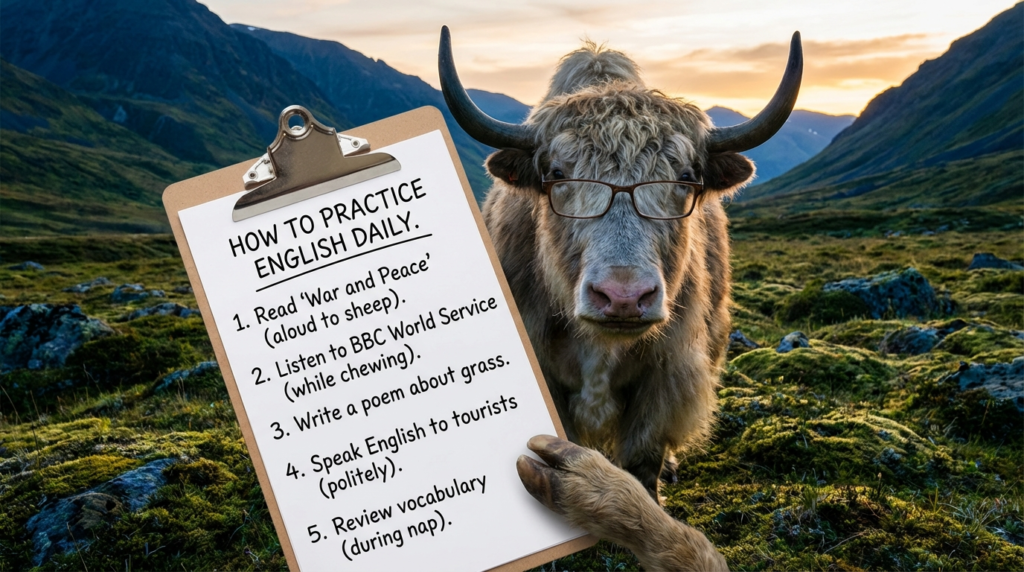
Your goal: practice English every day without burning out, forgetting everything, or “studying” for two hours and then quitting for two weeks.
Your secret weapon: a short routine you can actually finish. Consistency beats heroic effort. Daily tiny wins = real progress.
This guide gives you a simple daily English routine (5–15 minutes), plus practical vocabulary and phrases you can use in real life. You’ll practice speaking, listening, reading, and writing—without turning your day into a grammar prison.
Yak Box: The Daily Rule That Works
Do something in English every day—even 3 minutes. Your brain loves patterns. If you skip days, your brain goes, “Cool, we don’t do English anymore.”
- Minimum: 3 minutes (no excuses)
- Normal: 10–15 minutes (steady growth)
- Bonus: 25–40 minutes (when life allows)
Now let’s build your routine.
The Easy 15-Minute Daily English Routine
Minute 1–3: Speak Out Loud
Meaning: Say real sentences out loud. Not in your head. Your mouth needs training.
Do this: Read 3 sentences aloud and repeat them once with your own words.
“I’m getting ready for work. I’m running a little late. I’ll message you when I’m on my way.”
Try your version: “I’m getting ready for class. I’m running a little late. I’ll text you when I’m on my way.”
Minute 4–7: Listen For One Thing
Meaning: Don’t “listen to everything.” Pick one target: a phrase, a verb, or the speaker’s tone.
Do this: Listen to a short clip and catch one phrase. Replay once. Say it out loud.
Target phrase: “That makes sense.”
Example sentence: “Oh, that makes sense. Thanks for explaining.”
Minute 8–11: Read Something Tiny
Meaning: Read short, useful English: a text message, a post, a product description, a short news paragraph.
Do this: Read 1 short paragraph, then answer: What is the main idea?
Mini prompt: “What’s happening?” → “They changed the schedule.”
Example sentence: “Looks like the schedule changed. What time are we meeting now?”
Minute 12–15: Write 3 Lines
Meaning: Write a tiny journal. Not a novel. Your goal is clarity, not poetry.
Do this: Write 3 lines about your day using simple verbs.
- Today I…
- I need to…
- Tomorrow I will…
Example: “Today I worked from home. I need to buy groceries. Tomorrow I’ll call my friend.”
Visual Cards: Daily Practice Words You’ll Use Constantly
These are high-utility words and phrases for everyday life. Learn them once, then reuse them forever. Each card includes a simple meaning and real sentences.
Routine
Meaning: the usual way you do things every day.
Example: “My morning routine is coffee, a shower, and a quick walk.”
Example: “I’m trying to build a daily English routine.”
Stick With It
Meaning: continue even when it’s annoying or hard.
Example: “It felt awkward at first, but I stuck with it.”
Example: “Stick with this plan for two weeks and you’ll feel smoother.”
Quick Review
Meaning: a short look again to remember something.
Example: “I did a quick review of yesterday’s notes.”
Example: “Give me one minute—I’m doing a quick review.”
Focus
Meaning: pay attention to one thing, not everything.
Example: “I can’t focus when there’s a lot of noise.”
Example: “Today I’m focusing on past tense verbs.”
Out Loud
Meaning: using your voice (not silent).
Example: “Say it out loud so your mouth learns it.”
Example: “I practice English out loud while I cook.”
On My Way
Meaning: I’m going now / I’m traveling to you.
Example: “I’m on my way. I’ll be there in 10 minutes.”
Example: “Sorry—I’m running late, but I’m on my way.”
Useful Daily Phrases You Can Steal
Memorize? No. Reuse? Yes. Say these often and they’ll become automatic.
- I’m about to… (I will do it very soon.)
Example: “I’m about to leave—do you need anything?” - I’m trying to… (I’m making an effort.)
Example: “I’m trying to practice English every day.” - Can you say that again? (Repeat, please.)
Example: “Sorry—can you say that again?” - What do you mean by…? (Ask for clarification.)
Example: “What do you mean by ‘deadline’?” - Let me think. (I need a moment.)
Example: “Let me think… okay, here’s my idea.” - That makes sense. (I understand.)
Example: “That makes sense. I get it now.” - I’m not sure. (I don’t know, politely.)
Example: “I’m not sure. Let me check and I’ll tell you.” - It depends. (It changes based on the situation.)
Example: “It depends—what time do we need to leave?” - Good to know. (Helpful information.)
Example: “Good to know. I’ll remember that next time.” - I’ll get back to you. (I will reply later.)
Example: “I’ll get back to you after I confirm the details.” - Just a heads-up… (Small warning / notice.)
Example: “Just a heads-up, traffic is really bad today.” - Sounds good. (Agree casually.)
Example: “7 p.m.? Sounds good.”
Make It Stick: The “One Sentence Upgrade” Trick
Take a basic sentence and upgrade it slightly. This is how you grow vocabulary without drowning in word lists.
| Basic | Upgrade | Why It’s Better |
| I’m tired. | I’m wiped out. | More natural, casual American English. |
| I’m busy. | I’m swamped today. | Common in daily talk (casual). |
| I don’t know. | I’m not sure. | Softer and polite. |
| It’s okay. | It’s fine / It’s all good. | More everyday. |
Quick note: “Wiped out” and “swamped” are casual. In formal situations, say “I’m very tired” and “I’m very busy.”
Practice Section: 5-Minute Drills
Pick one drill each day. Keep it short. The goal is daily reps, not suffering.
Drill 1: Repeat + Swap One Word
Meaning: Repeat a sentence, then change one word to make a new sentence.
- Sentence: “I’m on my way.”
- Swap: “I’m on my way home.”
- Swap: “I’m on my way to the store.”
Drill 2: 3-Line Daily Journal
Meaning: Write three simple lines every day to build accuracy and speed.
Template: Today I… / I need to… / Tomorrow I will…
Example: “Today I studied English for 10 minutes. I need to reply to emails. Tomorrow I’ll go for a walk.”
Drill 3: Speak In “Chunks”
Meaning: Learn groups of words together (common combinations), not single words alone.
- Chunk: “run late” → “I’m running late.”
- Chunk: “get back to you” → “I’ll get back to you.”
- Chunk: “good to know” → “That’s good to know.”
Common Mistakes And Quick Fixes
- Mistake: Only reading or only watching videos.
Fix: Add speaking out loud for 2 minutes. Your mouth needs practice. - Mistake: Trying to learn 30 new words in one day.
Fix: Learn 3 and use each one in two sentences. - Mistake: Waiting until you “feel ready” to speak.
Fix: Speak first, feel ready later. (Annoying but true.) - Mistake: Translating every word.
Fix: Ask, “What’s the main idea?” and move on. - Mistake: Studying only grammar rules.
Fix: Learn a phrase and use it today: “I’m not sure,” “It depends,” “That makes sense.”
Tables Of Words: Daily Practice Vocabulary Sets
These tables keep things organized. Don’t memorize everything. Pick a small set and reuse it all week.
| Vocabulary | Meaning | Example 1 | Example 2 | Example 3 |
| practice | do something again to get better | I practice English daily. | I practice speaking in the mirror. | Practice makes you faster. |
| improve | get better | I want to improve my pronunciation. | This will improve your listening. | I’m improving slowly, but surely. |
| repeat | say/do again | Repeat that phrase. | Can you repeat it? | I repeat new sentences twice. |
| review | look again to remember | I review my notes at night. | Let’s review the basics. | A quick review helps a lot. |
| Vocabulary | Meaning | Example 1 | Example 2 | Example 3 |
| habit | something you do regularly | English is part of my habit now. | I’m building a study habit. | Good habits take time. |
| goal | something you want to achieve | My goal is 10 minutes a day. | Set a small goal. | I hit my goal this week. |
| schedule | plan for time | I practice on my schedule. | My schedule is busy today. | Let’s check the schedule. |
| consistency | doing it regularly | Consistency is the key. | I’m working on consistency. | Consistency beats intensity. |
Optional Variants: Polite Vs Casual
| Situation | Polite / Neutral | Casual |
| You didn’t understand | “Could you say that again?” | “Say that again?” |
| You need time | “Let me think for a moment.” | “Let me think.” |
| You will reply later | “I’ll get back to you soon.” | “I’ll get back to you.” |
| You agree | “That works for me.” | “Sounds good.” |
Final Yak
If you only remember one thing: daily tiny practice beats big weekly guilt sessions. Do 3 minutes on bad days, 15 minutes on normal days, and you’ll build real speaking confidence. Your future self will be annoyingly grateful.