French Transportation Vocabulary: 105+ Words & Phrases to Get Around (Without Getting Lost)
Topic: Transport / Getting around in French (with IPA + clickable audio)
You’re about to get a transportation cheat-sheet that works in real life: trains, metros, buses, taxis, airports, and all the tiny words that matter (like quai and correspondance).
Every item includes IPA pronunciation, an example sentence, and an audio button. Click, repeat, and enjoy sounding calm even when your connection is… not.
Yak Snark: In French travel situations, you can be wrong about directions and still be “polite.” That’s basically the whole strategy.
Quick pronunciation cheats (so you don’t fight the language)
French “r” is in the throat (ʁ). Nasal vowels matter: train /tʁɛ̃/ (don’t pronounce the “n”). And quai is just /kɛ/ (one syllable, surprise!).
The 8 “get-me-anywhere” essentials
High-frequency words you’ll actually use. Tap 🔊 and say them out loud once. (Yes, once. Then again. Then again.)
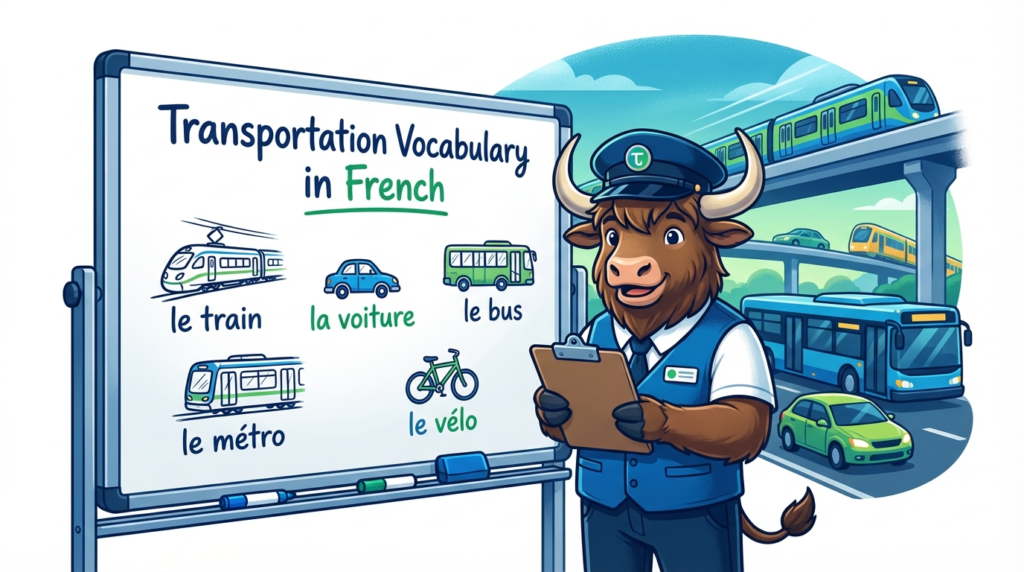
le métro
IPA: /lə metʁo/
the metro / subway
le bus
IPA: /lə bys/
the bus
le train
IPA: /lə tʁɛ̃/
the train
le taxi
IPA: /lə tak.si/
the taxi
la voiture
IPA: /la vwa.tyʁ/
the car
le vélo
IPA: /lə ve.lo/
the bicycle
l’avion
IPA: /la.vjɔ̃/
the airplane
le billet
IPA: /lə bi.jɛ/
the ticket (often for train/plane; also “ticket” exists)
Real-life phrases (the “please help me travel” pack)
Each phrase has a natural example so you can drop it into a sentence instead of freezing mid-syllable.
Où est l’arrêt de bus le plus proche ?
IPA: /u ɛ la.ʁɛ də by lə ply pʁɔʃ/
Where is the nearest bus stop?
Example: Excusez-moi, où est l’arrêt de bus le plus proche ?
“Excuse me, where is the nearest bus stop?”
Où est la station de métro ?
IPA: /u ɛ la sta.sjɔ̃ də metʁo/
Where is the metro station?
Example: Pardon, où est la station de métro la plus proche ?
“Sorry, where’s the nearest metro station?”
Je voudrais un billet pour Lyon, s’il vous plaît.
IPA: /ʒə vudʁɛ œ̃ bi.jɛ puʁ ljɔ̃ sil vu plɛ/
I’d like a ticket to Lyon, please.
Example: Je voudrais un billet pour Lyon, s’il vous plaît.
“I’d like a ticket to Lyon, please.”
Un aller simple, s’il vous plaît.
IPA: /œ̃n a.le sɛ̃.pl sil vu plɛ/
A one-way ticket, please.
Example: Un aller simple pour Bordeaux, s’il vous plaît.
“A one-way to Bordeaux, please.”
Un aller-retour, s’il vous plaît.
IPA: /œ̃n a.le ʁə.tuʁ sil vu plɛ/
A round trip, please.
Example: Un aller-retour pour demain matin, s’il vous plaît.
“A round trip for tomorrow morning, please.”
À quelle heure part le prochain train ?
IPA: /a kɛl œʁ paʁ lə pʁɔ.ʃɛ̃ tʁɛ̃/
What time does the next train leave?
Example: À quelle heure part le prochain train pour Nice ?
“What time does the next train to Nice leave?”
Sur quel quai ?
IPA: /syʁ kɛl kɛ/
On which platform?
Example: Sur quel quai part le train ?
“From which platform does the train leave?”
Est-ce que ce bus va vers le centre-ville ?
IPA: /ɛs kə sə by va vɛʁ lə sɑ̃tʁə vil/
Does this bus go toward downtown?
Example: Est-ce que ce bus va vers le centre-ville ou vers la gare ?
“Does this bus go toward downtown or toward the station?”
Je dois changer à Châtelet ?
IPA: /ʒə dwa ʃɑ̃.ʒe a ʃa.tə.lɛ/
Do I need to transfer at Châtelet?
Example: Je dois changer à République ?
“Do I need to transfer at République?”
C’est combien, le trajet ?
IPA: /sɛ kɔ̃.bjɛ̃ lə tʁa.ʒɛ/
How much is the ride?
Example: C’est combien, le trajet jusqu’à l’hôtel ?
“How much is the ride to the hotel?”
Vous pouvez mettre le compteur, s’il vous plaît ?
IPA: /vu pu.ve mɛtʁ lə kɔ̃.tœʁ sil vu plɛ/
Can you turn on the meter, please?
Example: Vous pouvez mettre le compteur, s’il vous plaît ?
“Can you turn on the meter, please?”
Je descends à la prochaine.
IPA: /ʒə de.sɑ̃ a la pʁɔ.ʃɛn/
I’m getting off at the next stop.
Example: Merci, je descends à la prochaine.
“Thanks, I’m getting off at the next stop.”
Pouvez-vous m’aider avec l’itinéraire ?
IPA: /pu.ve vu m‿e.de a.vɛk li.ti.nɛ.ʁɛʁ/
Can you help me with the route?
Example: Pouvez-vous m’aider avec l’itinéraire jusqu’au musée ?
“Can you help me with the route to the museum?”
Combien de temps ça prend ?
IPA: /kɔ̃.bjɛ̃ də tɑ̃ sa pʁɑ̃/
How long does it take?
Example: Combien de temps ça prend en métro ?
“How long does it take by metro?”
C’est direct ou avec correspondance ?
IPA: /sɛ di.ʁɛk u a.vɛk kɔ.ʁɛs.pɔ̃.dɑ̃s/
Is it direct or with a transfer?
Example: C’est direct ou avec correspondance à Lille ?
“Is it direct or with a transfer in Lille?”
Où puis-je acheter un ticket ?
IPA: /u pɥi ʒaʃ.te œ̃ ti.kɛ/
Where can I buy a ticket?
Example: Où puis-je acheter un ticket pour le métro ?
“Where can I buy a metro ticket?”
Je peux payer par carte ?
IPA: /ʒə pø pe.je paʁ kaʁt/
Can I pay by card?
Example: Je peux payer par carte bancaire ?
“Can I pay by bank card?”
Je dois valider mon ticket ?
IPA: /ʒə dwa va.li.de mɔ̃ ti.kɛ/
Do I need to validate my ticket?
Example: Je dois valider mon ticket avant de monter ?
“Do I need to validate my ticket before getting on?”
La sortie est par où ?
IPA: /la sɔʁ.ti ɛ paʁ u/
Which way is the exit?
Example: La sortie “Rue Victor Hugo”, c’est par où ?
“The ‘Rue Victor Hugo’ exit—where is it?”
Ce siège est libre ?
IPA: /sə sjɛʒ ɛ libʁ/
Is this seat free?
Example: Pardon, ce siège est libre ?
“Sorry, is this seat free?”
On s’arrête ici ?
IPA: /ɔ̃ sa.ʁɛt i.si/
Do we stop here?
Example: On s’arrête ici pour la gare ?
“Do we stop here for the station?”
J’ai raté ma correspondance.
IPA: /ʒe ʁa.te ma kɔ.ʁɛs.pɔ̃.dɑ̃s/
I missed my connection.
Example: J’ai raté ma correspondance, je fais quoi ?
“I missed my connection—what do I do?”
Le train est en retard.
IPA: /lə tʁɛ̃ ɛt ɑ̃ ʁə.taʁ/
The train is delayed.
Example: Le train est en retard de vingt minutes.
“The train is 20 minutes late.”
Mon vol est annulé.
IPA: /mɔ̃ vɔl ɛ a.ny.le/
My flight is canceled.
Example: Mon vol est annulé, quelles sont mes options ?
“My flight is canceled—what are my options?”
Je cherche un taxi.
IPA: /ʒə ʃɛʁʃ œ̃ tak.si/
I’m looking for a taxi.
Example: Je cherche un taxi pour aller à l’aéroport.
“I’m looking for a taxi to go to the airport.”
Yak Snark: If you can say Sur quel quai ? and look confident, people will assume you are… vaguely in control of your life.
Vocabulary tables (organized by real travel moments)
Use the search bar at the top to instantly filter these tables. (Because scrolling is cardio.)
1) Ways to travel
| French | IPA | Meaning (EN) | Example (FR) | Translation (EN) | Audio |
|---|---|---|---|---|---|
| se déplacer | /sə de.pla.se/ | to get around | Je me déplace en métro tous les jours. | I get around by metro every day. | |
| les transports en commun | /le tʁɑ̃.spɔʁ ɑ̃ kɔ.mœ̃/ | public transportation | Les transports en commun sont pratiques ici. | Public transport is convenient here. | |
| le métro | /lə metʁo/ | metro / subway | Le métro passe toutes les cinq minutes. | The metro comes every five minutes. | |
| le bus | /lə bys/ | bus | Je prends le bus pour aller au musée. | I take the bus to go to the museum. | |
| le tramway | /lə tʁam.wɛ/ | tram | Le tramway s’arrête juste devant l’hôtel. | The tram stops right in front of the hotel. | |
| le train | /lə tʁɛ̃/ | train | Le train pour Marseille est à l’heure. | The train to Marseille is on time. | |
| le TER | /te.ɛ.ʁ/ | regional train (France) | On prend le TER pour aller à la mer. | We take the regional train to go to the sea. | |
| le TGV | /te.ʒe.ve/ | high-speed train | Le TGV est plus rapide que le bus. | The high-speed train is faster than the bus. | |
| le taxi | /lə tak.si/ | taxi | Je prends un taxi quand il pleut. | I take a taxi when it’s raining. | |
| le VTC | /ve.te.se/ | ride-hailing car (private hire) | J’ai commandé un VTC sur l’appli. | I ordered a ride-hail car on the app. | |
| le covoiturage | /lə kɔ.vwa.ty.ʁaʒ/ | carpooling | Le covoiturage coûte souvent moins cher. | Carpooling is often cheaper. | |
| la voiture | /la vwa.tyʁ/ | car | On a loué une voiture pour le week-end. | We rented a car for the weekend. | |
| le vélo | /lə ve.lo/ | bicycle | Je vais au travail à vélo. | I go to work by bike. | |
| la trottinette électrique | /la tʁɔ.ti.nɛt e.lɛk.tʁik/ | electric scooter | Il vient en trottinette électrique. | He comes by electric scooter. |
2) At the station / stop
| French | IPA | Meaning (EN) | Example (FR) | Translation (EN) | Audio |
|---|---|---|---|---|---|
| la gare | /la ɡaʁ/ | train station | La gare est à dix minutes à pied. | The station is a 10-minute walk. | |
| l’arrêt (de bus) | /la.ʁɛ/ | stop (bus stop) | L’arrêt de bus est juste là-bas. | The bus stop is right over there. | |
| la station (de métro) | /la sta.sjɔ̃/ | station (metro) | La station ferme à minuit. | The station closes at midnight. | |
| la ligne | /la liɲ/ | line / route | Je prends la ligne 1 pour aller au centre. | I take line 1 to go downtown. | |
| la correspondance | /la kɔ.ʁɛs.pɔ̃.dɑ̃s/ | connection / transfer | On a cinq minutes pour la correspondance. | We have five minutes for the transfer. | |
| le quai | /lə kɛ/ | platform | Le train part du quai 7. | The train leaves from platform 7. | |
| la voie | /la vwa/ | track / platform track | Attention, le train arrive voie 3. | Attention, the train is arriving on track 3. | |
| le plan | /lə plɑ̃/ | map | Je regarde le plan du métro. | I’m looking at the metro map. | |
| l’horaire | /l‿ɔ.ʁɛʁ/ | schedule / timetable | L’horaire est affiché à l’entrée. | The schedule is posted at the entrance. | |
| le guichet | /lə ɡi.ʃɛ/ | ticket counter | Le guichet ouvre à huit heures. | The ticket counter opens at 8. | |
| la borne | /la bɔʁn/ | ticket machine / kiosk | On peut acheter des billets à la borne. | You can buy tickets at the machine. | |
| la sortie | /la sɔʁ.ti/ | exit | La sortie “Centre-ville” est à droite. | The “Downtown” exit is on the right. | |
| l’entrée | /l‿ɑ̃.tʁe/ | entrance | L’entrée du métro est en face. | The metro entrance is across the street. | |
| le contrôleur | /lə kɔ̃.tʁo.lœʁ/ | ticket inspector | Le contrôleur a demandé mon billet. | The inspector asked for my ticket. |
3) Tickets & money stuff
| French | IPA | Meaning (EN) | Example (FR) | Translation (EN) | Audio |
|---|---|---|---|---|---|
| le billet | /lə bi.jɛ/ | ticket (often train/plane) | J’ai déjà mon billet sur mon téléphone. | I already have my ticket on my phone. | |
| le ticket | /lə ti.kɛ/ | ticket (often metro/bus) | Il me faut deux tickets, s’il vous plaît. | I need two tickets, please. | |
| un aller simple | /œ̃n‿a.le sɛ̃.pl/ | one-way | Je prends un aller simple pour Nantes. | I’m getting a one-way to Nantes. | |
| un aller-retour | /œ̃n‿a.le ʁə.tuʁ/ | round trip | Un aller-retour revient moins cher. | A round trip costs less. | |
| un abonnement | /œ̃n‿a.bɔ.nə.mɑ̃/ | subscription / transit pass | J’ai un abonnement mensuel. | I have a monthly pass. | |
| un pass journalier | /œ̃ pas ʒuʁ.na.lje/ | day pass | On achète un pass journalier pour visiter la ville. | We buy a day pass to explore the city. | |
| le titre de transport | /lə titʁ də tʁɑ̃.spɔʁ/ | fare ticket (official term) | Gardez votre titre de transport jusqu’à la sortie. | Keep your ticket until you exit. | |
| la validation | /la va.li.da.sjɔ̃/ | validation (of ticket) | La validation se fait à l’entrée. | Validation is done at the entrance. | |
| valider (un ticket) | /va.li.de/ | to validate | N’oubliez pas de valider votre ticket. | Don’t forget to validate your ticket. | |
| le tarif réduit | /lə ta.ʁif ʁe.dɥi/ | reduced fare | Le tarif réduit est pour les étudiants. | The reduced fare is for students. | |
| le plein tarif | /lə plɛ̃ ta.ʁif/ | full fare | J’ai payé le plein tarif. | I paid the full fare. | |
| la carte bancaire | /la kaʁt bɑ̃.kɛʁ/ | bank card | Je peux payer par carte bancaire ? | Can I pay by card? | |
| l’amende | /la.mɑ̃d/ | fine | Sans ticket validé, vous risquez une amende. | Without a validated ticket, you risk a fine. |
4) Driving & roads
| French | IPA | Meaning (EN) | Example (FR) | Translation (EN) | Audio |
|---|---|---|---|---|---|
| le permis de conduire | /lə pɛʁ.mi də kɔ̃.dɥiʁ/ | driver’s license | Il faut un permis de conduire pour louer une voiture. | You need a driver’s license to rent a car. | |
| louer une voiture | /lwe yn vwa.tyʁ/ | to rent a car | On va louer une voiture à l’aéroport. | We’re going to rent a car at the airport. | |
| la location | /la lɔ.ka.sjɔ̃/ | rental | La location inclut l’assurance de base. | The rental includes basic insurance. | |
| la station-service | /la sta.sjɔ̃ sɛʁ.vis/ | gas station | Il y a une station-service à la sortie. | There’s a gas station at the exit. | |
| faire le plein | /fɛʁ lə plɛ̃/ | to fill up (tank) | On doit faire le plein avant de partir. | We need to fill up before leaving. | |
| le feu rouge | /lə fø ʁuʒ/ | red light | On s’arrête au feu rouge. | We stop at the red light. | |
| le rond-point | /lə ʁɔ̃ pwɛ̃/ | roundabout | Au rond-point, prenez la deuxième sortie. | At the roundabout, take the second exit. | |
| un embouteillage | /œ̃n ɑ̃.bu.tɛ.jaʒ/ | traffic jam | Il y a un embouteillage sur l’autoroute. | There’s a traffic jam on the highway. | |
| le péage | /lə pe.aʒ/ | toll | Le péage se paie par carte. | The toll can be paid by card. | |
| l’autoroute | /lo.tɔ.ʁut/ | highway | L’autoroute est plus rapide, mais il y a des péages. | The highway is faster, but there are tolls. | |
| la limitation de vitesse | /la li.mi.ta.sjɔ̃ də vi.tɛs/ | speed limit | La limitation de vitesse est de 50 en ville. | The speed limit is 50 in the city. | |
| le stationnement | /lə sta.sjɔ.nə.mɑ̃/ | parking (the act/fee) | Le stationnement est payant ici. | Parking is paid here. | |
| se garer | /sə ɡa.ʁe/ | to park | Je peux me garer près d’ici ? | Can I park near here? | |
| le GPS | /ʒe.pe.ɛs/ | GPS | Le GPS me dit de tourner à gauche. | The GPS tells me to turn left. |
5) Walking, cycling & micro-mobility
| French | IPA | Meaning (EN) | Example (FR) | Translation (EN) | Audio |
|---|---|---|---|---|---|
| la piste cyclable | /la pist si.klabl/ | bike lane | Restez sur la piste cyclable, s’il vous plaît. | Stay in the bike lane, please. | |
| le casque | /lə kask/ | helmet | Je mets mon casque avant de partir. | I put on my helmet before leaving. | |
| le cadenas | /lə ka.dna/ | lock | J’ai oublié mon cadenas. | I forgot my lock. | |
| la chaîne | /la ʃɛn/ | chain | La chaîne a sauté, je dois réparer. | The chain slipped off; I need to fix it. | |
| le pneu | /lə pnø/ | tire | J’ai crevé un pneu. | I got a flat tire. | |
| le guidon | /lə ɡi.dɔ̃/ | handlebar | Le guidon est un peu trop bas pour moi. | The handlebar is a bit too low for me. | |
| les freins | /le fʁɛ̃/ | brakes | Les freins ne marchent pas bien. | The brakes don’t work well. | |
| pédaler | /pe.da.le/ | to pedal | Il faut pédaler fort dans la côte. | You have to pedal hard up the hill. | |
| marcher | /maʁ.ʃe/ | to walk | On peut marcher jusqu’au centre-ville. | We can walk to downtown. | |
| traverser | /tʁa.vɛʁ.se/ | to cross | On traverse la rue au feu vert. | We cross the street on the green light. | |
| le passage piéton | /lə pa.saʒ pje.tɔ̃/ | crosswalk | Utilisez le passage piéton, s’il vous plaît. | Please use the crosswalk. | |
| le trottoir | /lə tʁɔ.twaʁ/ | sidewalk | Restez sur le trottoir. | Stay on the sidewalk. | |
| la station de vélos en libre-service | /la sta.sjɔ̃ də ve.lo ɑ̃ libʁə sɛʁ.vis/ | bike-share station | La station de vélos en libre-service est au coin. | The bike-share station is on the corner. |
6) Air & sea travel
| French | IPA | Meaning (EN) | Example (FR) | Translation (EN) | Audio |
|---|---|---|---|---|---|
| l’aéroport | /la.e.ʁɔ.pɔʁ/ | airport | L’aéroport est à trente minutes d’ici. | The airport is 30 minutes from here. | |
| l’avion | /la.vjɔ̃/ | airplane | Je prends l’avion demain matin. | I’m taking the plane tomorrow morning. | |
| le vol | /lə vɔl/ | flight | Mon vol part à 18 h 20. | My flight leaves at 6:20 p.m. | |
| la porte d’embarquement | /la pɔʁt dɑ̃.baʁ.kə.mɑ̃/ | boarding gate | La porte d’embarquement a changé. | The boarding gate has changed. | |
| la carte d’embarquement | /la kaʁt dɑ̃.baʁ.kə.mɑ̃/ | boarding pass | Je montre ma carte d’embarquement. | I show my boarding pass. | |
| l’embarquement | /l‿ɑ̃.baʁ.kə.mɑ̃/ | boarding | L’embarquement commence dans dix minutes. | Boarding starts in ten minutes. | |
| le contrôle de sécurité | /lə kɔ̃.tʁol də se.ky.ʁi.te/ | security check | Le contrôle de sécurité est juste après. | Security is right after that. | |
| le bagage à main | /lə ba.ɡaʒ a mɛ̃/ | carry-on bag | Mon bagage à main est trop lourd. | My carry-on is too heavy. | |
| la valise | /la va.liz/ | suitcase | Ma valise est enregistrée. | My suitcase is checked in. | |
| la soute | /la sut/ | cargo hold | La valise va en soute. | The suitcase goes in the hold. | |
| le bateau | /lə ba.to/ | boat | On va prendre le bateau pour l’île. | We’re going to take the boat to the island. | |
| le ferry | /lə fe.ʁi/ | ferry | Le ferry part à 9 heures. | The ferry leaves at 9 o’clock. | |
| le mal de mer | /lə mal də mɛʁ/ | seasickness | J’ai le mal de mer sur les petites vagues. | I get seasick on small waves. |
Variants & common alternates (aka “French words that love to double up”)
These come up constantly. If you learn just this box, you’ll already understand a lot of signs and announcements.
| Concept | Common French options | When you’ll see it |
|---|---|---|
| Ticket | le ticket • le billet • le titre de transport | Metro/bus often say “ticket”; trains/planes often “billet”; official notices love “titre de transport.” |
| Where you wait | l’arrêt • la station • la gare | Bus = arrêt. Metro = station. Trains = gare (big station). |
| Coach bus | le car • l’autocar | Long-distance bus/coach. (Yes, “car” in French is not “car” in English. Classic.) |
| Taxi-like | le taxi • le VTC | Taxi = licensed cab. VTC = app-based private hire ride. |