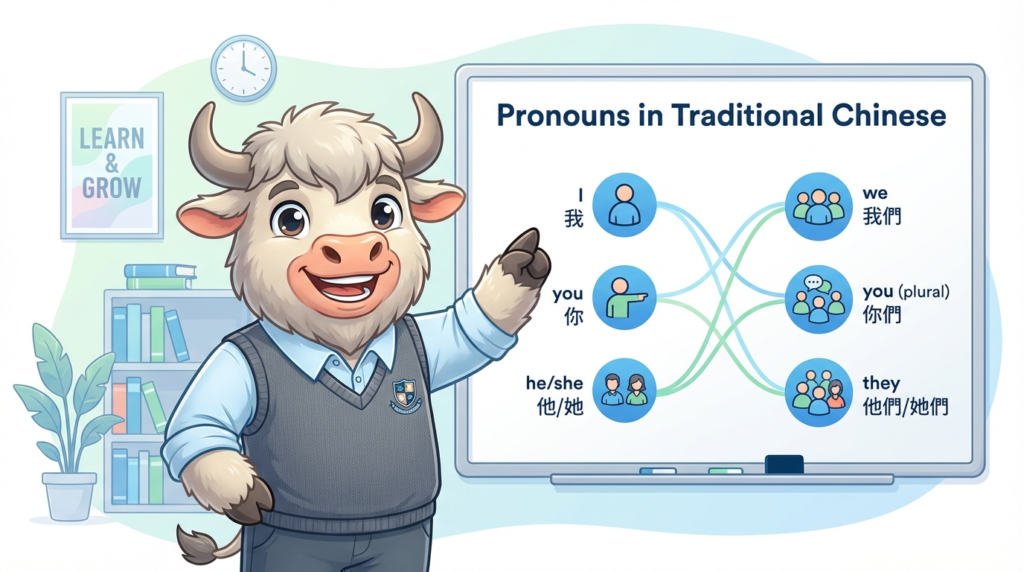
Pronouns in Traditional Chinese (Without the Headache)
Get the core pronouns, the polite versions, and the “why is it all tā?” stuff—with pinyin, meanings, and real sentences. 代名詞
This guide gives you Traditional Chinese pronouns in a way that actually sticks: characters, pinyin (with tone marks), clear meanings, and short real-life examples. Tap the speaker buttons to hear the Mandarin (zh-TW).
You’ll learn the everyday basics (I/you/he/she/it), plural forms (we/they), polite options, and the super useful “who/what/which/where” question words. Minimal drama. Maximum usefulness.
Quick-Use Pronoun Cards
These are the ones you’ll use constantly. Learn them first, then flex on the rest.
我
wǒ
I / me
我是台灣人。
Wǒ shì Táiwān rén.
I’m Taiwanese.
你
nǐ
you (singular)
你今天忙嗎?
Nǐ jīntiān máng ma?
Are you busy today?
您
nín
you (polite)
您好,請問您要喝什麼?
Nín hǎo, qǐngwèn nín yào hē shénme?
Hello—what would you like to drink?
他
tā
he / him
他在樓上。
Tā zài lóushàng.
He’s upstairs.
她
tā
she / her
她很會說中文。
Tā hěn huì shuō Zhōngwén.
She can speak Chinese well.
它
tā
it
這隻貓很可愛,我喜歡它。
Zhè zhī māo hěn kě’ài, wǒ xǐhuan tā.
This cat is cute—I like it.
我們
wǒmen
we / us
我們走吧。
Wǒmen zǒu ba.
Let’s go.
他們
tāmen
they / them (people)
他們是我的同事。
Tāmen shì wǒ de tóngshì.
They’re my coworkers.
Pronoun-Powered Phrases You’ll Actually Say
These are copy-paste useful in real life: introductions, blame avoidance, and “leave it to me” hero moments.
這是我。
Zhè shì wǒ.
This is me.
嗨,這是我。
Hāi, zhè shì wǒ.
Hi, this is me.
你是誰?
Nǐ shì shéi?
Who are you?
你是誰?我不認識你。
Nǐ shì shéi? Wǒ bù rènshi nǐ.
Who are you? I don’t know you.
我也是。
Wǒ yě shì.
Me too.
你喜歡咖啡嗎?我也是。
Nǐ xǐhuan kāfēi ma? Wǒ yě shì.
Do you like coffee? Me too.
不是我。
Bú shì wǒ.
Not me.
不是我弄的。
Bú shì wǒ nòng de.
I didn’t do it.
跟我來。
Gēn wǒ lái.
Follow me.
跟我來,我帶你去。
Gēn wǒ lái, wǒ dài nǐ qù.
Follow me—I’ll take you there.
交給我。
Jiāogěi wǒ.
Leave it to me.
這件事交給我。
Zhè jiàn shì jiāogěi wǒ.
Leave this matter to me.
你自己來。
Nǐ zìjǐ lái.
Do it yourself.
這很簡單,你自己來。
Zhè hěn jiǎndān, nǐ zìjǐ lái.
It’s simple—do it yourself.
我自己來。
Wǒ zìjǐ lái.
I’ll do it myself.
不用幫忙,我自己來。
Búyòng bāngmáng, wǒ zìjǐ lái.
No need to help—I’ll do it myself.
彼此彼此。
Bǐcǐ bǐcǐ.
Likewise / same to you.
你很客氣。彼此彼此。
Nǐ hěn kèqì. Bǐcǐ bǐcǐ.
You’re so polite. Likewise.
你們先走。
Nǐmen xiān zǒu.
You all go first.
你們先走,我等等就到。
Nǐmen xiān zǒu, wǒ děngděng jiù dào.
You go first—I’ll be there soon.
他們在那邊。
Tāmen zài nàbiān.
They’re over there.
他們在那邊等我們。
Tāmen zài nàbiān děng wǒmen.
They’re waiting for us over there.
這是我的。
Zhè shì wǒ de.
This is mine.
這是我的,不是你的。
Zhè shì wǒ de, bú shì nǐ de.
This is mine, not yours.
A Tiny Bit of “Why Does This Work Like That?”
他 / 她 / 它 all sound like “tā”. In speaking, context usually does the job. In writing, you’ll see different characters for he/she/it.
“們” makes plural. 你 → 你們, 他 → 他們. It’s most common for people; it can be used for animals/things sometimes, but people-first is the safe default.
Possessive is usually “的”. 我的 = my/mine, 他的 = his. In very close relationships, “的” can be dropped sometimes (我媽, 我朋友), but learn the “的” version first.
Table of Pronouns and Related Words
Grouped so your brain doesn’t rage-quit. Each row has an example sentence, pinyin, and translation.
People Pronouns & “Someone/Everyone” Words
Useful for talking about people in general, plus “someone / no one / anyone / everyone”.
| Traditional Chinese | Pinyin | Meaning (EN) | Example (ZH + pinyin) | Translation (EN) | Audio |
|---|---|---|---|---|---|
| 妳 | nǐ | you (female, written) | 妳今天好嗎? Nǐ jīntiān hǎo ma? | How are you today? | |
| 咱 | zán | I / we (casual, dialecty) | 咱先吃飯吧。 Zán xiān chīfàn ba. | Let’s eat first. | |
| 咱們 | zánmen | we / us (casual, inclusive) | 咱們一起走。 Zánmen yìqǐ zǒu. | Let’s go together. | |
| 大家 | dàjiā | everyone (all of us/you) | 大家都到了嗎? Dàjiā dōu dào le ma? | Is everyone here? | |
| 別人 | biérén | other people / others | 不要一直麻煩別人。 Búyào yìzhí máfan biérén. | Don’t keep bothering others. | |
| 其他人 | qítā rén | other people | 其他人還沒到。 Qítā rén hái méi dào. | The others haven’t arrived yet. | |
| 某人 | mǒurén | someone (unspecified) | 某人把門打開了。 Mǒurén bǎ mén dǎkāi le. | Someone opened the door. | |
| 有人 | yǒurén | someone / there is someone | 有人找你。 Yǒurén zhǎo nǐ. | Someone is looking for you. | |
| 沒有人 | méi yǒurén | no one | 這裡沒有人。 Zhèlǐ méi yǒurén. | There’s no one here. | |
| 任何人 | rènhé rén | anyone | 你可以問任何人。 Nǐ kěyǐ wèn rènhé rén. | You can ask anyone. | |
| 每個人 | měi ge rén | everyone (each person) | 每個人都有自己的想法。 Měi ge rén dōu yǒu zìjǐ de xiǎngfǎ. | Everyone has their own ideas. | |
| 人人 | rénrén | everyone (all people) | 人人都需要休息。 Rénrén dōu xūyào xiūxí. | Everyone needs rest. | |
| 所有人 | suǒyǒu rén | everyone / all people | 所有人都同意。 Suǒyǒu rén dōu tóngyì. | Everyone agrees. |
Plural & Group Forms
When it’s more than one person (or you’re addressing a group).
| Traditional Chinese | Pinyin | Meaning (EN) | Example (ZH + pinyin) | Translation (EN) | Audio |
|---|---|---|---|---|---|
| 你們 | nǐmen | you (plural) | 你們想吃什麼? Nǐmen xiǎng chī shénme? | What do you all want to eat? | |
| 她們 | tāmen | they (women) | 她們今天不來。 Tāmen jīntiān bù lái. | They (the women) aren’t coming today. | |
| 它們 | tāmen | they (things/animals) | 這些杯子很乾淨,我喜歡它們。 Zhèxiē bēizi hěn gānjìng, wǒ xǐhuan tāmen. | These cups are clean—I like them. | |
| 各位 | gèwèi | everyone (polite address) | 各位,請往這邊走。 Gèwèi, qǐng wǎng zhèbiān zǒu. | Everyone, please come this way. | |
| 我們大家 | wǒmen dàjiā | all of us | 我們大家一起拍照。 Wǒmen dàjiā yìqǐ pāizhào. | All of us take a photo together. | |
| 你們大家 | nǐmen dàjiā | all of you | 你們大家都準備好了嗎? Nǐmen dàjiā dōu zhǔnbèi hǎo le ma? | Are all of you ready? | |
| 這些人 | zhèxiē rén | these people | 這些人是我的朋友。 Zhèxiē rén shì wǒ de péngyǒu. | These people are my friends. | |
| 那些人 | nàxiē rén | those people | 那些人不認識我。 Nàxiē rén bù rènshi wǒ. | Those people don’t know me. | |
| 彼此 | bǐcǐ | each other | 我們彼此幫忙。 Wǒmen bǐcǐ bāngmáng. | We help each other. | |
| 互相 | hùxiāng | mutually / each other | 他們互相尊重。 Tāmen hùxiāng zūnzhòng. | They respect each other. |
Possessives with 的
My/your/his/her/their. Put 的 after the pronoun to show ownership.
| Traditional Chinese | Pinyin | Meaning (EN) | Example (ZH + pinyin) | Translation (EN) | Audio |
|---|---|---|---|---|---|
| 我的 | wǒ de | my / mine | 這是我的手機。 Zhè shì wǒ de shǒujī. | This is my phone. | |
| 你的 | nǐ de | your / yours | 你的外套在那邊。 Nǐ de wàitào zài nàbiān. | Your jacket is over there. | |
| 您的 | nín de | your / yours (polite) | 這是您的訂單。 Zhè shì nín de dìngdān. | This is your order. | |
| 他的 | tā de | his | 他的名字很特別。 Tā de míngzì hěn tèbié. | His name is unique. | |
| 她的 | tā de | her | 我喜歡她的笑容。 Wǒ xǐhuan tā de xiàoróng. | I like her smile. | |
| 它的 | tā de | its | 這台機器有它的問題。 Zhè tái jīqì yǒu tā de wèntí. | This machine has its issues. | |
| 我們的 | wǒmen de | our / ours | 這是我們的座位。 Zhè shì wǒmen de zuòwèi. | These are our seats. | |
| 你們的 | nǐmen de | your / yours (plural) | 你們的計畫很棒。 Nǐmen de jìhuà hěn bàng. | Your plan is great. | |
| 他們的 | tāmen de | their (people) | 他們的公司在台北。 Tāmen de gōngsī zài Táiběi. | Their company is in Taipei. | |
| 她們的 | tāmen de | their (women) | 她們的房間很乾淨。 Tāmen de fángjiān hěn gānjìng. | Their room is very clean. | |
| 它們的 | tāmen de | their (things/animals) | 狗狗有它們的規矩。 Gǒugǒu yǒu tāmen de guījǔ. | Dogs have their own rules. | |
| 別人的 | biérén de | someone else’s | 不要拿別人的東西。 Búyào ná biérén de dōngxī. | Don’t take other people’s stuff. | |
| 自己的 | zìjǐ de | one’s own | 每個人都要照顧自己的健康。 Měi ge rén dōu yào zhàogù zìjǐ de jiànkāng. | Everyone should take care of their own health. |
Demonstratives: This / That / Here / There
Pointing at things is a life skill. These make it easy.
| Traditional Chinese | Pinyin | Meaning (EN) | Example (ZH + pinyin) | Translation (EN) | Audio |
|---|---|---|---|---|---|
| 這 | zhè | this | 這很重要。 Zhè hěn zhòngyào. | This is important. | |
| 那 | nà | that | 那不是我想要的。 Nà bú shì wǒ xiǎng yào de. | That’s not what I want. | |
| 這個 | zhè ge | this one | 我想要這個。 Wǒ xiǎng yào zhè ge. | I want this one. | |
| 那個 | nà ge | that one | 那個比較便宜。 Nà ge bǐjiào piányí. | That one is cheaper. | |
| 這些 | zhèxiē | these | 這些都是你的嗎? Zhèxiē dōu shì nǐ de ma? | Are these all yours? | |
| 那些 | nàxiē | those | 那些我不需要。 Nàxiē wǒ bù xūyào. | I don’t need those. | |
| 這裡 | zhèlǐ | here | 我們在這裡等。 Wǒmen zài zhèlǐ děng. | We’ll wait here. | |
| 那裡 | nàlǐ | there | 他在那裡。 Tā zài nàlǐ. | He’s there. | |
| 這邊 | zhèbiān | over here / this side | 請坐這邊。 Qǐng zuò zhèbiān. | Please sit here. | |
| 那邊 | nàbiān | over there / that side | 廁所在那邊。 Cèsuǒ zài nàbiān. | The restroom is over there. | |
| 這附近 | zhè fùjìn | around here / nearby | 這附近有咖啡店嗎? Zhè fùjìn yǒu kāfēidiàn ma? | Is there a café around here? | |
| 那裡面 | nà lǐmiàn | in there | 鑰匙在那裡面。 Yàoshi zài nà lǐmiàn. | The keys are in there. |
Question Pronouns: Who / What / Which / Where
These pop up everywhere—because humans love asking questions and being confused.
| Traditional Chinese | Pinyin | Meaning (EN) | Example (ZH + pinyin) | Translation (EN) | Audio |
|---|---|---|---|---|---|
| 誰 | shéi | who | 那是誰? Nà shì shéi? | Who is that? | |
| 哪位 | nǎwèi | who (polite “which person”) | 請問您是哪位? Qǐngwèn nín shì nǎwèi? | May I ask who you are? | |
| 什麼 | shénme | what | 你在看什麼? Nǐ zài kàn shénme? | What are you looking at? | |
| 哪 | nǎ | which | 你想去哪一家? Nǐ xiǎng qù nǎ yì jiā? | Which place do you want to go to? | |
| 哪個 | nǎ ge | which one | 你要哪個? Nǐ yào nǎ ge? | Which one do you want? | |
| 哪些 | nǎxiē | which ones | 哪些是你的? Nǎxiē shì nǐ de? | Which ones are yours? | |
| 哪裡 | nǎlǐ | where | 你住哪裡? Nǐ zhù nǎlǐ? | Where do you live? | |
| 哪邊 | nǎbiān | where (which side) | 出口在哪邊? Chūkǒu zài nǎbiān? | Where is the exit? | |
| 多少 | duōshǎo | how many / how much | 這個多少錢? Zhè ge duōshǎo qián? | How much is this? | |
| 幾 | jǐ | how many (small number) | 你有幾個兄弟姐妹? Nǐ yǒu jǐ ge xiōngdì jiěmèi? | How many siblings do you have? | |
| 幾個 | jǐ ge | how many (count) | 你要幾個? Nǐ yào jǐ ge? | How many do you want? | |
| 誰的 | shéi de | whose | 這是誰的包包? Zhè shì shéi de bāobāo? | Whose bag is this? | |
| 什麼樣的 | shénme yàng de | what kind of | 你喜歡什麼樣的電影? Nǐ xǐhuan shénme yàng de diànyǐng? | What kind of movies do you like? | |
| 哪一個 | nǎ yí ge | which one (explicit) | 哪一個是你選的? Nǎ yí ge shì nǐ xuǎn de? | Which one did you choose? |
Indefinite Patterns: “Everyone / Anyone / Anything / Anywhere”
These are super common with 都 (all) and 也 (even/also), especially with negation.
| Traditional Chinese | Pinyin | Meaning (EN) | Example (ZH + pinyin) | Translation (EN) | Audio |
|---|---|---|---|---|---|
| 誰都 | shéi dōu | everyone / anyone | 這件事誰都知道。 Zhè jiàn shì shéi dōu zhīdào. | Everyone knows this. | |
| 誰也 | shéi yě | anyone (with negation) | 我誰也不想見。 Wǒ shéi yě bù xiǎng jiàn. | I don’t want to see anyone. | |
| 什麼都 | shénme dōu | anything / everything | 他什麼都會。 Tā shénme dōu huì. | He can do everything. | |
| 什麼也 | shénme yě | anything (with negation) | 我什麼也沒說。 Wǒ shénme yě méi shuō. | I didn’t say anything. | |
| 哪裡都 | nǎlǐ dōu | everywhere / anywhere | 週末我哪裡都不想去。 Zhōumò wǒ nǎlǐ dōu bù xiǎng qù. | This weekend I don’t want to go anywhere. | |
| 哪裡也 | nǎlǐ yě | anywhere (with negation) | 我哪裡也找不到它。 Wǒ nǎlǐ yě zhǎo bú dào tā. | I can’t find it anywhere. | |
| 任何東西 | rènhé dōngxī | anything (a thing) | 我不想買任何東西。 Wǒ bù xiǎng mǎi rènhé dōngxī. | I don’t want to buy anything. | |
| 某些 | mǒuxiē | some (certain) | 某些人不喜歡早起。 Mǒuxiē rén bù xǐhuan zǎoqǐ. | Some people don’t like waking up early. | |
| 其中一個 | qízhōng yí ge | one of them | 我想要其中一個就好。 Wǒ xiǎng yào qízhōng yí ge jiù hǎo. | I just want one of them. | |
| 別的 | bié de | other (one/ones) | 我想換別的。 Wǒ xiǎng huàn bié de. | I want to switch to another one. | |
| 其他的 | qítā de | other (ones) | 其他的我都不要。 Qítā de wǒ dōu bú yào. | I don’t want the others. |
Helpful Variants (So You Don’t Accidentally Sound Too Casual)
Same idea, different vibe. Learn these and your Chinese instantly sounds more natural.
| Variant | Use | Notes | Audio |
|---|---|---|---|
| 你 / 您 | nǐ / nín | Use 您 for customers, elders, or formal situations. Use 你 with friends and peers. | |
| 你 / 妳 | nǐ / nǐ | 妳 is a written “you” for women. In speech, both are just nǐ. | |
| 他 / 她 / 它 | tā / tā / tā | Same sound, different characters. Speaking relies on context; writing shows gender/thing. | |
| 我們 / 咱們 | wǒmen / zánmen | 咱們 feels extra casual and often “inclusive”. 我們 works everywhere. | |
| 他們 / 她們 / 它們 | tāmen / tāmen / tāmen | Writing distinguishes men/mixed groups vs women vs things. Speaking: all tāmen. |