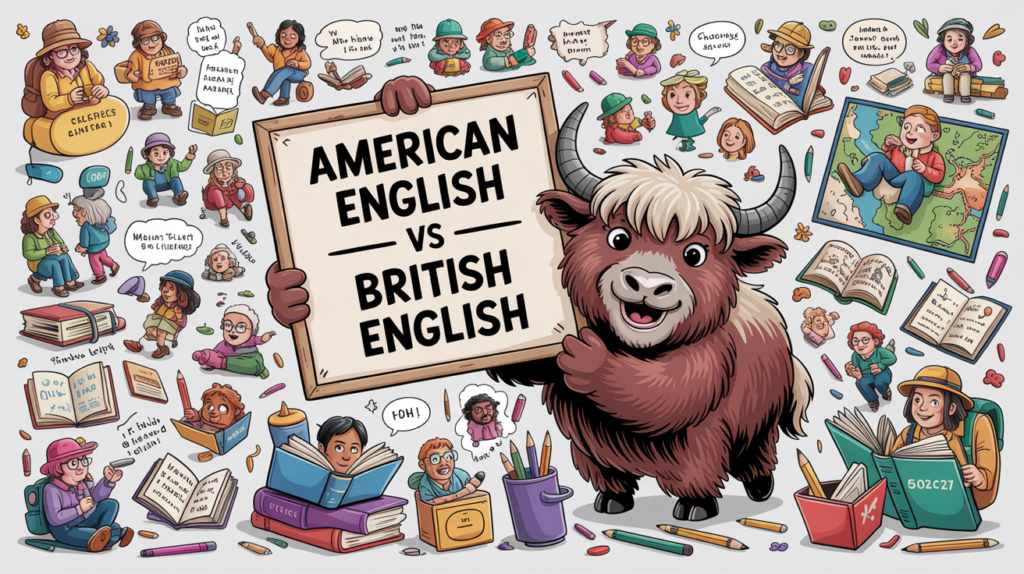
English is a global language, but like any global language it has regional flavours. Two of its biggest flavours are American English (AmE) and British English (BrE). They’re both English, and if you know one you’ll often understand the other—but there are enough differences to cause confusion, weird looks, or even accidental laughs. Whether you’re writing, speaking, or just watching Netflix, knowing the key differences helps you sound right, understand more, and avoid mishaps.
This guide will walk you through how American and British English differ in pronunciation, vocabulary, spelling, grammar, style, and usage — plus how to decide which one to use and why. (And yes, a Yak cameo appears.)
Why There Are Differences
The split between AmE and BrE isn’t random. Briefly:
• English arrived in North America and evolved separately. Wikipedia+1
• In the U.S., early lexicographers like Noah Webster deliberately introduced spelling reforms (colour → color) and standardised usage. Wikipedia+1
• Both regions kept influencing each other through media, migration and trade — but local usage diverged anyway.
The result: same fundamental language, different flavours. Think vanilla vs French vanilla with extra swirl.
Major Areas of Difference
1. Pronunciation & Accent
The way words sound is probably the first difference you’ll notice.
- BrE uses a lot of non-rhoticity (the “r” at the end of a syllable often isn’t pronounced). AmE tends to pronounce the “r”. Reddit+1
- Stress patterns and vowel sounds differ: e.g., “schedule” (‘shed-ule’ in UK vs ‘sked-ule’ in US) or “leisure” (‘le-zhure’ vs ‘lee-zhure’) depending on region. English with a Smile+1
- Some words are pronounced the same but mean different things (see vocabulary section for examples).
Tip: When you watch British TV or U.S. series, pay attention to how common words are said and you’ll catch these subtle differences.
2. Vocabulary (Words That Differ)
This is big and fun. Many everyday items have different names.
| British English | American English | Notes |
| lorry | truck | Large vehicle |
| flat | apartment | Living space |
| biscuit | cookie | Snack food |
| queue | line | Waiting in line |
| petrol | gasoline / gas | Fuel for cars |
| boot (of car) | trunk | Car storage space |
Vocabulary diverges for cultural/historical reasons. BrE uses “flat” from British housing traditions; AmE uses “apartment.” Knowing both means you’ll understand across regions.
3. Spelling Differences
Spellings often clue you in on which version you’re using.
| British | American | Example |
| colour | color | “colour” vs “color” Wikipedia |
| centre | center | “centre” vs “center” |
| organise | organize | BrE uses -ise more often, AmE uses -ize |
| travelled | traveled | Double-l in UK when adding suffix, single-l more common in US |
These differences don’t affect meaning — but if you write for a particular audience (U.S. vs U.K.) it’s courteous to match the style.
4. Grammar & Usage Differences
Grammatical differences are fewer but still important.
- Collective nouns: BrE sometimes treats “team” or “government” as plural (“the team are …”), whereas AmE usually treats them as singular (“the team is …”). Wikipedia
- Past simple vs present perfect: In AmE you’ll hear/intend “I already ate.” In BrE: “I’ve already eaten.” Thinking in English
- Preposition differences: BrE might say “at the weekend,” AmE says “on the weekend.”
- Use of “have got” (BrE) vs “have” (AmE) for possession: BrE: “I’ve got a car.” AmE: “I have a car.”
5. Style & Punctuation
Things like date formats, quotation marks, and punctuation differ.
- Date: U.S. uses MM/DD/YYYY (e.g., 07/14/2025); U.K. uses DD/MM/YYYY (14/07/2025) or writes “14 July 2025”. Wikipedia
- Quotation marks: U.S. often uses double quotes (“…”), U.K. may start single (‘…’) and alternate.
- Spelling of numbers: BrE often uses “and” in spoken numbers (“one hundred and fifty”), AmE may omit the “and”. Wikipedia
6. Idioms, Tone & Cultural Flavour
The idioms and small phrases change. A Brit might say “cheeky pint,” an American “grab a beer.” Some British idioms feel charming in the U.S., others could confuse.
With global media, the dialects borrow from each other — but the heart is still regional. The Guardian
Why It Matters For Learners
- Understanding: If you know one version, you might misunderstand a vocabulary item in the other.
- Writing: If you’re writing for a specific audience (U.S., U.K., international) pick consistent spelling and style.
- Confidence: Knowing you’re using “apartment” vs “flat” intentionally gives you control.
- Flexibility: The world of English learners is global — you’ll meet both versions in films, books, friends, workplaces.
Which Should You Use?
Short answer: it depends on your goal.
- If you’re writing or working in the U.S. → lean AmE.
- If you’re writing or working in the U.K. or Commonwealth → lean BrE.
- If you’re writing for an international audience (business, tourism, digital) → pick one version and be consistent; explicitly say you use “American spelling” or “British spelling”.
There’s no “better” version — just different. Think of it like choosing between vanilla and chocolate ice-cream: both are fine, just pick what fits your situation.
Practical Tips For Learners
- Pick your version: Choose at the start (AmE or BrE) and stick with it when writing.
- Flash the differences: Have a mini-cheat-sheet for vocabulary differences you often use.
- Watch and listen: U.S. TV vs U.K. TV — listen to accents, vocabulary, phrasing.
- Read both: Mix reading U.S. newspapers and U.K. newspapers to see styles side by side.
- Be ready to adapt: In conversation, you’ll understand both; don’t stress if you switch between.
- Consistency in writing: Don’t mix “colour” and “color,” “travelling” and “traveling” in the same text.
Quick Reference: Top Common Differences
Vocabulary
- BrE: holiday → AmE: vacation
- BrE: lift → AmE: elevator
- BrE: biscuit → AmE: cookie
- BrE: queue → AmE: line
- BrE: flat → AmE: apartment
- BrE: rubbish → AmE: trash/garbage
Spelling
- colour / color
- organise / organize
- travelled / traveled
- aluminium (UK) / aluminum (US)
- licence (noun UK) / license (US)
Grammar & Usage
- BrE: I’ve just eaten. / AmE: I just ate.
- BrE: The team are playing well. / AmE: The team is playing well.
- BrE: At the weekend. / AmE: On the weekend.
Pronunciation
- “schedule” → UK /ˈʃedjuːl/ vs US /ˈskedʒuːl/
- “leisure” → UK /ˈleʒə/ vs US /ˈliːʒər/
Watch Out For These Learner Traps
- Mixing versions in the same text (e.g., using U.S. spelling but U.K. vocabulary) can distract readers.
- Using a word meaning one thing in BrE that means something else in AmE (e.g., “boot” in BrE = car trunk, in AmE “boot” = shoe).
- Pronouncing words in the way you learned, but locally they use different pronunciation — you’ll still be understood, but it may mark you as international. And that’s fine!
- Assuming one version is “better” — it isn’t. They’re just different paths through the same forest.
Real-Life Usage: A “Yak Café” Example
Imagine you’re chatting with friends from different countries in an online Yak-learners café.
You say: “I took the elevator up to my flat, popped into the shop and bought some biscuits.”
Your American friend raises an eyebrow: “Elevator? Flat? Biscuits?”
You laugh and explain: “In the U.K. that’s elevator = lift, flat = apartment, biscuits = cookies.”
Everyone nods. You’ve just navigated dialect differences with charm, clarity and a little Yak-flair.
Yak’s Final Chewables
Learning the differences between American English and British English isn’t about rigid rules or picking sides — it’s about expanding your toolkit and sounding naturally you, no matter which side of the Atlantic you’re on. Think of it like learning two flavours of speech: both valid, both useful, both fun.
So whether you say “colour” or “color,” “flat” or “apartment,” “queue” or “line,” keep it consistent, keep it confident, and enjoy the journey. And yes — even a Yak wanders into dialect territory sometimes. What matters is: you’re exploring, learning, adapting, and sounding great.