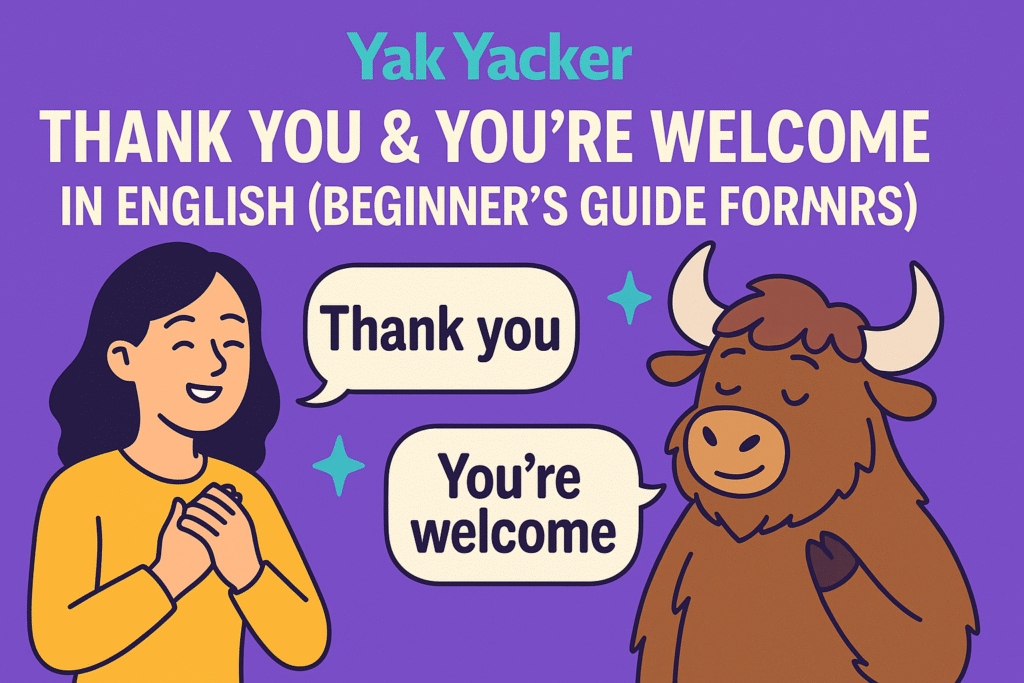
A friendly guide to every natural way to say “thank you” and “you’re welcome” in English — from polite and professional expressions to casual, modern, playful everyday phrases.
Why “Thank You” and “You’re Welcome” Matter in English
In English-speaking cultures, gratitude is everywhere. People say “thank you” constantly — for big things, small things, tiny things, and sometimes for things that didn’t even happen yet. It’s one of the most essential social habits in English because it signals politeness, respect, and warmth.
But here’s something many learners don’t realize:
English speakers also expect a response.
If someone says “thank you,” the natural reply (“you’re welcome”) completes the social exchange. Skipping this part can feel awkward or impolite, even if it’s normal in other languages.
English uses gratitude phrases to:
- show appreciation
- create friendly connection
- soften requests
- end conversations politely
- make social or workplace interactions smoother
Understanding the different levels of tone — formal, casual, playful, modern — helps you sound confident and natural in any English-speaking environment.
Whether you’re thanking someone for passing the salt, helping you with a project, buying you a gift, or holding the elevator, there’s a perfect English phrase for every situation. And this guide will walk you through all of them: the classics, the modern versions, the fun ones, and, of course, the Yak Yacker favorites.
Classic English Ways to Say Thank You
These are the simple, universal thank-you phrases you can use anywhere. They work with strangers, friends, coworkers, customer service, and every polite situation. If you learn only this set, you can handle almost any English interaction gracefully.
Common Classic Phrases
| Phrase | Tone | When You’d Use It |
| Thank you. | Standard, polite | Any situation |
| Thanks. | Friendly, casual | Everyday conversations |
| Thanks a lot. | Stronger appreciation | When someone helped you |
| Thank you very much. | Polite, formal or sincere | Work or heartfelt thanks |
| Thanks so much. | Warm, friendly | When someone did something kind |
| Thank you so much. | Deep appreciation | Gifts, help, support |
These are the core English gratitude expressions.
When to Use Them
- “Thank you.”
The safest, most universal option. Works everywhere. - “Thanks.”
Everyday situations: friends, coworkers, shops, cafés. - “Thanks a lot.”
Stronger meaning — but tone matters. Said playfully, it’s great; said angrily, it can sound sarcastic. - “Thank you very much.”
Slightly formal; used in business or when you want to show respect. - “Thank you so much.”
A warm, emotional thank you.
Politeness and Tone Notes
English thank-you phrases often come with friendly tone markers:
- small smile
- light voice
- eye contact (if comfortable culturally)
- a rising, warm intonation
Tone changes the meaning:
- “Thanks a lot!” (warm) = genuine appreciation
- “Thanks a lot…” (flat, negative) = sarcasm
Context and voice are everything.
Formal English Ways to Say Thank You
Formal thank-you phrases are polite, professional, and respectful. You’ll hear these in workplaces, emails, meetings, customer interactions, interviews, and anywhere you want to sound polished.
Formal English doesn’t mean stiff — it just means clear, courteous, and appropriate.
Professional Expressions
These phrases are perfect for the office, business calls, or polite conversations with coworkers, clients, or supervisors.
- Thank you for your help.
- Thank you for your time.
- I really appreciate it.
- I appreciate your support.
- Thank you for your assistance.
- Thank you for getting back to me.
- I appreciate your patience.
- Thank you for letting me know.
- Thank you for the update.
Customer Service Context
Used when talking to customers, clients, or anyone receiving service.
- Thank you for choosing us.
- Thank you for waiting.
- Thank you for your understanding.
- We appreciate your business.
- Thank you for being patient.
- Thank you for your feedback.
These soften the interaction and make the experience feel smoother and more respectful.
Business Email Examples
These are extremely common in professional email English.
- Thank you for reaching out.
- Thank you for your message.
- Thank you for the information.
- Thank you in advance.
- Thank you for your consideration.
- I appreciate your quick response.
- Thank you for following up.
Emails almost always begin or end with gratitude. It’s a cultural norm.
Mini-Tips for Formal English
- Use full sentences (“Thank you for your help”), not short forms (“Thanks”).
- Be specific: People appreciate knowing what you’re thankful for.
- In email English, “I appreciate…” often sounds better than repeated “Thank you.”
- Avoid too much emotion — keep it polished, friendly, and neutral.
Casual & Friendly English Ways to Say Thank You
These are the natural, everyday ways people express thanks to friends, classmates, coworkers they know well, roommates, neighbors, or anyone in a comfortable setting. They’re warm, relaxed, and used constantly in daily English.
Everyday Variations
These are the English thank-yous you hear 100 times a day.
- Thanks!
- Thanks a bunch!
- Thanks a ton!
- Thanks so much!
- Thanks, I appreciate it.
- Really appreciate it.
- You’re the best! (very friendly)
- That means a lot.
- Seriously, thank you.
These are warm without being formal.
Short, Relaxed Forms
Super quick, modern, casual English.
- Thanks!
- Thanks! (yes, repeated because it’s that common)
- Thx! (texting)
- Appreciate it!
- Really appreciate it!
- ’Preciate it. (very casual spoken version)
- Cool, thanks!
- Awesome, thanks!
- Alright, thanks!
Short, punchy, extremely natural.
Warm Tone Options
These add friendliness or personality.
- Thanks for doing that.
- That was really kind of you.
- You didn’t have to do that — thank you!
- Aw, thank you! (cute/warm)
- I owe you one! (friendly, playful)
- You’re a lifesaver!
- Thanks, I needed that.
English speakers use these constantly for emotional warmth.
Mini-Tips for Casual Thank Yous
- Casual English = shorter, lighter, warmer
- Avoid long emotional gratitude unless the situation really calls for it
- Adding a small detail (“Thanks for helping me with this”) sounds natural and sincere
- Tone makes the difference between friendly and sarcastic
Creative, Cute & Playful English Thank-You Phrases
These expressions add personality, humor, or affection. They’re perfect for friends, close coworkers, classmates, siblings, or anyone with whom you have an easy, fun relationship. They should not be used in formal or professional situations.
Playful English Thank-Yous
These are light, fun, and commonly used among friends.
- You’re amazing — thank you!
- You’re the best!
- You rock!
- Legend! (UK/Australia especially)
- You’re a star!
- You saved my day!
- You’re my hero today.
- Thank you, thank you, thank you! (dramatic/funny)
These show excitement and gratitude at the same time.
Cute or Warm Thank-Yous
Used when you’re being sweet or friendly.
- Aww, thank you!
- That was so sweet of you.
- You didn’t have to do that — thank you!
- Thank youuuu! (extra letters = warmth)
- You’re too kind!
- Big thanks!
- So grateful for you! (friendly, informal)
Native speakers use these with partners, close friends, or in warm conversations.
Funny or Dramatic Thank-Yous
Perfect for exaggeration or humorous moments.
- I owe you my life. (joke)
- I’ll name my first child after you. (joke)
- Bless your soul! (playful dramatic)
- Thank you, kind human.
- May the universe reward you.
- I can’t thank you enough — but I’ll try!
- You just saved my entire existence.
These add personality and humor to everyday English.
Friendly Teasing Thank-Yous
Used only with people who enjoy joking around.
- About time! But thank you.
- Finally! Thanks though.
- Look who’s useful today — thanks!
- You? Helping me? Wow. Thanks!
Tone is everything — these must be said with warmth and a smile.
Mini-Tips for Playful Thank-Yous
- Check the relationship first — playful phrases can feel too casual for strangers.
- Tone makes or breaks the humor.
- These are great for texts, chats, and friendly conversations.
- Never use teasing versions in a professional setting.
English Ways to Say “You’re Welcome” (Classic & Polite)
When someone says “thank you,” replying politely is an important part of English communication. These classic responses are universal — friendly, respectful, and appropriate in nearly every situation.
They’re safe for workplaces, schools, customer interactions, emails, and polite social settings.
Standard Polite Replies
These are the English equivalents of “the basics.” They work everywhere.
- You’re welcome.
- You’re very welcome.
- My pleasure.
- The pleasure is mine. (formal)
- No problem.
- Not at all. (polite; British tone)
- Don’t mention it.
- Of course.
Each carries slightly different energy, but all are polite and natural.
Tone and Usage Tips
- “You’re welcome.”
The standard, most universal option. - “My pleasure.”
Sounds warm and elegant. Often used in restaurants, hotels, and polite service situations. - “No problem.”
Very common, but slightly more casual. Still polite. - “Don’t mention it.”
British or older-fashioned, but still polite and friendly. - “Of course.”
Good for when you genuinely wanted to help.
When You Want to Sound Extra Polite
These are slightly more formal and show sincere appreciation.
- I’m happy to help.
- It was no trouble at all.
- Glad I could help.
- Anything you need. (warm + service tone)
- Happy to be of assistance. (professional)
Great for business English, customer service, or respectful interactions.
Mini-Tips for Polite English Replies
- Always reply with a warm tone — flat tone can sound cold.
- Don’t overthink it; simple replies are perfectly natural.
- Never say “Please” as a reply to “Thank you.” (A common learner mistake.)
- If someone gives you a heartfelt thank-you, choose a warmer reply like “My pleasure” or “Happy to help.”
Casual, Modern & Friendly English Ways to Say “You’re Welcome”
These are the responses English speakers use with friends, family, close coworkers, classmates, or anyone they feel comfortable with. They’re warm, relaxed, modern, and used constantly in real-life conversation.
Think of them as the “everyday sneakers” of gratitude replies — comfortable, versatile, and always in style.
Relaxed, Everyday Responses
These are the most common casual replies:
- No worries!
- No problem!
- Not a problem at all.
- Anytime!
- Sure thing!
- No big deal.
- All good!
- It was nothing.
- No sweat.
These sound natural and friendly without being too formal.
Warm, Friendly Replies
These add a bit of kindness or closeness.
- Happy to help!
- Glad to help!
- Glad I could help.
- Of course!
- For sure!
- Absolutely!
- You got it!
- Always. (very warm, only for close people)
These replies feel supportive and genuine.
Short Modern Texting Replies
Perfect for messaging apps, social media, or quick digital chats.
| Text-Style | Meaning |
| np | “no problem” |
| yw | “you’re welcome” |
| sure! | casual, friendly |
| kk | very casual “okay okay” |
| 👌 | “you’re welcome” / “no problem” |
| 👍 | informal acknowledgment |
These are fast and commonly used among younger speakers.
When You Want to Sound Cool or Chill
Super casual, used mostly by friends.
- No probs!
- No worries at all.
- Don’t sweat it.
- It’s chill.
- All good, all good.
- You’re good.
These are very relaxed, so avoid them in formal situations.
Mini-Tips for Casual Replies
- Casual English = shorter, lighter, warmer.
- Tone is important — casual replies can sound rude if said too flatly.
- “No worries” and “Anytime!” are the safest modern-friendly choices.
- Texting versions should stay in texts only.
Creative, Playful & Funny English Ways to Say “You’re Welcome”
These responses are perfect for friends, siblings, partners, classmates, and anyone you joke with. They add humor, personality, or dramatic flair. They should not be used in workplaces, formal settings, or with strangers — but they make everyday casual conversations more fun.
Playful English “You’re Welcome” Replies
Friendly, fun versions that show warmth and personality.
- Anytime — seriously!
- You know it!
- Always happy to help!
- That’s what friends are for!
- Don’t even worry about it!
- I gotchu. (very casual)
- At your service. (playfully formal)
These feel friendly and expressive.
Cute or Warm Replies
Use these when you want to be a little sweeter.
- You’re so welcome!
- Of course you are!
- Glad I could make your day.
- Anytime, friend.
- Happy to help, truly!
- You’re welcome, silly. (very close friends)
- Anything for you! (for people you’re comfortable with)
These work in warm personal relationships.
Funny or Dramatic Replies
These exaggerate the moment for humor.
- Your wish is my command.
- I expect a statue in my honor.
- Please applaud.
- Add that to my list of accomplishments.
- All in a day’s work.
- I accept cookies as payment.
- I know, I’m amazing. (ONLY as a joke!)
- You’re welcome… mortal. (nerdy/fun tone)
Used only with people who understand your humor.
Lightly Sarcastic (Friendly Only)
These are jokingly sarcastic — never rude if tone is soft.
- Wow, finally some appreciation.
- Took you long enough to say thanks.
- About time!
- Bow before your helper.
- I’ll try not to let it go to my head.
Tone + smile = makes it clearly playful.
Mini-Tips for Playful “You’re Welcome” Replies
- Only use these with friends or people who like joking.
- Tone must be warm; sarcasm without warmth sounds rude.
- They’re great for texting, memes, and creative conversations.
- Never use dramatic or sarcastic replies with customers or coworkers.
Thank-You and You’re-Welcome Expressions for Different Situations in English
Different situations call for different tones in English. The way you thank someone in an email is not the same as the way you thank a friend who helped you carry groceries… or someone who just bought you boba tea. English speakers naturally shift between formal, casual, warm, and playful depending on context.
Here are the most natural expressions for each situation.
Workplace / Professional Situations
Professional English should be clear, respectful, and not overly casual.
When YOU say thank you:
- Thank you for your help.
- Thank you for your time.
- I appreciate your support.
- Thank you for the update.
- Thanks for letting me know.
- I appreciate your assistance.
When THEY say thank you and you’re replying:
- You’re welcome.
- My pleasure.
- Happy to help.
- Glad to assist.
- No problem at all.
- Of course.
These are safe and natural in offices, meetings, emails, and customer interactions.
Friends & Family Situations
Warm, relaxed, and friendly.
When YOU say thank you:
- Thanks so much!
- You’re the best.
- Really appreciate it.
- You saved me.
- Thanks, that means a lot.
When THEY say thank you:
- Anytime!
- No worries!
- You got it.
- For sure!
- Happy to help!
These are natural in everyday life.
Texting / Online Chats
Shorter and more modern.
| Text Thank You | Meaning |
| thx | thanks |
| ty | thank you |
| tysm | thank you so much |
| 🙏 | thank you |
| thanks!! | warm tone |
| Text Welcome | Meaning |
| np | no problem |
| yw | you’re welcome |
| sure! | casual welcome |
| kk | understood / okay |
| 👍 | acknowledgment |
Service Situations (restaurants, hotels, shops)
Warm, polite, and customer-friendly.
When YOU say thank you:
- Thank you.
- Thank you so much.
- Thanks, I appreciate it.
- Thank you for your help.
When THEY say thank you (you are the customer):
- You’re welcome.
- My pleasure.
- Of course!
- Happy to help.
- No problem.
Hotels especially use:
- “Absolutely.”
- “Of course — enjoy your stay.”
When Someone Gives You a Gift
Tone should be warm and sincere.
Your thanks:
- Thank you so much — this is lovely.
- I really appreciate this.
- This means a lot to me.
- Thank you, it’s perfect.
Your welcome (you’re the giver):
- You’re very welcome.
- I’m glad you like it.
- Happy you enjoyed it.
- Of course — it’s for you.
When Someone Helps You with Something
Practical everyday thank-yous.
Your thanks:
- Thanks for helping me with that.
- I appreciate your help so much.
- That made things easier — thank you.
- Thanks, I couldn’t have done it without you.
Your welcome:
- Anytime!
- No worries — happy to help.
- Glad I could help.
- Sure thing!
- You got it.
Common English Mistakes Learners Make with Thank You / You’re Welcome
Even learners with strong English skills sometimes make gratitude-related mistakes — not because their grammar is wrong, but because English uses specific social habits that aren’t universal across cultures.
Here are the most frequent issues and how to fix them quickly.
Mistake 1: Using “Please” as a Response to “Thank you”
Many learners reply like this:
A: Thank you.
B: Please. ❌
In English, please is only used when requesting something, never as a reply to gratitude.
Correct replies:
- You’re welcome.
- No problem.
- My pleasure.
Mistake 2: Not Responding at All
In some languages, replying to “thank you” is optional.
In English-speaking cultures, not replying can feel cold or impolite.
Even a simple:
- You’re welcome.
- Anytime!
- No worries.
…keeps the interaction smooth.
Mistake 3: Overusing “Thank you very much” in Casual Situations
Learners often choose the most formal version because it feels safest.
But using it with friends can sound overly serious or emotional.
Use these instead:
- Thanks!
- Thanks a lot!
- Appreciate it!
Mistake 4: Using “Thanks a lot” With the Wrong Tone
This phrase is tone-sensitive:
- “Thanks a lot!” (warm tone) → genuine
- “Thanks a lot…” (flat tone) → sarcasm, annoyance
Learners sometimes say it flatly without meaning to.
Choose “Thanks so much” if you want warmth without risk.
Mistake 5: Saying “Thank you” Too Many Times in One Conversation
English speakers often use gratitude, but repeating it excessively can sound unnatural.
Instead of repeating “thank you,” vary it:
- I appreciate it.
- That really helps.
- You’re a lifesaver.
Mistake 6: Using Playful or Cute Replies in Formal Situations
Phrases like:
- “You got it!”
- “No worries!”
- “I gotchu.”
- “Anytime, friend.”
…sound friendly but not professional.
For workplace English, stick to:
- You’re welcome.
- Happy to help.
- My pleasure.
Mistake 7: Using Text-Slang in Spoken English
Learners sometimes say:
- “np” (spoken aloud) ❌
- “yw” (spoken aloud) ❌
These belong only in written chats.
Mistake 8: Confusing “You’re welcome” With “Welcome”
“You’re welcome” = reply to thank you.
“Welcome” = greeting when someone arrives.
Incorrect:
A: Thank you!
B: Welcome. ❌
Correct:
A: Thank you!
B: You’re welcome. ✔
Mistake 9: Forgetting Intonation
Tone matters:
- Warm tone = friendly
- Flat tone = cold or annoyed
- Rising tone = positive
- Low tone = serious or formal
A soft smile + warm voice = perfect English politeness.
Mistake 10: Not Mirroring the Other Person’s Tone
If someone says a formal thank you, reply formally.
If someone gives a friendly thank you, reply casually.
This is how native speakers keep the interaction balanced.
50+ Ways to Say Thank You & You’re Welcome (in a Table)
This section gives learners a fast, at-a-glance reference they can screenshot, save, or review anytime. Everything is grouped by tone so they instantly know which version to use.
Thank You — 25 Natural Expressions
| Thank-You Phrase | Tone / Use Case |
| Thank you. | Standard, polite |
| Thanks. | Casual, everyday |
| Thanks a lot. | Stronger appreciation |
| Thank you very much. | Polite, formal |
| Thanks so much. | Warm, friendly |
| Thank you so much. | Deep appreciation |
| Really appreciate it. | Warm, sincere |
| I appreciate your help. | Professional |
| Thank you for your time. | Workplace |
| Thank you for your patience. | Customer service |
| Thanks for the update. | Work/email |
| Thanks for doing that. | Everyday |
| You’re the best! | Friendly |
| You rock! | Playful |
| Legend! | Playful (UK/Aus) |
| You saved me! | Dramatic, friendly |
| Aw, thank you! | Cute/warm |
| That means a lot. | Emotional sincerity |
| I owe you one! | Playful, casual |
| Big thanks! | Friendly |
| So grateful for you! | Warm (friends) |
| Thank youuu! | Cute texting |
| Thx / tysm | Text/chat |
| 🙏 | Universal digital thank you |
You’re Welcome — 25 Natural Expressions
| You’re-Welcome Phrase | Tone / Use Case |
| You’re welcome. | Standard, polite |
| You’re very welcome. | Polite, warm |
| My pleasure. | Formal, service |
| The pleasure is mine. | Very formal |
| No problem. | Casual/professional |
| No worries. | Casual, friendly |
| Not at all. | Polite (British) |
| Don’t mention it. | Polite, older style |
| Of course. | Warm and sincere |
| Glad to help. | Neutral/warm |
| Happy to help. | Work or everyday |
| I’m happy to assist. | Professional |
| Anytime! | Friendly, warm |
| Sure thing! | Casual |
| You got it! | Friendly |
| Absolutely! | Casual confident |
| It was nothing. | Casual modest |
| All good! | Relaxed, modern |
| No sweat. | Very casual |
| Always. | Warm/intimate |
| At your service. | Playfully dramatic |
| You’re welcome, silly. | Cute/friendly |
| I gotchu. | Very casual |
| I accept cookies as payment. | Funny |
| Your wish is my command. | Dramatic, playful |
Yak’s Final Chewables
Learning how to say thank you and you’re welcome in English isn’t just about vocabulary — it’s about rhythm, tone, and social habits. English speakers sprinkle gratitude everywhere: in shops, emails, tiny daily interactions, and even in moments that don’t strictly require it. Once you get comfortable matching the tone (formal, friendly, playful, digital), everything starts to feel much more natural.
If you remember nothing else, remember these three chewy truths:
- Polite English is simple.
“Thank you” + “You’re welcome” already covers 90% of situations. - Tone matters more than the words.
A warm voice makes even simple phrases feel friendly and fluent. - Match the mood.
Use polite expressions in formal settings, casual ones with friends, and playful ones only with people who enjoy that style.
Keep practicing. Mix and match. Try new tones. And if someone ever thanks you for reading this article…
You already know 50+ perfect ways to answer.