


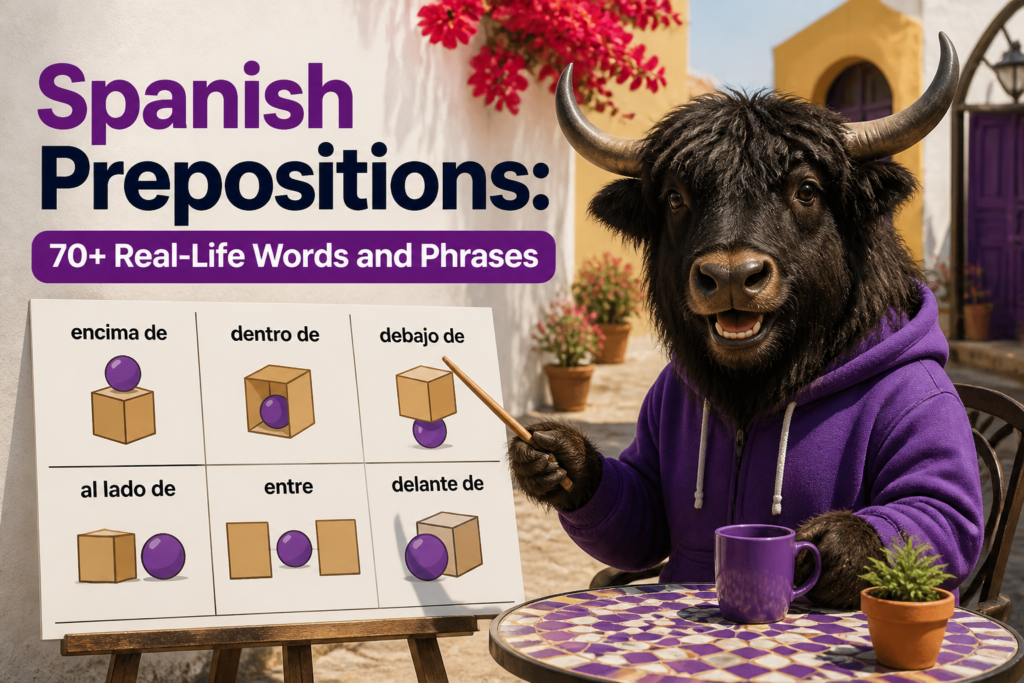
Spanish prepositions look tiny, but they do a lot of heavy lifting. They connect ideas, show location, time, movement, cause, purpose, and all the little “between the lines” bits that make a sentence actually make sense. In other words: small words, big attitude.
For the broader learning path, visit our parent guide.
If English prepositions already feel slippery, Spanish can seem extra dramatic. The good news is that many of them are simple and very practical once you see them in real sentences. By the end of this guide, you’ll be able to use the most common Spanish prepositions with more confidence, fewer random guesses, and less eye twitching.
For a quick warm-up, remember that prepositions usually come before a noun, pronoun, or infinitive verb: en la mesa, para ti, sin comer. They’re little glue words, not the main stars. Still, they’re everywhere.
The Most Useful Spanish Prepositions
Here’s a big, practical set of Spanish prepositions and preposition-like expressions you’ll see all the time. Some are single words, and some are multiword expressions such as al lado de or debajo de. Spanish loves these. It’s very committed to the bit.
| Spanish | Pronunciation | Meaning | Example Sentence | Translation | Learner Note |
|---|---|---|---|---|---|
| a | ah | to, at, by | Voy a casa a las ocho. | I’m going home at eight. | Very common with time and movement. |
| de | deh | of, from, about | La mesa es de madera. | The table is made of wood. | Also used for possession and origin. |
| en | en | in, on, at | Estoy en la oficina. | I’m at the office. | Very flexible, like English “in/on/at.” |
| con | kohn | with | Salgo con mis amigos. | I go out with my friends. | Used for company or instruments. |
| sin | seen | without | Tomé café sin azúcar. | I had coffee without sugar. | Common in everyday food and travel talk. |
| para | pah-rah | for, in order to, by | Este regalo es para ti. | This gift is for you. | Often used for purpose and destination. |
| por | pohr | through, by, because of, for | Entramos por la puerta trasera. | We entered through the back door. | Big topic on its own. Not the same as para. |
| sobre | soh-breh | on, about, over | Leí un artículo sobre música. | I read an article about music. | Useful for topics and physical position. |
| entre | en-treh | between, among | La cafetería está entre la farmacia y la panadería. | The café is between the pharmacy and the bakery. | Used with two things or a group. |
| hasta | ahs-tah | until, up to | Trabajo hasta las seis. | I work until six. | Often marks a limit in time or space. |
| desde | des-deh | from, since | Vivo aquí desde 2020. | I’ve lived here since 2020. | Pairs nicely with hasta. |
| hacia | AH-see-ah | toward | Camina hacia la estación. | Walk toward the station. | Shows direction, not exact arrival. |
| según | seh-GOON | according to | Según el mapa, estamos cerca. | According to the map, we’re close. | Common in news, instructions, and opinions. |
| durante | doo-RAHN-teh | during | Durante la clase, no usamos el móvil. | During class, we don’t use the phone. | Very useful for time periods. |
| contra | KON-trah | against | El equipo jugó contra el líder. | The team played against the leader. | Also used for opposition or resistance. |
| seguido de | seh-GEE-do deh | followed by | El nombre va seguido de la ciudad. | The name is followed by the city. | More advanced, but useful in instructions. |
| excepto | ehk-SEP-toh | except | Todos vinieron excepto Marta. | Everyone came except Marta. | Common in everyday speech and writing. |
| incluido | een-kloo-EE-doh | including | La cena está incluida. | Dinner is included. | Often appears on receipts, offers, and travel info. |
| mediante | meh-DYAN-teh | by means of | Se paga mediante tarjeta. | You pay by card. | More formal, but useful in business or instructions. |
| versus / frente a | BEHR-soos / FREHN-teh ah | versus, compared with | España frente a México tiene diferencias de uso. | Spain compared with Mexico has usage differences. | frente a is useful in comparisons. |
| al | ahl | to the | Voy al supermercado. | I’m going to the supermarket. | Short for a + el. |
| del | del | of the, from the | Vengo del médico. | I’m coming from the doctor’s. | Short for de + el. |
| al lado de | ahl LAH-doh deh | next to | La farmacia está al lado del banco. | The pharmacy is next to the bank. | Super common location phrase. |
| cerca de | SEHR-kah deh | near | Vivo cerca de la playa. | I live near the beach. | Use for proximity, not exact location. |
| lejos de | LEH-hos deh | far from | La estación está lejos de aquí. | The station is far from here. | Nice opposite of cerca de. |
| debajo de | deh-BAH-ho deh | under | El gato está debajo de la mesa. | The cat is under the table. | Often more precise than en. |
| encima de | en-SEE-ma deh | on top of | Las llaves están encima de la mesa. | The keys are on top of the table. | Useful in homes, hotels, and offices. |
| dentro de | DEN-troh deh | inside of | El cargador está dentro de la mochila. | The charger is inside the backpack. | Great for containers and spaces. |
| fuera de | FWEH-rah deh | outside of | Dejé el coche fuera de casa. | I left the car outside the house. | Common in directions and logistics. |
| delante de | deh-LAHN-teh deh | in front of | El taxi está delante del hotel. | The taxi is in front of the hotel. | Useful for directions. |
| detrás de | deh-TRAS deh | behind | Hay un parque detrás de la escuela. | There’s a park behind the school. | Another classic location phrase. |
| alrededor de | ahl-reh-deh-DOR deh | around | Hay muchas tiendas alrededor de la plaza. | There are many shops around the square. | Good for neighborhoods and city descriptions. |
| junto a | HOON-toh ah | next to, beside | La mesa está junto a la ventana. | The table is beside the window. | Similar to al lado de, slightly more formal. |
| sobre todo | SOH-breh TOH-doh | especially | Me gustan las frutas, sobre todo las fresas. | I like fruit, especially strawberries. | Not literally “on top of all.” Sneaky little phrase. |
| además de | ah-deh-MAHS deh | besides, in addition to | Además de estudiar, trabajo por la tarde. | Besides studying, I work in the afternoon. | Great for adding extra info. |
| antes de | AHN-tehs deh | before | Lavarse las manos antes de comer es buena idea. | Washing your hands before eating is a good idea. | Often followed by an infinitive. |
| después de | dehs-PWEHS deh | after | Después de cenar, salimos a caminar. | After dinner, we went out for a walk. | Also commonly followed by an infinitive. |
| por encima de | pohr en-SEE-ma deh | above, over | El puente pasa por encima del río. | The bridge goes over the river. | Helpful for physical position and movement. |
| en vez de | en BEHS deh | instead of | Tomé té en vez de café. | I had tea instead of coffee. | Very useful for substitutions. |
| a través de | ah tray-BES deh | through | Vimos el paisaje a través de la ventana. | We saw the landscape through the window. | Common in writing and travel descriptions. |
| alrededor | ahl-reh-deh-DOR | around | Hay ruido alrededor. | There’s noise around us. | Usually needs context or another word. |
| para con | PAH-rah kohn | toward, regarding | Su actitud para con los clientes es amable. | His attitude toward customers is kind. | More formal and a bit old-school. |
Real Academia Española is a boring but reliable place to check tricky prepositions, especially when a phrase seems to change meaning depending on context. In Spanish, that happens more than it should.
Common Spanish Preposition Pairs That Matter
Some Spanish prepositions work best when you learn them in pairs or nearby opposites. This is where things start to click. Or at least stop wobbling quite so much.
| Pair | Meaning | Spanish Examples | English Translation | Learner Note |
|---|---|---|---|---|
| en / a | location vs destination | Estoy en casa. / Voy a casa. | I’m at home. / I’m going home. | en = where you are; a = where you go. |
| de / desde | origin vs starting point | Vengo de Lima. / Estudio desde las ocho. | I’m from Lima. / I study since eight. | desde often points to a starting time or place. |
| para / por | purpose vs cause/method | Estudio para aprender. / Lo hice por ti. | I study to learn. / I did it because of you. | Big grammar topic. Don’t expect miracles overnight. |
| cerca de / lejos de | near vs far | Vivo cerca de la playa. / Vivo lejos de la playa. | I live near the beach. / I live far from the beach. | Nice for directions and housing descriptions. |
| antes de / después de | before vs after | antes de comer / después de comer | before eating / after eating | Often followed by an infinitive, which keeps life easier. |
| encima de / debajo de | on top of vs under | encima de la mesa / debajo de la mesa | on top of the table / under the table | Very useful for home and furniture vocabulary. |
| dentro de / fuera de | inside vs outside | dentro de la caja / fuera de la caja | inside the box / outside the box | Literal and figurative uses both show up. |
| delante de / detrás de | in front of vs behind | delante del hotel / detrás del hotel | in front of the hotel / behind the hotel | Perfect for directions in cities and buildings. |
How Spanish Uses A and De
These two are everywhere. They are tiny, common, and annoyingly important. If you understand a and de, a lot of Spanish starts behaving itself.
Rule: a often shows movement, direction, time, or indirect object. de often shows possession, origin, material, or “from.”
| Pattern | Meaning | Spanish Example | English Translation | Learner Note |
|---|---|---|---|---|
| a + place | to, toward | Voy a la tienda. | I’m going to the store. | Used with movement. |
| a + time | at | La reunión es a las 3. | The meeting is at 3. | Time expressions are very common with a. |
| de + possession | of, belonging to | El libro de Ana. | Ana’s book. | Spanish often uses de instead of apostrophe possession. |
| de + material | made of | Un vaso de vidrio. | A glass cup. | Material questions show up a lot in shopping talk. |
| de + origin | from | Soy de Colombia. | I’m from Colombia. | Very standard way to say where you’re from. |
One useful pattern is ser de for origin or ownership, and estar en for location. For example: El café es de Colombia means the coffee is from Colombia, while Estoy en Colombia means I’m in Colombia. Same preposition family, very different jobs.
Yak wisdom: Prepositions are tiny until you put them in the wrong place, and then suddenly they become the whole plot.
Real-Life Preposition Phrases You’ll Actually Use
Let’s move from “dictionary list” to “real life.” These are the phrases that show up in conversations, directions, messages, and everyday errands. The stuff real humans say while trying to find the bathroom or the charger.
| Spanish | Pronunciation | Meaning | Example Sentence | Translation | Learner Note |
|---|---|---|---|---|---|
| por favor | pohr fah-VOR | please | Una mesa para dos, por favor. | A table for two, please. | Polite and essential. No drama. |
| gracias a | GRAH-see-as ah | thanks to | Gracias a tu ayuda, terminé temprano. | Thanks to your help, I finished early. | Shows positive cause. |
| por culpa de | pohr KOOL-pah deh | because of, due to a bad cause | Llegué tarde por culpa del tráfico. | I arrived late because of the traffic. | Usually negative or annoying cause. |
| en frente de | en FREHN-teh deh | in front of | La parada está en frente del cine. | The stop is in front of the cinema. | Common in Latin America; in Spain, delante de is often preferred. |
al final deMore Spanish to explore How to Type Spanish Accents on Your Phone and Computer Best graded readers for Spanish The Boy and the Sheep: A1 Beginner Spanish Story with Audio Martina the Little Cockroach: A1 Beginner Spanish Story with Audio |